

Understanding duration measurement is essential for any behavior analyst working in Applied Behavior Analysis. This continuous measurement procedure helps quantify how long behaviors last, providing critical data for assessment and intervention planning. For BCBA candidates, mastering duration concepts is crucial for both clinical practice and exam success.
Table of Contents
- Duration Measurement ABA: What is Duration in Applied Behavior Analysis?
- Measuring and Calculating Duration: A Step-by-Step Guide
- Duration in Practice: Worked Examples from Assessment to Intervention
- Duration on the BCBA Exam: Relevance and Common Traps
- Quick Reference: Duration Measurement Checklist
- References
Duration Measurement ABA: What is Duration in Applied Behavior Analysis?
Duration recording measures the total time a behavior lasts from start to finish. This measurement approach is particularly valuable for behaviors with distinct beginnings and endings that vary in length across occurrences.
The Official Definition and Key Characteristics
In technical terms, duration refers to the total elapsed time between the onset and offset of a behavior. Unlike frequency measurement (which counts occurrences) or rate calculation (occurrences per time unit), duration specifically quantifies temporal aspects of behavior.
This measurement method falls under continuous measurement procedures and is ideal for behaviors where how long they last matters more than how often they occur. Common applications include measuring tantrum duration, on-task behavior during academic work, or engagement in social interactions.
Duration vs. Latency: A Critical Distinction for the Exam
Many BCBA candidates confuse duration with latency measurement, but these serve different purposes. Duration measures how long a behavior occurs, while latency measures the time between an antecedent stimulus and the initiation of the response.
- Duration: Time behavior lasts (onset to offset)
- Latency: Time to start behavior (stimulus to onset)
- Example difference: Duration tracks how long a tantrum lasts; latency tracks how long it takes a student to begin work after instruction
Measuring and Calculating Duration: A Step-by-Step Guide
Implementing duration recording requires specific tools and procedures. The basic process involves timing each behavior occurrence and recording the elapsed time.
Tools and Procedures for Duration Recording
Several tools support accurate duration measurement. The most common include digital stopwatches, timer apps on smartphones or tablets, and specialized data collection software designed for ABA applications.
- Start timing at behavior onset (clear beginning)
- Stop timing at behavior offset (clear ending)
- Record the elapsed time immediately
- Use a consistent operational definition for what constitutes onset and offset
- Note that interval recording methods (whole-interval, partial-interval, momentary time sampling) do not measure total duration
From Raw Data to Interpretable Metrics: Calculating Average Duration and Percentage
Raw duration data becomes meaningful through calculation. Two key metrics help interpret duration patterns: average duration and percentage of total time.
The formula for average duration is simple: Total Duration ÷ Number of Occurrences. For example, if tantrums last 5, 8, and 4 minutes across three occurrences, total duration is 17 minutes, and average duration is approximately 5.67 minutes.
To calculate percentage of total time: (Total Duration ÷ Total Observation Time) × 100. If a student engages in off-task behavior for 12 minutes during a 30-minute observation, the percentage is 40%.
Duration in Practice: Worked Examples from Assessment to Intervention
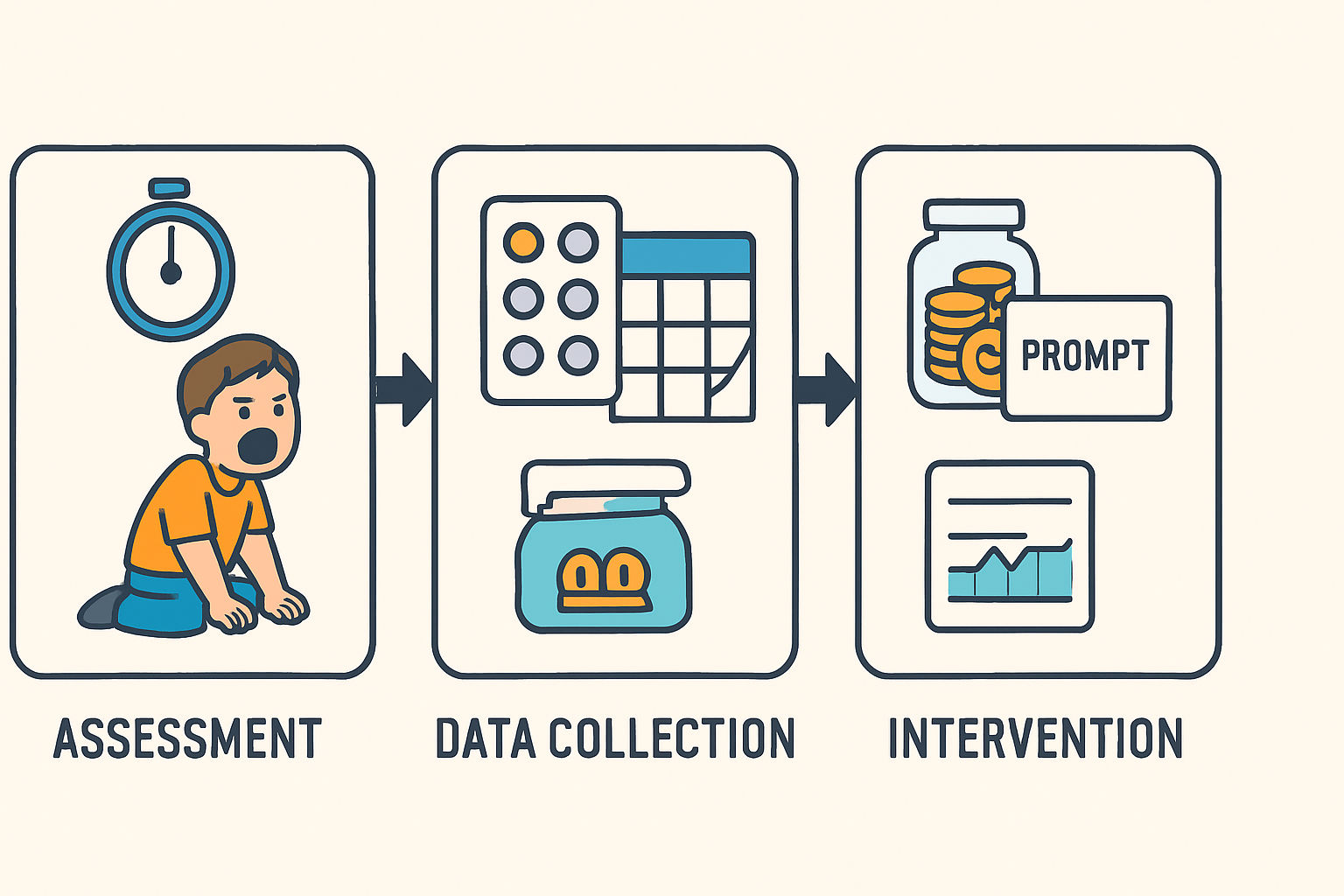
Real-world applications demonstrate how duration measurement informs clinical decision-making. These examples show the connection between data collection and intervention planning.
Example 1: Measuring Tantrum Behavior
Consider a child who engages in tantrums when denied access to preferred items. The ABC data might show: Antecedent – tablet access denied; Behavior – crying, flopping, screaming; Consequence – parent attention provided.
Hypothesized function: Socially-mediated positive reinforcement (access to attention). Duration data across three instances: 5 minutes, 8 minutes, 4 minutes. Average duration: 5.67 minutes. This data helps evaluate whether interventions reduce tantrum length over time.
Example 2: Increasing On-Task Behavior During Homework
For academic behaviors, duration often serves as the primary target. Antecedent: homework assignment presented; Behavior: eyes on work, pencil moving; Consequence: natural completion of problems.
Hypothesized function: Automatic negative reinforcement (removal of homework demand through completion). The intervention goal becomes increasing the duration of on-task behavior, perhaps from an average of 3 minutes to 10 minutes per session.
Duration on the BCBA Exam: Relevance and Common Traps
The BACB exam frequently tests understanding of measurement procedures. Duration questions typically ask candidates to select appropriate measurement methods or interpret duration data correctly.
How the BACB Tests Your Understanding of Duration
Exam questions may present behavior descriptions and ask which measurement procedure is most appropriate. Other questions might show duration data and ask for interpretation, or require differentiation between duration and related concepts like latency or inter-response time.
Understanding when to use duration versus other continuous measurement methods is crucial. For comprehensive exam preparation, consider reviewing our guide to data collection methods in ABA.
Frequent Exam Mistakes and How to Avoid Them
Several common errors trip up BCBA candidates on duration-related questions. Being aware of these traps improves exam performance.
- Confusing duration with latency: Remember duration = how long; latency = how long to start
- Selecting interval recording when total duration is needed: Interval methods estimate occurrence, not total time
- Misapplying duration to behaviors without clear onset/offset: Use frequency for discrete, rapid behaviors
- Forgetting to calculate both average duration and percentage of time when both are relevant
Quick Reference: Duration Measurement Checklist
This actionable summary supports both study and clinical application. Use this checklist to ensure proper implementation of duration recording procedures.
- Define behavior with clear onset and offset criteria
- Select appropriate timing tools (stopwatch, app, software)
- Start timer at behavior onset, stop at offset
- Record elapsed time immediately after each occurrence
- Calculate average duration across sessions
- Determine percentage of total time when relevant
- Graph data to visualize trends over time
- Use duration data to evaluate intervention effectiveness
Mastering duration measurement strengthens both clinical practice and exam preparation. This continuous measurement procedure provides essential temporal data about behavior patterns. For further study of measurement concepts, explore the seven dimensions of ABA, particularly the dimension of technological procedures that include precise measurement. Remember that accurate data collection forms the foundation of effective behavior analysis, and duration measurement plays a vital role in understanding behaviors where time matters.
References
Complete BCBA Exam Prep
Turn this topic into exam-day practice
Practice concepts in context with five full-length 6th Edition mock exams, two bonus practice exams, a 6th Edition study guide, and key-term flashcards—all in one $120 USD package.
Get the $120 All-in-One Prep Pack
Review everything included on the product page before ordering. No pass guarantee is implied.



