
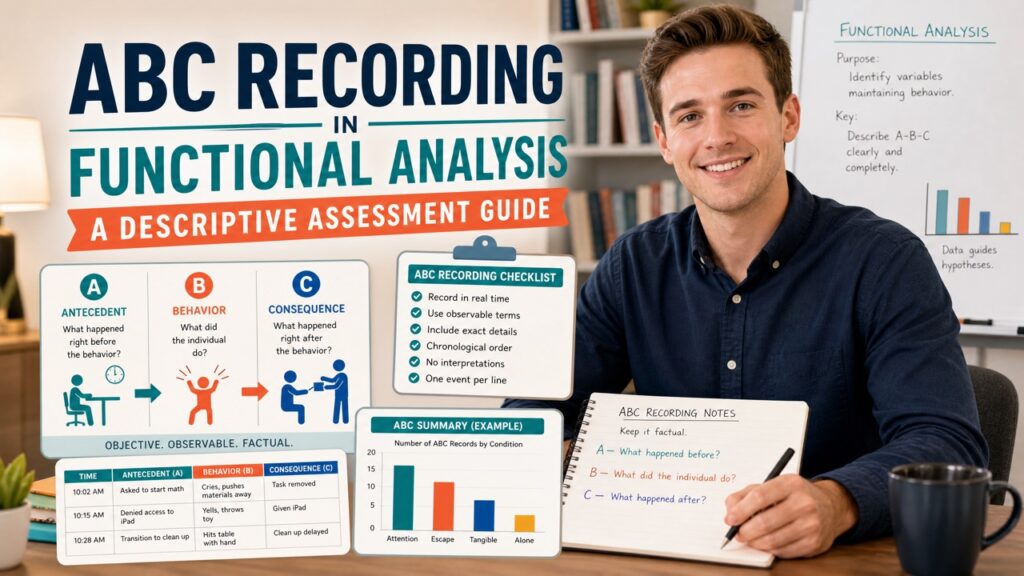
What Is ABC Recording?
ABC recording is a descriptive assessment method used in applied behavior analysis to gather data on behavior as it naturally occurs. The acronym stands for antecedent, behavior, and consequence. During ABC recording, an observer notes the events immediately preceding a behavior (antecedents), the precise behavior itself, and the events that follow it (consequences). This process is conducted in the individual’s typical environment, without manipulating variables. The goal is to identify patterns that suggest possible functions of behavior, but ABC data are correlational, not experimental. They provide valuable hypotheses that require further testing through methods such as functional analysis.
Table of Contents
- What Is ABC Recording?
- How ABC Recording Differs from Functional Analysis
- When and Why to Use ABC Recording
- Step-by-Step Guide to Conducting ABC Recording
- Interpreting ABC Data and Forming Hypotheses
- Common Pitfalls and How to Avoid Them
- Using ABC Recording Within a Broader Behavior Intervention Plan
- Study Checklist for ABC Recording
- Ready to Test Your Knowledge?
- Reference
It is essential to understand that ABC recording is used primarily in descriptive assessment, not functional analysis. However, many students and professionals misuse the phrase “ABC recording is used primarily in functional analysis.” The truth is that while ABC recording often informs functional analysis, it is not a component of it. Functional analysis involves the systematic manipulation of environmental variables to prove a functional relation. ABC recording, on the other hand, is purely observational. It observes and records what happens without changing anything. Because of this, ABC recording is used primarily in the initial phases of assessment to generate informed guesses about why a behavior occurs. These hypotheses can then be tested with more rigorous experimental procedures.
How ABC Recording Differs from Functional Analysis
ABC recording is used primarily in functional analysis? No, that statement is a common misconception. Let’s clarify: ABC recording is used primarily in descriptive assessments, not functional analysis. While both aim to understand the function of behavior, they differ fundamentally in methodology. Functional analysis involves the deliberate manipulation of environmental variables to demonstrate a cause-and-effect relationship. For example, an analyst might create separate conditions—such as attention, escape, and alone—to see which consistently produces higher rates of the target behavior. This experimental approach can prove a function.
ABC recording, on the other hand, is observational. It does not involve manipulation, so it cannot prove causality. Instead, it provides correlational data that may reveal patterns. For instance, if a child’s hitting often follows a peer’s approach and is followed by the peer moving away, one might hypothesize that hitting functions to gain access to attention or to escape a social situation. However, this is only a hypothesis; other unobserved variables could be influencing the behavior. Therefore, ABC recording is best used as a hypothesis-generating tool, not as a definitive assessment of function.
When and Why to Use ABC Recording
ABC recording is a valuable tool in the initial stages of a functional behavior assessment. It is particularly useful when the function of a behavior is unclear and you need a starting point. Because it does not require controlled environmental manipulation, it can be conducted in natural settings such as classrooms, homes, or community settings. This flexibility makes it accessible and relatively easy to implement, especially when time or resources are limited. However, its primary value lies in generating hypotheses about potential controlling variables. These hypotheses can then be tested experimentally through functional analysis.
Behavior analysts often use ABC recording to inform the design of a functional analysis. By identifying which antecedents and consequences frequently co-occur with the behavior, you can select the most relevant conditions to test. For example, if ABC data consistently show that a student’s disruptive behavior occurs during difficult tasks and is followed by removal of the task, you might hypothesize an escape function. You could then design a functional analysis with an escape condition to test this hypothesis rigorously. This approach maximizes the efficiency and effectiveness of the assessment process.
- Use ABC recording when you need a naturalistic snapshot of behavior in the environment.
- Use it when you need to generate hypotheses before conducting a functional analysis.
- Use it when ethical or practical constraints limit the feasibility of experimental manipulation.
- Avoid using ABC recording in isolation to conclusively determine function—typically follow up with experimental analysis.
Step-by-Step Guide to Conducting ABC Recording
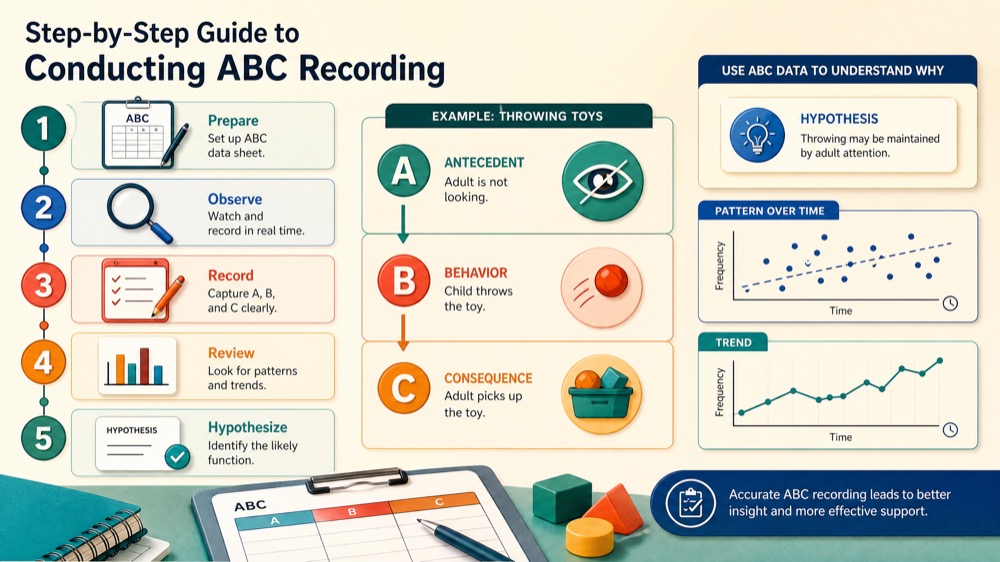
To conduct ABC recording effectively, follow these steps:
- Define the target behavior in observable, measurable terms (e.g., “hitting” as “forceful contact of open hand with another person’s body”).
- Develop a structured data sheet with columns for date, time, antecedent, behavior, and consequence, plus space for notes.
- Train observers thoroughly to recognize the behavior and record antecedents and consequences accurately.
- Observe the behavior in natural settings, either in real time or via video recording, over multiple sessions to capture a representative sample.
- Record each instance of the behavior, noting what happened immediately before and after, including environmental and social events.
- After data collection, summarize the data by identifying common antecedents and consequences.
- Analyze patterns to generate hypotheses about possible functions (e.g., attention, escape, tangible, sensory).
For example, consider a child who frequently throws toys during playtime. An ABC recording might reveal that throwing often happens when an adult is not looking (antecedent) and is followed by the adult picking up the toy and giving it back (consequence). This pattern could suggest an attention function, but it might also be maintained by the return of the toy (tangible). To confirm, you would need to conduct a functional analysis with conditions that isolate these variables.
Interobserver agreement is crucial for reliable data. Ensure that two observers independently record the same events and compare their data. High agreement indicates that the observations are objective and reliable. If agreement is low, retrain observers and refine definitions. Additionally, consider using video recording to allow for repeated review and more accurate coding, especially for complex behaviors.
Interpreting ABC Data and Forming Hypotheses
Once you have collected ABC data, the next step is to interpret them. Look for consistent patterns: Does a specific antecedent typically precede the behavior? Does a specific consequence typically follow it? These patterns suggest potential functions. For instance, if every time the teacher gives a direction, the student engages in tantrum behavior, and the teacher then withdraws the direction, an escape function is plausible. Similarly, if the behavior is followed by peer laughter, an attention function may be hypothesized.
It is vital to remember that ABC data are correlational, not causal. A pattern does not prove that a consequence reinforces the behavior; it only shows a temporal relationship. For example, a child’s hitting may frequently follow peer attention and be followed by teacher reprimand. This suggests that hitting might be maintained by peer attention, but the reprimand could also be a reinforcer if it provides attention. To determine which, you must experimentally manipulate these variables.
Common Pitfalls and How to Avoid Them
When using ABC recording, be aware of common mistakes that can undermine your assessment. Avoiding these pitfalls will improve the reliability of your data and the validity of your conclusions. Here are some frequent errors and practical solutions:
- Using ABC data in isolation to determine function—follow up with experimental analysis.
- Including vague definitions—use precise, observable terms to ensure accurate recording.
- Sampling too few observations—collect data across multiple settings and times to capture a representative picture.
- Ignoring subtle antecedents—note all events, including those that are not obvious (e.g., changes in noise level).
- Confusing correlation with causation—remember ABC data only suggest hypotheses.
- Not training observers properly—ensure all observers are fluent in recording procedures and check interobserver agreement (IOA).
Using ABC Recording Within a Broader Behavior Intervention Plan
ABC recording is just one piece of a comprehensive behavior assessment. Its results can inform the development of a behavior intervention plan (BIP) by providing a foundational understanding of the behavior’s context. Once a hypothesis about function is formed and experimentally verified, the BIP can be designed to address that specific function. For example, if the function is escape from difficult tasks, the BIP might include teaching the individual to request a break or providing task modifications to reduce aversiveness.
Study Checklist for ABC Recording
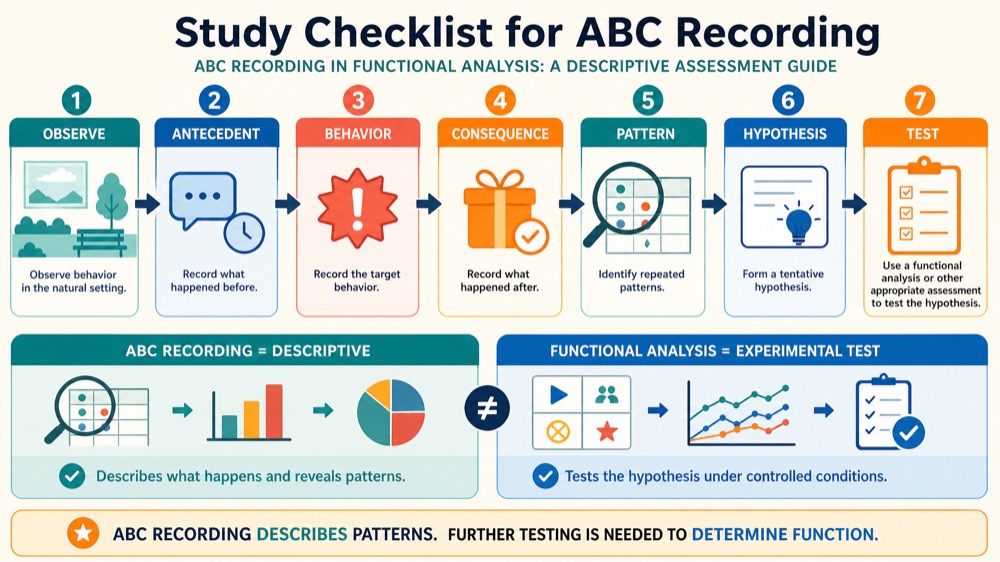
Use this checklist to solidify your understanding of ABC recording for the BCBA exam:
- Define the three components: antecedent, behavior, consequence.
- Explain how ABC recording differs from functional analysis.
- Identify when to use ABC recording in the assessment process.
- List the steps for conducting ABC recording.
- Interpret ABC data to form hypotheses.
- Recognize common pitfalls and how to avoid them.
- Understand the role of ABC recording within a broader BIP.
- Answer practice questions on ABC recording and functional analysis.
Practice with real-world scenarios to apply these concepts. For more practice, check out our free BCBA mock exam to test your knowledge. Additionally, review our article on stimulus control in ABA to understand related concepts. Understanding stimulus control is essential because antecedents can function as discriminative stimuli, increasing the likelihood of a behavior. You can also explore stimulus generalization in ABA to see how behaviors can occur in the presence of similar stimuli. For targeted practice, try our BCBA practice questions on stimulus control.
Ready to Test Your Knowledge?
Now that you have a comprehensive understanding of ABC recording and its role in functional assessment, it’s time to put your knowledge to the test. This topic is a frequent area of confusion on the BCBA exam, and mastering it can significantly boost your score. Take advantage of our free BCBA mock exam to practice questions that cover descriptive assessments, functional analysis, and other important domains. The mock exam provides detailed feedback and explanations, helping you identify areas for further study.
In addition to the mock exam, explore the other resources available at bcbamockexam.com, including articles on stimulus control, generalization, and many more ABA topics. Consistent practice and review are the keys to success on the BCBA exam. Begin your journey today and join thousands of candidates who have used our materials to pass the exam with confidence. With the right preparation, you can achieve your goal of becoming a Board Certified Behavior Analyst.



