
A learner-first BCBA guide to individualized assessment in ABA: connect priorities, context, records, observation, skills data, measurable goals, and ethical review. If you searched for individualized assessment ABA, you may be trying to answer a practical question: how can an assessment describe this learner rather than simply place a person into a standard checklist? In applied behavior analysis, an individualized assessment begins with the learner’s strengths, communication, routines, support needs, and meaningful outcomes. It then combines the evidence needed for the decision instead of treating one score or one interview as the whole answer.
Table of Contents
- Individualized Assessment ABA: What It Means
- Start With the Learner, Family, and Context
- Build an Evidence Chain, Not a Single-Test Answer
- An Individualized Assessment Evidence Matrix
- Turn Assessment Findings Into Measurable Next Steps
- Common Assessment Mistakes to Avoid
- Use the Same Reasoning on BCBA Questions
- Frequently Asked Questions
- Quick Review Checklist
- Take the Free BCBA Mock Exam
The most useful way to think about the process is as a chain: priorities → context → evidence → measurable goals → review. That chain protects against two opposite errors. A generic evaluation can miss what matters in daily life, while an informal list of concerns can produce goals that are not observable or measurable. The assessment should be individualized, but the reasoning should remain systematic.
Scope note: This is an educational BCBA study guide, not a diagnosis, medical opinion, or individualized treatment recommendation. Real assessment decisions require a qualified professional, consent, appropriate records, and attention to the learner’s communication, safety, culture, and preferences.
Individualized Assessment ABA: What It Means
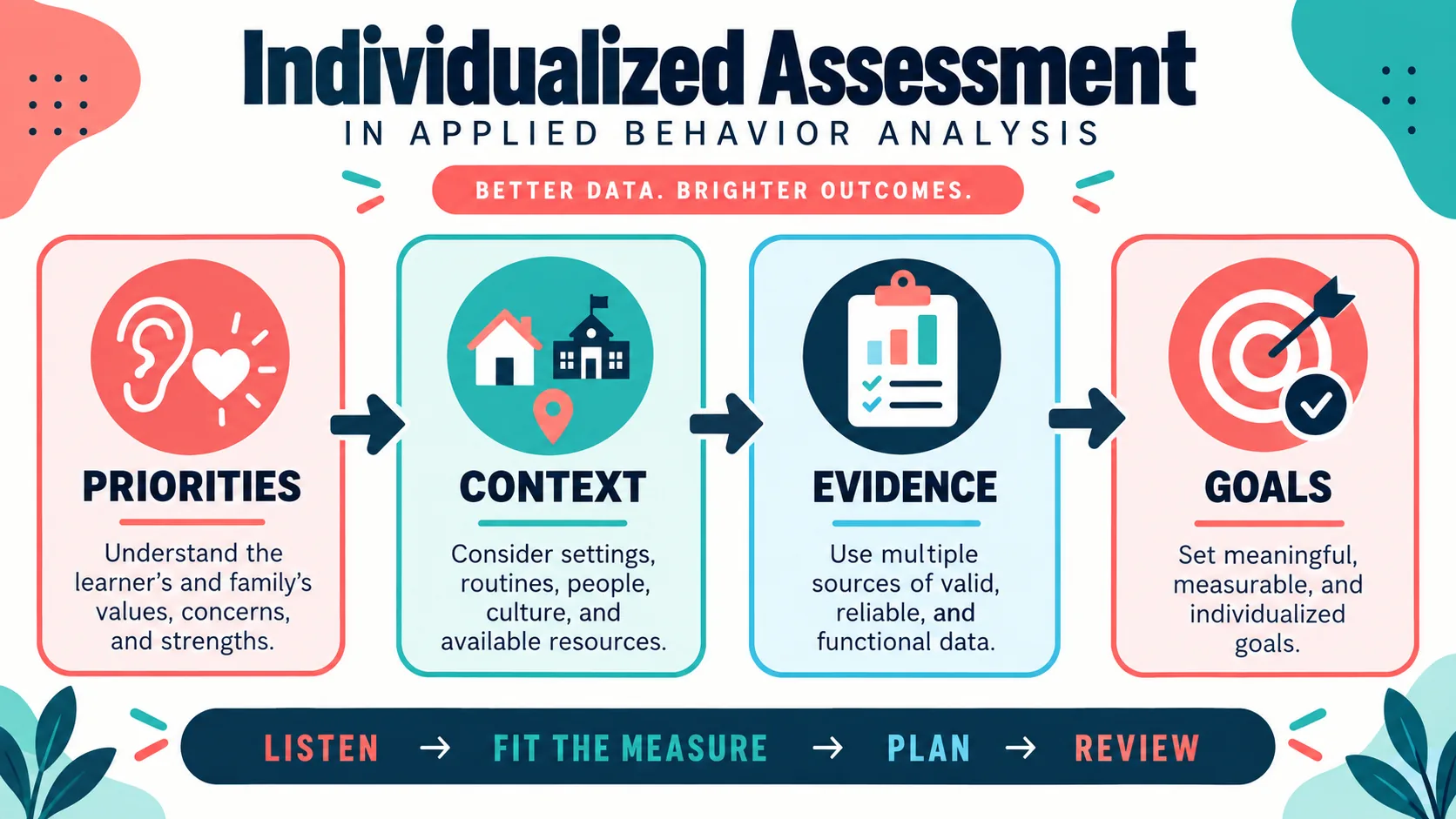
Individualized assessment in ABA is the process of selecting and interpreting assessment information around a particular learner and decision. It asks more than “Which tool should we use?” It asks: What decision are we trying to make? What does the learner already do? What does the learner need to communicate or participate? Which environments matter? What does the family value? What evidence can answer the question safely and fairly?
Individualization does not mean abandoning measurement. A strong assessment still uses operational definitions, observable responses, appropriate measurement systems, and a clear explanation of how findings support the next step. The individualization appears in the questions selected, the people and contexts included, the accommodations used, the goals prioritized, and the way the team checks whether the plan is meaningful. For BCBA exam reasoning, separate three ideas:
- Assessment: gathering and interpreting information to understand strengths, needs, environmental variables, and priorities.
- Diagnosis or eligibility: a separate decision that may belong to another qualified professional or system.
- Treatment planning: translating defensible assessment findings into measurable goals, procedures, service decisions, and review criteria.
The National Academies assessment resource is useful background because it frames assessment for ABA treatment planning as comprehensive and individualized rather than dependent on one instrument. The current BACB Handbook should be used for certification and professional-pathway questions; it does not turn a study article into a clinical evaluation.
Start With the Learner, Family, and Context
Before selecting a test or writing a goal, define the decision context. A learner may need different assessment questions for communication, daily living, social participation, school routines, safety, sleep-related routines, or reduction of a specific interfering behavior. The same tool is not automatically appropriate for every question.
A learner-first intake should invite information from the learner whenever possible and from the people who know the learner across settings. Ask what the learner enjoys, how the learner communicates assent or refusal, which routines are difficult, what supports already work, and what outcomes would make a meaningful difference. Family priorities should be treated as data about social validity and context, not as an afterthought added after a standardized score.
Context also includes culture, language, disability-related access needs, sensory conditions, setting demands, transportation, caregiver availability, and opportunities to practice skills naturally. If a response depends on a communication device, interpreter, visual support, or movement break, the assessment conditions should not mistake lack of access for lack of ability. Use a short question set to keep the intake individualized:
- What meaningful routine or outcome is the team trying to improve?
- How does the learner currently communicate needs, preferences, assent, and refusal?
- Where does the skill or behavior occur, and with whom?
- What happens before and after the response?
- Which strengths, interests, reinforcers, or existing supports can make assessment more accessible?
- How will the learner and caregivers recognize useful progress?
These questions do not replace direct measurement. They help the team select the right measurement and avoid writing a plan around a problem description that is too broad to evaluate.
Build an Evidence Chain, Not a Single-Test Answer
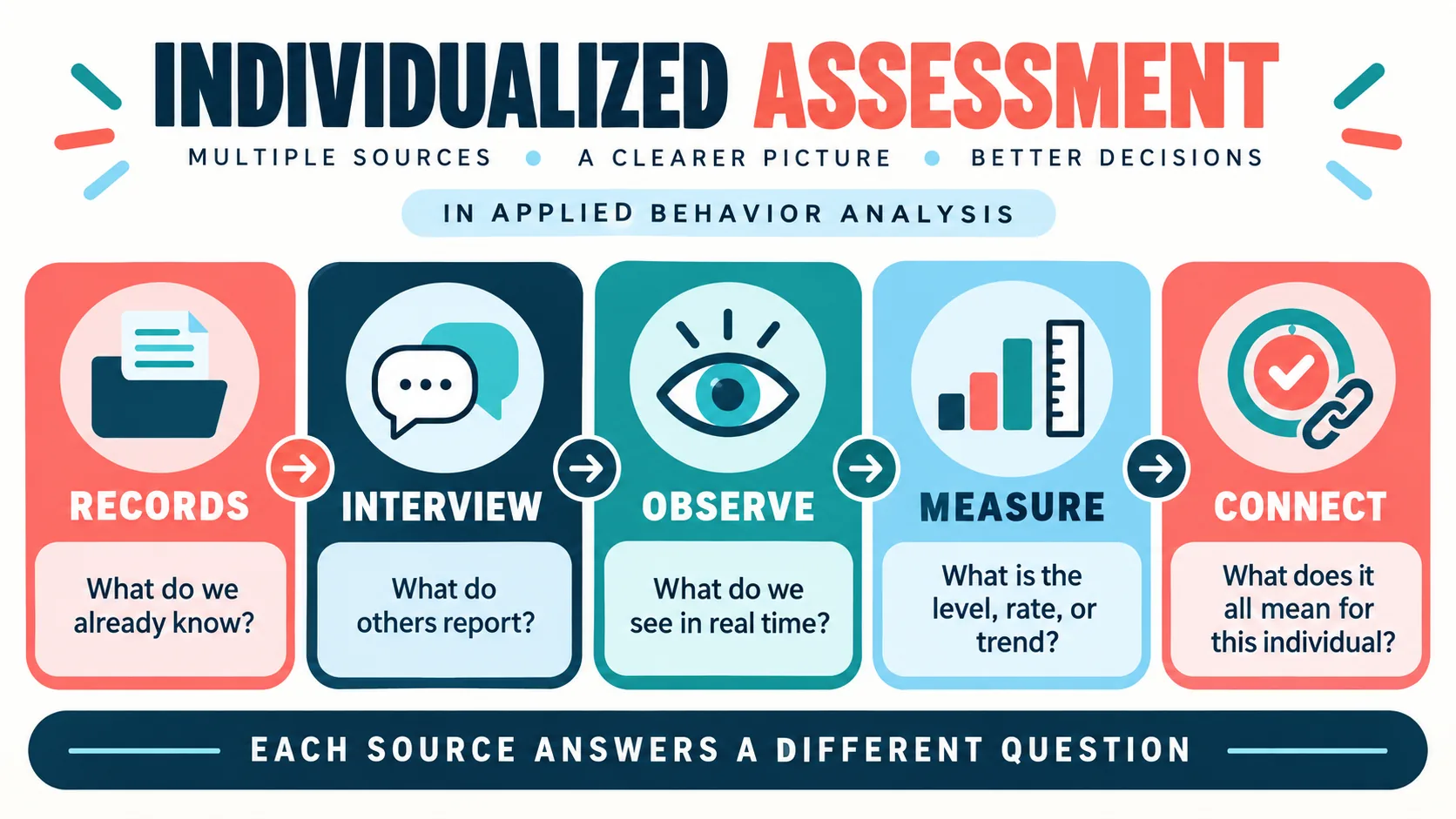
Individualized assessment is strongest when different sources answer different parts of the same decision. Records can show history and prior response to intervention. Interviews can identify routines, priorities, and hypotheses. Direct observation can show what happens in context. Skills assessment can map what the learner can do, what prompts are needed, and where barriers appear. No one source should be forced to answer every question.
For example, a caregiver may report that a learner “does not communicate.” A direct observation might show spontaneous communication through gestures and a device during preferred activities, but limited access during transitions. A skills assessment may show that the learner can select between two items but needs a prompt to request help. The individualized next step is not simply “teach communication”; it is a measurable plan matched to the response form, context, prompt level, and meaningful outcome.
When behavior reduction is part of the assessment, do not substitute labels for operational definitions. “Noncompliance,” “meltdown,” or “aggression” may describe a family’s understandable concern, but the assessment needs observable terms, context, frequency or duration information when appropriate, and a careful distinction between descriptive patterns and experimentally demonstrated function.
An Individualized Assessment Evidence Matrix
The table below shows how a team can match an information source to a decision. It is a study framework, not a fill-in-the-blank clinical form. The same learner may need several rows, and the plan should state what will be reviewed next.
| Source | What it can answer | Individualization check |
|---|---|---|
| Records | History, prior assessments, response to earlier supports, medical or educational context. | Are the records current, relevant, accessible, and interpreted within the learner’s present context? |
| Interview | Priorities, routines, communication, caregiver concerns, strengths, and hypotheses. | Were the learner’s voice, preferred language, assent, and family values included? |
| Observation | Antecedents, observable responses, consequences, setting events, and opportunities. | Were the relevant people, environments, communication supports, and routines observed? |
| Skills data | Current repertoire, prompt needs, barriers, preference, fluency, and generalization opportunities. | Does the measure fit the response, access needs, and decision rather than just the available form? |
Notice the distinction between a source and a conclusion. An interview can generate a hypothesis; it does not prove a function. A skills assessment can show performance under its conditions; it does not prove that a learner cannot perform elsewhere. A direct observation can show a pattern; it does not automatically establish experimental control. Good assessment writing states what each source supports and what it cannot support.
Turn Assessment Findings Into Measurable Next Steps
After gathering evidence, connect each meaningful priority to a measurable next step. A useful goal names the response, the condition or opportunity, the measurement system, and the criterion for review. It also explains why the goal matters in the learner’s life and how the team will promote generalization.
Imagine that the assessment identifies a learner who reaches toward an adult but does not yet use a reliable request for help during difficult tasks. An individualized plan might define a functional communication response, measure independent requests across specified opportunities, teach the response with an accessible modality, and test it with different people and routines. It should not assume that a single clinic performance represents the learner’s full repertoire.
Individualized planning also requires a review loop. The team should decide what data will be collected, how often it will be reviewed, what improvement would support continuation, what pattern would trigger a modification, and how the learner/caregiver will be involved in that decision. If the data are missing, inconsistent, or socially invalid, the answer may be to improve measurement or fit—not automatically to intensify intervention.
For the broader connection between assessment and plan writing, see the site’s ABA assessment and treatment plan guide. For the measurement side, the direct assessment guide explains observation and measurement boundaries. These internal links keep this article focused on individualization rather than duplicating every assessment method.
Common Assessment Mistakes to Avoid
- Starting with a favorite tool: choose the assessment method after defining the decision, not before.
- Treating a score as a treatment plan: scores can inform a decision, but goals still need meaningful, observable, measurable definitions.
- Ignoring access: a learner cannot demonstrate a skill reliably when the response form, language, sensory conditions, or communication support is inaccessible.
- Confusing reports with proof: interviews and rating scales can guide hypotheses; direct and experimental evidence have different roles.
- Writing goals without the learner’s priorities: technical measurability does not automatically make a goal socially valid.
- Skipping generalization: success with one therapist in one room is not the same as useful performance across people, places, materials, and time.
- Overclaiming scope: an ABA assessment guide should not present itself as a diagnosis, medical evaluation, or guarantee of coverage.
Use the Same Reasoning on BCBA Questions
On a BCBA question, look for the decision the assessment is meant to support. Then identify which evidence is direct, which is indirect, what has actually been measured, and whether the proposed goal matches the learner’s context and priorities. The best answer is usually the one that preserves observable definitions, uses the least assumption, and links data to a defensible next step.
When you are ready to practise that reasoning under time pressure, try the Free BCBA Mock Exam. Use the explanations to note whether you missed the assessment source, the measurement choice, the scope boundary, or the generalization decision. That turns a practice score into a targeted study action.
Frequently Asked Questions
What is individualized assessment in ABA?: It is a learner-centered assessment process that selects and interprets information around a specific decision, person, context, communication profile, family priority, and meaningful outcome. It combines appropriate evidence rather than treating one tool or score as the whole evaluation.
Is an individualized ABA assessment the same as a diagnosis?: No. An ABA assessment can describe behavior, skills, environmental variables, priorities, and treatment-planning needs. Diagnosis and eligibility decisions may belong to different professionals or systems and should not be inferred from an ABA assessment article.
What information is included in an individualized ABA assessment?: Depending on the decision, it may include records review, interviews, direct observation, skill or preference data, communication and access needs, family priorities, cultural and environmental variables, baseline measurement, and a plan for reviewing progress.
Can one standardized assessment be enough?: Usually, one score should not be treated as a complete picture. A standardized measure may provide useful information, but it should be interpreted alongside relevant records, interviews, direct evidence, context, and the learner’s meaningful goals.
How does individualized assessment guide treatment planning?: It connects the learner’s priorities and current repertoire to observable goals, matched measurement, teaching or behavior-support procedures, generalization opportunities, and data-based review criteria. The plan should state what evidence supports each decision.
Bottom line: Individualized assessment in ABA is not a looser version of assessment. It is a more precise process: start with the learner and meaningful decision, build an evidence chain, choose accessible measures, write measurable next steps, and keep reviewing whether the plan is useful in real life.
Quick Review Checklist
Use this final checklist to turn individualized assessment aba into exam-ready reasoning. The goal is not to memorize a label in isolation; it is to identify the relevant evidence and explain why the best answer fits the scenario. Key ideas to review:
- State the central definition or decision point for individualized assessment aba in your own words.
- Identify the detail that makes individualized assessment aba different from its closest related ABA term.
- Separate the observable facts in a scenario from assumptions that are not supported by the facts.
- Write one example and one nonexample so you can recognize the concept in a new setting.
Exam application checks:
- Ask what the question is actually requesting before comparing the answer choices.
- Mark the antecedent, response, consequence, or other evidence that supports the selected answer.
- Look for a distractor that describes a related process but does not answer the specific question.
Final self-check:
- Explain how you would verify the interpretation with clear observations or data.
- Change one detail in the scenario and decide whether your answer should change.
- Give a one-sentence rationale that a supervisor or study partner could evaluate.
Take the Free BCBA Mock Exam
When you are ready to apply the idea, use the free practice resource below for additional feedback. Take the Free BCBA Mock Exam



