
The best BCBA study materials are not the same for every candidate. The right combination depends on what you need to do next: understand a difficult concept, memorize terminology, apply a rule to a scenario, practice under time pressure, or verify that a weak area is improving. Buying more material does not automatically create a better study plan.
Table of Contents
- Best BCBA Study Materials: The Short Answer
- Match the Material to the Study Job
- Build a Minimal Study Stack
- Choose by Time, Budget, and Study Style
- Use Practice to Validate the Choice
- A BCBA Materials Checklist and Next Step
- Frequently Asked Questions
- Sources for Further Study
- Take the Free BCBA Mock Exam
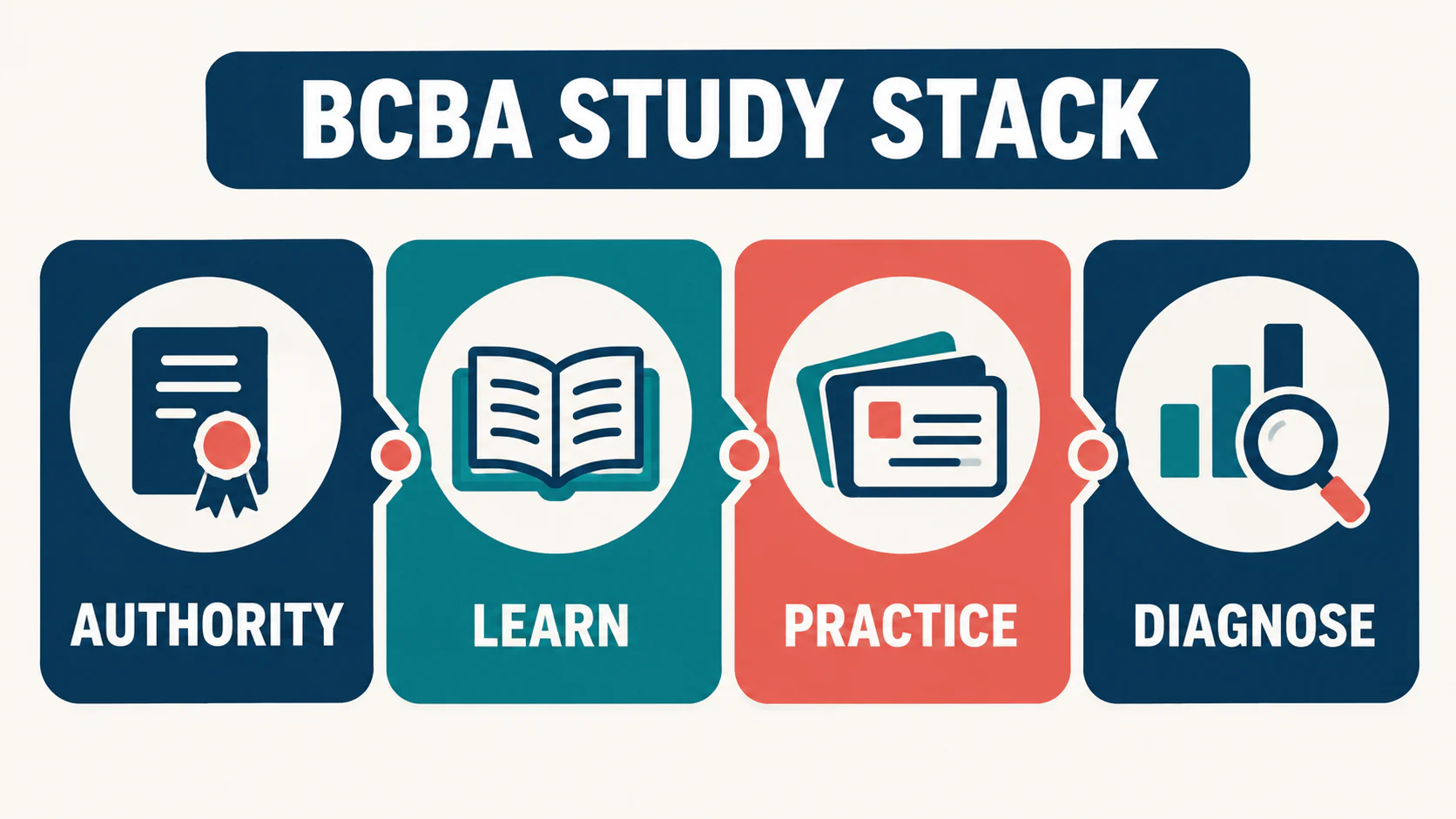
A strong resource stack usually has four layers: a current official source for authority, a learning resource for depth, active-recall or scenario practice for application, and a feedback loop that tells you what to study next. The best choice is the smallest stack that solves your current problem and that you will actually use. This guide is a new decision-focused page. The existing BCBA study materials guide, practice-material guide, and mock-exam comparison remain read-only references. No commercial resource is BACB-endorsed here, and no practice score guarantees certification.
Best BCBA Study Materials: The Short Answer
Start with the current BACB BCBA Handbook and official BCBA resource hub for credential and pathway information. Then choose materials based on your learning job:
- Need conceptual depth? Use a reputable textbook, course text, or research-informed reference.
- Need organized review? Use a study guide mapped to the current exam content and your course plan.
- Need retrieval? Use flashcards or short recall prompts, but make sure they include definitions, examples, and boundaries.
- Need application? Use scenario questions that require selecting a measurement, assessment step, intervention, or ethical response.
- Need exam pacing? Use a mock exam after you have enough content knowledge to learn from the explanations.
This order matters. A mock exam can reveal that you are weak in assessment, but it may not teach the concept. A textbook can explain a concept, but it may not train fast discrimination between two plausible answer choices. Treat each resource as a tool with a job.
Match the Material to the Study Job
| Study problem | Useful material | What to look for |
|---|---|---|
| I cannot explain the concept. | Textbook, lecture, chapter, or structured lesson. | Clear definitions, examples, nonexamples, limits, and references. |
| I recognize it but cannot recall it. | Flashcards, retrieval prompts, and short spaced reviews. | Prompts that require you to generate an answer, not only reread one. |
| I know the definition but miss scenarios. | Application questions and error explanations. | Rationales that identify the discriminating clue and why alternatives fail. |
| I run out of time. | Timed sets, pacing drills, and a full mock exam. | Review that separates knowledge gaps from reading or pacing errors. |
Do not use a product label as proof of quality. “Complete,” “ultimate,” or “best” are marketing words until you test whether the material explains the concept, matches the current target, respects official boundaries, and helps you change your next study action.
Build a Minimal Study Stack
A minimal stack is easier to finish and easier to evaluate. A practical starting point is:
- Authority layer: current official BACB information for requirements, pathway details, and terminology that must be verified.
- Learning layer: one primary text, course, or guide that explains the concepts in a sequence you can follow.
- Recall layer: flashcards or short prompts for terms that you repeatedly miss.
- Application layer: scenario questions that force you to choose and defend an answer.
- Diagnostic layer: a timed mock exam or practice set used to identify the next weakness, not to predict the future.
| Stack size | Best fit | Risk to manage |
|---|---|---|
| Lean | One guide, official source, and targeted practice. | A difficult concept may need a second explanation. |
| Balanced | Guide or course, recall tool, scenario practice, and mock exam. | Switching resources can become procrastination. |
| Deep | Learners who need research depth or are building long-term professional knowledge. | Reading breadth may crowd out retrieval and application. |
Add a resource only when you can name the problem it solves. If your score shows a vocabulary gap, buying another full course may be inefficient. If you understand definitions but miss scenarios, more passive reading may not address the problem.
Choose by Time, Budget, and Study Style
The “best” BCBA study materials also depend on constraints. A learner with six months and a quiet study schedule can use a deeper reference. A learner with three weeks may need a narrower sequence with daily retrieval and targeted explanations. Neither situation makes one product universally superior.
- Limited budget: begin with the official handbook, library or course resources, free explanations, and targeted practice before purchasing a large bundle.
- Limited time: use a diagnostic set to identify high-impact weaknesses, then study those domains instead of reading everything equally.
- Visual learner: use diagrams and structured notes, but still test yourself without looking at the visual.
- Discussion-oriented learner: use an instructor, study group, or supervisor for explanations, then verify official claims at BACB.
- Independent learner: keep an error log so self-study produces feedback rather than repeated guessing.
Use Practice to Validate the Choice
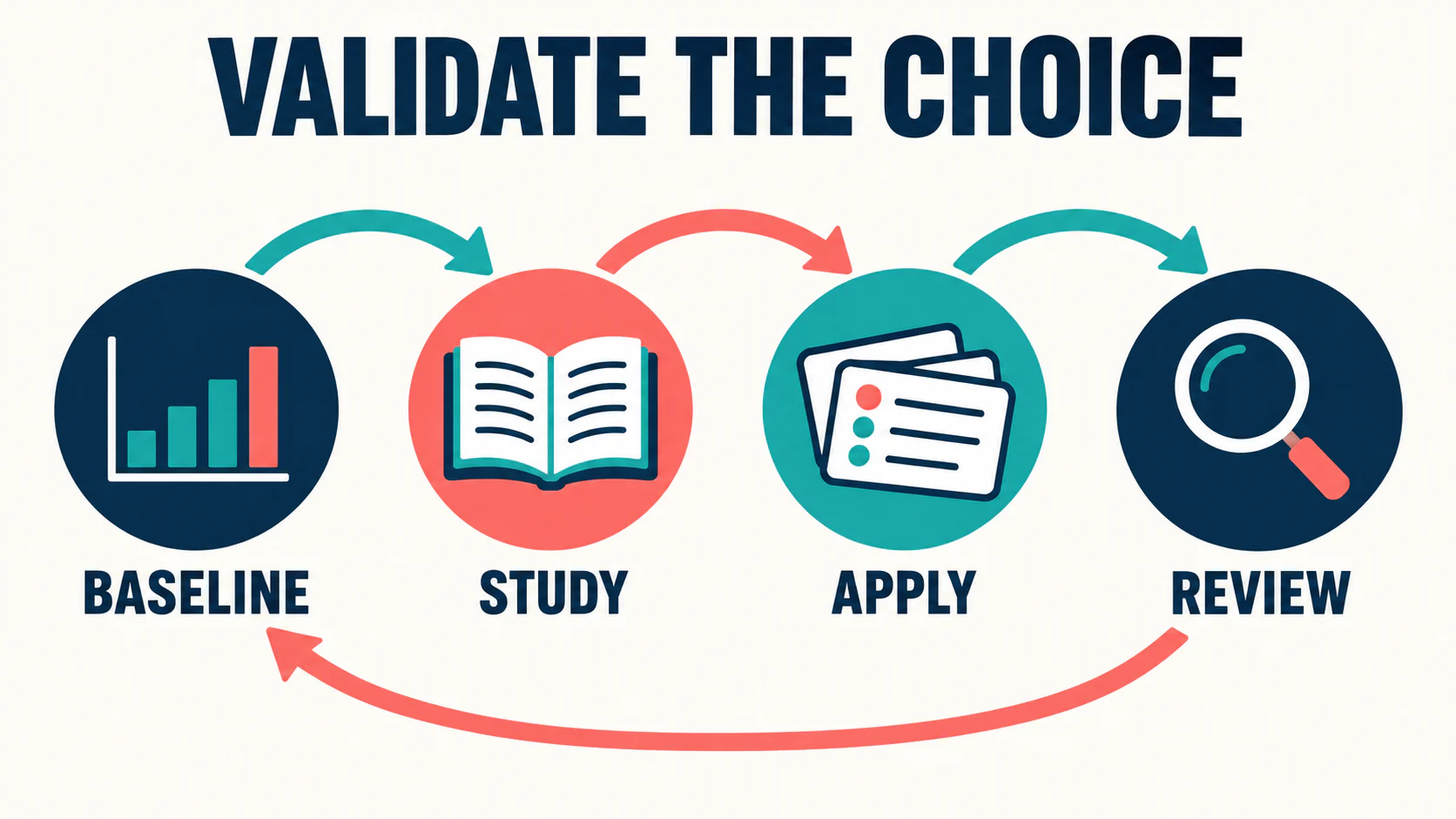
After using a resource for a defined period, test whether it changed your performance. Do not evaluate it only by how polished the pages feel or how many hours you spent reading. Use a small cycle:
- Baseline: complete a short set without extra help and record the domain, question type, and error reason.
- Study: use one material for a planned session. Write a concise explanation and one boundary or nonexample.
- Apply: complete new questions that require the same discrimination in a different scenario.
- Review: compare the error pattern. If the same mistake remains, change the learning approach or seek qualified feedback.
| Result after practice | Likely interpretation | Next action |
|---|---|---|
| You can explain the concept and apply it to new scenarios. | The resource is doing its learning job for this topic. | Space the review and move to the next weakness. |
| You remember terms but cannot discriminate scenarios. | You may need more examples, nonexamples, or rationale practice. | Use scenario questions and explain why alternatives fail. |
| Scores vary widely between similar sets. | Check content coverage, fatigue, reading, and question quality. | Collect another small sample before buying a new product. |
| The resource makes claims that conflict with BACB. | The resource may be outdated, oversimplified, or outside its scope. | Verify the official source and do not use the product as policy authority. |
A mock exam is most useful when it produces an error map. Record the domain, the clue you missed, the rule you applied, and the better reasoning. A raw percentage without an explanation may feel precise but does not tell you what to do next.
A BCBA Materials Checklist and Next Step
Before you buy or commit to a study resource, ask:
- Is the source official, instructional, recall-focused, application-focused, or diagnostic?
- Which exact study problem will it solve?
- Does it identify its edition and current alignment?
- Does it explain answers, boundaries, and common traps rather than only display a score?
- Can you use it consistently within your time and budget?
- Does it avoid BACB endorsement claims or passing guarantees?
For a structured overview of study-resource options, review the existing BCBA Exam Study Materials page. When you are ready to diagnose application and pacing, try the Free BCBA Mock Exam. Both are study resources, not BACB endorsements or guarantees.
Frequently Asked Questions
What are the best BCBA study materials for a beginner?: Start with current official BACB information, one clear learning resource, and small sets of explained practice questions. Add flashcards or a mock exam only when they solve a specific recall or application problem. Are BCBA flashcards enough to pass?: Flashcards can support retrieval, but they rarely provide enough depth or scenario discrimination by themselves. Pair them with explanations, application questions, and feedback on errors.
Should I take a mock exam before studying?: A short diagnostic set can identify a starting point. A full mock exam may be more useful after you have reviewed core concepts, because the explanations will be easier to use and the result will be less noisy.
How do I know whether a BCBA study resource is current?: Check the edition or revision date, compare policy claims with the current BACB handbook and resource hub, and confirm that the resource explains its alignment. Do not rely on a page that hides its source or makes a passing guarantee.
Sources for Further Study
Use the current BACB BCBA Handbook, BCBA resource hub, and BACB Ethics Codes for official context. Compare study approaches in the Track My BCBA prep guide and ABA Study Guide comparison, then verify current details before purchasing or relying on any resource.
Take the Free BCBA Mock Exam
When you are ready to apply the idea, use the free practice resource below for additional feedback. Take the Free BCBA Mock Exam



