
Skills based treatment ABA usually refers to a treatment progression that builds meaningful communication, tolerance, cooperation, safety, and generalization skills after a functional assessment process. It is often discussed alongside practical functional assessment (PFA) and skill-based treatment (SBT), but it should not be reduced to “teach any skill” or “make a learner comply.”
Table of Contents
- Skills Based Treatment ABA: The Short Answer
- Separate SBT From a Generic Skill-Acquisition Plan
- Move From Assessment to Functional Communication
- Build Tolerance With Safety and Assent Visible
- Check Data, Team Fidelity, and Generalization
- BCBA Exam Traps and FAQ
- Frequently Asked Questions
- Sources for Further Study
- Quick Review Checklist
- Take the Free BCBA Mock Exam
A responsible SBT discussion keeps the learner’s communication, assent, safety, dignity, and quality of life visible. The exact steps, assessment design, reinforcement arrangements, and team responsibilities must be individualized and supervised. This page is an educational framework for learners and BCBA exam preparation, not a universal treatment protocol. The existing PFA and SBT overview, functional communication guide, and generalization guide remain read-only. This new URL focuses on the progression and implementation checkpoints that connect those ideas.
Skills Based Treatment ABA: The Short Answer
Skills-based treatment is a function-informed way of building a learner’s repertoire so the learner can communicate, tolerate relevant situations, participate safely, and use skills across contexts. In PFA/SBT discussions, the treatment path is often connected to the variables identified through an assessment and to meaningful responses that can replace unsafe or ineffective behavior. The short answer has four parts:
- Function matters: the team considers what the learner may be trying to obtain, avoid, or communicate.
- Communication comes early: an effective functional communication response can give the learner a safer, clearer way to access needs or signal “not now.”
- Tolerance is taught gradually: the learner practices brief, achievable changes while the team monitors assent, stress, safety, and the value of reinforcement.
- Generalization is planned: the team checks whether the response works with different people, materials, routines, and environments.
These are not permission to skip assessment or to move through a fixed checklist regardless of the learner’s response. A BCBA must use competence, supervision, data, consent/assent processes, and current professional requirements to decide what is appropriate.
Separate SBT From a Generic Skill-Acquisition Plan
| Term or layer | Main question | Boundary to remember |
|---|---|---|
| PFA/FBA process | What variables and functional relations should guide assessment and treatment planning? | A label or interview answer is not the same as a completed individualized assessment. |
| SBT framework | How can function-informed communication, tolerance, safety, and generalization skills be built? | The framework must be adapted to learner assent, risk, access, context, and data. |
| Skill-acquisition plan | What teaching steps, prompts, reinforcement, and mastery criteria build a defined skill? | It can be used in many ABA programs and is not automatically an SBT plan. |
| Fidelity and review | Was the plan implemented safely and as designed, and what should change? | Poor implementation or missing data can make an outcome hard to interpret. |
For a BCBA exam question, identify the level being asked about. If the stem asks for the function-informed treatment sequence, SBT may be relevant. If it asks how to teach a specific response with prompts and mastery criteria, it may be testing a general skill-acquisition procedure instead.
Move From Assessment to Functional Communication
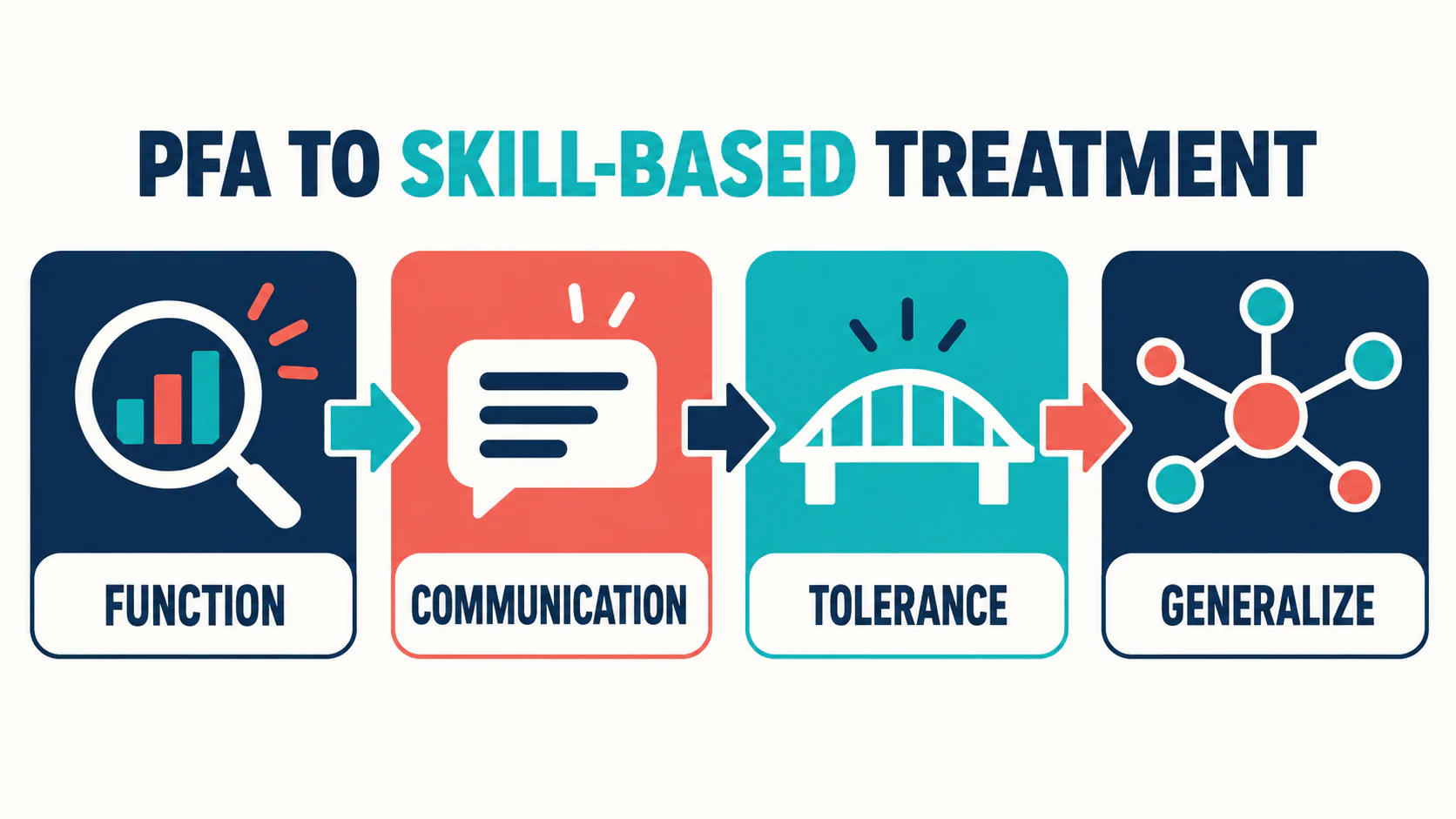
Functional communication is often a central early target because it gives the learner a practical response that can compete with a less safe or less efficient response. The response might be spoken language, a sign, a device selection, a visual, or another accessible form. The form is not the definition of “good communication”; the important question is whether the response is meaningful, available, and supported across the situations in which the learner needs it. A careful progression might look like this:
- Identify the communication job: what can the learner request, reject, delay, ask for help with, or signal safely?
- Make the response efficient: teach a form that the learner can access with the available motor, sensory, language, and technology supports.
- Honor the response: arrange the environment so an appropriate communication response has a meaningful effect when safe and clinically appropriate.
- Expand carefully: teach the next step only when the current response is functional and the learner can participate without unnecessary distress.
| Treatment checkpoint | What to observe | If the checkpoint fails |
|---|---|---|
| Access | The learner can recognize and use the response with realistic materials and supports. | Adjust the form, prompt, technology, or communication partner. |
| Meaning | The response changes the relevant interaction or access to a need. | Recheck the function and whether the team is honoring the response consistently. |
| Safety | The response is not being used to justify unsafe delay, escalation, or loss of essential support. | Pause, consult supervision, and revise the plan before increasing demands. |
Build Tolerance With Safety and Assent Visible
Tolerance targets should be defined as meaningful, safe skills rather than a general expectation that a learner accepts everything. Examples might involve waiting briefly, accepting a change in materials, transitioning with support, tolerating a denied request while using a communication response, or participating in a necessary routine. The team should identify why the skill matters and how the learner can communicate discomfort or refusal.
Assent is more than the absence of an obvious protest. Watch for communication, approach, withdrawal, changes in affect, stress signals, and the learner’s ability to use an available break or refusal response. A plan that produces short-term task completion while suppressing communication may not be meeting the broader goals of safety, autonomy, and quality of life.
Increase difficulty gradually and use data to examine the learner’s response. If risk, distress, or communication loss increases, the right next step is not automatically “be more consistent.” The team may need to reduce the demand, change the support, reassess the function, consult a supervisor, or pause the progression.
Check Data, Team Fidelity, and Generalization
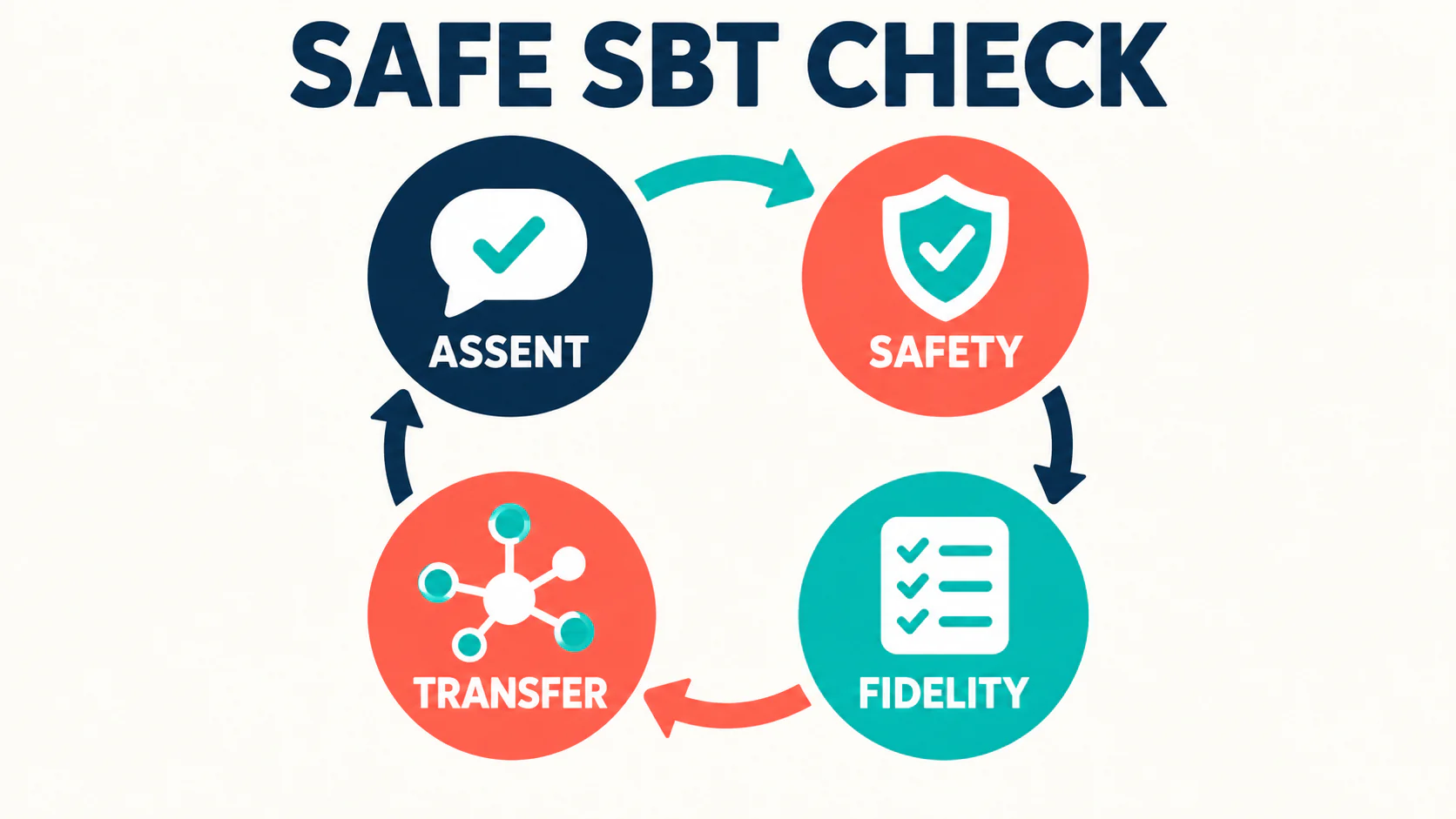
Data should show more than whether a learner completed a step. A useful SBT review can include independent communication, prompted communication, tolerance duration or response, safety signals, problem behavior, reinforcement access, and context changes. Choose measures that match the decision and that can be collected consistently by the people involved.
- Outcome data: did the learner use the communication or tolerance response?
- Context data: where, with whom, and under what conditions did the response occur?
- Fidelity data: were the planned prompts, materials, reinforcement, and safety procedures used?
- Assent and well-being notes: did the learner show approach, refusal, stress, or a need for a break?
- Generalization data: does the response work across relevant people, routines, and settings?
| Pattern | Possible interpretation | Prudent next question |
|---|---|---|
| Communication improves with one trained provider only. | The response may not yet be generalized or the team may differ in implementation. | What materials, prompts, and partner behaviors need to transfer? |
| Tolerance increases while refusal communication decreases. | The plan may be improving task completion at the cost of autonomy or assent. | Is the break or refusal response easy, honored, and safe? |
| Data vary after the routine or reinforcer changes. | The context may be affecting the response, not only the learner’s skill. | Which variables changed, and should the measure or teaching step be adapted? |
| The team cannot implement the steps consistently. | A fidelity or feasibility barrier may limit conclusions about the treatment. | Can the plan be simplified, modeled, coached, or redesigned? |
Generalization should be planned, not assumed. Vary one relevant feature at a time when safe, such as the communication partner, material, room, schedule, or level of support. Continue to monitor whether the learner can use the skill and whether the plan remains acceptable to the learner and team.
BCBA Exam Traps and FAQ
Common exam traps include treating SBT as a synonym for all skill acquisition, skipping the functional relation, ignoring assent and safety, calling a prompted response independent, and claiming generalization because a skill worked in one session. Another trap is selecting a treatment step without identifying the communication response, reinforcement history, data measure, or supervision boundary.
For targeted review of PFA/SBT concepts, functional communication, measurement, and ethical decision making, the Free BCBA Mock Exam can help you practice distinguishing framework, procedure, data, and professional-boundary questions. It is a study diagnostic, not a treatment protocol or certification guarantee.
Frequently Asked Questions
What is skills-based treatment in ABA?: It is a function-informed treatment framework that can build communication, tolerance, safety, and generalization skills in a progression connected to assessment and meaningful outcomes. The exact plan must be individualized and supervised.
Is SBT the same as a skill-acquisition plan?: No. A skill-acquisition plan teaches a defined skill and may appear in many ABA programs. SBT refers to a broader function-informed progression and its related assessment, communication, tolerance, safety, data, and generalization decisions.
Does SBT mean teaching compliance?: No. A responsible plan should make communication, assent, safety, dignity, and meaningful participation visible. Tolerance targets should have a clear purpose and should not be used to suppress refusal or transfer risk to the learner.
How is generalization measured in SBT?: Measure whether the learner uses the relevant response across the people, materials, settings, routines, and support levels that matter. Vary context gradually and check fidelity, safety, assent, and maintenance rather than assuming transfer.
Sources for Further Study
For current professional boundaries, review the BACB Ethics Codes, BCBA Handbook, and BCBA resource hub. For framework context, compare the GVSU START resource and the SBT scoping review. Recheck current clinical, state, payer, privacy, supervision, and safety requirements before applying any treatment process.
Quick Review Checklist
Use this final checklist to turn skills based treatment aba into exam-ready reasoning. The goal is not to memorize a label in isolation; it is to identify the relevant evidence and explain why the best answer fits the scenario. Key ideas to review:
- State the central definition or decision point for skills based treatment aba in your own words.
- Identify the detail that makes skills based treatment aba different from its closest related ABA term.
- Separate the observable facts in a scenario from assumptions that are not supported by the facts.
- Write one example and one nonexample so you can recognize the concept in a new setting.
Exam application checks:
- Ask what the question is actually requesting before comparing the answer choices.
- Mark the antecedent, response, consequence, or other evidence that supports the selected answer.
- Look for a distractor that describes a related process but does not answer the specific question.
Final self-check:
- Explain how you would verify the interpretation with clear observations or data.
- Change one detail in the scenario and decide whether your answer should change.
- Give a one-sentence rationale that a supervisor or study partner could evaluate.
Take the Free BCBA Mock Exam
When you are ready to apply the idea, use the free practice resource below for additional feedback. Take the Free BCBA Mock Exam



