

What Are Independent and Dependent Va
In applied behavior analysis, understanding the distinction between the independent variable and the dependent variable is foundational for designing experiments and interpreting data. The independent variable (IV) is the intervention or condition that the researcher manipulates to observe its effect on behavior. It represents the change you intentionally introduce. In contrast, the dependent variable (DV) is the target behavior you measure; it is the outcome that depends on the independent variable. For BCBA exam success, mastering this distinction is critical because nearly every experimental design question relies on it.
Table of Contents
- What Are Independent and Dependent Va
- How to Tell Them Apart: A Simple Framework for BCBA Candidates
- ABA Examples of Independent and Dependent Variables
- Exam Relevance: Why This Matters for the BCBA Test
- Quick Checklist for Exam Day
- Summary and Key Takeaways
Unlike general research contexts, ABA emphasizes the IV as an environmental manipulation (e.g., a reinforcement schedule, prompting strategy) and the DV as a directly observable and measurable behavior (e.g., frequency of aggression, duration of on-task behavior). This operational clarity ensures that interventions are replicable and data-driven. As a BCBA candidate, you must be able to identify both variables in complex scenarios, from functional analyses to skill acquisition programs.
Independent Variable Defined (The Intervention): The independent variable in ABA is the manipulated variable—the treatment, condition, or procedure implemented by the practitioner. It is also called the intervention or treatment variable. Examples include the delivery of reinforcement, the introduction of a token economy, or the implementation of extinction. The IV must be clearly defined so that its presence or absence is unambiguous, as this is essential for experimental control. In a reversal design, the IV might be the presence vs. absence of the intervention. In a multiple baseline design, the IV is the staggered introduction of the intervention across tiers.
Dependent Variable Defined (The Behavior): The dependent variable is the target behavior that is measured to evaluate the effect of the independent variable. It must be defined in observable, measurable terms (operational definition). Examples include instances of self-injury per hour, percentage of correct responses in a discrete trial, or duration of tantrum behavior. The DV should be sensitive to change and have social validity. For BCBA exam questions, common DVs include rates of behavior, duration, latency, and interresponse time. Remember: the DV is what you graph on the y-axis of a line graph.
How to Tell Them Apart: A Simple Framework for BCBA Candidates
When you encounter a scenario on the BCBA exam, you can use a straightforward rule to differentiate the independent and dependent variables: IV is what you change; DV is what you measure. Ask yourself: ‘What am I systematically altering? What am I tracking to see if it changes?’ This heuristic works across all experimental designs, from ABAB to multielement. However, be aware that the exam may present the IV as a condition (e.g., ‘contingent attention’) rather than explicitly labeling it.
For deeper understanding, consider the ‘if-then’ logic: If I implement the intervention (IV), then I expect the behavior (DV) to improve. In functional analysis, the IV is the specific test condition (e.g., attention, demand), while the DV is the rate of the problem behavior. This framework helps you avoid confusion with extraneous variables or confounding factors, which are not manipulated.
Let’s apply the rule to a few examples:
- Scenario: A teacher gives a sticker for every 5 math problems completed correctly. IV: sticker delivery (intervention); DV: number of problems completed correctly (behavior).
- Scenario: A BCBA implements a DRO schedule to reduce out-of-seat behavior. IV: DRO procedure; DV: frequency of out-of-seat behavior.
- Scenario: A study compares the effects of 1-minute versus 5-minute break durations on task engagement. IV: break duration; DV: percentage of task engagement.
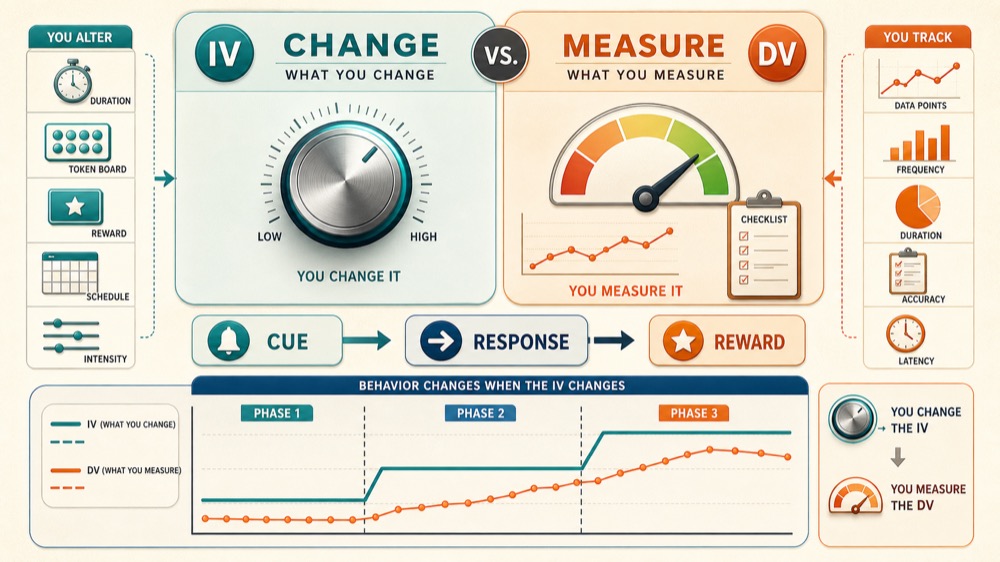
The 'Change vs. Measure' Rule: The simplest way to identify variables is the change vs. measure rule. The independent variable is what the researcher changes or manipulates. The dependent variable is what is measured as a result. For instance, in a token economy study, the IV might be the implementation of the token system (yes/no), and the DV could be the frequency of on-task behavior. This rule helps you quickly parse exam items, even when the phrasing is complex.
In ABA, the IV is often an independent variable that is under the practitioner’s control, such as a prompting strategy or reinforcement schedule. The DV is the behavior that is hypothesized to change. Remember, the DV is always the primary outcome you care about, and it should be socially significant. When graphing, the DV appears on the vertical axis, while the IV (or conditions) appear on the horizontal axis.
Common Confusions and How to Avoid Them: BCBA exam candidates often make mistakes when identifying variables. Here are the most common traps and how to avoid them:
- Confusing the DV with extraneous variables: The DV is the target behavior you measure, not a variable that might influence it incidentally (e.g., time of day). Focus on the behavior of interest.
- Misidentifying the IV in reversal designs: Some candidates think the IV is only present during B phases. Actually, the IV is the contrast between A and B conditions (e.g., baseline vs. treatment). The IV is not just ‘treatment’ but the presence/absence of the intervention.
- Overlooking operational definitions: If a scenario describes a behavior vaguely (e.g., ‘aggression’), you must use the operational definition given. The DV is the specific measure (e.g., ‘frequency of hitting per hour’).
- Assuming the IV is always a positive intervention: The IV can be a punishment condition, extraneous variable, or even a test condition in a functional analysis. Stay flexible.
ABA Examples of Independent and Dependent Variables
Working through real ABA scenarios solidifies your understanding. Below are three common examples that appear on the BCBA exam, complete with hypothesized functions and measurement details.
Example 1: DRA for Aggression: Scenario: A child with autism engages in aggression (hitting, biting) to escape from demands. The BCBA implements a differential reinforcement of alternative behavior (DRA) procedure: the child is taught to request a break using a picture card, and each request results in a 1-minute break from demands. The independent variable is the implementation of DRA (specifically, the delivery of reinforcement for alternative behavior). The dependent variable is the frequency of aggression per session. The hypothesized function is escape from demands. In this design, the DV measures whether aggression decreases as a function of the IV. Data are graphed as a line graph with frequency on the y-axis.
Example 2: Functional Analysis of Self-Injury: Scenario: A functional analysis (FA) is conducted for a 10-year-old who engages in head-banging. The FA includes four test conditions: alone, attention, demand, and tangible (plus a control play condition). The independent variable is the test condition (which specific environment is in effect). The dependent variable is the rate of self-injury (responses per minute). The hypothesized function is attention, as data show highest rates in the attention condition. The IV alternates across sessions using a multielement design, and the DV is measured continuously. Understanding this distinction is key for exam questions about FA interpretation.
Example 3: Token Economy in a Classroom: Scenario: A teacher implements a token economy to increase on-task behavior during math time. Students earn tokens for staying on task (defined as looking at the worksheet or writing) and exchange tokens for preferred activities. The independent variable is the token system (present vs. absent, using an ABAB design). The dependent variable is the percentage of on-task behavior measured via momentary time sampling. The hypothesized function is access to tangibles (preferred activities). The DV is the primary outcome tracked on a graph. Note that the token economy itself is the IV, while on-task behavior is the DV.
Exam Relevance: Why This Matters for the BCBA Test
The BCBA exam frequently tests your ability to identify independent and dependent variables in vignettes and graph interpretations. Questions may ask you to select the IV in a description, determine what the DV is based on operational definitions, or predict how changes in the IV affect the DV. To excel, you need to apply this knowledge under time pressure and avoid common pitfalls. For deeper study, consider how variables relate to internal validity—if the IV is not clearly defined, you cannot attribute changes in the DV to the intervention.
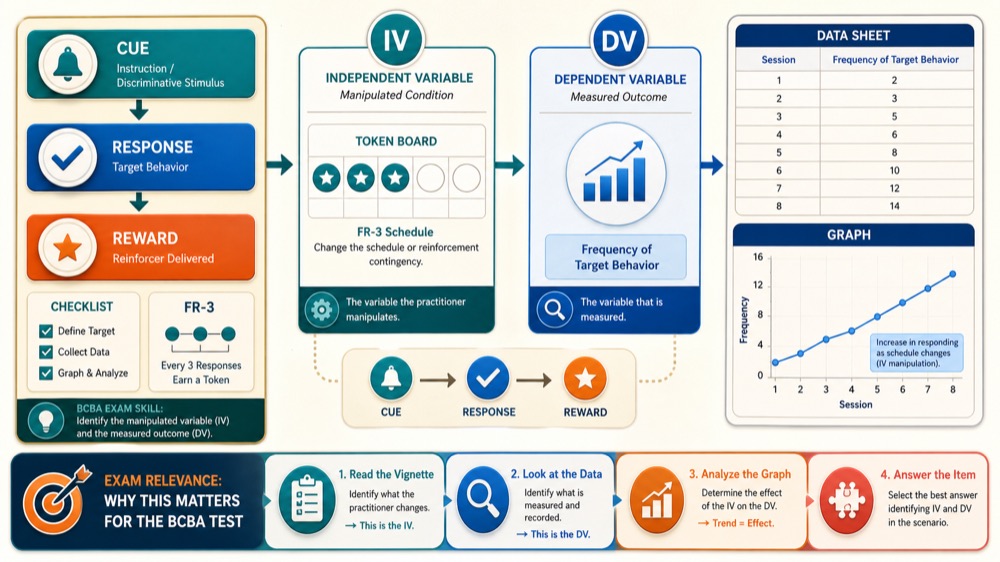
How the BCBA Exam Tests This Concept: Typical question formats include:
- Identifying variables in a description: A paragraph describes a study; you must pick the IV and DV from a list.
- Graph interpretation: You are shown a graph and asked which condition represents the IV or how the DV changed across phases.
- Experimental design questions: You must determine which variable is manipulated to demonstrate a functional relation.
Practicing with free BCBA mock exam questions can help you build fluency. Focus on scenarios that include baseline logic and replication. For more on experimental control, review the 7 dimensions of ABA to see how these variables fit into applied research.
Predicting Common Traps in Multiple-Choice Items: Exam writers often use the following traps to test your precision:
- Presenting the IV as a confound: The scenario mentions another variable that might affect the DV (e.g., medication). The correct IV is still the planned intervention, not the confound.
- Omitting operational definitions: If the behavior is not clearly defined, you must refer to the given definition. The DV is the measured dimension (e.g., count, duration).
- Using reversal designs with multiple DVs: Stay focused on the primary research question. The IV remains the same across conditions; the DVs are the different target behaviors.
Quick Checklist for Exam Day
Use this checklist when you encounter a question involving independent and dependent variables:
- Read the scenario carefully. Identify the research question and the behavior of interest.
- Ask: What is being manipulated? This is your independent variable. Look for words like ‘implemented,’ ‘provided,’ ‘condition A vs. B.’
- Ask: What is being measured? This is your dependent variable. It should be a specific, observable behavior.
- Check the operational definitions. The DV must be measurable; the IV must be replicable.
- Look for the graph. If present, the DV is on the y-axis; the phase change or condition label indicates the IV.
- Eliminate extraneous variables. Do not confuse the DV with factors like time of day or participant characteristics.
- Match your answer to the question format. Some questions ask for the ‘intervention’ (IV) or ‘target behavior’ (DV).
Summary and Key Takeaways
Mastering the independent variable and dependent variable example is essential for BCBA exam success. Remember: the IV is the intervention you manipulate; the DV is the behavior you measure. Use the ‘change vs. measure’ rule to quickly identify each in exam scenarios. Practice with real ABA examples, such as DRA, functional analysis, and token economies, to build fluency. Avoid common traps by focusing on operational definitions and not confusing DVs with extraneous variables. For more structured prep, try our BCBA exam prep guide to reinforce these concepts through mock exams. With consistent practice, you’ll confidently tackle any variable identification question on the test.
Additional resource: For authoritative guidelines on experimental design, refer to the BACB’s Behavior Analyst Certification Board website.



