
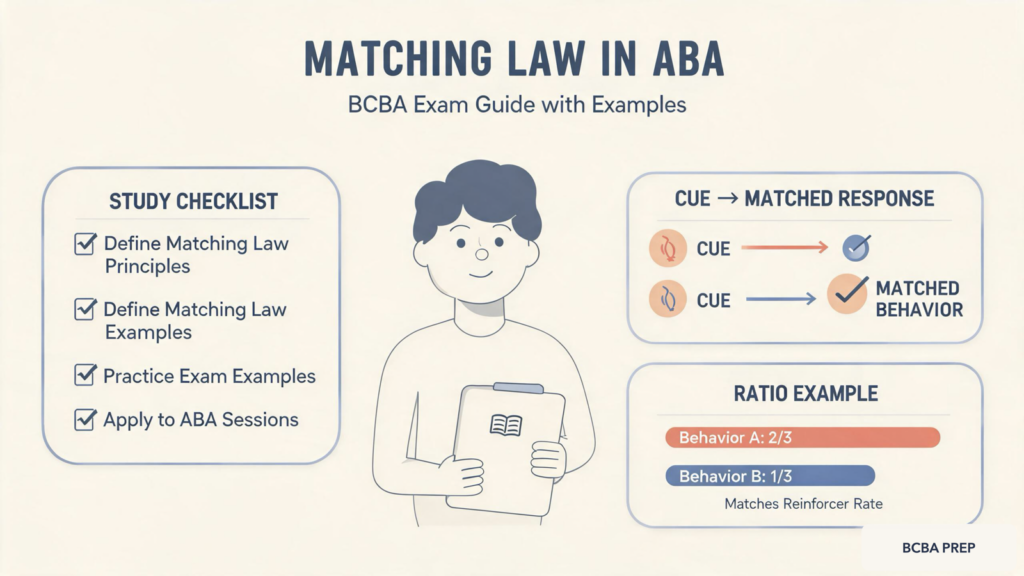
Understanding the Matching Law in Behavior Analysis
The matching law is a principle from the experimental analysis of behavior that describes how organisms allocate their behavior among multiple concurrently available options. In simple terms, it states that the proportion of responses directed toward a given alternative matches the proportion of reinforcement obtained from that alternative. This concept is central to understanding choice behavior and is frequently tested on the BCBA exam.
Table of Contents
- Understanding the Matching Law in Behavior Analysis
- Matching Law in Action: ABA Worked Examples
- Exam Relevance and Common Traps
- Quick Reference Checklist for the Matching Law
- Summary: Why the Matching Law Matters for BCBAs
At its core, the matching law provides a mathematical framework for predicting how an individual will distribute their time and effort when faced with two or more choices. It was first systematically described by Richard Herrnstein in 1961 and has since been widely applied in applied behavior analysis.
The Formula: Proportional Matching
The classic matching law formula is expressed as: B1 / (B1 + B2) = R1 / (R1 + R2), where B1 and B2 are the rates of responding on two alternatives, and R1 and R2 are the rates of reinforcement obtained from those alternatives. Put simply, the proportion of responses to choice 1 equals the proportion of reinforcement earned from choice 1 relative to total reinforcement from both choices.
For example, imagine a pigeon in a Skinner box with two keys. If pecking the left key produces food 60% of the time and the right key produces food 40% of the time, the matching law predicts that the pigeon will emit approximately 60% of its pecks on the left key and 40% on the right. This proportional relationship holds across many species and settings, including human behavior in clinical and educational contexts.
Matching Law in Action: ABA Worked Examples
Applying the matching law to real-world ABA scenarios helps solidify your understanding and prepares you for scenario-based exam questions. Below are three detailed examples illustrating how the matching law operates in common intervention contexts.
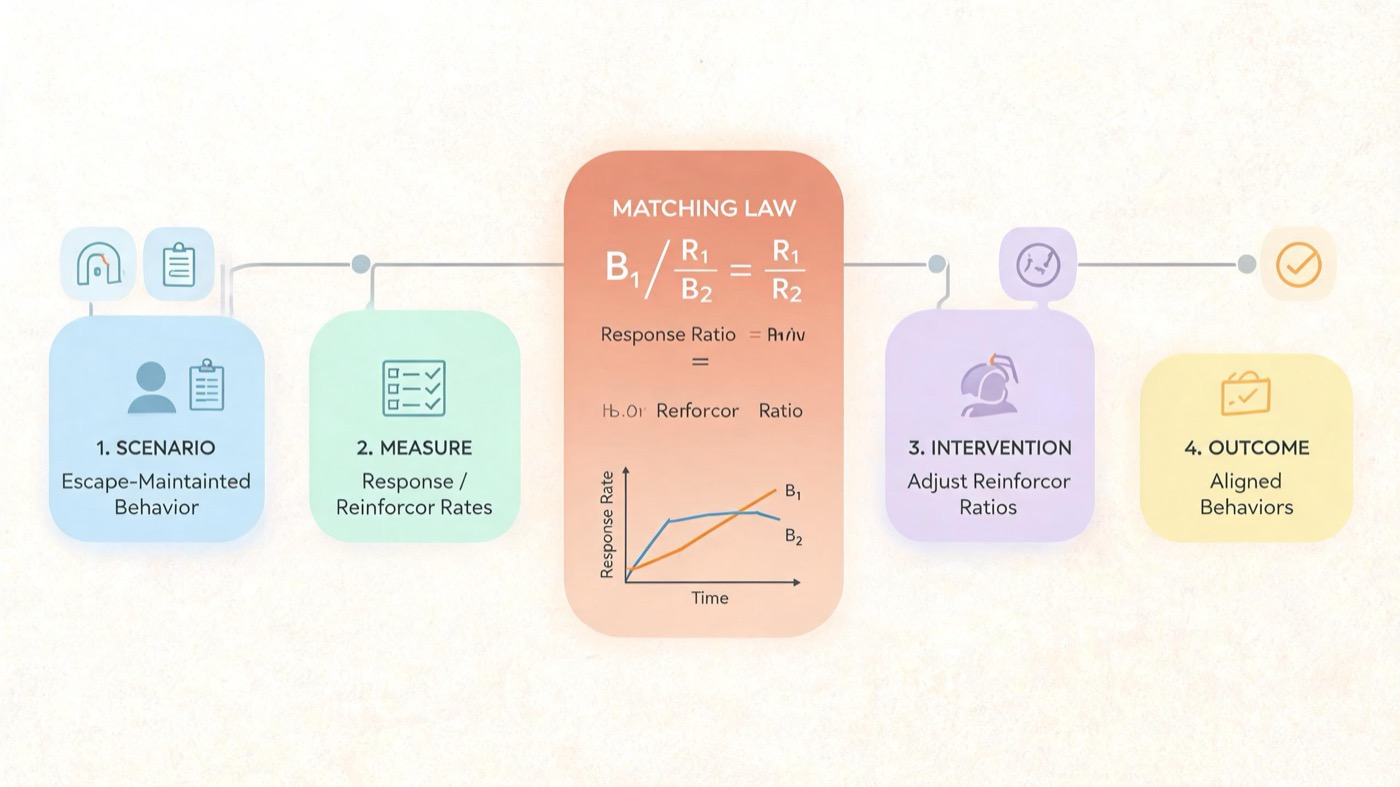
Example 1: Classroom Behavior with Escape-Maintained Behavior
A student with escape-maintained problem behavior is given two independent work tasks during a math period. Task A is a difficult long-division worksheet, and Task B is a simpler single-digit addition sheet. The student engages in disruptive behavior (e.g., tantrum) to escape Task A but not Task B. Over a 30-minute observation, the teacher records that the student completes 10 problems on Task A and 40 problems on Task B, while receiving escape from Task A after each disruptive episode (5 times) and no escape from Task B (0 times).
Applying the matching law: total responses = 50; proportion of responses on Task B = 40/50 = 0.8. Total reinforcement (escape) episodes = 5; proportion of reinforcement from Task A = 5/5 = 1. The student’s behavior does not perfectly match due to other variables (e.g., rate of reinforcement per response differs), but the pattern shows a strong preference for Task B where no aversive demands are present. This example highlights the importance of analyzing both response allocation and reinforcement rates across alternatives.
Example 2: Self-Injurious Behavior (SIB) with Access to Tangibles
A young child engages in self-injurious behavior (head-hitting) that is maintained by access to preferred tangibles (iPad time) and adult attention. During a functional analysis, the therapist provides two concurrent options: Option 1 yields access to the iPad for 1 minute every 10 seconds of no SIB (dense schedule), and Option 2 yields therapist attention for 1 minute every 30 seconds of no SIB (lean schedule). Over a 20-minute session, the child exhibits SIB 12 times. The therapist calculates that the child receives iPad access 8 times and attention 4 times. Total reinforcements = 12; proportion for iPad = 8/12 = 0.67. Total responses (SIB episodes) = 12; proportion of SIB during Option 1 periods = 0.67 (8 SIB episodes occurred when iPad was available). This close match suggests that the child’s SIB is more strongly influenced by the denser schedule of tangible reinforcement, consistent with the matching law.
Example 3: Choice Between Social and Edible Reinforcers in DTT
During discrete trial training (DTT), a learner with autism is offered a choice between social praise (‘Great job!’) and a small edible (a goldfish cracker) as a consequence for correct responses. Data over 50 trials show that the learner selects the edible 40 times and social praise 10 times. The therapist delivers the edible immediately after each selection (fixed ratio 1) and social praise similarly. However, the edible reinforcer is more potent (higher quality), leading to a higher rate of reinforcement. The proportion of edible selections = 40/50 = 0.8. The proportion of edible reinforcements relative to total reinforcers = 40/50 = 0.8. Here, the matching is nearly perfect. This example illustrates how the quality of reinforcement affects response allocation, a key implication for reinforcer assessment and intervention design.
Exam Relevance and Common Traps
The BCBA exam tests your ability to identify, calculate, and apply the matching law in various formats. Understanding the concept is one thing; avoiding common pitfalls is another.
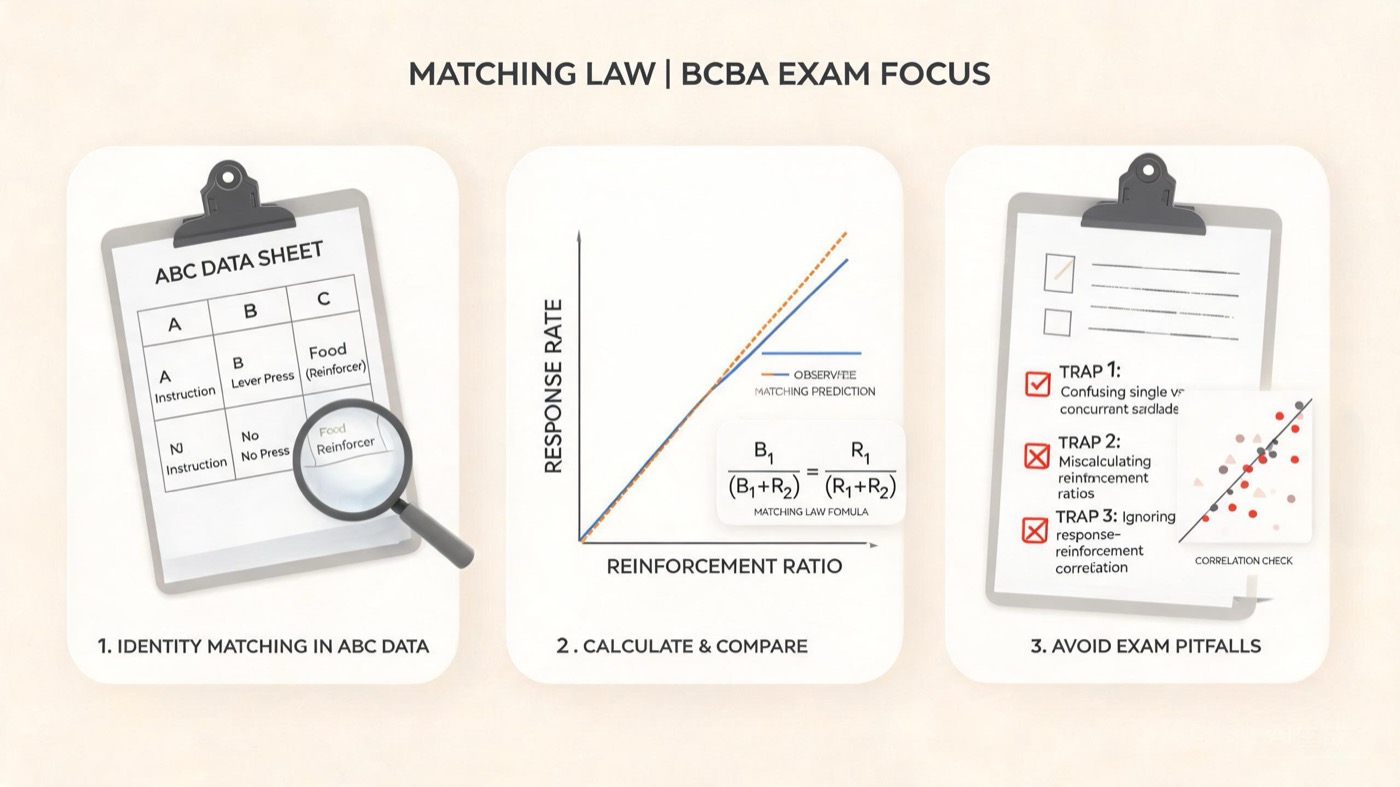
How the BCBA Exam Tests the Matching Law
You may encounter questions that require you to:
- Calculate proportions from given rates of responding and reinforcement and determine whether behavior matches the law.
- Identify a matching pattern from a graph or data set and explain the relationship between response allocation and reinforcement distribution.
- Compare the matching law to behavioral contrast, a related but distinct concept (i.e., contrast involves a change in reinforcement schedule in one context affecting behavior in another, whereas matching describes concurrent allocation).
- Apply the matching law to clinical decisions, such as selecting which intervention to implement when a client engages in multiple problem behaviors maintained by different reinforcers.
Pitfalls to Avoid
Common mistakes students make on exam questions include:
- Confusing matching with behavioral contrast: Remember that matching is about concurrent schedules, while contrast occurs across successive contexts or components (e.g., multiple schedule phases).
- Misapplying the formula: Ensure you use the correct proportions (responses vs. reinforcement) and do not invert numerator and denominator. Practice with mock data.
- Forgetting schedule of reinforcement effects: The matching law generally holds for ratio schedules but may deviate with interval schedules (often producing undermatching or overmatching due to changed reinforcement rates).
- Ignoring other variables: The matching law is a simplified model; actual behavior can be influenced by preference, effort, delay, and competing contingencies. Always consider the broader context.
Quick Reference Checklist for the Matching Law
Use this checklist as a last-minute review before your exam:
- Recall the matching law formula: B1/(B1+B2) = R1/(R1+R2).
- Identify the two concurrently available choices and their respective reinforcement schedules.
- Calculate the proportion of responses for each alternative.
- Calculate the proportion of reinforcement obtained from each alternative.
- Compare the two proportions: if they are approximately equal, behavior matches the law.
- Distinguish matching from behavioral contrast (contrast involves a change across components).
- Consider schedule type: ratio schedules typically produce closer matching than interval schedules.
- Apply to clinical scenarios: When a client allocates more behavior to one problematic response, ask whether that response produces a larger proportion of reinforcement.
Summary: Why the Matching Law Matters for BCBAs
The matching law is not just a theoretical concept; it has direct implications for assessment and intervention. By understanding how a client distributes their behavior across different response options relative to reinforcement, BCBAs can design more effective treatments. For example, if a child’s aggression is maintained by attention and they also request attention appropriately, the matching law suggests that increasing the rate of reinforcement for appropriate requests (while keeping attention for aggression constant) will shift response allocation toward the appropriate behavior. The matching law provides a quantitative framework for predicting such shifts and measuring treatment effects.
To further explore this topic and practice with exam-style questions, check out our comprehensive BCBA exam prep guide and our mock exam resources. For additional reading, see the original work by Herrnstein (1961) and the BACB’s Task List (6th ed.) for related content on concurrent schedules and matching.
Complete BCBA Exam Prep
Turn this topic into exam-day practice
Practice concepts in context with five full-length 6th Edition mock exams, two bonus practice exams, a 6th Edition study guide, and key-term flashcards—all in one $120 USD package.
Get the $120 All-in-One Prep Pack
Review everything included on the product page before ordering. No pass guarantee is implied.



