
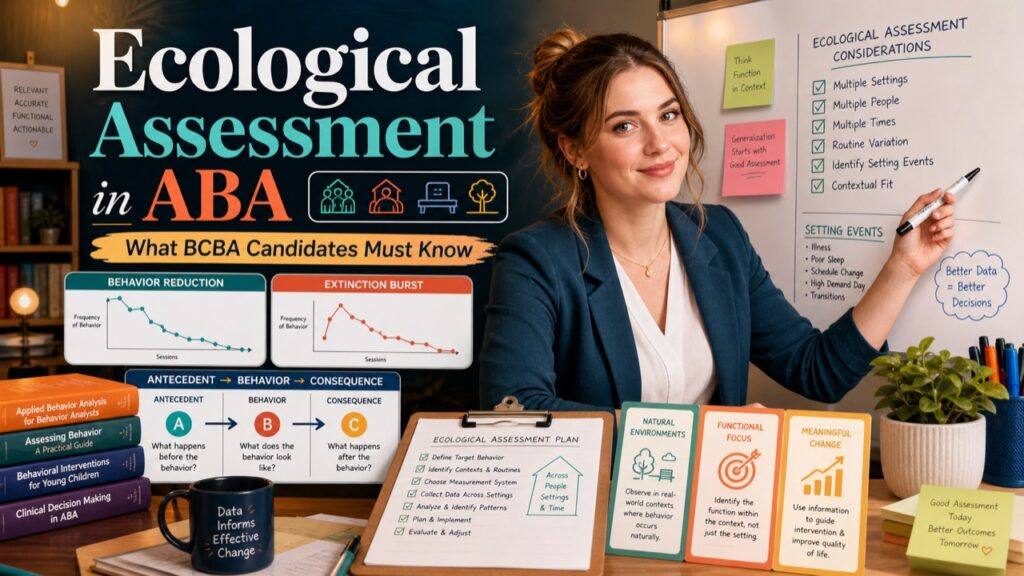
What Is Ecological Assessment in Applied Behavior Analysis?
An ecological assessment is a systematic process used in applied behavior analysis to evaluate how environmental variables influence behavior. Unlike a traditional functional behavior assessment that focuses on identifying the function of a behavior, an ecological assessment examines the broader context including physical surroundings, social interactions, routines, and other setting events. The goal is to identify environmental modifications that can prevent problem behavior or promote skill acquisition. This approach is grounded in the understanding that behavior is influenced by multiple interacting factors, not just consequences.
Table of Contents
- What Is Ecological Assessment in Applied Behavior Analysis?
- The Ecological Assessment Process: A Step-by-Step Guide
- Real-World ABA Examples of Ecological Assessment
- Why Ecological Assessment Matters for the BCBA Exam
- Summary: Integrating Ecological Assessment into Your ABA Practice
Key Components of an Ecological Assessment: A thorough ecological assessment includes several core components. The physical environment is assessed for factors like lighting, noise, seating arrangements, and access to materials. The social environment examines peer and adult interactions, communication styles, and social contingencies. Routines and schedules are analyzed for predictability, transitions, and timing. Also evaluated are contextual variables such as health status, medication effects, sleep patterns, and recent life events. Each component provides a piece of the puzzle for understanding why a behavior occurs in certain settings.
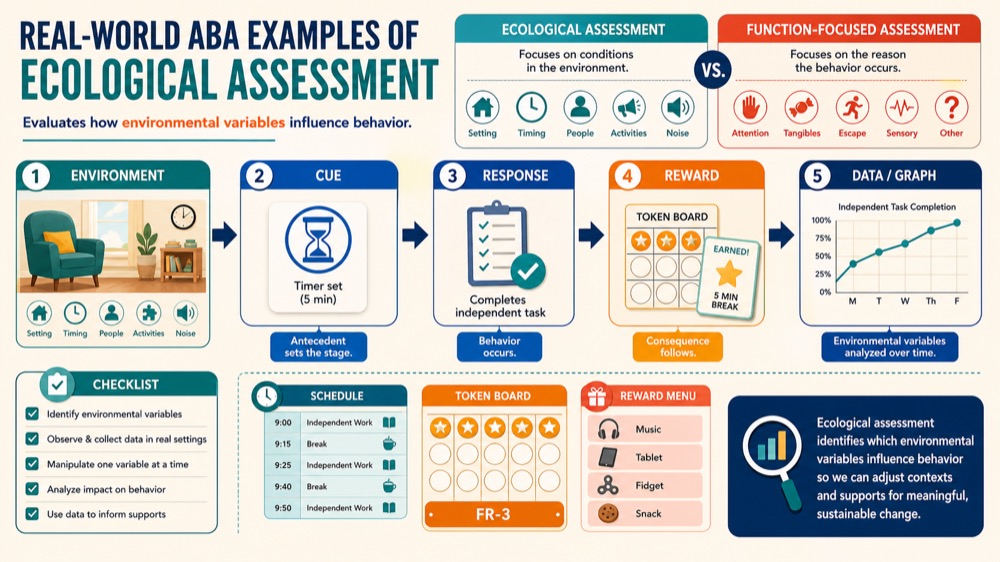
How Ecological Assessment Differs from FBA: While both ecological assessment and functional behavior assessment (FBA) are essential tools, they have distinct focuses. An FBA aims to determine the function of a behavior (e.g., escape, attention, access to tangibles, automatic reinforcement) through methods like interviews, direct observation, and functional analysis. In contrast, an ecological assessment looks at the environmental conditions that set the stage for behavior. The table below summarizes key differences.
- Purpose: Ecological assessment identifies environmental deficits and excesses; FBA identifies behavior functions.
- Methods: Ecological assessment uses environmental checklists, ecological inventories, and setting analysis; FBA uses ABC data, functional analysis, and preference assessments.
- Outcome: Ecological assessment leads to environmental modifications; FBA leads to function-based interventions.
- When to use: Ecological assessment is often used early in assessment or when behavior occurs across multiple settings; FBA is used when problem behavior is severe or persistent.
Both approaches complement each other. For BCBA exam questions, you may need to choose which assessment to recommend based on the scenario. If the problem seems related to environmental triggers, lean toward ecological assessment; if the behavior serves a clear function, an FBA is appropriate.
The Ecological Assessment Process: A Step-by-Step Guide
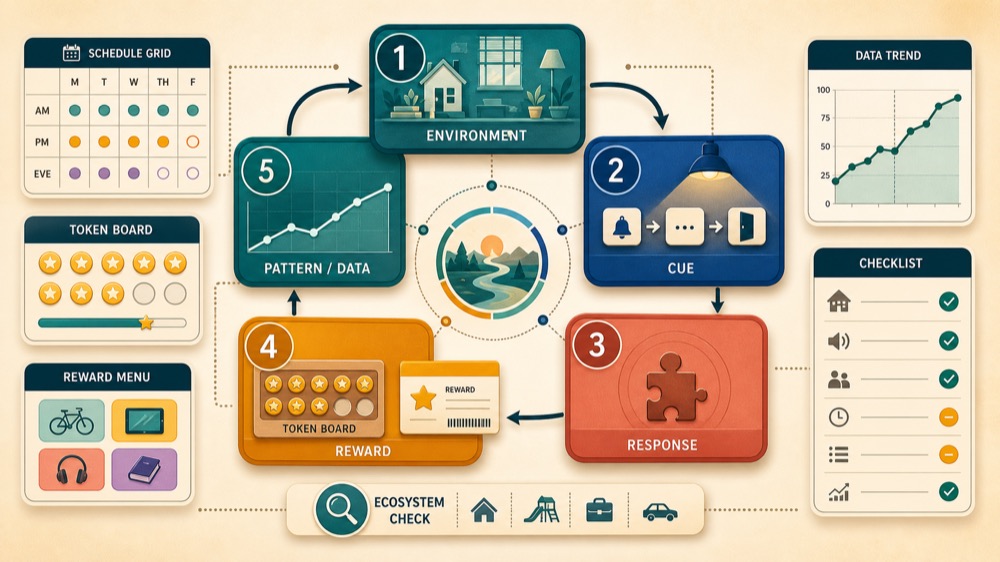
Step 1: Identify Environmental Variables: The first step involves gathering data on potential environmental influences. Direct observation is conducted across different times and settings to capture natural conditions. Interviews with caregivers, teachers, and the individual help identify patterns. Standardized checklists like the Ecological Assessment Form can guide data collection. Key variables include setting events (e.g., hunger, lack of sleep), antecedents (e.g., instructions, demands), and consequences (e.g., attention, escape). This step sets the foundation for analysis.
Step 2: Analyze the Data and Form Hypotheses: Once data is collected, the BCBA analyzes patterns to develop hypotheses about how environmental modifications could improve behavior. For example, if a child engages in tantrums during transitions, the hypothesis might be that unpredictable schedule changes function as a setting event for escape-maintained behavior. The analyst then predicts what environmental changes (e.g., visual schedule, transition warnings) would reduce problem behavior. Hypotheses should be specific and testable, linking environmental variables to behavioral outcomes.
Step 3: Implement and Monitor Environmental Changes: The final stage involves collaborating with stakeholders to implement changes and monitor results. Modifications might include rearranging furniture, adjusting task difficulty, providing choice, or changing staff assignments. Data on the target behavior is collected to evaluate effectiveness. If the behavior improves, the changes are maintained; if not, the hypothesis is revised and new modifications tried. This iterative process ensures that interventions are evidence-based and contextually appropriate.
Real-World ABA Examples of Ecological Assessment
Example 1: Disruptions During Circle Time in a Classroom: A teacher reports that a kindergarten student calls out during circle time. An ecological assessment reveals the seating area is cramped, noise levels are high, and the activity lasts too long. The hypothesis is that the behavior is maintained by escape from overstimulation. Environmental modifications include reducing group size, providing a visual schedule, and incorporating movement breaks. After changes, calling out decreases by 80%.
Example 2: Aggression in a Group Home Setting: An adult with intellectual disabilities hits staff when asked to complete chores. The ecological assessment shows inconsistent daily routines, fluctuating staff assignments, and high demand periods. The hypothesis is that aggression is maintained by attention from staff due to unpredictable schedules. Modifications include creating a structured routine with consistent staff, adding choice to chores, and providing regular positive attention. Aggression drops significantly over three weeks.
Example 3: Task Refusal During One-on-One Tutoring: A child refuses to complete worksheets during tutoring sessions. The ecological assessment identifies the room temperature is too hot and the task difficulty exceeds the child’s skill level. The hypothesis is that the behavior is maintained by avoidance of demanding tasks in an uncomfortable setting. Adjustments include lowering the room temperature, providing easier worksheets, and using a token system. Task compliance improves from 30% to 90%.
Why Ecological Assessment Matters for the BCBA Exam
The BCBA exam tests your ability to select and justify assessment methods. Understanding ecological assessment helps you answer questions about environmental modifications and when to conduct a broader assessment versus a functional analysis. Many candidates confuse ecological assessment with FBA, so mastering the distinction is critical for high scores.
Common Exam Traps: Avoid these pitfalls that trip up exam takers:
- Confusing ecological assessment with FBA: Remember that FBA targets behavior function; ecological assessment targets environmental variables.
- Forgetting setting events: Ecological assessment includes setting events like medication, sleep, and hunger that may not be captured in a standard ABC analysis.
- Overlooking maintenance variables: After initial behavior change, ecological assessment can identify variables that support long-term maintenance.
- Assuming one assessment fits all: Each behavior problem requires a tailored assessment strategy. Ecological assessment is not always the answer; it is one tool in your toolbox.
Quick Checklist for BCBA Candidates: Use this checklist to solidify your understanding before the exam:
- Define ecological assessment in one sentence.
- Identify three key components (physical, social, routines).
- Differentiate from FBA based on purpose and outcomes.
- List two environmental modifications you might recommend.
- Describe a scenario where ecological assessment would be more appropriate than FBA.
- Give an example of a setting event that could be identified through ecological assessment.
For more exam prep resources, check out our BCBA exam prep guide and practice with free BCBA mock exam questions to reinforce these concepts.
Summary: Integrating Ecological Assessment into Your ABA Practice
Ecological assessment is a vital component of comprehensive ABA practice. It helps practitioners identify and modify environmental variables to prevent problem behavior and enhance skill development. For BCBA candidates, mastering this assessment method can improve clinical decision-making and exam performance. Key takeaways: understand the components, differentiate from FBA, apply the step-by-step process, and avoid common traps. By integrating ecological assessment into your repertoire, you become a more effective and ethical behavior analyst.
To deepen your knowledge, refer to the BACB Task List and ethical guidelines, which emphasize the importance of environmental analysis. Combine ecological assessment with other methods like preference assessments and functional analysis to create robust intervention plans. Your clients and your exam scores will benefit from this holistic approach.
How to Study ecological assessment for BCBA-Style Questions
When you review ecological assessment, do not stop at the definition. The exam usually tests whether you can apply the concept inside a short scenario, separate it from similar terms, and choose the most behaviorally precise answer. A strong study routine should connect the term to observable behavior, environmental context, measurement, and likely consequences.
- Define the response: identify exactly what the learner or client does, not just the broad skill area.
- Find the context: note the antecedent, setting, materials, people, or condition that makes the concept relevant.
- Check the consequence: ask what changes after the response and whether that change supports the answer choice.
- Compare close terms: write one sentence explaining why the best answer is not a related but different ABA concept.
For practice, turn each example into a quick discrimination exercise. Ask, “What would make this answer wrong?” and then change one detail in the scenario. This builds flexible exam reasoning instead of memorizing a single phrase.



