
What Are Independent and Dependent Variables?
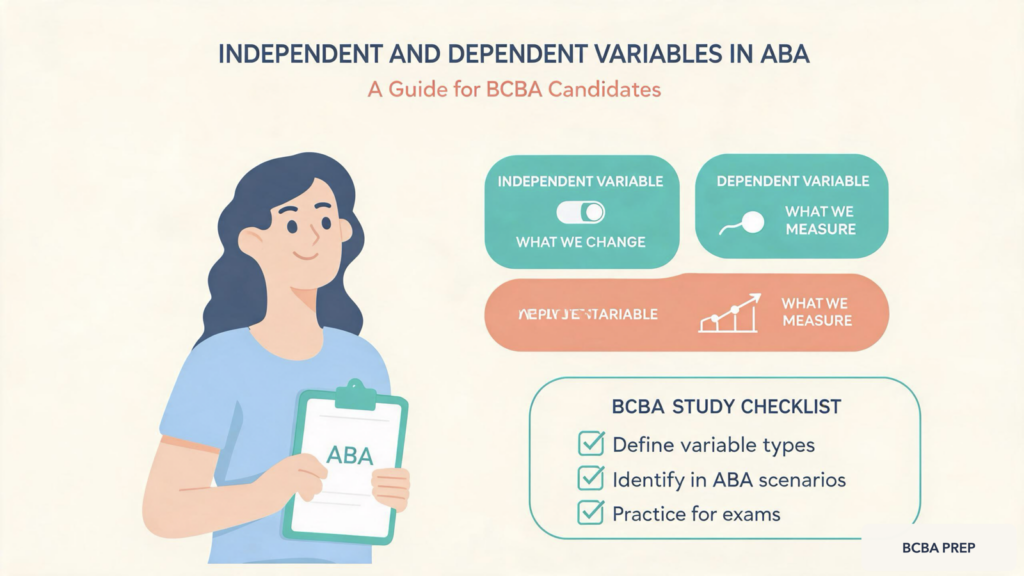
If you are preparing for the BCBA exam, you must master the independent and dependent variables concepts. These terms form the backbone of experimental design in applied behavior analysis (ABA). Simply put, the independent variable is what you manipulate, and the dependent variable is what you measure.
Table of Contents
- What Are Independent and Dependent Variables?
- How Independent and Dependent Variables Apply to ABA
- BCBA Exam Examples: Using the ABC Model
- Why This Matters for the BCBA Exam: Common Traps to Avoid
- Quick Checklist for Identifying IV and DV
- Summary: Independent and Dependent Variables in ABA
In ABA, every intervention you design is an independent variable. The behavior you track—like frequency of tantrums or duration of on-task behavior—is the dependent variable. Understanding this distinction is critical for interpreting research and for designing your own behavior-change programs.
Independent Variable (IV) Definition
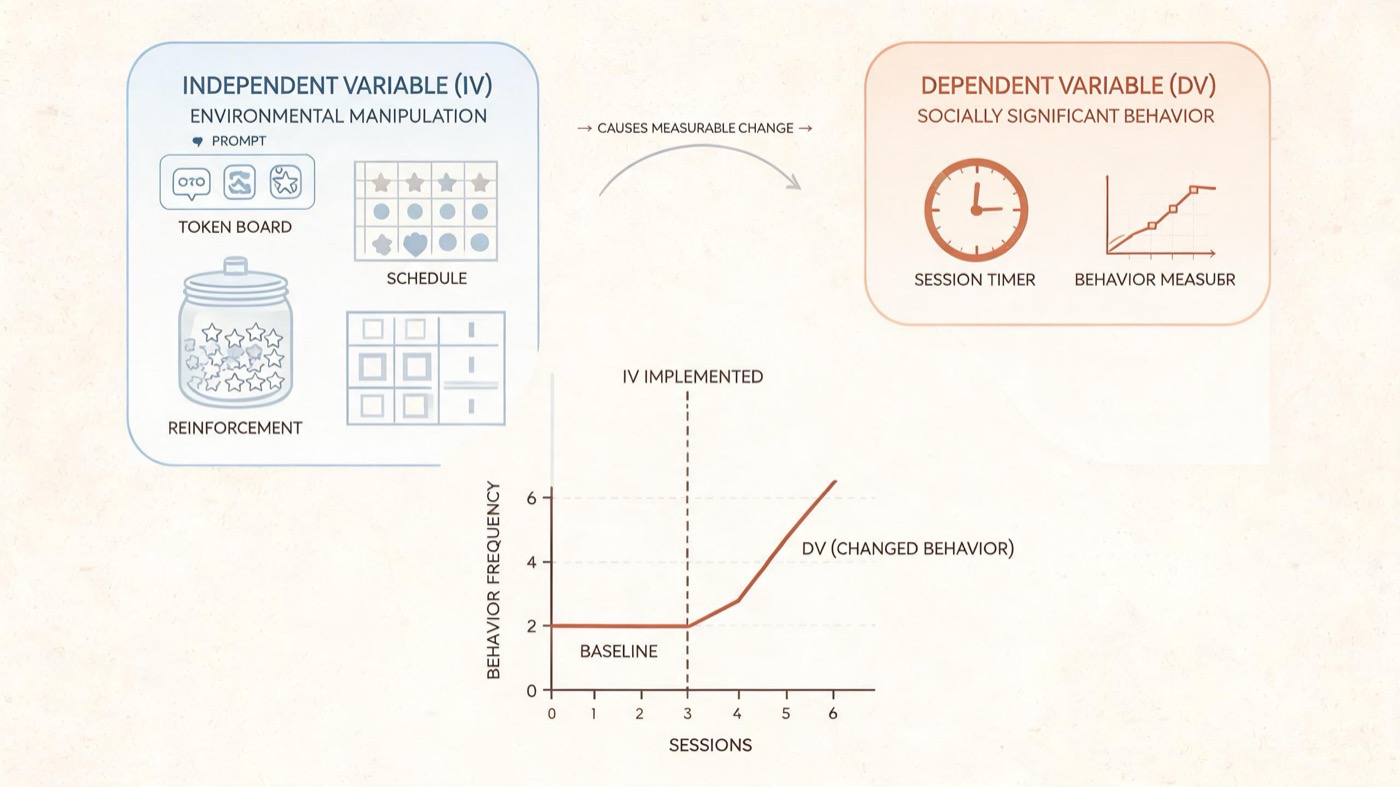
The independent variable is the intervention or treatment that the researcher controls. In ABA, this could be a token economy, a prompting procedure, or a differential reinforcement schedule. The IV is the cause in the cause-effect relationship.
Dependent Variable (DV) Definition
The dependent variable is the behavior of interest that is measured. It must be operationally defined so it can be observed and recorded reliably. Examples include percentage of correct responses, number of aggressive acts, or latency to follow an instruction.
How Independent and Dependent Variables Apply to ABA
In applied behavior analysis, the IV-DV relationship is central to single-subject research designs. The IV is always the environmental manipulation, and the DV is a socially significant behavior. Here’s how they work together:
- IV as intervention: Examples include antecedent manipulations (e.g., picture schedules) or consequence manipulations (e.g., token reinforcement). The IV is what you change to influence behavior.
- DV as target behavior: The DV is the measurable behavior you aim to improve. It must be defined clearly—for instance, “aggression” is operationally defined as hitting, kicking, or biting others.
- Experimental control: Systematically manipulating the IV while measuring the DV allows you to demonstrate a functional relation. Without a clear IV and DV, you cannot claim that your intervention caused the behavior change.
- Internal validity: Proper identification of the IV and DV helps rule out extraneous variables. For example, if you implement a token system (IV) and see a decrease in out-of-seat behavior (DV), you want to be confident that the token system—not something else—produced the effect.
BCBA Exam Examples: Using the ABC Model
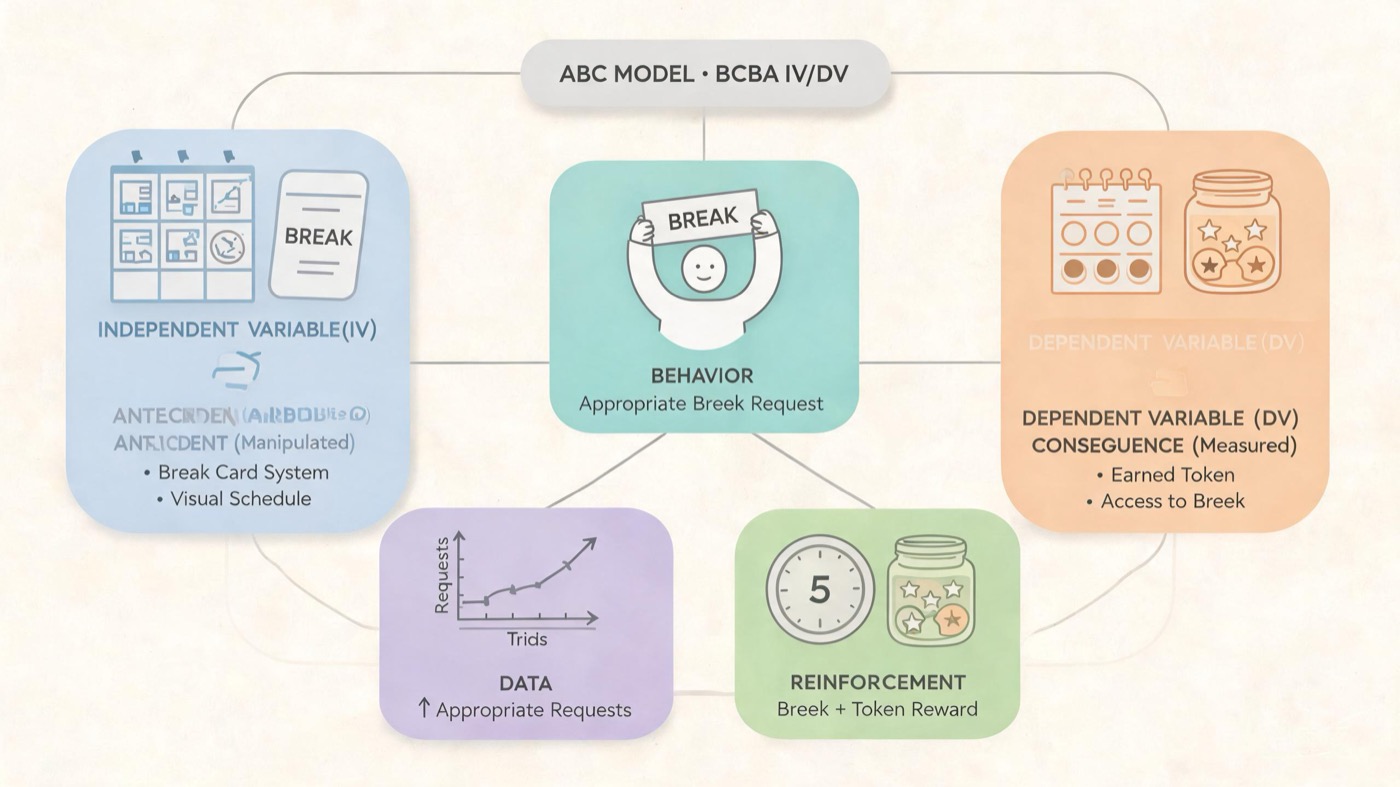
Exam questions often ask you to identify the independent variable or dependent variable in a scenario. Practice with these realistic examples built around the ABC (antecedent-behavior-consequence) model.
Example 1: Reducing Aggression
A BCBA implements a break card plus differential reinforcement for appropriate requests. The target behavior is aggression (hitting, kicking). The hypothesized function is escape from demands.
- IV: Break card + differential reinforcement (intervention)
- DV: Frequency of aggressive acts per session
Example 2: Increasing Compliance
The BCBA uses a high-probability request sequence before giving a low-probability instruction. The target behavior is compliance within 5 seconds. The hypothesized function is attention.
- IV: High-p request sequence
- DV: Percentage of compliance with low-p requests
Example 3: Decreasing Out-of-Seat Behavior
A token economy with response cost is introduced. The target behavior is out-of-seat instances. The hypothesized function is sensory/automatic reinforcement.
- IV: Token economy + response cost
- DV: Number of out-of-seat episodes per hour
Example 4: Increasing Manding (Requesting)
A BCBA uses incidental teaching to increase mands (requests) in a child with autism. The hypothesized function is access to preferred items.
- IV: Incidental teaching procedure
- DV: Frequency of independent mands per session
Why This Matters for the BCBA Exam: Common Traps to Avoid
The BCBA exam tests your ability to distinguish between independent and dependent variables in research descriptions. Many candidates fall into predictable traps. Watch out for these:
Trap 1: Confusing the IV with Extraneous Variables
An extraneous variable is anything other than the IV that could affect the DV. For example, if a student receives tutoring outside of school, that tutoring is an extraneous variable, not the IV. The IV is the intervention you purposely manipulate. Avoid labeling uncontrolled events as the IV.
Trap 2: Misidentifying the DV
The DV must be the directly measured behavior, not a global outcome. For instance, “academic success” is not a good DV; “number of correct math problems” is. On the exam, if the DV is described as “social skills,” look for the specific operational definition—like “frequency of initiations during recess.”
Trap 3: Forgetting the DV Must Be Measurable
The DV must be something you can count, time, or record. If a question says the DV is “happiness,” it is likely wrong—happiness is not directly measurable in ABA. Instead, the BCBA might measure “smiling frequency” or “engagement duration.”
Quick Checklist for Identifying IV and DV
When you encounter a BCBA exam scenario, use this checklist to correctly identify the variables:
- Look for manipulation: What is the BCBA actively changing? That’s the IV.
- Look for measurement: What behavior is being tracked? That’s the DV.
- Ensure the DV is operational: Can the behavior be observed and recorded? If not, it’s not a proper DV.
- Check for control: Is the IV systematically applied? If not, it might be a confound.
- Differentiate from extraneous: Is the variable part of the design or an uncontrolled factor? Only the manipulated variable is the IV.
Summary: Independent and Dependent Variables in ABA
Understanding independent and dependent variables is essential for passing the BCBA exam and for effective practice. The IV is the intervention you control; the DV is the behavior you measure. Use the ABC model to practice identifying them in exam scenarios, and avoid common traps like confusing the IV with extraneous variables or misidentifying the DV. For more study tips, check out our BCBA exam prep guide. Also review the BACB website for official guidelines. Keep this guide handy as you prepare, and you will master this foundational concept.



