
Defining Independent and Dependent Variables
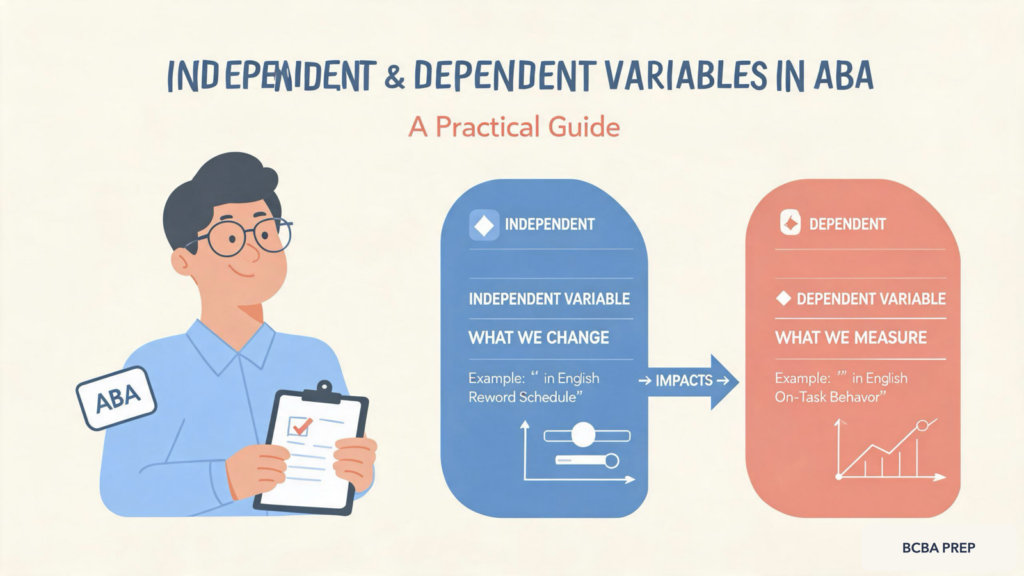
In applied behavior analysis, understanding the relationship between an intervention and a behavior change is fundamental. The independent and dependent variables form the backbone of every ABA experiment. The independent variable (IV) is what the experimenter manipulates, while the dependent variable (DV) is the behavior that is measured to see if it changes as a result of the IV.
Table of Contents
- Defining Independent and Dependent Variables
- Independent vs Dependent Variable in ABA: Key Differences
- ABA Examples of Independent and Dependent Variables
- Common BCBA Exam Traps for Variable Identification
- Quick Checklist: How to Identify Variables in Any Scenario
- Final Summary
On the BCBA exam, you will frequently be asked to identify these variables in a scenario. Let us break them down clearly.
What Is an Independent Variable? (IV)
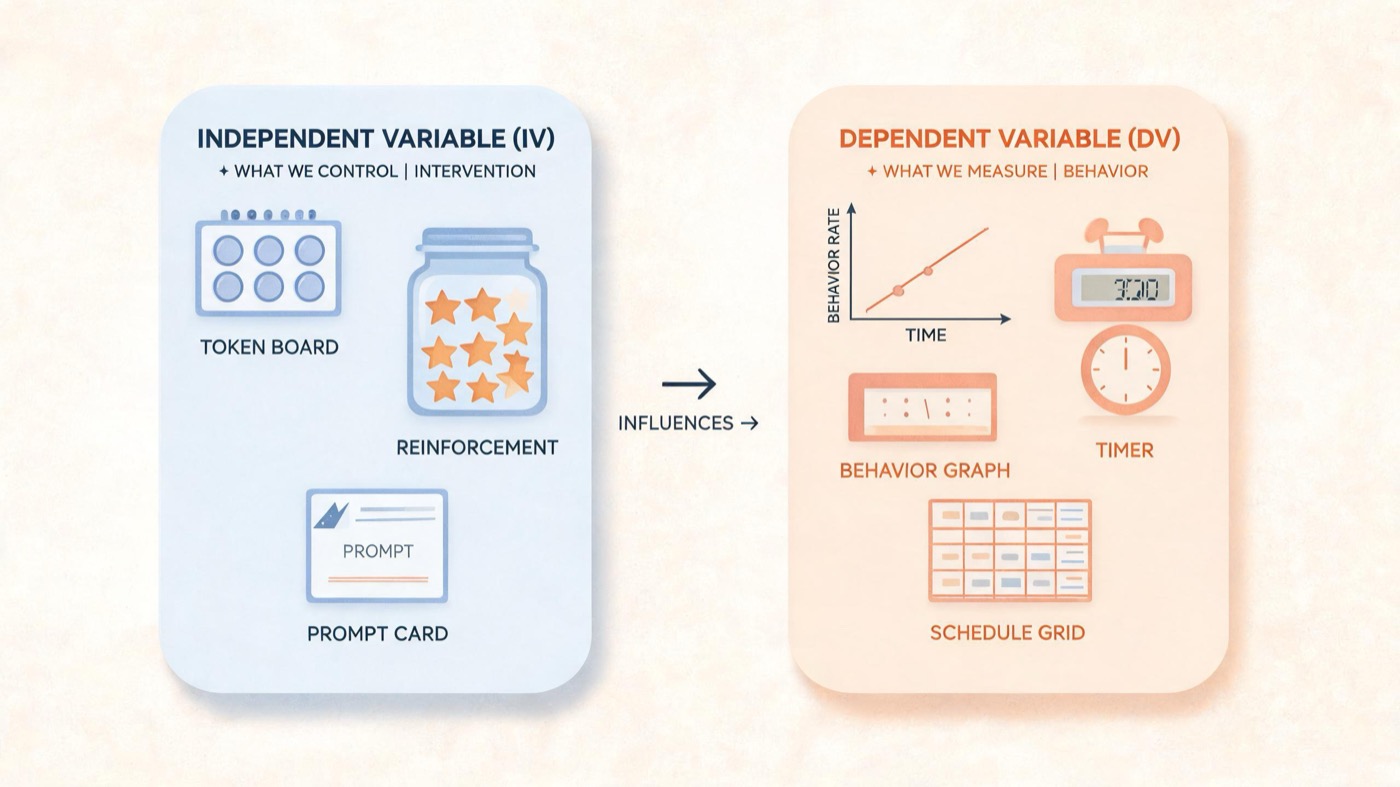
The independent variable is the component of the environment that is systematically altered by the practitioner. In ABA, this is almost always the intervention, treatment, or condition being tested. The IV is independent because it is not affected by other variables in the study; rather, it is the presumed cause. For example, if you implement a token economy to increase on-task behavior, the token delivery schedule is the IV.
What Is a Dependent Variable? (DV)
The dependent variable is the target behavior that is measured to evaluate the effect of the IV. It is called dependent because its value depends on the IV. In the token economy example, the percentage of intervals with on-task behavior is the DV. The DV must be operationally defined so that it can be observed and measured reliably. For instance, operational definitions specify exactly what counts as on-task (e.g., eyes on materials, writing, raising hand).
Independent vs Dependent Variable in ABA: Key Differences
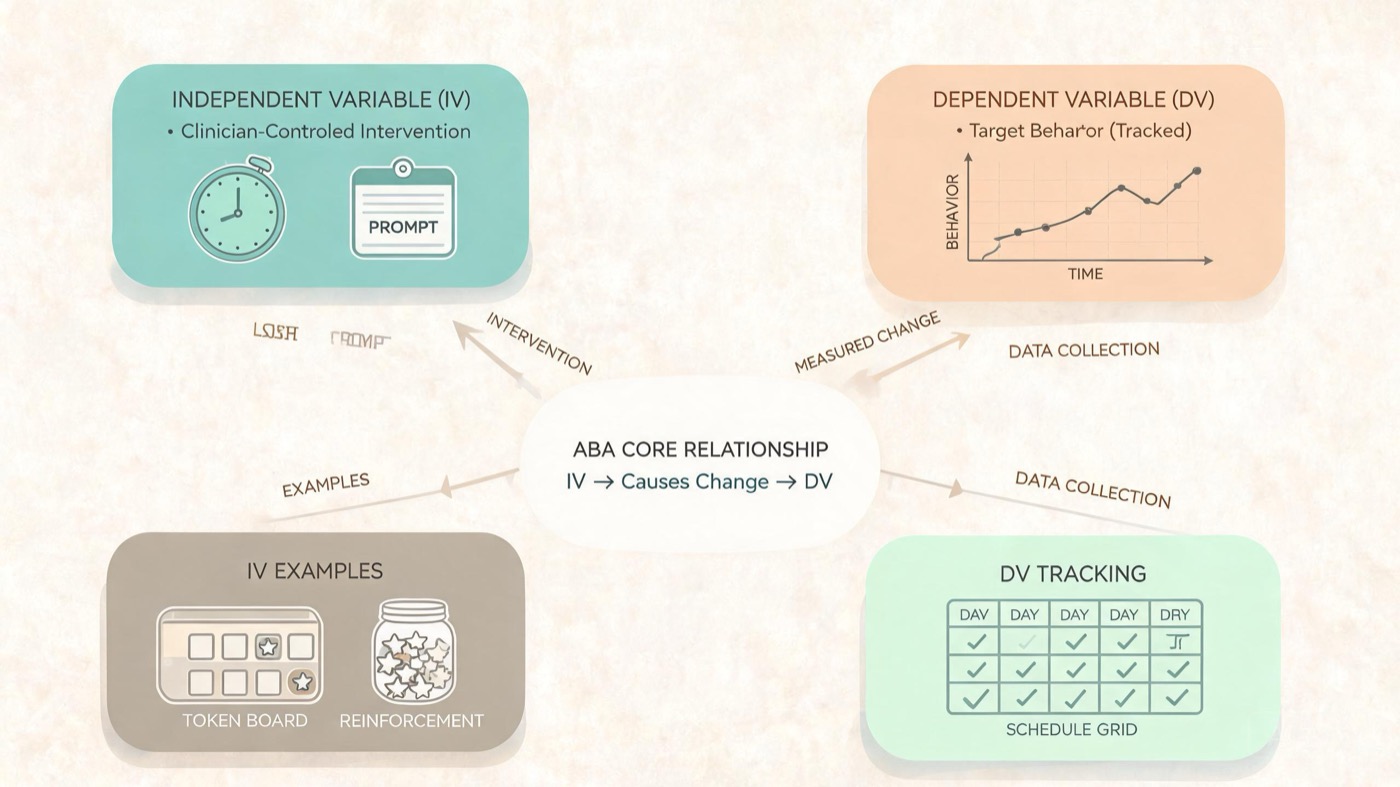
The core difference is that the IV is manipulated, while the DV is measured. The IV is the cause; the DV is the effect. In ABA, experimental control is demonstrated when changes in the DV are functionally related to changes in the IV. This is typically shown through a functional relationship in single-subject designs.
Operational Definitions: How to Define Variables Clearly
Both IV and DV must be defined operationally. An operational definition describes a variable in terms of the specific procedures used to measure or manipulate it. For example, the IV of a DRA procedure might be defined as delivering praise and a preferred item when the client requests appropriately, while withholding reinforcement for aggression. The DV, aggression, might be defined as hitting, kicking, or biting. Without clear definitions, replication and data analysis become impossible.
Confounding Variables: What to Watch For
A confounding variable is an uncontrolled factor that could influence the DV, threatening internal validity. Common confounds in ABA include: history (events outside the session), maturation, and procedural drift. For example, if a client receives medication during the intervention phase, the medication could be a confound. To control for confounds, use stable baselines, counterbalancing, and treatment integrity checks. For more on experimental control, see our guide to single-subject designs.
ABA Examples of Independent and Dependent Variables
Exam questions often present a scenario and ask you to identify the IV and DV. Here are three realistic examples to help you practice.
Example 1: Token Economy to Increase On-Task Behavior
A BCBA implements a token economy for a student with attention-deficit/hyperactivity disorder. Independent variable: The token delivery schedule (token delivered after each 30-second interval of on-task behavior). Dependent variable: The percentage of 30-second intervals with on-task behavior (operationally defined as eyes on worksheet, writing, or raising hand). The hypothesized function is positive reinforcement. The ABC contingency would be: antecedent (worksheet), behavior (writing), consequence (token).
Example 2: Differential Reinforcement to Reduce Aggression
A BCBA uses a DRA procedure to reduce aggression in a child with autism. Independent variable: The DRA procedure (reinforcing appropriate requests with access to a preferred toy, withholding reinforcement for aggression). Dependent variable: Frequency of aggression (operationally defined as hitting, kicking, biting, or throwing objects). The hypothesized function is access to tangibles. By systematically implementing the DRA, the BCBA measures changes in aggression frequency across baseline and intervention phases.
Example 3: Functional Analysis Condition Comparison
A functional analysis compares three test conditions: attention, escape, and alone, plus a control (play) condition. Independent variable: The condition type (e.g., attention condition, escape condition). Dependent variable: Frequency of the target behavior (e.g., self-injurious behavior). The multielement design graph shows the DV under each IV condition, allowing identification of the maintaining function. This is a classic exam scenario: remember that the IV is the condition being presented, not the consequence delivered.
Common BCBA Exam Traps for Variable Identification
Many candidates stumble on variable identification questions. Here are three common traps and how to avoid them.
Trap 1: Confusing the Independent Variable with the Setting Event
Setting events are antecedent factors that affect the value of a reinforcer or punisher but are not manipulated by the experimenter. For example, if a client’s sleep deprivation affects behavior, sleep is a setting event, not the IV. The IV is the intervention you control, such as the schedule of reinforcement.
Trap 2: Overlooking Multiple Dependent Variables
Some scenarios measure more than one behavior. For instance, a study might target both aggressive and self-injurious behavior simultaneously. Each behavior is a separate DV. When answering, list all DVs before making any other judgment.
Trap 3: Misidentifying the Variable in Reversal Designs
In an ABAB design, the IV is the phase condition (baseline or intervention). The DV is the target behavior measured in each phase. A common exam question: in a reversal design, what is the independent variable? Answer: the presence or absence of the intervention (the phase).
Quick Checklist: How to Identify Variables in Any Scenario
Use this step-by-step checklist on exam day:
- Read the scenario and identify what the practitioner changed (that is the IV).
- Identify what behavior was measured (that is the DV).
- Check for operational definitions of both variables.
- Look for confounding variables that may have influenced the DV.
- Determine the experimental design (e.g., reversal, multielement) to confirm the IV.
- List all DVs if more than one behavior is targeted.
- Double-check that you have not confused the IV with a setting event or a measurement system.
Final Summary
Mastering the distinction between independent and dependent variables is essential for the BCBA exam and for effective practice. Remember: the IV is manipulated, the DV is measured. Operational definitions bring clarity, and confounding variables must be controlled. Use the examples and checklist to solidify your understanding. For more exam prep content, check out our BCBA exam prep resources. Also, review the BACB’s official website for the latest standards.



