
What Is Ecological Assessment in ABA?
In ABA, an ecological assessment goes beyond simply describing the physical environment. It is a systematic process that examines the interplay between a person’s behavior and the multiple contexts in which they live, learn, and interact. This includes setting events, antecedents, consequences, and broader environmental factors like noise, lighting, social demands, and routine structures.
Practice this concept
Before a full mock exam, check ecological-assessment reasoning with BCBA FBA practice questions.
Table of Contents
- What Is Ecological Assessment in ABA?
- How Ecological Assessment Results Are Used to Develop Interventions
- Worked ABA Examples: Ecological Assessment in Action
- Exam Relevance and Common Traps
- Quick Checklist: Using Ecological Assessment Results
- Final Summary
- References
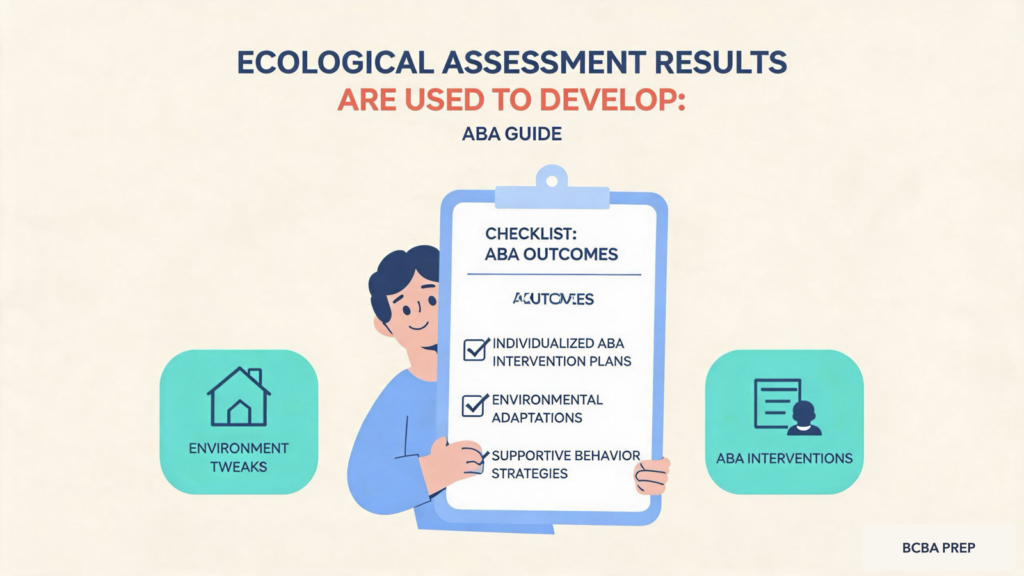
Importantly, ecological assessment results are used to develop individualized, function-based interventions that maximize contextual fit. Rather than only noting that ‘the classroom is loud,’ the assessment pinpoints how that noise functions as a setting event for disruptive behavior. This distinction is critical for BCBA exam success: ecological assessment is not merely descriptive—it is inherently prescriptive, guiding the design of behavior intervention plans (BIPs) that address the whole person-environment system.
How Ecological Assessment Results Are Used to Develop Interventions
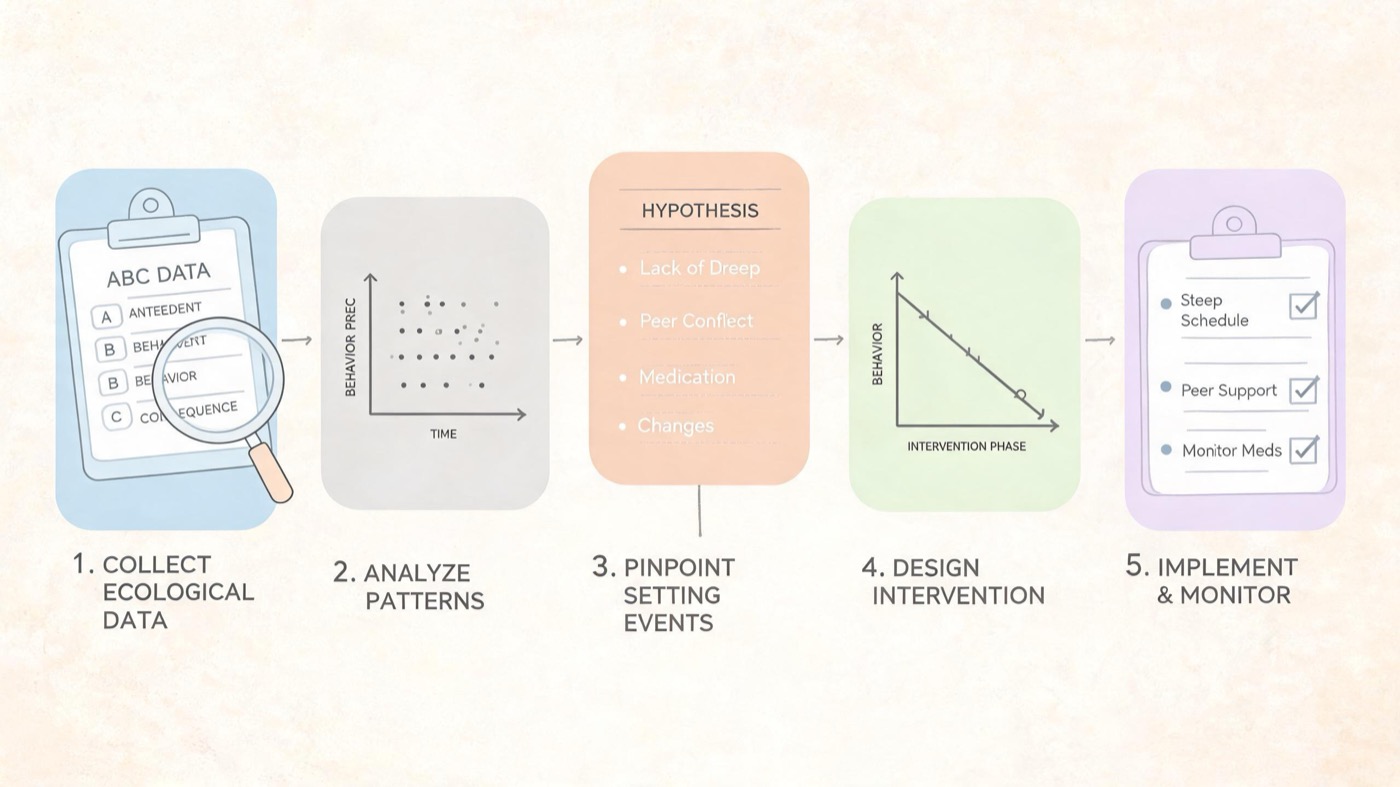
Once the assessment data is collected, the BCBA systematically translates findings into intervention components. The process typically follows three steps:
Step 1: Identify Setting Events and Antecedents
Ecological assessment data helps pinpoint setting events (e.g., lack of sleep, medication changes, peer conflict) and specific antecedents (e.g., a request to transition, a loud announcement) that reliably precede the target behavior. For example, ABC data from several settings may reveal that aggression occurs most often after unstructured free time in a noisy cafeteria. The intervention then manipulates these ecological variables to reduce the likelihood of the behavior.
Step 2: Match Intervention Strategies to Functions
The hypothesized function of behavior (escape, attention, tangible, sensory) directly informs the type of intervention. If the function is escape from loud environments, the ecological assessment results are used to develop strategies like providing noise-canceling headphones, offering a quiet break area, or teaching a functional communication response (e.g., ‘Break, please’). The key is that the intervention is contextually fit, meaning it is acceptable, feasible, and effective within that specific environment.
Step 3: Plan for Generalization and Maintenance
Finally, ecological assessment identifies natural reinforcers and supports across settings (home, school, community). The BCBA then plans for systematic fading of interventions and teaches skills that the client can use across different environments. For instance, if the assessment shows that a child’s aggression occurs during transitions both at school and at home, the intervention should include common transition cues (visual schedules, timers) that are portable and consistent across settings.
Worked ABA Examples: Ecological Assessment in Action
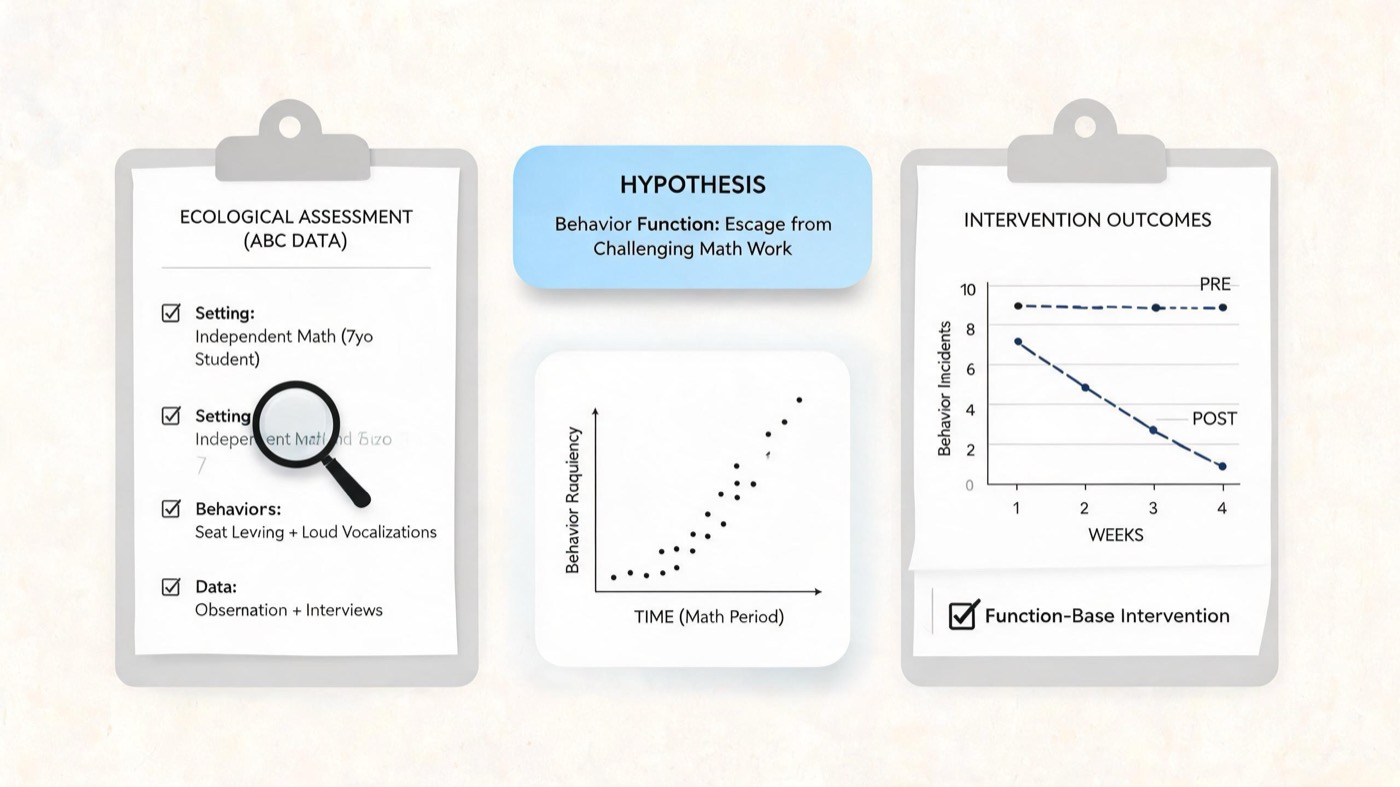
The following examples illustrate how ecological assessment data is directly used to develop function-based interventions.
Example 1: Disruptive Behavior in a Classroom
Setting: A 7-year-old student frequently leaves his seat and makes loud vocalizations during independent math work. Ecological assessment (interviews, observations, ABC data) revealed that disruptive behavior occurred almost exclusively when the classroom noise level was high (setting event) and when the student was presented with a difficult worksheet (antecedent). The hypothesized function was escape from aversive noise and task demands.
Intervention developed: The BCBA recommended (a) reducing classroom noise during work time by using a visual noise meter, (b) offering the student a quiet corner desk with a partition, and (c) teaching a request-for-break card to access a 2-minute quiet break. Within two weeks, disruptive behavior decreased by 80%. The ecological assessment results were used to develop a contextually fit intervention that changed the environment, not just the child.
Example 2: Aggression During Transitions
Setting: A 10-year-old with autism would bite and hit staff when asked to move from one activity to another. Ecological assessment (including parent interview and school observation) showed that transitions were unexpected and lacked any warning. The function was escape from the abrupt change. The BCBA used this data to develop a visual schedule with transition cues: a timer signaled 5 minutes before the end of an activity, followed by a song and picture card of the next activity. Aggression dropped 90%.
Example 3: Noncompliance in a Home Setting
Setting: A 4-year-old frequently refused to clean up toys in the family room. Ecological assessment revealed that the child was often told to clean while in the middle of a preferred TV show (setting event: highly preferred activity interrupted). The function was to continue watching TV (tangible/access). The BCBA developed an intervention using a 3-minute warning before transitions and a first-then board (first clean, then movie). The intervention also included a consistent routine where the parent started cleaning with the child (antecedent modification). Noncompliance decreased from 80% of trials to 10% after one week.
Exam Relevance and Common Traps
The BCBA exam tests your ability to distinguish ecological assessment from other assessments and to know how the results are applied. Watch for these common traps:
Misinterpreting Ecological Assessment as Only Environmental
A common mistake is to think ecological assessment only looks at physical aspects (e.g., room size, lighting). In reality, it also includes social, instructional, and organizational variables. For example, if an exam scenario asks about using assessment results, the correct answer might involve modifying staff behavior or peer interactions, not just rearranging furniture.
Overlooking Indirect Measures
Some students assume ecological assessment must rely solely on direct observation. However, interviews and checklists (e.g., the Ecological Assessment Checklist) are valid and important sources. An exam question might describe a BCBA using a caregiver interview to identify setting events; that is a legitimate part of ecological assessment.
Confusing Ecological Assessment with Functional Assessment
While both involve identifying antecedents and consequences, ecological assessment is broader, encompassing the entire ecology (setting events, resource availability, cultural practices). Functional assessment specifically tests a hypothesis about function. On the exam, if the question mentions developing a contextually relevant BIP, think ecological assessment.
Quick Checklist: Using Ecological Assessment Results
When reviewing an exam scenario, use this checklist to decide if the answer involves ecological assessment results:
- Identify if the assessment included multiple settings and sources (observation, interview, checklist).
- Determine if the results pinpoint setting events or antecedent triggers that can be modified.
- Ensure the intervention addresses the function of behavior, not just topography.
- Check that the intervention is practical and acceptable in the natural environment.
- Confirm that generalization and maintenance plans are based on natural reinforcers.
For more on how assessment data guides intervention, see our guide on functional behavior assessment (FBA) and behavior intervention plan (BIP) development.
Final Summary
Ecological assessment results are used to develop individualized, function-based behavior plans that fit the client’s unique environment. By identifying setting events, antecedents, and natural reinforcers, the BCBA creates interventions that are more likely to be effective and maintained. On the BCBA exam, remember that ecological assessment is not just about describing the environment; it is a tool for designing ecologically valid, contextually relevant change. Practice with the checklist above, and you will be ready for related exam questions.



