
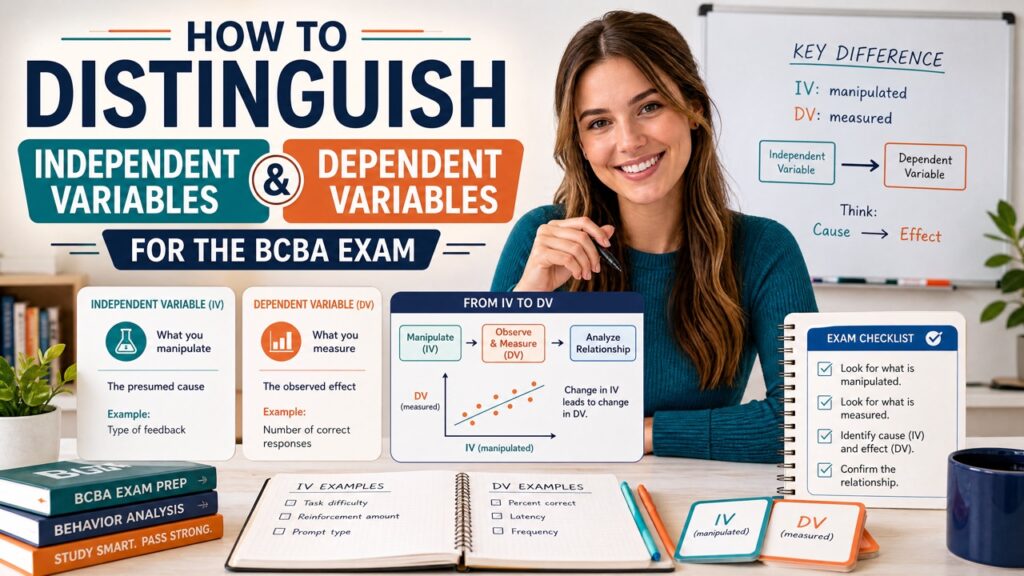
Why This Distinction Matters for BCBA Candidates
Every BCBA exam includes scenario-based questions that demand you identify the independent variable and the dependent variable from a brief vignette. This skill is not just a test item; it’s the foundation of applied behavior analysis. When you read about a teacher implementing a token system or a therapist using differential reinforcement, your brain must automatically separate the intervention from the behavior it targets.
Table of Contents
- Why This Distinction Matters for BCBA Candidates
- Independent and Dependent Variables: Definitions You Need
- How to Identify Variables in ABA Scenarios
- Worked ABA Examples: From Vignette to Variables
- Common Traps and How to Avoid Them on the Exam
- Quick Checklist for Variable Identification
- How This Applies Beyond the Exam: Real-World ABA Practice
- Test Your Knowledge: Practice Prompts
- Summary and Key Takeaways
- Quick Review Checklist
- Take the Free BCBA Mock Exam
The ability to distinguish these variables is also critical for evaluating research articles, designing your own interventions, and communicating effectively with team members. In your supervision hours, you’ll constantly be asked: “What did you change, and what did you measure?” That’s the essence of the distinction. Mastering this early will save you time and frustration later.
How Exam Questions Test Variable Identification: Exam questions often present a short description of a behavior change program and then ask: “What is the dependent variable?” or “What is the independent variable?” Sometimes they ask you to identify both from a list of options. The key is to scan for the behavior being measured and the environmental change that was implemented. With practice, you’ll recognize these cues instantly.
Independent and Dependent Variables: Definitions You Need
In ABA, the independent variable (IV) is the environmental event that the practitioner manipulates—typically an intervention, a procedure, or a change in antecedents and consequences. The dependent variable (DV) is the measurable behavior that is expected to change as a result of that manipulation. This is a classic functional relationship: the IV is the cause, and the DV is the effect.
Remember, in ABA we focus on socially significant behaviors, so the DV must be observable and measurable. For example, “on-task behavior” can be defined as “eyes oriented toward the task and engaging with materials” and counted via partial interval recording. Similarly, the IV must be described with enough detail to be replicated—like “a token economy with response cost” rather than just “a reward system.”
Independent Variable as the Environmental Event: In the natural sciences, an independent variable might be a subject characteristic like age or gender, but in ABA it is always an environmental event. This includes instructions, prompting, reinforcement schedules, environmental arrangements, and even the introduction of a new teaching procedure. The IV is what you, as the behavior analyst, control and change to produce a behavior change.
Dependent Variable as the Measurable Behavior: The dependent variable is the target behavior that you measure before, during, and after the intervention. It could be the frequency of aggressive acts, the duration of tantrums, or the percentage of correct responses. The DV must be defined in operational terms so that any observer can reliably measure it. Without a clear operational definition, you can’t determine whether the IV had an effect.
How to Identify Variables in ABA Scenarios
When you’re faced with a scenario, follow a systematic approach. Start by reading the vignette twice: once for the overall gist, and once specifically to identify the variables. This two-pass method prevents you from getting lost in the details. Then use the steps below to isolate the IV and DV with confidence. These steps are especially useful for the BCBA exam, where time pressure can lead to careless mistakes. Practicing them now will make the process feel automatic.
Step 1: Find the Behavior Being Measured: Look for the target behavior that is recorded or tracked. It might be described as “the number of times John hits his brother” or “the percentage of intervals Jane stays seated.” That behavior is your dependent variable because it’s the outcome you care about. If you’re unsure, ask yourself: “What is the practitioner trying to increase or decrease?” The answer is the DV.
Step 2: Identify What the Practitioner Manipulates: Next, ask: “What was intentionally changed or introduced?” This is the independent variable. It could be a new reinforcement system, a prompt fading method, or a change in the physical environment. The IV is under the practitioner’s control. In contrast, the DV is merely measured, not manipulated.
Step 3: Use the ABC Contingency to Confirm: Map the three-term contingency: Antecedent, Behavior, Consequence. The behavior is the DV. The IV often aligns with an alteration to the antecedent (like a new discriminative stimulus) or to the consequence (like delivering reinforcement for alternative behavior). By seeing how the IV fits into the contingency, you can double-check that you’ve identified it correctly.
Worked ABA Examples: From Vignette to Variables
Let’s put these steps into practice with realistic examples. Each scenario shows how to extract the IV and DV from a brief description, just like the ones you’ll see on the exam. These examples also highlight how the same concept applies across different settings—schools, clinics, and homes.
Example 1: Token Economy in a Classroom: Scenario: A teacher implements a token economy where students earn stars for staying on task and can exchange them for extra recess. On-task behavior is recorded via momentary time sampling. The independent variable is the token economy system, and the dependent variable is the on-task behavior. This is a classic example of a reinforcement-based intervention targeting a specific behavior.
Example 2: Differential Reinforcement of Alternative Behavior (DRA): Scenario: A therapist reinforces a client for requesting a break using a communication card, instead of hitting. The frequency of hitting and the frequency of requesting are both recorded. The independent variable is the DRA procedure, and the dependent variable is the frequency of hitting (or requesting, depending on which is the primary target). Notice that the DV is the behavior that changes as a result of the IV.
Example 3: Functional Communication Training (FCT): Scenario: A child who engages in property destruction to gain access to a preferred toy is taught to say “my turn” to request the toy. The intervention is FCT, and data are collected on both destructive behavior and communication attempts. The independent variable is the FCT intervention, and the dependent variable is the destructive behavior (and the communication attempts). FCT is a common exam topic, so understanding this distinction is crucial.
Common Traps and How to Avoid Them on the Exam
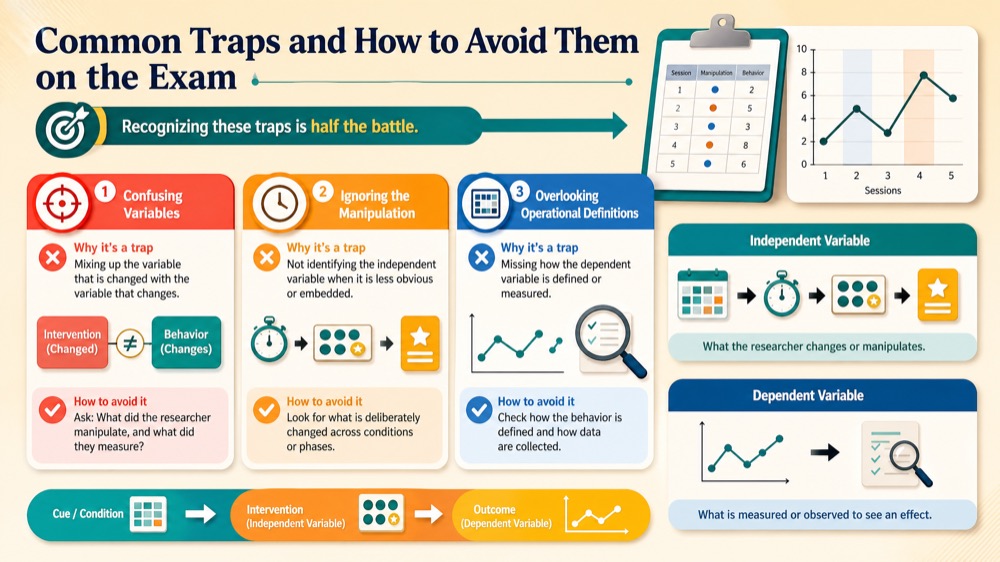
Even well-prepared candidates can fall into predictable traps when identifying variables. Here are the three most frequent mistakes, along with strategies to sidestep them. Recognizing these traps is half the battle.
- Trap 1: Confusing the behavior with the intervention. The intervention is what you do (e.g., token system), and the behavior is what you measure (e.g., on-task). If you’re unsure, ask: “What is being changed?” vs. “What is being counted?”
- Trap 2: Focusing on the person instead of the environment. In ABA, the IV is an environmental event, not a person characteristic. For instance, “child’s age” or “diagnosis” is not an independent variable in an ABA experiment. Instead, look for what was altered in the environment.
- Trap 3: Overlooking the operational definition. The DV must be operationally defined to be measurable. If a scenario says “aggression” without specifying what that means, you can’t identify the DV reliably. Always look for precise, observable definitions.
Quick Checklist for Variable Identification
Use this checklist when you’re analyzing any scenario—whether on the exam or in your daily practice. It condenses the process into a few rapid questions that lead you to the correct answers.
- Is the behavior observable and measurable? (DV)
- What was intentionally changed by the practitioner? (IV)
- Does the change follow the introduction of the intervention? (Temporal relationship)
- Is the variable **manipulated by the practitioner**? (IV) vs. **measured**? (DV)
- Does the behavior change as a result of the intervention? (Demonstrates the functional relation)
- Avoid subject variables as IV; in ABA, IV must be environmental.
How This Applies Beyond the Exam: Real-World ABA Practice
Your ability to distinguish these variables has direct implications for the quality of your behavior intervention plans. When you write a treatment plan, you explicitly state the independent variable (the intervention) and the dependent variable (the target behavior). This clarity guides data collection, graph interpretation, and treatment fidelity. Without it, your plan wouldn’t be replicable or evaluable.
Moreover, when you supervise RBTs, you need to explain these concepts in simple terms. For instance, you might say, “We’re changing the way we respond to the child’s requests (IV), and we’ll measure how often the child asks instead of grabbing (DV).” This helps your team stay aligned and focused.
Data Collection and Analysis: Correct identification of the IV and DV is essential for graphing and evaluating intervention effectiveness. If you misidentify the DV, your graphs won’t reflect the behavior you intended to change. Similarly, if you don’t clearly define the IV, you can’t ensure that the intervention was implemented as planned. This connection is a key part of the BCBA exam’s focus on measurement and experimental design.
Behavior Intervention Plans: In a BIP, the IV is the intervention strategy (e.g., noncontingent reinforcement, FCT, token economy), and the DV is the target behavior (e.g., hitting, screaming, off-task). The entire BIP hinges on the logical link between these two variables. By mastering this distinction, you’ll write stronger BIPs and make better data-based decisions.
Test Your Knowledge: Practice Prompts
Now it’s your turn. Try these quick prompts to assess your understanding. Write down your answers, then check them against the explanations below. This active retrieval will strengthen your recall. Prompt 1: Identify the IV and DV: Scenario: A BCBA uses a social story to reduce tantrums during transitions. Tantrums are measured as frequency. Identify the independent variable and the dependent variable. (Answer: IV = social story; DV = frequency of tantrums)
Prompt 2: Which is the IV?: Multiple choice: In an experiment studying the effect of a fixed-ratio schedule on response rate, what is the independent variable? A) The number of responses, B) The fixed-ratio schedule, C) The participant’s age, D) The response rate. Correct answer: B) The fixed-ratio schedule. The response rate is the DV.
Summary and Key Takeaways
Now you have a clear framework for distinguishing independent and dependent variables in ABA. Remember: the independent variable is what you change; the dependent variable is what you measure. This simple rule will guide you through exam questions and real-world practice.
We also covered common traps, such as confusing the intervention with the behavior, and we provided a checklist you can use anytime. As you continue your BCBA journey, keep practicing with real scenarios. If you’re looking for more guidance, check out our guide on independent and dependent variables in ABA for additional practice. Also, review continuous measurement to solidify your understanding of how the DV is measured.
For a deeper dive into experimental design, you might explore the experimental analysis of behavior. And remember, the BACB’s official website offers resources on measurement and experimental design. Keep practicing, and you’ll master this concept.
Quick Review Checklist
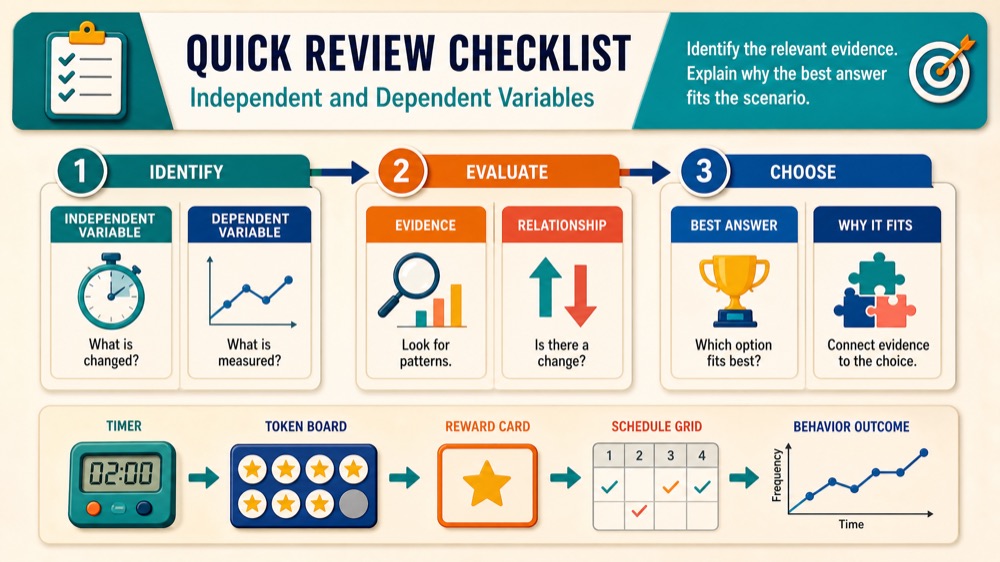
Use this final checklist to turn independent and dependent variables into exam-ready reasoning. The goal is not to memorize a label in isolation; it is to identify the relevant evidence and explain why the best answer fits the scenario. Key ideas to review:
- State the central definition or decision point for independent and dependent variables in your own words.
- Identify the detail that makes independent and dependent variables different from its closest related ABA term.
- Separate the observable facts in a scenario from assumptions that are not supported by the facts.
- Write one example and one nonexample so you can recognize the concept in a new setting.
Exam application checks:
- Ask what the question is actually requesting before comparing the answer choices.
- Mark the antecedent, response, consequence, or other evidence that supports the selected answer.
- Look for a distractor that describes a related process but does not answer the specific question.
Final self-check:
- Explain how you would verify the interpretation with clear observations or data.
- Change one detail in the scenario and decide whether your answer should change.
- Give a one-sentence rationale that a supervisor or study partner could evaluate.
Take the Free BCBA Mock Exam
Ready for more practice? Use the free mock exam to keep testing your accuracy with realistic BCBA-style items. Take the Free BCBA Mock Exam



