
What Does Ontogenetic Mean?
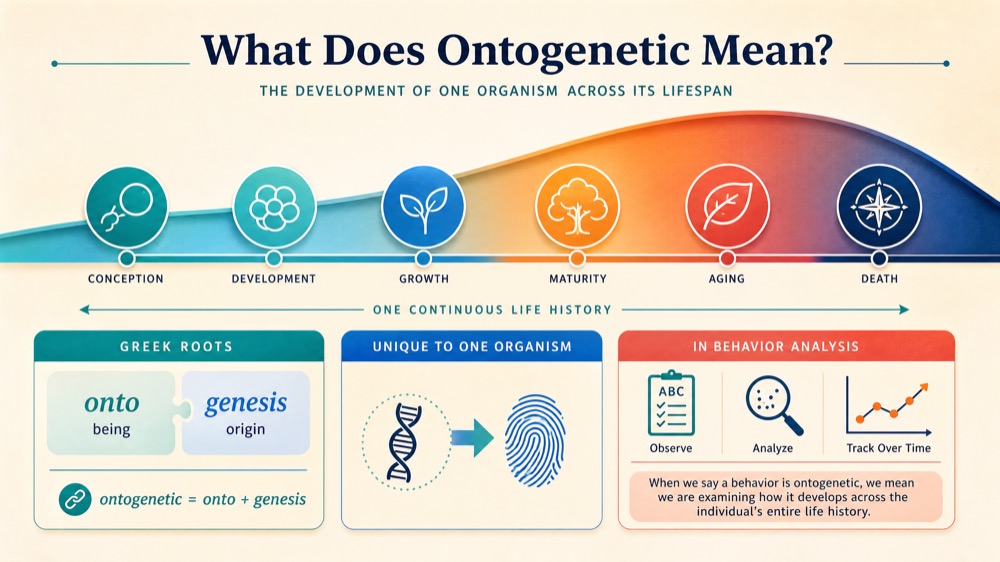
In behavior analysis, ontogenetic refers to the development of an individual organism from conception to death. The term combines the Greek roots “onto” (being) and “genesis” (origin), emphasizing the unique life history of a single organism. For BCBA candidates, understanding this concept is foundational because it explains why behavior changes over time based on experience.
Table of Contents
- What Does Ontogenetic Mean?
- Ontogenetic Variables in Applied Behavior Analysis
- Applied Examples: Ontogenetic Explanations in Action
- Exam Relevance: Why This Matters for BCBA Candidates
- Quick Checklist for Ontogenetic Understanding
- Final Summary
- Take the Free BCBA Mock Exam
When we say a behavior is ontogenetic, we mean it was acquired through the individual’s interactions with the environment—not inherited biologically. This stands in contrast to phylogenetic factors, which involve the evolutionary history of a species. For example, a child’s ability to speak a specific language is ontogenetic, while the anatomical capacity for vocal language is phylogenetic.
Understanding Ontogenetic Development: Ontogenetic development includes all changes that occur within an individual’s lifetime, from prenatal maturation to learned skills in adulthood. In applied behavior analysis (ABA), we focus on ontogenetic variables because they are modifiable through environmental interventions. A behavioral repertoire emerges from a personal history of reinforcement, punishment, and extinction, making each individual’s learning history unique.
Consider a toddler who learns to say “please” to receive a toy. This behavior is not present at birth; it develops through modeling, prompting, and reinforcement. The child’s ontogenetic history—specific interactions with caregivers—shapes the future probability of that response. This perspective aligns with the philosophical assumption of determinism in behavior analysis: behavior is lawful and caused by prior events.
Ontogenetic vs. Phylogenetic: The distinction between ontogenetic and phylogenetic is a common source of confusion on the BCBA exam. Phylogenetic factors include species-wide biological traits, such as reflexes or fixed action patterns, that are the result of natural selection. Ontogenetic factors, on the other hand, arise from an individual’s learning history.
For instance, a dog salivating when it sees its food bowl is partly ontogenetic (learned) and partly phylogenetic (innate). But in ABA, we are primarily concerned with ontogenetic influences because they can be altered. When assessing behavior, BCBAs must identify which variables are under environmental control—these are the ontogenetic variables that can be targeted for intervention.
Ontogenetic Variables in Applied Behavior Analysis
Ontogenetic variables are the environmental events that have shaped an individual’s behavior over time. These include reinforcement history, punishment history, and the context in which learning occurred. In practice, a behavior analyst must analyze these variables to understand why a behavior occurs and how to change it.
The three-term contingency (antecedent-behavior-consequence) is a useful framework for assessing ontogenetic influences. By examining the antecedents that evoke a behavior and the consequences that maintain it, we trace the individual’s learning history. For example, a student who throws tantrums to escape homework has likely experienced negative reinforcement in the past—removal of the task after tantrum behavior. This ontogenetic history increases the future likelihood of tantrums under similar demand conditions.
How Ontogenetic Factors Shape Behavior: Ontogenetic factors shape behavior through a process known as operant conditioning. Behavior that is followed by reinforcing consequences becomes more likely to occur again; behavior followed by punishing consequences becomes less likely. This learning history is unique to each individual.
Reinforcement history is perhaps the most powerful ontogenetic variable. For instance, a child who receives attention every time they cry will cry more often in the future. Conversely, if crying is ignored and appropriate requests are reinforced, the child’s repertoire shifts. This is why functional behavior assessments (FBAs) are critical—they help identify which ontogenetic variables (e.g., attention, escape, tangible, automatic) are maintaining behavior.
Examples of Ontogenetic Influences: Consider a teenager who learns to drive a car. Initially, the behavior is clumsy and requires effort, but with practice and feedback (reinforcement for correct lane changes, correction for errors), driving becomes smooth and automatic. This skill acquisition is ontogenetic.
Every skill a person exhibits—from tying shoes to solving algebra problems—is the product of ontogenetic development. Even behaviors that seem “natural” are learned through repeated environmental interactions. In ABA, we leverage this principle when designing interventions: we arrange environments to teach new skills and reduce problem behaviors by altering reinforcement contingencies.
Applied Examples: Ontogenetic Explanations in Action
To truly grasp the ontogenetic definition, it helps to see it applied in real-world ABA scenarios. Below are three examples that illustrate how ontogenetic learning history explains behavior and guides intervention. Example 1: Escape from Demands: A student named Jake engages in aggressive behavior when given math worksheets. An assessment reveals that when Jake hits, the teacher removes the worksheet and sends him to the principal’s office. This escape is a negative reinforcer, strengthening aggression. Jake’s ontogenetic history—the repeated association between hitting and removal of demands—maintains the behavior. The intervention would involve teaching Jake to request a break (e.g., saying “break, please”) and reinforcing that appropriate escape response while withholding reinforcement for aggression.
Example 2: Attention-Seeking Behavior: Maria, a preschooler, whines constantly when her mother is on the phone. The whining often results in her mother hanging up and attending to Maria. This attention is a positive reinforcer, making whining more likely in similar situations. Maria’s ontogenetic history with attention shapes this behavior. A behavior analyst would teach Maria to say “excuse me” or tap her mother’s arm, and ensure that attention is delivered only after appropriate requests, not after whining.
Example 3: Self-Injurious Behavior: In more complex cases, such as self-injurious behavior (SIB), ontogenetic variables can include automatic reinforcement (sensory stimulation) and social consequences. For instance, an individual with autism may hit their head because it produces a pleasant visual effect or because it consistently leads to caregiver attention. The ontogenetic explanation considers the individual’s unique learning history across these contexts. Intervention might involve providing alternative sensory activities or teaching communication to access attention functionally.
Exam Relevance: Why This Matters for BCBA Candidates
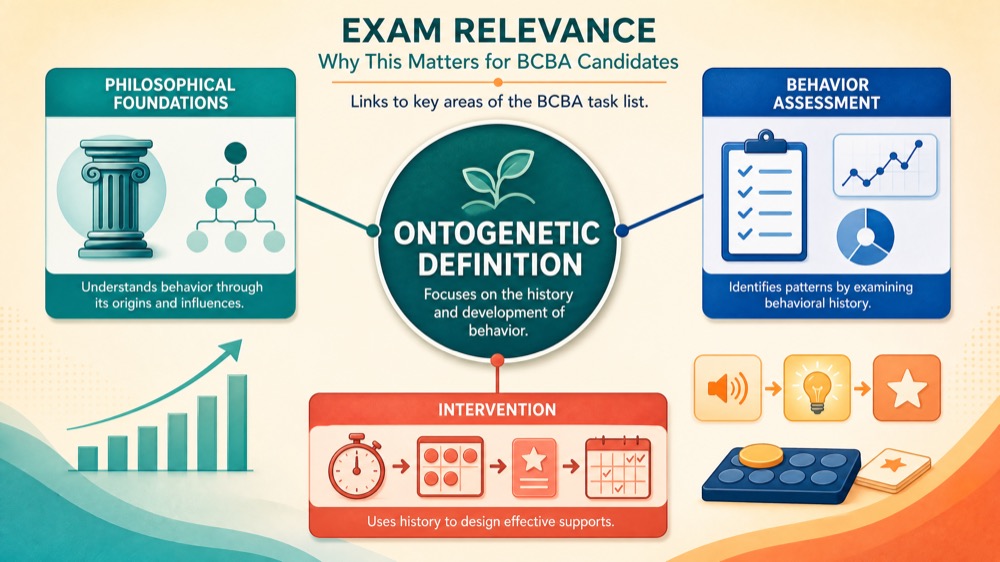
For BCBA candidates, understanding ontogenetic variables is essential because it links to several key areas of the BCBA task list, including philosophical foundations, behavior assessment, and intervention. Recognizing whether a behavior is controlled by phylogenetic or ontogenetic factors informs treatment decisions.
Moreover, experimental designs used in ABA, such as reversal designs, directly manipulate ontogenetic variables to demonstrate functional relations. When you reverse contingencies and observe corresponding changes in behavior, you’re showing that the individual’s ontogenetic history with those contingencies is the cause of the behavior. This is the essence of experimental analysis. Common Exam Traps and How to Avoid Them: Exam questions often test your ability to distinguish between ontogenetic and phylogenetic explanations. Here are common traps:
- Trap 1: Confusing “learned” with “innate.” Always ask: did this behavior require personal experience? If yes, it’s likely ontogenetic.
- Trap 2: Overgeneralizing findings from one individual to another. Ontogenetic histories differ; what works for one person may not work for another.
- Trap 3: Ignoring the role of reinforcement history in skill deficits. Many “can’t do” behaviors are actually “haven’t learned” behaviors—ontogenetic.
Sample Practice Questions: Test your understanding with these prompts:
- Question 1: A child cries when placed in a car seat. The parents usually take the child out. What is the most likely ontogenetic variable? Answer: Negative reinforcement (removal of the seat).
- Question 2: Which of the following is a phylogenetic explanation? Answer: A newborn’s rooting reflex—this is species-typical, not learned.
- Question 3: Why is it important to consider ontogenetic variables in ABA? Answer: Because they are modifiable via environmental interventions.
Quick Checklist for Ontogenetic Understanding
Use this checklist to solidify your grasp of ontogenetic concepts before the exam:
- Define ontogenetic as individual learning history.
- Contrast with phylogenetic (species history).
- Identify three kinds of ontogenetic variables: reinforcement, punishment, and extinction history.
- Apply the three-term contingency to describe ontogenetic control.
- Explain how FBA results reflect ontogenetic variables.
- Recognize that interventions alter ontogenetic histories.
Final Summary
Understanding the ontogenetic definition is a cornerstone of applied behavior analysis. It reminds us that behavior is not fixed but continuously shaped by environmental interactions. For BCBA candidates, mastering ontogenetic concepts is not only exam-relevant but also critical for effective practice. By analyzing an individual’s learning history, you can explain why behavior occurs and design ethical, function-based interventions.
As you prepare, revisit this guide whenever you encounter questions about the origins of behavior. And if you’re looking for more targeted prep, check out our article on identifying the goals of behavior analysis. Also, the BACB website provides official resources to deepen your understanding.
Take the Free BCBA Mock Exam
Ready for more practice? Use the free mock exam to keep testing your accuracy with realistic BCBA-style items. Take the Free BCBA Mock Exam



