
What Is Behavioral Skills Training? A BCBA Exam Perspective
Behavioral skills training, commonly abbreviated as BST, is a **training package** that combines several evidence-based procedures to teach new skills. In applied behavior analysis, BST is used to train caregivers, teachers, and staff to implement interventions with fidelity. The approach rests on active learning: the learner receives information, observes a demonstration, practices the skill, and gets feedback. This cycle ensures that the learner does not just know what to do but can actually perform the skill when needed.
Table of Contents
- What Is Behavioral Skills Training? A BCBA Exam Perspective
- How to Implement Behavioral Skills Training: Step-by-Step Guide
- Behavioral Skills Training in Action: ABA Examples
- Exam Tips and Common Traps for BST Questions
- Quick Checklist for Behavioral Skills Training
- Summary: BST in Your BCBA Exam Prep
- Take the Free BCBA Mock Exam
- References
For the BCBA exam, understanding BST is essential because it appears in questions about staff training, parent education, and treatment integrity. The exam may ask you to identify the components of BST, sequence the steps correctly, or recognize when BST is the appropriate intervention. The key is to move beyond memorizing definitions and think about how BST fits into the broader framework of behavior change programs.
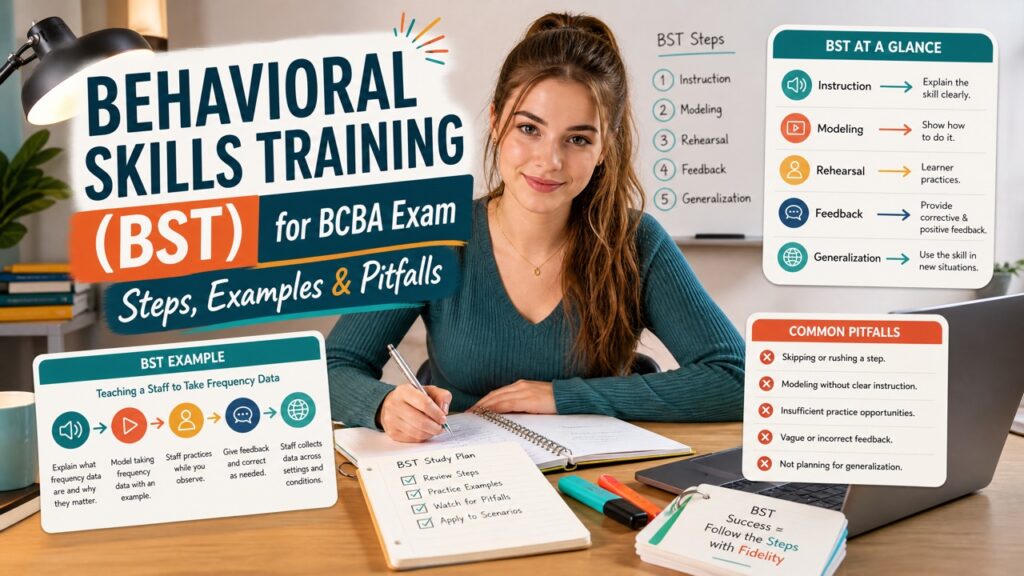
Defining BST in Applied Behavior Analysis: In ABA, BST is defined as a **behavioral intervention** that involves four core components: instruction, modeling, rehearsal, and feedback. It is a proactive approach because it teaches the desired behavior rather than simply telling someone what not to do. Research consistently supports BST as an effective method for training skills across populations, from children with autism to professionals in clinical settings. The Four Core Components of BST: The four components work together, and each plays a distinct role:
- Instruction: The trainer describes the skill, its importance, and the steps involved.
- Modeling: The trainer demonstrates the skill, either in person or via video.
- Rehearsal: The learner practices the skill in a simulated or real situation.
- Feedback: The trainer provides specific praise for correct performance and corrective feedback for errors.
Each component is critical; skipping any one often results in incomplete learning. For example, instruction alone rarely produces fluent performance, and feedback without rehearsal does not allow the learner to adjust their behavior.
How to Implement Behavioral Skills Training: Step-by-Step Guide
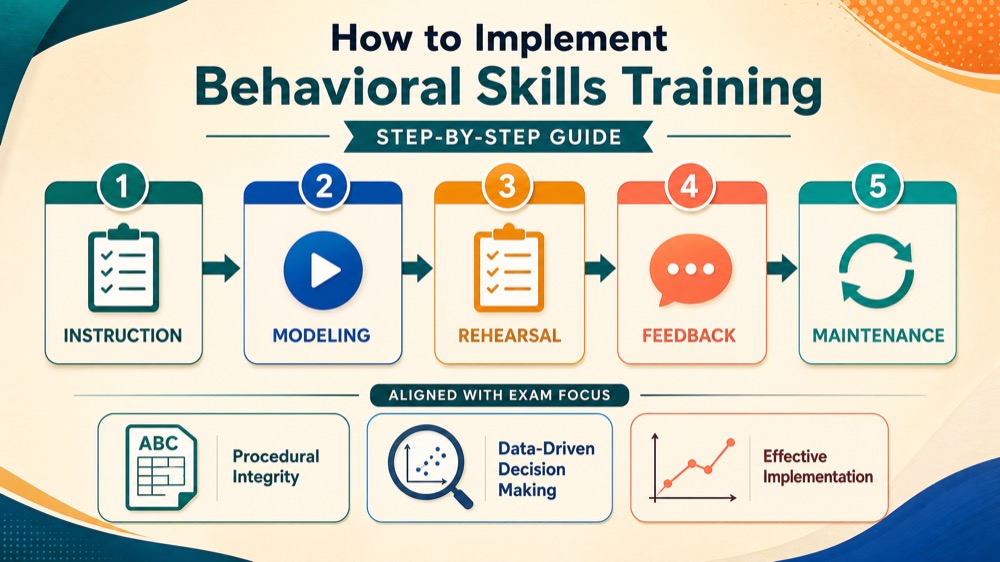
Implementing BST effectively requires a systematic approach. The following steps align with the exam’s emphasis on procedural integrity and are the same steps you would use in practice. Whether you are training a parent to implement a behavior plan or teaching a paraprofessional to collect data, these steps ensure the learner acquires the skill correctly.
Step 1: Assess the Learner's Current Skills: Before you begin, you need to know what the learner already knows. Conduct a **baseline assessment** by asking the learner to perform the skill or by observing them in a relevant situation. Use a task analysis to break the skill into smaller, observable components. This assessment tells you which steps the learner can already perform and which steps require training.
Step 2: Provide Clear Instructions: Instructions should be concise, specific, and jargon-free. Describe the skill, explain why it is important, and list the steps. For example, if you are teaching a parent to use discrete trial teaching, you would explain the three-term contingency and show a written task analysis. Instructions are most effective when they are paired with visual aids or written summaries that the learner can refer to later.
Step 3: Model the Skill: Modeling involves demonstrating the skill exactly as it should be performed. You can model in vivo (in real time) or use video modeling. Ensure the model is accurate and includes all the steps. If the skill has multiple components, you might model the entire sequence first, then break it into smaller parts. Modeling gives the learner a clear behavioral template to imitate.
Step 4: Practice Through Rehearsal: Rehearsal, also called role-play or simulation, gives the learner an opportunity to perform the skill in a safe environment. This is where active learning happens. The trainer may set up a scenario, and the learner practices the skill while the trainer observes. Rehearsal should be repeated until the learner demonstrates the skill fluently. It is important to provide plenty of opportunities for practice, as this strengthens the behavioral repertoire.
Step 5: Deliver Specific Feedback: Feedback is the component that shapes performance. Immediately after rehearsal, provide **specific praise** for what the learner did correctly and **corrective feedback** for errors. For example, say, “Great job presenting the discriminative stimulus clearly, but remember to wait 3 seconds for a response before prompting.” Feedback should be objective, non-judgmental, and directly tied to the steps in the task analysis.
Step 6: Repeat Until Mastery: BST is not a one-shot intervention. Repeat the cycle of instruction, modeling, rehearsal, and feedback until the learner meets a predetermined mastery criterion. Mastery typically means the learner performs the skill correctly across multiple consecutive trials. After mastery, plan for maintenance and generalization by scheduling follow-up observations and booster sessions.
Behavioral Skills Training in Action: ABA Examples
To fully grasp BST, it helps to see it applied to real ABA scenarios. The following examples are similar to case studies you might encounter on the BCBA exam. Each example includes a brief behavior-analytic description, including antecedents, behaviors, and consequences, and explains how BST would be used to train the relevant person.
Example 1: Training a Parent to Implement Discrete Trial Teaching: Scenario: A mother of a 4-year-old with autism needs to implement discrete trial teaching (DTT) at home. A functional behavior assessment indicates that the child’s noncompliance is maintained by attention. In a DTT session, the antecedent is the instruction “point to dog,” the behavior is the child pointing to a picture of a dog, and the consequence is praise and a small token. The hypothesized function of the child’s correct responding is to gain access to attention.
BST application: The BCBA assesses the mother’s current DTT skills. She knows the basic steps but often forgets to wait for the child’s response before prompting. The BCBA provides instructions with a step-by-step task analysis, models a full DTT trial, and then the mother rehearses while the BCBA observes. Feedback focuses on the mother’s pacing, prompt timing, and delivery of praise. After several rehearsal sessions, the mother reaches mastery and the BCBA schedules follow-up to ensure maintenance.
Example 2: Teaching a Teacher to Use Prompting and Fading: Scenario: A classroom teacher has difficulty using prompting and fading when instructing a student with intellectual disability. The target skill is for the student to raise his hand, but the teacher often uses full physical prompts and never fades them. A functional behavior assessment suggests that the student’s avoidance of tasks is maintained by escape. The antecedent is the teacher’s demand, the behavior is the student’s refusal, and the consequence is the teacher removing the demand.
BST application: The BCBA uses BST to train the teacher. Instructions include the types of prompts and the fading hierarchy. The BCBA models a least-to-most prompting sequence. The teacher rehearses by role-playing with a colleague, receiving feedback on prompt selection and when to fade. After mastery, the teacher implements the procedure in the classroom, and the BCBA collects data to ensure the student’s on-task behavior increases.
Example 3: Training a Staff Member to Conduct Functional Communication Training: Scenario: A residential staff member needs to conduct functional communication training (FCT) for a client who engages in aggression to access tangibles. The replacement behavior is requesting a break or a preferred item using a picture exchange system. The hypothesized function of the aggression is to obtain tangibles. In an FCT session, the antecedent is a demand, the behavior is the client’s request, and the consequence is delivery of the requested item.
BST application: The BCBA trains the staff member using BST. Instruction covers the rationale for FCT and the steps for reinforcing appropriate requests. The BCBA models how to prompt the client to exchange a picture. The staff member rehearses with the BCBA acting as the client. Feedback focuses on response latency and consistency in reinforcing the replacement behavior. The staff member practices until mastery, and the BCBA monitors implementation to ensure the client’s aggression decreases.
Exam Tips and Common Traps for BST Questions
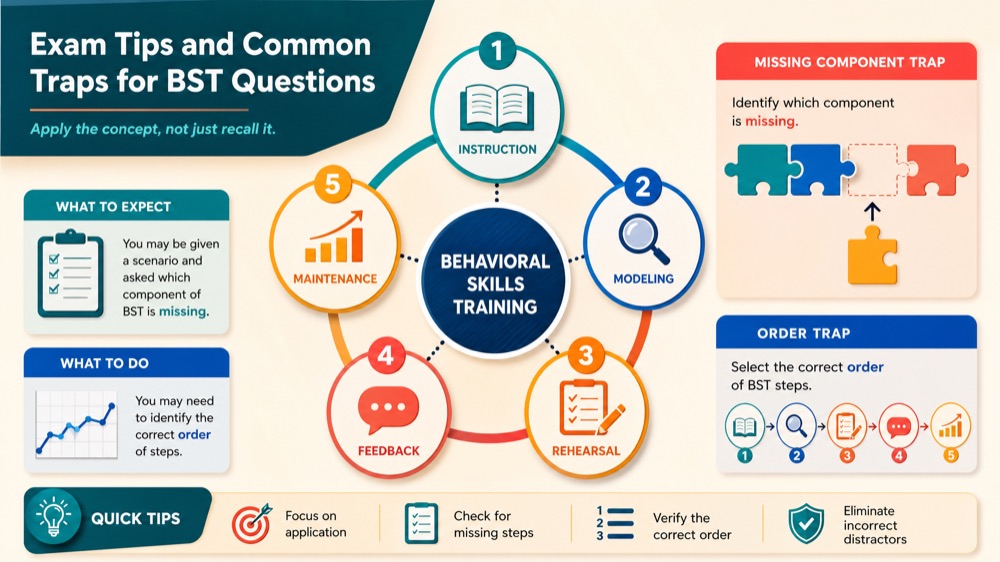
BCBA exam questions about BST often test your ability to apply the concept, not just recall it. You may be given a scenario and asked which component of BST is missing, or you may need to identify the correct order of steps. To score well, you must understand the nuances and avoid common misunderstandings. Key Terms You Must Know: Familiarity with these terms will help you navigate BST questions:
- Task analysis: breaking a skill into its component steps.
- Modeling: demonstrating the behavior for the learner.
- Rehearsal: the learner practicing the skill.
- Feedback: specific information about performance.
- Mastery criteria: pre-defined level of performance for completion.
- Generalization: the skill occurring in new settings or with new people.
These terms often appear in answer choices, so knowing their precise definitions is crucial. Common Traps in BCBA Exam Questions: Here are three frequent traps and how to avoid them:
- Trap 1: Thinking feedback only means praise. Feedback includes both positive and corrective statements. Both are essential for shaping behavior.
- Trap 2: Mixing the order of steps. BST has a specific sequence: instruction, modeling, rehearsal, feedback. Repetition is part of the cycle, not a separate step.
- Trap 3: Using BST when the learner lacks prerequisite skills. BST requires imitation and verbal comprehension. If the learner does not have these, other teaching strategies may be needed.
Remember that BST is a training package, not a single technique. Recognizing when it is and is not appropriate is a key skill for exam success.
Quick Checklist for Behavioral Skills Training
Use this checklist for last-minute review or as a guide during supervision sessions. It condenses the essential actions into a quick reference. Checklist:
- Identify the target skill and create a task analysis.
- Assess the learner’s current level of performance.
- Provide clear, concise instructions with rationale.
- Model the skill accurately, in vivo or via video.
- Allow the learner to rehearse in a safe environment.
- Deliver immediate, specific feedback (praise + correction).
- Repeat the cycle until mastery is reached.
- Plan for maintenance and generalization.
If you can mentally walk through these steps for any given skill, you are well-prepared for BST questions on the exam.
Summary: BST in Your BCBA Exam Prep
Behavioral skills training is a core competency for BCBAs, and it will likely appear on your exam in multiple forms. By mastering the four components and the implementation sequence, you can answer questions with confidence. The practical examples above illustrate how BST is applied in real settings, and the exam tips highlight common pitfalls to avoid.
For additional exam preparation, check out our guide on BCBA exam essentials. You can also explore our resources on functional behavior assessment to deepen your understanding of related concepts. Keep practicing, and good luck with your studies!
Take the Free BCBA Mock Exam
Ready for more practice? Use the free mock exam to keep testing your accuracy with realistic BCBA-style items. Take the Free BCBA Mock Exam
References
Next step for BCBA exam prep
Turn this topic into exam-day practice
Use this topic as a focused review, then test it in exam-style conditions with a free mock before deciding whether five full-length mocks are the right next step.
Start the Free BCBA Mock ExamContinue with Five Full-Length Mocks — $99
Review the included materials and access details before ordering. No pass guarantee is implied.



