

If you are asking how to become a BCBA in Arizona, start by separating two different approvals: national BCBA certification through the Behavior Analyst Certification Board (BACB) and permission to practice through Arizona’s licensing system. Your first practical task is not filling out a form. It is choosing the correct track, building the right evidence packet, and checking whether your application will be reviewed under the requirements in effect when you apply.
Table of Contents
- How to Become a BCBA in Arizona: The Short Answer
- Why BACB Certification and Arizona Licensure Are Separate
- Choose Your Arizona Path Before You Collect Documents
- Complete the National BCBA Certification Track
- Match the Arizona License Application to Your Situation
- Build the Evidence Packet in the Right Order
- Use the 2026-to-2027 Checkpoint
- Track Administrative and Substantive Review
- Avoid Application-Readiness Mistakes
- How to Become a BCBA in Arizona FAQ
- Connect Eligibility Work to Exam Readiness
- Take the Free BCBA Mock Exam
This guide is narrower than the site’s broad BCBA Certification Arizona guide. That page remains the main overview. This page is an application-readiness checklist: route selection, document ownership, the 2026-to-2027 checkpoint, and a simple way to track what happens after submission.
Important boundary: Arizona rules, fees, forms, and BACB requirements can change. Use the current Arizona Board application page and the current BACB BCBA Handbook before you apply. This article provides educational planning support; it does not determine your eligibility or provide legal advice.
How to Become a BCBA in Arizona: The Short Answer
The short answer is a two-layer plan. First, complete a BACB eligibility pathway: the required graduate degree, behavior-analytic coursework, supervised fieldwork, and BCBA examination under the applicable BACB rules. Second, if you will practice behavior analysis in Arizona, review the Arizona Board of Psychologist Examiners route that applies to you and submit the state application and supporting documentation. A BCBA certificate is not the same thing as an Arizona behavior-analyst license.
| Layer | Main question | Primary owner | Your next proof |
|---|---|---|---|
| National certification | Do I meet the current BCBA eligibility and examination requirements? | BACB | Current handbook pathway, coursework, fieldwork, application, and exam records. |
| Arizona practice authority | Which state application lets me practice in Arizona? | Arizona Board of Psychologist Examiners | Correct state route, fee, primary-source verifications, and application status. |
| Exam preparation | Can I demonstrate the knowledge represented by the current exam outline? | You, your program, and qualified supervisors | A study plan tied to the current BCBA Test Content Outline and practice results. |
The BACB’s official BCBA resource hub and Arizona’s official application pages should be your final checkpoints.
Why BACB Certification and Arizona Licensure Are Separate
The distinction is easy to miss because people often use “BCBA license” as casual shorthand. For application planning, keep the terms precise. BACB certification is a national credential. Arizona licensure is state practice authority. The Arizona Board expressly warns applicants that BCBA certification is not a license, and the Board’s application system asks for state-specific information and verifications.
- Exam eligibility: start with the current BACB Handbook and certification portal; an Arizona application does not replace BACB review.
- Arizona practice: start with the Board’s current behavior-analyst application instructions; a BCBA certificate alone is not the state answer.
- Documents: use the exact route’s checklist; a document sent to one organization is not automatically transferred to the other.
Choose Your Arizona Path Before You Collect Documents
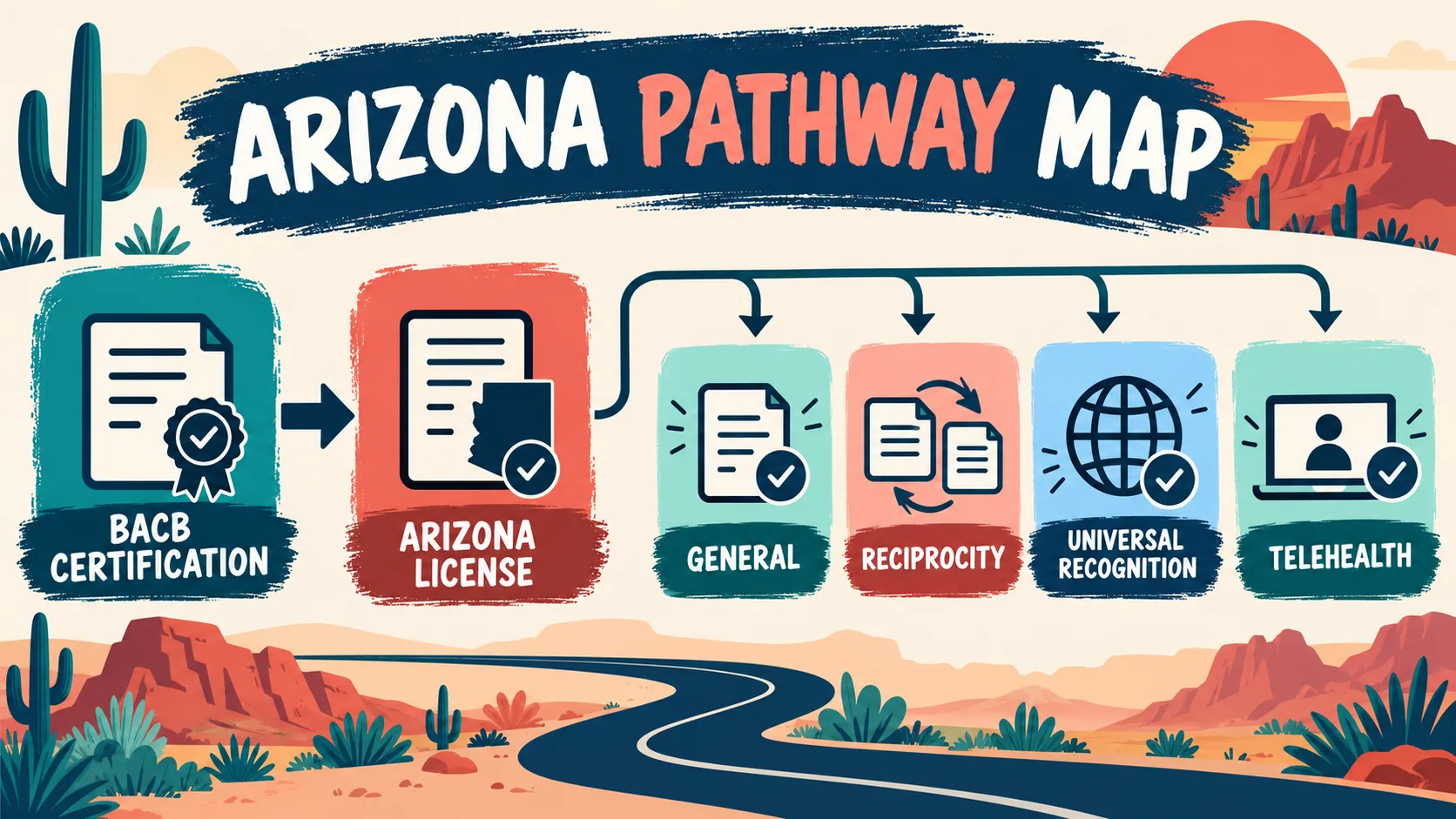
Do not collect every possible document first. Choose the route, then use that route’s official instructions to define your evidence packet. The Arizona Board describes a general behavior-analyst application, a reciprocity pathway within the licensure application, a universal-recognition route, and a telehealth registry option for the circumstances described by the Board.
| Possible route | Use it as a planning question | Verification to make |
|---|---|---|
| General Arizona licensure | Am I applying for Arizona licensure through the standard behavior-analyst pathway? | Current education, examination, fieldwork, verification, fee, and application instructions. |
| Reciprocity | Does my existing professional license and history fit the Board’s reciprocity requirements? | Which licenses must be verified directly and whether the same application is used. |
| Universal recognition | Do I meet the Arizona residence, duration, good-standing, and comparable credential conditions? | Residence evidence, every relevant license or certification, and the Board’s current instructions. |
| Telehealth registry | Am I an out-of-state licensed behavior analyst seeking the specific telehealth-only option? | Whether the registry fits the service and location facts in the current Board rules. |
If two routes appear possible, compare the official conditions and ask the Board which category matches your facts. A complete packet sent under the wrong route can still create delay.
Complete the National BCBA Certification Track
Your Arizona plan still depends on the national certification track if your professional goal is to become a BCBA. Start with the current BACB Handbook instead of an old study post or a saved screenshot. The handbook describes the applicable eligibility pathway, coursework, supervised fieldwork, application, examination, and maintenance requirements.
- Identify the applicable rule set. Write down the year in which you expect to submit the complete certification application and which handbook version controls that submission.
- Verify the degree and coursework evidence. Keep official transcripts and any required attestation or evaluation information in the format the BACB requests.
- Close the fieldwork record. Confirm that your supervisor documentation, hours, signatures, and dates are internally consistent before you apply.
- Plan the examination step. Use the current BCBA Test Content Outline as the study map, then check the current examination information and application-processing instructions.
| BACB checkpoint | Evidence to name | Ready means |
|---|---|---|
| Education | Degree, coursework, transcript, and any required pathway documentation. | You can point to the current handbook section that supports the evidence. |
| Fieldwork | Supervision records, dates, hours, observations, and signatures. | The record is complete, legible, and consistent with the applicable pathway. |
| Application | Portal submission, payment, transcripts, and requested supporting evidence. | The application is submitted through the current BACB process, not an old form. |
| Exam | Authorization and a study plan tied to the current outline. | You know what is scheduled, what is still pending, and what is not guaranteed. |
Match the Arizona License Application to Your Situation
Once you know your national certification status and Arizona route, read the Board’s instructions line by line. The official licensure and reciprocity page explains that general licensure and reciprocity use the behavior-analyst application, while universal recognition has separate conditions. It also says applicants need not live in Arizona for the general or reciprocity application; all other requirements still apply.
Universal recognition can involve Arizona residence evidence, at least one year of a comparable credential, good standing, and primary-source verification. A BCBA certificate is not automatically a state license, so check the route instead of relying on credential shorthand.
| Situation | Do first | Do not upload blindly |
|---|---|---|
| You are pursuing BCBA certification now | Finish the applicable BACB planning and identify when Arizona licensure becomes relevant. | A state application before you understand the state’s practice requirement. |
| You hold BCBA certification and want to practice in Arizona | Read the current Arizona behavior-analyst application instructions. | Assuming your national certificate is the state application. |
| You hold another state credential | Compare reciprocity and universal recognition conditions. | Assuming “licensed elsewhere” automatically satisfies Arizona’s route. |
Build the Evidence Packet in the Right Order
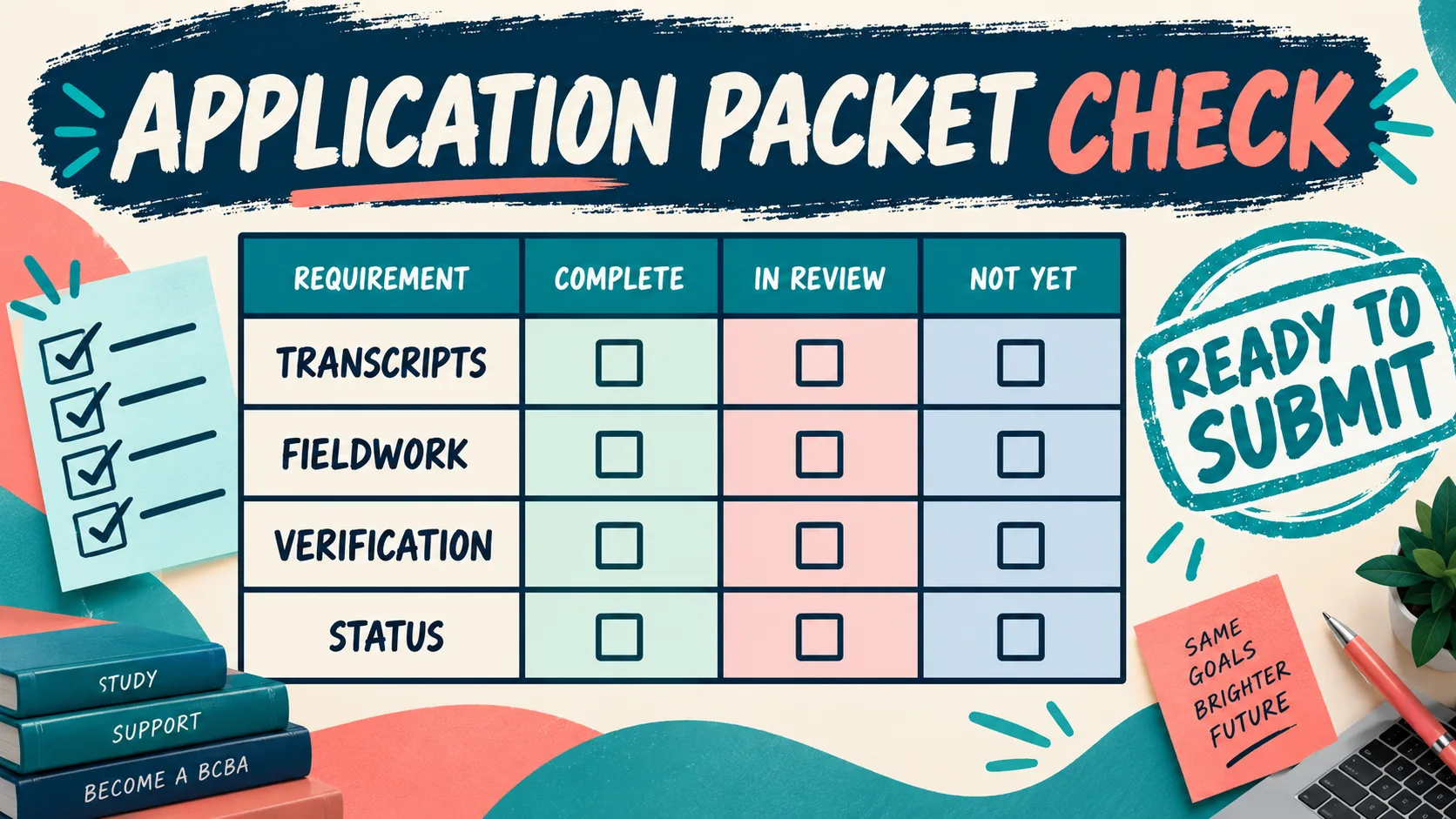
An application-ready packet is not just a folder full of PDFs. It is a map showing which authority needs each document, how the document will be verified, and what status it has. The Arizona Board explains that some verification materials may be sent before the application and retained for a limited period, so record the date each item was sent and confirm the current retention instructions.
- Identity and route: write the exact application category and the facts that make it fit.
- Education: request official transcripts through the channel the receiving organization accepts.
- Fieldwork and supervision: identify who must verify experience and which dates and signatures must match.
- Credential history: list current and prior licenses or certifications when the route requires primary-source verification.
- Submission log: record fee, date submitted, confirmation number, missing-item request, and next follow-up date.
| Packet item | Owner | Record in your tracker | Stop condition |
|---|---|---|---|
| Official transcript | School or approved transcript service | Request date, recipient, delivery confirmation | Recipient or format is unclear |
| Fieldwork verification | Supervisor and applicant | Supervisor contact, period, signature, submission date | Hours or dates do not reconcile |
| License history | Issuing boards and applicant | Every jurisdiction, status, verification route | A prior credential is omitted or unverified |
| Application confirmation | Applicant | Payment, date, confirmation, missing-item messages | No confirmation or the route is wrong |
Use the Arizona Board’s application process page to distinguish administrative from substantive review. Some applications can take five to six months or more, so track status instead of repeatedly resubmitting documents.
Use the 2026-to-2027 Checkpoint
The BACB lists January 1, 2027 as the start of revised BCBA eligibility and maintenance requirements. The practical question is not “Which year sounds better?” It is “When will my complete application be received, and which requirements and examination version apply at that time?” Read the current BACB upcoming changes page and transition guidance before you decide.
| Checkpoint | Question to answer | Evidence to save |
|---|---|---|
| Before December 31, 2026 | Could my complete certification application be received under the current rules? | Current handbook section, application status, payment, transcripts, and required documents. |
| On or after January 1, 2027 | Which 2027 pathway and examination requirements apply to my application date? | Current 2027 handbook and BACB transition guidance reviewed on the planning date. |
| Arizona step | Does Arizona require a separate current state application after or alongside certification? | Board route, fee, verification status, and any state-specific response. |
Do not treat an old checklist as a transition ruling. BACB controls certification requirements and Arizona controls its state process; save the date you checked each authority.
Track Administrative and Substantive Review
After you submit, use statuses that tell you what action is actually needed. “Submitted” and “approved” are not interchangeable. Arizona’s process page describes administrative review of completeness and a later substantive review of whether the statutory and rule requirements are met. The committee process and meeting schedule can affect timing.
| Tracker status | Meaning | Your next action |
|---|---|---|
| Preparing | Route and evidence packet are not final. | Resolve missing documents before paying or submitting. |
| Submitted | The portal accepted an application, not necessarily a complete file. | Save confirmation and watch for official requests. |
| Administrative review | Staff are checking whether the file is ready for substantive review. | Respond exactly to a missing-item request and keep proof of delivery. |
| Substantive review | The applicable requirements are being evaluated. | Do not interpret silence as approval; follow the official status channel. |
| Decision or deficiency | The Board has issued a response or identified a problem. | Read the actual notice, deadline, and appeal or correction instructions. |
Avoid Application-Readiness Mistakes
The most expensive mistakes are often routing mistakes rather than difficult exam concepts. Before submitting, run this short audit:
- Credential language: did you write “certification” and “license” accurately in every form and email?
- Route match: did you confirm general, reciprocity, universal recognition, or telehealth eligibility from the current Board page?
- Document owner: does the right school, supervisor, licensing board, or applicant send each item?
- Date consistency: do degree, fieldwork, certification, and license dates tell the same story?
- 2027 checkpoint: did you recheck the BACB handbook if your application will cross January 1, 2027?
- Status proof: do you have confirmation numbers and a follow-up date rather than only a screenshot of a completed form?
How to Become a BCBA in Arizona FAQ
Do I need both BCBA certification and an Arizona license? Analyze the national credential and state practice requirements separately. The Arizona Board states that BCBA certification is not a license. Can I apply for Arizona licensure if I do not live in Arizona? The Board says applicants need not live in Arizona for the general or reciprocity application. Confirm the current route and requirements directly with the Board. Is reciprocity the same as universal recognition? No. They are different routes with different conditions. Read the current Arizona instructions. What changes for BCBA applicants in 2027? The BACB lists revised eligibility and maintenance requirements beginning January 1, 2027. Use the current handbook and transition guidance for your application date. How long will the Arizona application take? The Board warns that some applications can take five to six months or more. Track status and respond to official requests; an estimate is not a guarantee.
Connect Eligibility Work to Exam Readiness
Once your pathway and evidence packet are clear, separate paperwork work from exam work. Use the current BCBA Test Content Outline to organize study time, then practice explaining why an answer fits the described concept rather than memorizing a state-specific shortcut. A strong plan has both a document tracker and a learning tracker.
- Plan: confirm one application route and choose one BCBA outline domain.
- Do: request or verify one document, then complete practice questions on that domain.
- Review: save the confirmation and record exam errors by concept, not only by score.
For a focused knowledge checkpoint, try the site’s free BCBA mock exam. It is independent practice content, not an official BACB exam, not an Arizona licensing service, and not a guarantee of a passing result. Bottom line: keep the BACB and Arizona tracks separate, choose the correct route, audit the packet, recheck 2027 requirements, and track the actual review status from primary sources. Reviewed October 11, 2026. Confirm current BACB and Arizona Board instructions before submitting an application.
Take the Free BCBA Mock Exam
A useful next step is to apply this idea in a fresh set of BCBA-style practice questions and review the feedback. Take the Free BCBA Mock Exam



