

When a BCBA study question says a learner is satiated ABA style, do not stop at “the learner had enough.” Ask what changed in the value of a specific reinforcer and what happened to behavior that previously contacted it. Satiation can function as an abolishing operation (AO), but the label is strongest when the relevant value and behavior changes are supported by the vignette or data.
Table of Contents
- What Does Satiated ABA Mean in a Vignette?
- Use the Four-Question Decision Tree
- Separate Satiation From Nearby Explanations
- Check Reinforcer Value and Behavior Separately
- Troubleshoot the Session Before Naming an AO
- Use the Satiation Versus Deprivation Matrix
- Keep the Client-Welfare Boundary Visible
- Apply the Decision to a BCBA Exam Vignette
- Satiated ABA FAQ
- Turn the Distinction Into Practice
- Take the Free BCBA Mock Exam
This page is a decision tree for reading a vignette and troubleshooting a session. It is narrower than the site’s satiation definition and examples guide, the reinforcer-value explanation, and the deprivation-versus-satiation comparison. Those pages remain useful references; this article helps you decide which explanation fits a particular pattern.
Safety and accuracy boundary: a practice article cannot determine a client’s reinforcer, authorize a deprivation procedure, or replace supervision. Use the current BACB Ethics Code resources, client-welfare safeguards, assent practices, and qualified clinical judgment before changing access to any stimulus.
What Does Satiated ABA Mean in a Vignette?
In behavior analysis, satiation refers to a condition in which recent or extended access to a stimulus may reduce that stimulus’s reinforcing effectiveness. When that condition also reduces behavior that previously produced the stimulus, it can be analyzed as an abolishing operation. The important words are specific stimulus, reinforcing effectiveness, and behavior previously associated with that consequence.
| Vignette clue | What it may support | What it does not prove alone |
|---|---|---|
| Extended access to a preferred item | A possible reduction in that item’s reinforcing effectiveness. | That every behavior maintained by every reinforcer will decrease. |
| Fewer requests for the same item | A possible abative effect when the item was the relevant consequence. | That satiation is the cause if prompting, effort, or the contingency also changed. |
| Item rejection | A clue to reduced preference or value that needs context. | A definitive test of reinforcer effectiveness by itself. |
| A different reinforcer still works | A stimulus-specific value change may be more plausible. | That the learner is globally “unmotivated.” |
The current BCBA Test Content Outline is the exam-facing reference for motivating operations, reinforcement, measurement, and behavior-change reasoning. Use it to classify the principle, then use the facts in the question to decide whether the principle actually fits.
Use the Four-Question Decision Tree
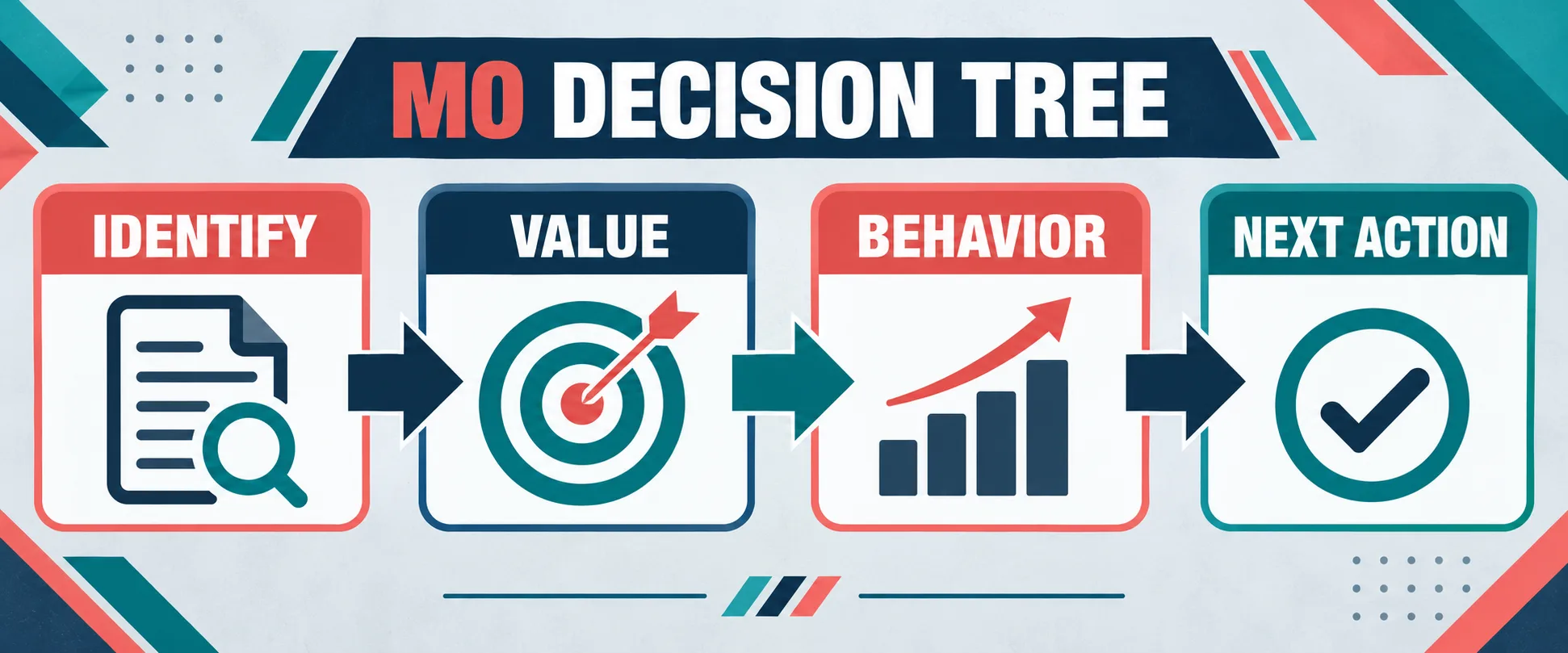
Move through the questions in order. If a branch is unsupported, do not force the answer to “satiation.” In an exam item, the strongest answer usually follows the exact relation described, not the most familiar vocabulary word.
- What is the relevant stimulus? Name the item, event, attention, escape, or activity whose reinforcing value may have changed.
- What changed before the target behavior? Look for access, restriction, aversive stimulation, deprivation, effort, delay, or another environmental event.
- What happened to value and behavior? Look for evidence that the consequence became less effective and that behavior previously producing it changed.
- What is the next verification? Check the contingency, the measurement, alternative reinforcers, and procedural integrity before naming an AO with confidence.
| Decision point | Strong evidence | Weak shortcut |
|---|---|---|
| Stimulus identified | The question names the reinforcer or makes its function clear. | The item is merely called “preferred.” |
| Value change | Access or restriction is linked to later acceptance, choice, or responding. | The learner looks tired, quiet, or distracted. |
| Behavior change | The behavior previously reinforced by that stimulus changes in the expected direction. | One unaccepted presentation is treated as a complete analysis. |
Separate Satiation From Nearby Explanations
Many wrong answers sound similar because they all involve less responding. The discriminating question is what process changed and what evidence the question gives you.
| Candidate explanation | Core pattern | Question to ask |
|---|---|---|
| Satiation / AO | Recent access may reduce the value of a specific reinforcer and behavior that contacted it. | Is the value change tied to the same consequence? |
| Deprivation / EO | Restricted access may increase value and evoke behavior previously producing it. | Did limited access precede stronger responding? |
| Extinction | The response–reinforcer contingency is discontinued or altered. | Was the consequence still available for the target response? |
| Habituation or repeated exposure | Responding to a repeated stimulus may decline without the same reinforcer-function analysis. | Is the question about stimulus exposure rather than a consequence? |
| Implementation or data problem | Prompting, effort, timing, definition, recording, or staff fidelity changed. | Did the procedure change before the behavior changed? |
Check Reinforcer Value and Behavior Separately
A common exam error is to infer a value change from response rate alone. Response rate can change because of effort, competing events, schedule, prompting, health, sleep, or a recording error. Treat value and behavior as two related but separate observations.
- Value clue: the learner selects, approaches, accepts, or works for the stimulus differently.
- Behavior clue: a response that previously produced the stimulus changes in frequency, latency, persistence, or choice.
- Contingency clue: the stimulus is still delivered according to the same relevant contingency.
- Comparison clue: another stimulus or condition helps show whether the effect is specific or global.
| Observation | Interpret cautiously as | Next check |
|---|---|---|
| Learner rejects one item after free access | Possible reduced value, preference shift, or momentary context effect. | Offer a valid alternative and review repeated observations. |
| Requests for that item decline while another item works | A stimulus-specific AO hypothesis is more plausible. | Check the contingency and measure both choice and responding. |
| All responding declines | A global context, health, effort, prompt, schedule, or data issue may be involved. | Review session conditions and procedural integrity before an AO label. |
Troubleshoot the Session Before Naming an AO
In practice, the safest next action is often a short data and fidelity review. Research on motivating operations shows why presession access or restriction can matter, but it also shows the need to examine the actual condition and measured effect rather than assuming that a scheduled exposure created satiation.
| Check | What to compare | Why it matters |
|---|---|---|
| Access history | What access occurred, for how long, and under what conditions? | A label such as “free access” may hide timing or dosage differences. |
| Definition and measure | Are the behavior definition and recording procedure stable? | A measurement change can imitate a behavior change. |
| Contingency | Does the response still produce the same consequence with the same delay and effort? | A changed contingency points away from a pure value explanation. |
| Alternative conditions | Does another reinforcer, task, or context produce a different pattern? | A comparison helps separate stimulus-specific from global effects. |
- Mark the exact time of access and the first observation after it.
- Compare raw records before relying on a dashboard summary.
- Ask whether staff implemented the same prompt, schedule, and consequence.
- Escalate an unexpected or safety-relevant change to the responsible supervisor.
Use the Satiation Versus Deprivation Matrix
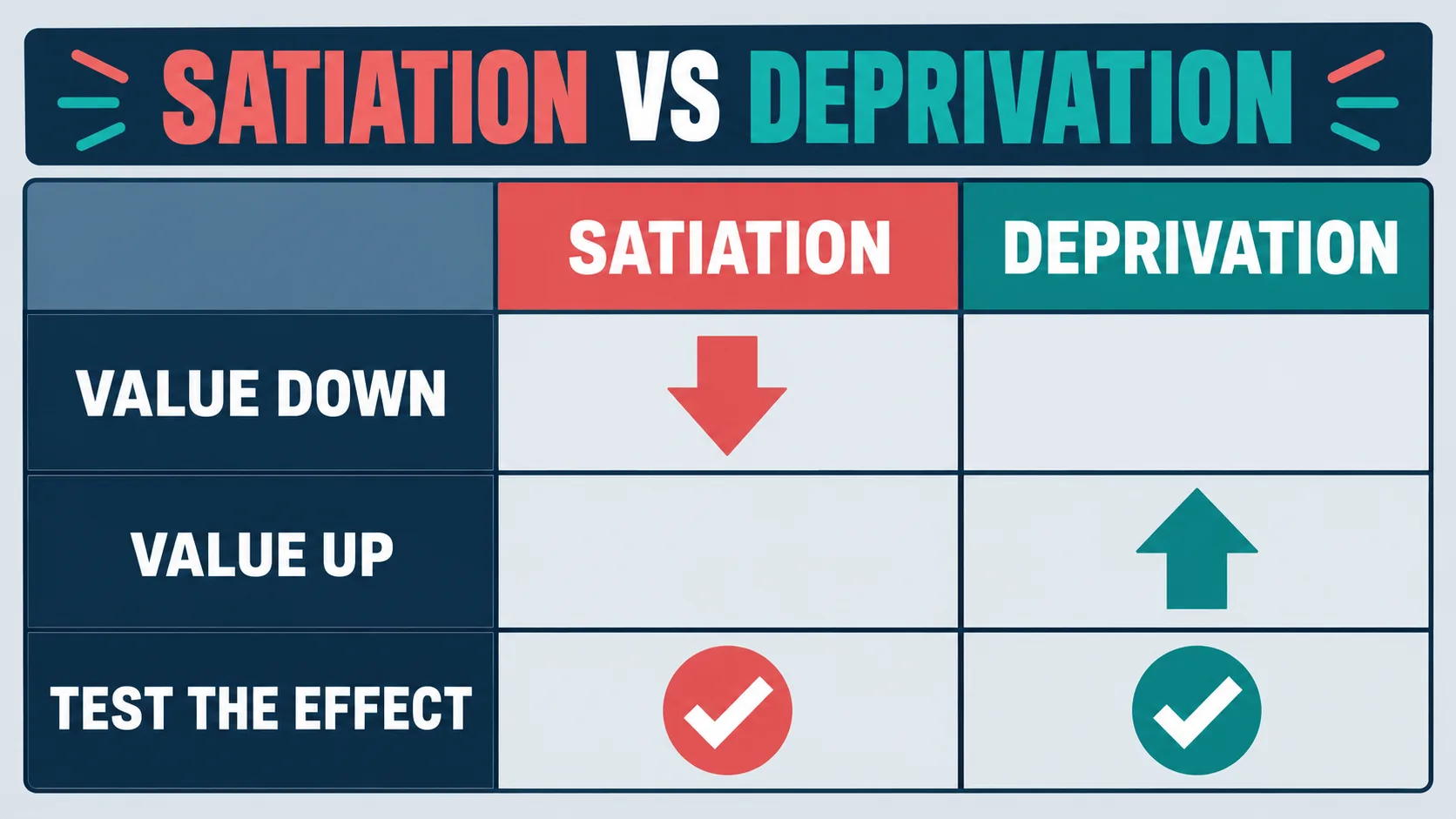
Use this matrix as an exam-time memory aid: the direction of the value change matters. Satiation and deprivation are not interchangeable because they predict opposite changes in the effectiveness of a relevant reinforcer. The actual question still controls; do not assign a label when the relation is missing.
| Condition | Reinforcer value | Likely behavior effect | Exam cue |
|---|---|---|---|
| Satiation / AO | Down for a relevant stimulus | Less behavior that previously produced it | Recent or extended access is described |
| Deprivation / EO | Up for a relevant stimulus | More behavior that previously produced it | Restricted access or absence is described |
| Unclear | Not established | Do not predict from a single response | Check procedure, data, and alternatives |
Keep the Client-Welfare Boundary Visible
Satiation is a functional concept, not permission to withhold food, water, attention, communication, or other meaningful access without a sound, supervised, client-centered rationale. The BACB’s ethics resources emphasize client welfare, dignity, respect, privacy, integrity, and competence. When a plan changes access to a stimulus, consider assent, risks, alternatives, cultural context, and the least intrusive path consistent with the client’s goals.
| Boundary question | Safer reasoning | Red flag |
|---|---|---|
| Is a basic need involved? | Protect access and consult the responsible clinical team. | Treating hunger, thirst, or distress as a convenient teaching tool. |
| Is the client’s assent meaningful? | Use observable assent and dissent signals and adjust the plan with supervision. | Ignoring refusal because a reinforcer is needed. |
| Is the analyst competent for the decision? | Consult current sources and qualified supervision. | Turning one study card into an individualized treatment decision. |
Apply the Decision to a BCBA Exam Vignette
On a multiple-choice item, underline the stimulus, the prior access or restriction, the response that changed, and the consequence. Then eliminate answers that describe a different process. The correct answer should account for the direction of the reinforcer-value change and the behavior change described in the stem.
| Stem detail | Question in your head | Answer move |
|---|---|---|
| Recent free access | Could this reduce the value of the same stimulus? | Consider satiation/AO, then look for the behavioral effect. |
| More responding after restricted access | Did deprivation increase value and evoke prior responding? | Consider deprivation/EO rather than satiation. |
| Consequence stopped | Did the contingency change? | Consider extinction or another contingency effect. |
| No clear value evidence | Is the stem asking for a hypothesis or a confirmed function? | Choose the answer best supported by the stated facts, not a guess. |
- Name the reinforcer before naming the operation.
- Match the direction: access often points toward reduced value; restriction often points toward increased value.
- Check whether the behavior previously produced the stimulus.
- Reject a label that ignores a changed contingency or measurement procedure.
Satiated ABA FAQ
Is satiation always an abolishing operation? No. It can function as an AO when it reduces the reinforcing effectiveness of a relevant stimulus and changes behavior associated with that stimulus. The relation must be supported by the facts. Does refusing an item prove satiation? No. Refusal may reflect preference, context, effort, illness, communication, or a changed contingency. Treat it as a clue that needs repeated, respectful assessment.
What is the fastest way to distinguish satiation from deprivation? Look at the direction of value change and responding. Recent access suggests a possible decrease; restricted access suggests a possible increase. Then verify the same reinforcer and contingency. Should I use deprivation to make a reinforcer work? Do not turn an exam concept into an unsupervised procedure. Client welfare, assent, ethics, clinical evidence, and qualified supervision come first.
Turn the Distinction Into Practice
After you can separate satiation, deprivation, extinction, habituation, and procedural error, use practice questions to make the discrimination faster. Explain why the reinforcer value changed, what behavior should be affected, and which detail would falsify your first answer. That is stronger preparation than memorizing “satiation equals AO” without the functional relation.
For a focused checkpoint, try the site’s free BCBA mock exam. It is independent practice content, not an official BACB exam, not an individualized clinical recommendation, and not a guarantee of a passing result.
Bottom line: when a vignette describes someone as satiated, identify the specific stimulus, the access history, the change in reinforcer effectiveness, and the behavior that changed. Then rule out altered contingencies and implementation problems before calling the pattern an abolishing operation. Reviewed October 11, 2026. Confirm current BACB resources and use qualified supervision before applying motivating-operation concepts to real client care.
Take the Free BCBA Mock Exam
A useful next step is to apply this idea in a fresh set of BCBA-style practice questions and review the feedback. Take the Free BCBA Mock Exam



