
In ABA, tangible function means behavior is maintained by access to a particular item or activity. If a BCBA exam vignette says a learner cries after a tablet is removed and receives the tablet after crying, the relevant consequence is access to a tangible—not simply “the learner wanted something.” The exam task is to trace the consequence and rule out competing explanations.
Table of Contents
- What Does Tangible ABA Mean?
- Use the Tangible-Function Decision Tree
- Separate Tangible From Nearby Functions
- Trace the ABC Pattern Before Naming the Function
- Choose the Next Data Check
- Do Not Overcall a Tangible Function
- Check Multiple Control and Delayed Access
- Apply the Pattern to a BCBA Vignette
- Tangible ABA FAQ
- Turn the Distinction Into Practice
- Take the Free BCBA Mock Exam
This tangible ABA guide is deliberately narrower than the site’s four-functions overview and its BCBA exam guide. Those pages explain the larger framework. This page helps you decide whether a specific vignette supports tangible function, what evidence is still missing, and which next data check is defensible.
Accuracy and safety boundary: descriptive patterns can generate a hypothesis but do not, by themselves, establish a functional relation. Use the current BCBA Test Content Outline, qualified supervision, client-welfare safeguards, and appropriate assessment procedures before applying these concepts to real care.
What Does Tangible ABA Mean?
A tangible function is a socially mediated function in which behavior produces access to a specific item or activity. The item may be a toy, device, food item, game, movement activity, or another concrete event. The key is not that the item is visible or preferred. The key is that access to it follows the behavior and helps explain why that behavior continues.
| Vignette element | What supports a tangible hypothesis | What is not enough alone |
|---|---|---|
| Antecedent | Access is blocked, delayed, or the item is removed. | The learner looks at or reaches toward an item. |
| Behavior | The response reliably occurs in relation to losing or being denied the item. | Any challenging behavior that happens near a toy. |
| Consequence | The same or equivalent item/activity is delivered after the response. | Attention, comfort, or escape is delivered at the same time. |
| Pattern | The response changes when the tangible contingency changes. | A single anecdote with no comparison or repeated observation. |
The current BACB outline places assessment and functional-analysis reasoning within the knowledge expected of BCBA candidates. On an exam, answer the question asked: identify the most supported function or assessment step. Do not turn a vocabulary clue into a clinical conclusion.
Use the Tangible-Function Decision Tree
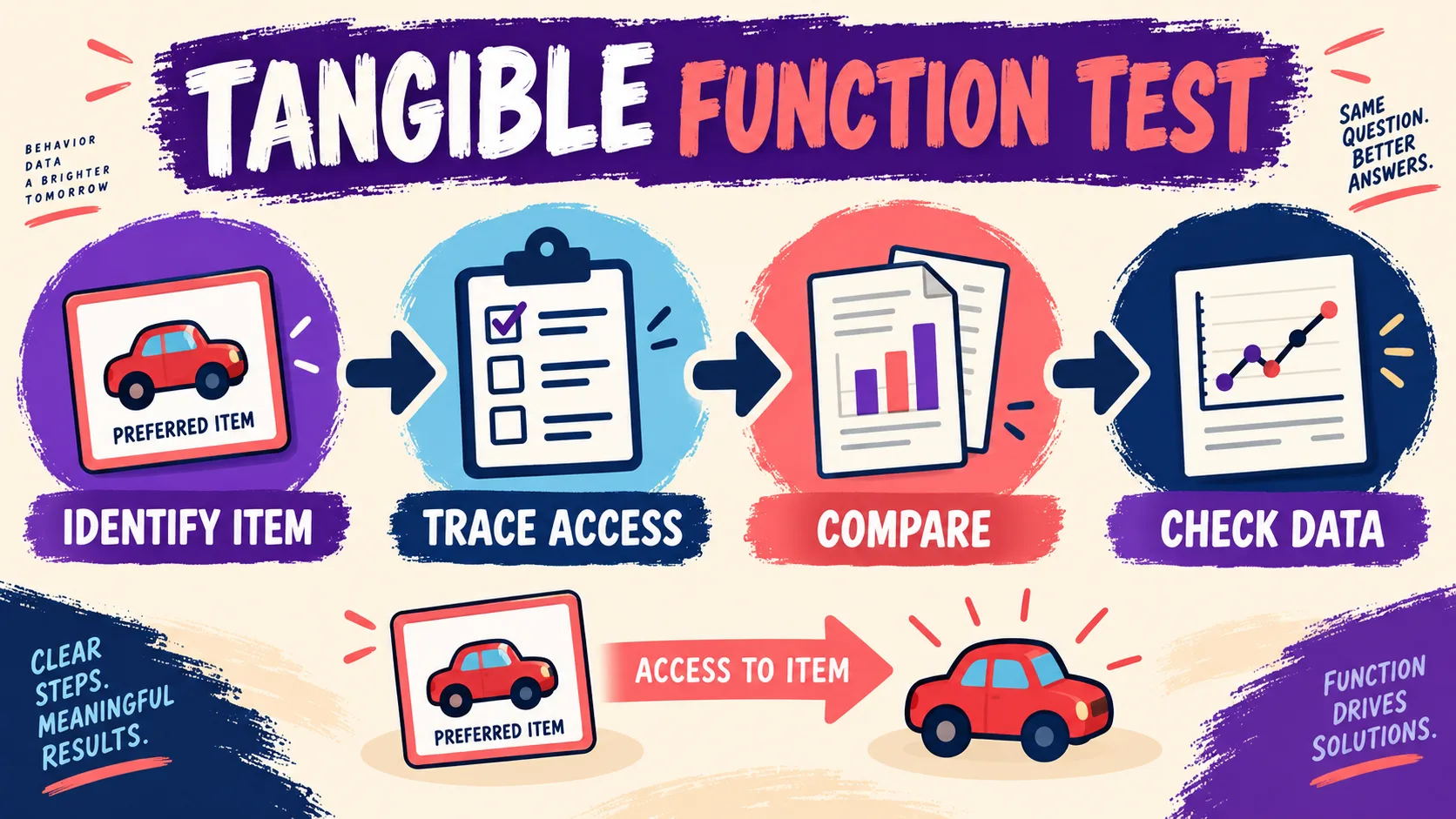
Use the four questions below in order. They keep the consequence, rather than the object, at the center of the analysis.
- What exact item or activity is involved? Name it. “Something preferred” is too vague if the answer depends on a specific consequence.
- What happened to access? Look for removal, denial, delay, interruption, or a request that was not honored.
- What followed the behavior? Did the learner get the item, activity, or a close equivalent? Did the learner instead get attention or escape from a task?
- What comparison would change your conclusion? Check another function, another item, a different condition, or a measure of the relevant contingency.
| Decision point | Strong clue | Exam trap |
|---|---|---|
| Item identified | The stem names the item or makes the access event clear. | Calling any preference a tangible function. |
| Access changed | Removal or denial occurs before the response. | Ignoring a demand or social event that happened first. |
| Consequence matched | The item or activity follows the response. | Assuming the item was the consequence when only attention followed. |
Separate Tangible From Nearby Functions
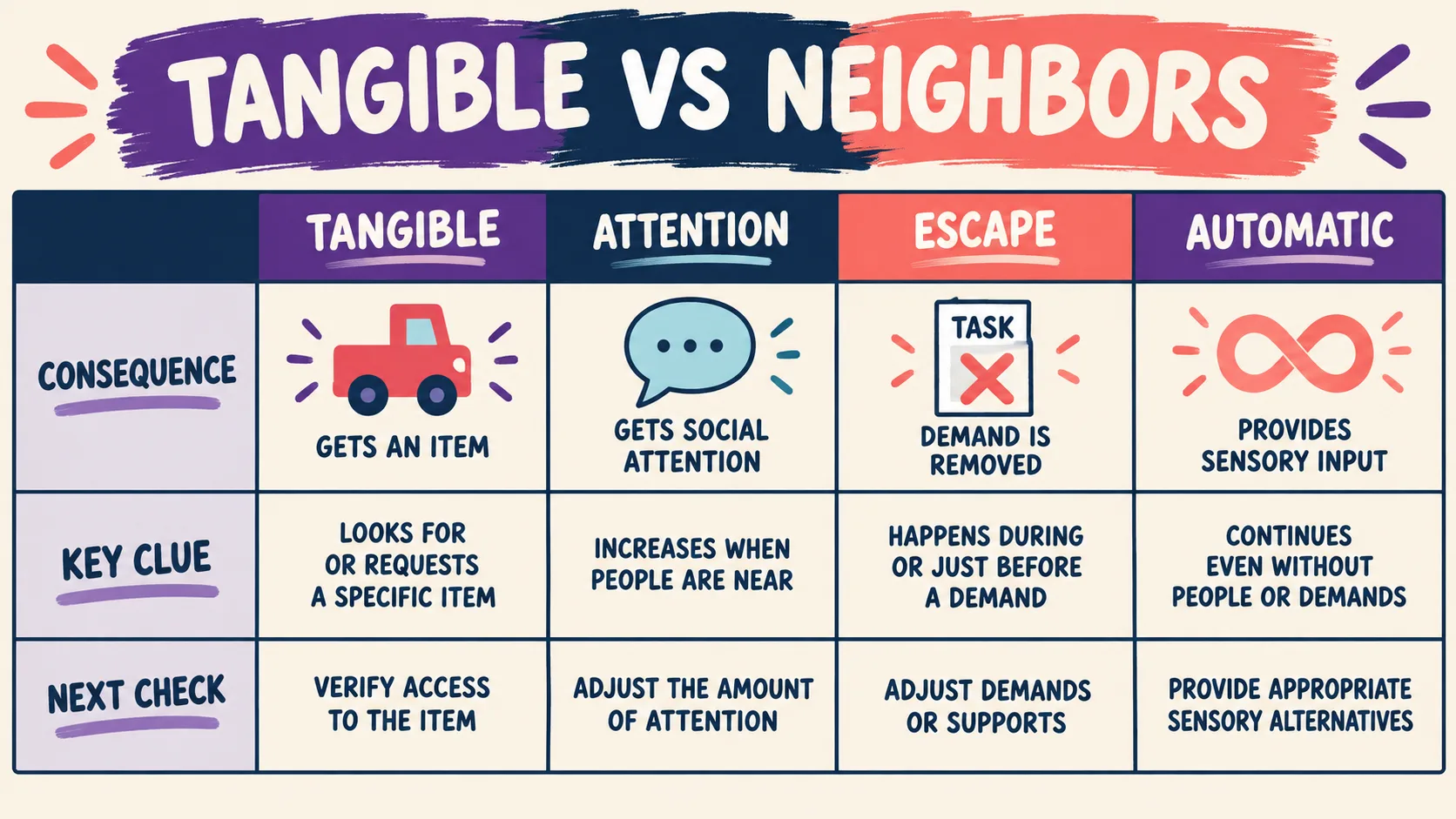
Several functions can look similar when a preferred item is present. The correct classification depends on the event that changes the future likelihood of behavior.
| Possible function | Maintaining consequence | Fast discriminating question |
|---|---|---|
| Tangible | Access to a specific item or activity. | Did access follow the response? |
| Attention | Social interaction, conversation, comfort, or reaction. | Would the behavior continue if the item were unavailable but attention remained? |
| Escape | Removal, delay, or reduction of a demand or aversive event. | Did the response end or postpone a task? |
| Automatic | Sensory stimulation produced by the behavior itself. | Does the behavior persist without another person delivering the item? |
An item can appear in an attention or escape vignette without being the maintaining consequence. For example, a caregiver may hand over a tablet while talking to the learner; the answer depends on which event is functionally related to the behavior, not which object is most noticeable.
Trace the ABC Pattern Before Naming the Function
Write the sequence in a compact form: what happened before, what the learner did, and what changed immediately afterward. Then ask whether the pattern repeats. A clear ABC summary is more reliable than the label “tangible-motivated” written at the top of a note.
- Before: identify the access event, demand, social event, or absence of stimulation.
- Behavior: use an observable definition rather than “tantrum” or “wanted the toy.”
- After: record the actual consequence, its delay, duration, and whether access was complete or partial.
- Repeat: compare several opportunities before treating the pattern as a strong hypothesis.
| ABC question | Tangible-focused record | Why it prevents an error |
|---|---|---|
| What was unavailable? | Name the item/activity and the access rule. | Separates denial from a general preference. |
| What did the response produce? | Item, activity, attention, escape, or nothing. | Separates tangible access from a coincidental object. |
| How quickly did it follow? | Record delay and duration of access. | Shows whether the consequence plausibly contacts the response. |
Choose the Next Data Check
If the vignette does not establish the function, the best answer may be a next assessment step rather than a label. Descriptive assessment can show patterns; experimental functional analysis is used when an appropriate, supervised design is needed to test functional relations. The current BACB outline distinguishes assessment tasks and expects candidates to reason about measurement and interpretation.
| What is missing? | Useful next check | Do not claim yet |
|---|---|---|
| Consequence is unclear | Collect ABC data that records the exact event after behavior. | That the item maintains behavior. |
| Pattern is inconsistent | Compare access, attention, demands, and competing items across opportunities. | That one function explains every episode. |
| A functional relation is needed | Use an appropriate, ethically supervised functional-analysis approach. | That a descriptive correlation proves causation. |
- Measure the behavior’s critical dimension consistently.
- Record whether access was contingent, noncontingent, delayed, or accidentally delivered.
- Document competing consequences instead of assuming a single function.
Do Not Overcall a Tangible Function
Research on functional analysis has documented why a tangible outcome can be misleading. A response may occur in the presence of a preferred item because of attention, escape, multiple control, or a general change in the session—not because access to the item is the maintaining consequence. Treat tangible as a hypothesis that must fit the whole pattern.
| Warning sign | Possible alternative | Better reasoning |
|---|---|---|
| Item is present, but no access follows behavior. | Attention, escape, or automatic reinforcement. | Trace the actual consequence, not the visible object. |
| Item follows behavior along with praise and comfort. | Multiple control or attention as the critical event. | Look for comparison data or a controlled assessment. |
| Behavior decreases when the item is freely available. | A value change may be relevant, but causation is not established. | Check the contingency and repeat the observation. |
Check Multiple Control and Delayed Access
A learner can contact more than one consequence in the same episode. A request may produce the item, eye contact, language, and a break from a task. If access is delayed, the consequence may also be too remote to explain the response unless the pattern is clear. On an exam, the best answer usually names the consequence most directly supported by the stem.
| Pattern | What to isolate | Exam move |
|---|---|---|
| Item and attention arrive together | Which consequence changes when the response occurs? | Do not choose tangible from the object alone. |
| Item arrives after a long delay | Whether an earlier consequence contacted the behavior. | Prefer the relation supported by timing and data. |
| Several items are available | Specific choice, access, and response pattern. | Name the stimulus class only as precisely as the stem allows. |
Apply the Pattern to a BCBA Vignette
For a multiple-choice question, underline four details: the item or activity, the access event, the observable response, and the consequence. Then cross out answers that describe a different change. This prevents “tangible” from becoming a reflex answer whenever a toy, tablet, or snack appears.
| Stem detail | Ask yourself | Likely exam move |
|---|---|---|
| Tablet is removed, crying occurs, tablet returns | Did access to the same item follow? | Tangible is supported if the relation is repeated or clearly stated. |
| Work starts, learner cries, demand ends | What consequence changed immediately? | Consider escape rather than tangible. |
| Adult talks and hugs after behavior | Was social interaction the consequence? | Consider attention unless item access is the clear contingency. |
| Item is visible but never delivered | Is the visible item actually the consequence? | Choose the answer supported by the delivered event or select more data. |
- Name the consequence before naming the function.
- Match the function to the behavior–consequence relation, not the object’s presence.
- If the relation is incomplete, choose assessment or data collection rather than certainty.
Tangible ABA FAQ
What is a tangible function in ABA? It is behavior maintained by access to a particular item or activity. The item must be part of the consequence relation; being nearby is not enough. Is tangible the same as attention? No. Attention is social interaction; tangible is access to an item or activity. They can occur together, so trace which event most directly follows and changes responding. Does “no” always mean tangible function? No. Denial can be a useful antecedent clue, but the consequence and repeated pattern still matter. A learner may be responding to escape, attention, or another variable. Can a descriptive ABC pattern prove tangible function? It can support a hypothesis, but descriptive correlation does not establish a functional relation. The assessment question determines whether more controlled analysis is needed. What should I remember for the BCBA exam? Identify the item, trace access, compare competing consequences, and select the answer that matches the strongest stated relation.
Turn the Distinction Into Practice
Practice tangible-function questions by explaining the consequence in one sentence: “After the response, the learner gained access to ___.” Then write one alternative explanation and one data point that would distinguish it. This builds flexible reasoning instead of memorizing a four-function acronym. For a focused checkpoint, try the site’s free BCBA mock exam. It is independent practice content, not an official BACB exam, not an individualized assessment, and not a guarantee of a passing result.
Bottom line: tangible ABA is about the consequence—access to a specific item or activity—not simply a preferred object in the room. Trace the ABC sequence, separate tangible from attention and escape, watch for multiple control, and choose more data when the relation is incomplete. Reviewed October 11, 2026. Use current BACB resources and qualified supervision for real assessment decisions.
Take the Free BCBA Mock Exam
A useful next step is to apply this idea in a fresh set of BCBA-style practice questions and review the feedback. Take the Free BCBA Mock Exam



