
If you are asking how much do bcba make an hour, the honest answer is that there is no single universal BCBA hourly rate. Some BCBAs receive a salary, some receive a W-2 hourly wage, and some accept 1099 contract work. The advertised number can also be tied to billable hours rather than every hour you spend working. To compare offers, convert the compensation into a realistic paid-hour value first.
Table of Contents
- How Much Do BCBA Make an Hour? Start With the Right Comparison
- Convert Annual Salary to an Hourly Equivalent
- Compare W-2, Salary, and 1099 Offers
- Separate Guaranteed Hours From Billable Hours
- Run the Six-Question Offer Audit
- Move From Compensation Planning to BCBA Exam Readiness
- FAQ and Source Boundaries
- Take the Free BCBA Mock Exam
Short answer: an hourly equivalent is annual salary divided by the paid hours that salary covers. A contract rate is not automatically better because it is larger; you must check guaranteed hours, unpaid documentation, cancellations, taxes, insurance, paid time off, retirement, and who pays business expenses. Public wage sources are useful benchmarks, but they are not promises about your specific market or offer.
How Much Do BCBA Make an Hour? Start With the Right Comparison
The phrase how much do bcba make an hour usually hides three different questions:
- What is the hourly equivalent of a salaried BCBA job?
- What hourly rate is attached to a W-2 or 1099 offer?
- What will I actually earn when cancellations, admin work, benefits, and taxes are included?
Those questions need different calculations. The U.S. Bureau of Labor Statistics wage-methodology page explains that wage distributions vary by occupation, industry, and location, which is a useful warning against treating one aggregator’s number as a guaranteed BCBA rate. Use market pages and job postings as directional evidence, then calculate the offer in front of you.
| Pay format | What the advertised number means | First question to ask |
|---|---|---|
| Annual salary | A fixed gross amount for the employment arrangement, often with benefits | How many paid weeks and hours does the salary cover? |
| W-2 hourly | A wage for hours defined as payable under the employer’s policy | Are meetings, documentation, travel, and cancellations paid? |
| 1099 contract | A gross contractor rate before taxes, insurance, unpaid time, and business costs | How many hours are guaranteed, and what costs move to me? |
Convert Annual Salary to an Hourly Equivalent
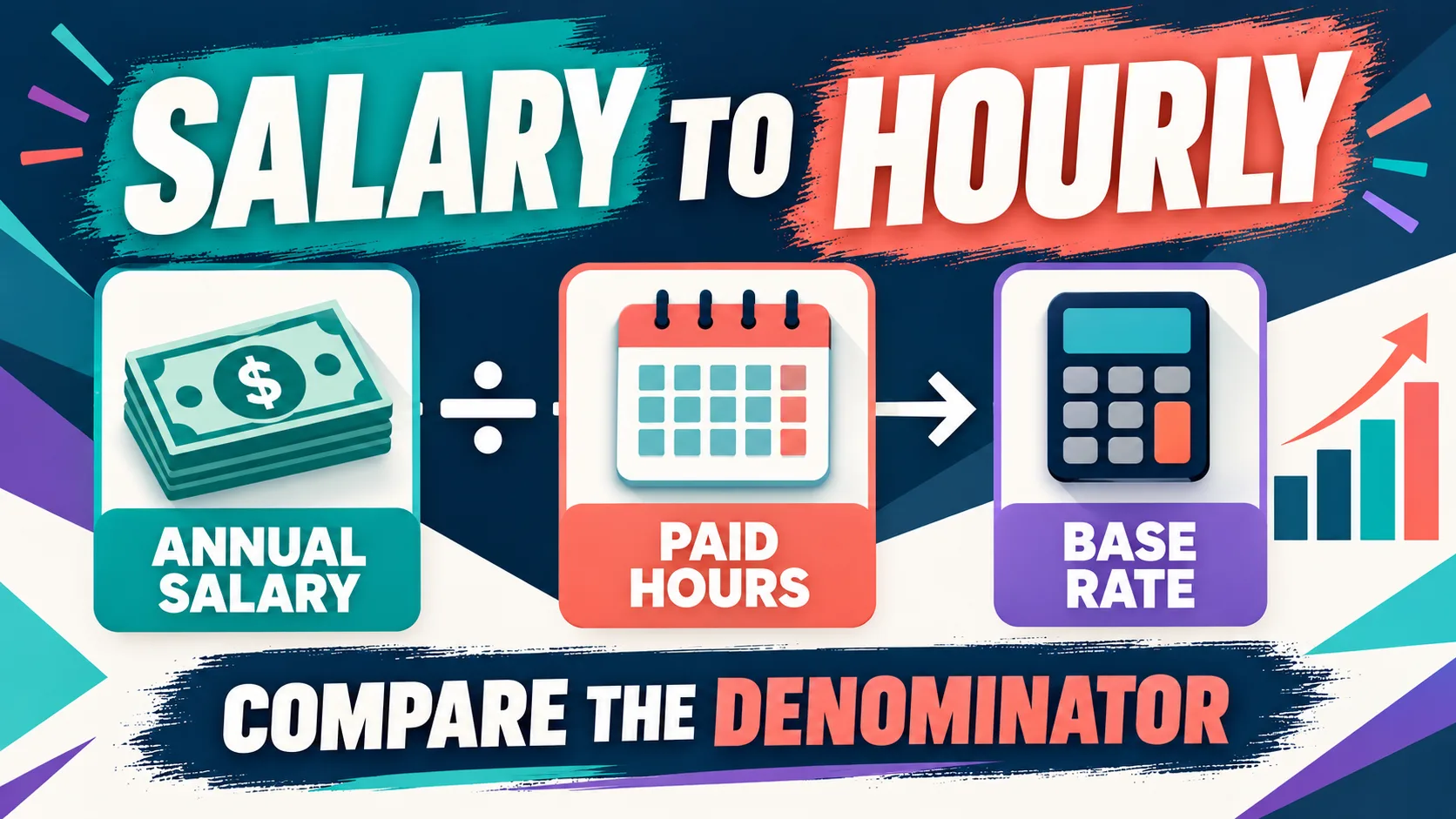
Use this simple formula as a starting point: Hourly equivalent = annual salary ÷ paid hours covered by the salary. If you use 2,080 hours as a rough full-time comparison, an $80,000 salary equals about $38.46 per paid hour, $90,000 equals about $43.27, $100,000 equals about $48.08, and $110,000 equals about $52.88. These are transparent math examples, not national market averages. Change the denominator when the job includes a school calendar, unpaid breaks, part-time guarantees, or fewer paid weeks.
| Illustrative annual salary | Assumed paid hours | Simple hourly equivalent | What can change the result |
|---|---|---|---|
| $80,000 | 2,080 | $38.46/hour | Calendar, PTO, unpaid closure, and actual weekly hours |
| $90,000 | 2,080 | $43.27/hour | Benefits, bonus rules, and expected billable load |
| $100,000 | 2,080 | $48.08/hour | Whether nonbillable work is inside or outside the schedule |
| $110,000 | 2,080 | $52.88/hour | Caseload, travel, on-call expectations, and unpaid time |
The most common mistake is using 2,080 automatically when the job does not actually pay 40 hours for 52 weeks. A salary with four unpaid weeks should be divided by roughly 1,920 paid hours if the employer still expects a 40-hour workweek during the remaining 48 weeks. Conversely, a salaried role with paid holidays, PTO, and employer-covered health insurance may be more valuable than the bare quotient suggests.
Compare W-2, Salary, and 1099 Offers
A large 1099 number often looks attractive because it removes employer-paid costs from the headline. That does not make the offer bad; it means the comparison must include the costs and flexibility that travel with the arrangement.
| Comparison item | W-2 or salary role | 1099 contract role |
|---|---|---|
| Taxes | Employer handles payroll withholding and payroll-tax share according to the arrangement | You plan for self-employment tax, estimated payments, and recordkeeping |
| Benefits | May include health insurance, retirement match, PTO, holidays, or disability coverage | Usually not included unless the contract says otherwise |
| Hours | May offer a salary or a more stable schedule | Often depends on client census, authorization, and contract demand |
| Business costs | Employer may cover systems, supervision, mileage policy, and administrative support | You may carry insurance, software, travel, unpaid admin, and professional costs |
Before you compare two advertised rates, write down the parts that are easy to miss:
- Pay basis: salary, W-2 hourly, or 1099 contractor rate.
- Time basis: paid hours, billable hours, unpaid documentation, and expected availability.
- Stability: guaranteed minimum, cancellation policy, caseload risk, and school-calendar interruptions.
- Total package: benefits, taxes, mileage, insurance, supervision, and professional expenses.
For an illustration, $60 per hour at 25 paid hours each week for 52 weeks is $78,000 gross before contractor costs. That can be a strong offer if the hours are reliable and the flexibility matters, but it is not directly comparable to a $90,000 salary with paid benefits and 40 paid hours. Compare the entire arrangement, not only the headline rate.
Separate Guaranteed Hours From Billable Hours
Ask an employer to define each hour category in writing. A billable-hour requirement is a productivity expectation; it is not automatically a guarantee that the hour will be available or paid. Cancellations, authorization gaps, school breaks, travel, team meetings, parent training, documentation, and supervision can all change the effective rate.
- Guaranteed hours: the minimum hours you are paid or can reasonably schedule even when a client cancels.
- Billable hours: hours that can be billed to a client or payer under the employer’s rules.
- Nonbillable clinical work: supervision, treatment-plan writing, meetings, data review, and documentation that may still be essential.
- Unpaid availability: time spent waiting, traveling, answering messages, or completing required work outside the paid schedule.
If a role pays $75 for billable hours but expects 25 billable hours inside a 40-hour workweek, ask whether the remaining 15 hours are paid, how cancellations are handled, and what happens when the caseload is below target. The effective value depends on the complete answer.
Run the Six-Question Offer Audit
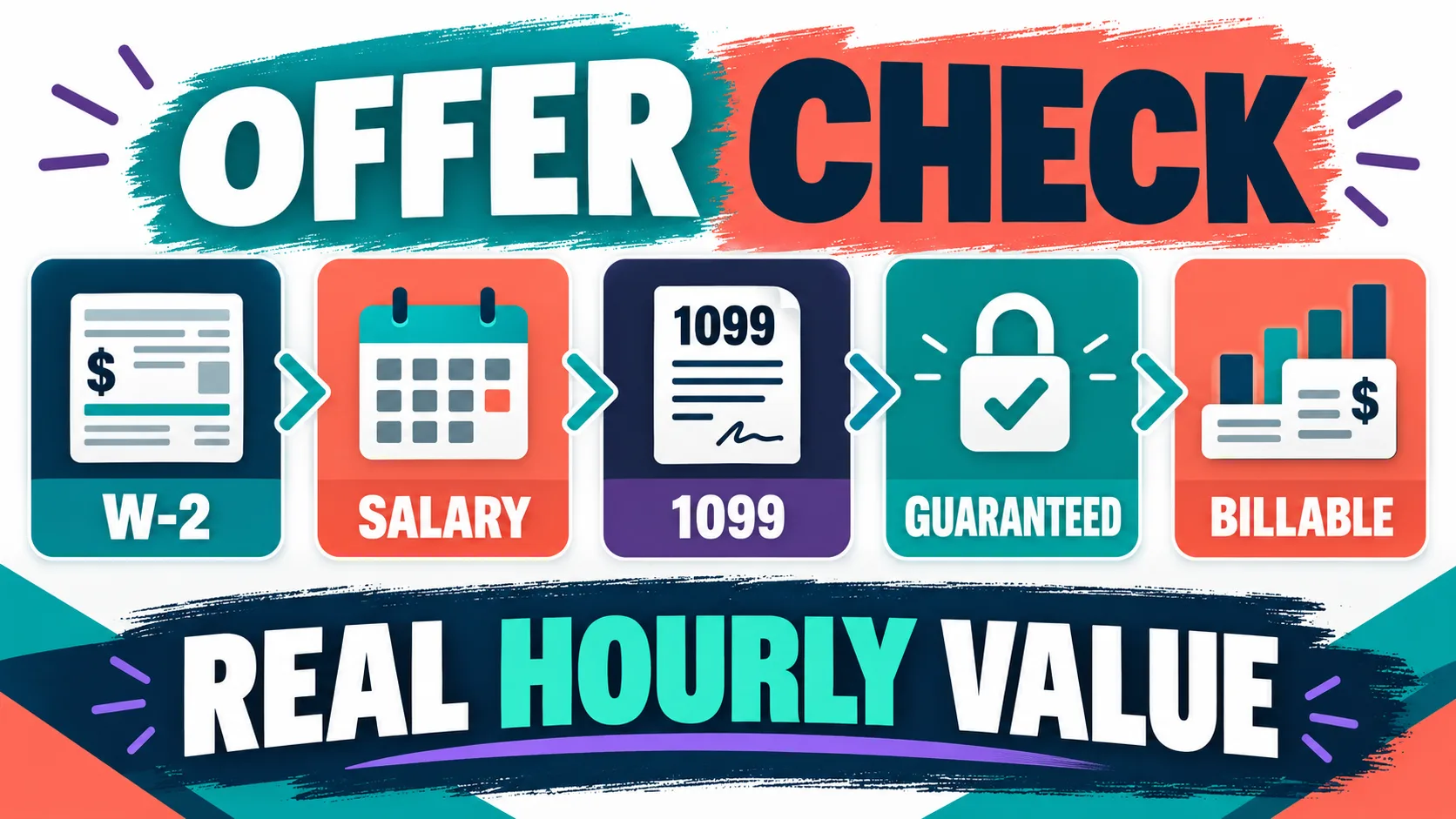
- What is the pay format? Write salary, W-2 hourly, or 1099 before comparing any number.
- What hours are guaranteed? Record paid weekly hours, paid weeks, and cancellation protection.
- What hours are billable? Ask for the target, the measurement period, and the consequence of missing it.
- What work is included? List documentation, meetings, parent training, supervision, travel, and on-call time.
- What benefits or costs move the rate? Price PTO, insurance, retirement, mileage, professional liability, taxes, and software.
- What is the effective hourly value? Recalculate using realistic paid hours, not the most optimistic schedule.
Keep the offer letter, compensation schedule, and answers to these questions together. If an employer cannot explain whether documentation and cancellations are paid, the uncertainty is part of the compensation decision.
Move From Compensation Planning to BCBA Exam Readiness
Hourly pay research is most useful when it supports a concrete career decision: choosing a qualifying program, evaluating a first BCBA role, or deciding whether an offer is worth the workload. If you are not yet certified, do not let a salary number replace the eligibility and exam steps. Check the current BACB task-list resources for the official exam-reference boundary, then use the site’s BCBA jobs comparison guide for the next decision.
When your credential path is clear, use our free BCBA mock exam as a readiness checkpoint. A stronger exam score does not guarantee an hourly wage, but it can help you reach the credential gate that makes the comparison relevant.
FAQ and Source Boundaries
Is a higher hourly number always better? No. Compare guaranteed hours, benefits, unpaid work, taxes, business expenses, and schedule stability. A smaller W-2 number can be worth more than a larger contractor number when the total package is stronger.
How do I convert a BCBA salary to hourly pay? Divide annual salary by the realistic paid hours the salary covers. Use 2,080 only as a rough full-time comparison, then adjust for paid weeks, PTO, and the actual schedule. Why do hourly estimates online disagree? Sources may use different occupations, locations, samples, contract postings, experience levels, or paid-hour assumptions. Public wage data is a benchmark, not a personal offer. Should I ask about billable hours in an interview? Yes. Ask for the target, guarantee, cancellation policy, nonbillable expectations, and how the employer measures productivity. Write down the answer before comparing rates.
Bottom line: the answer to “how much do BCBA make an hour” is a calculation, not one magic number. Convert the salary, identify the paid and billable hours, price the benefits and contractor costs, and compare the effective hourly value. That method gives you a more honest career decision than copying the largest number from a job board. For targeted review, use our how much do bcba make an hour practice questions to apply the concept in exam-style scenarios.
Take the Free BCBA Mock Exam
When you are ready to apply the idea, use the free practice resource below for additional feedback. Take the Free BCBA Mock Exam



