
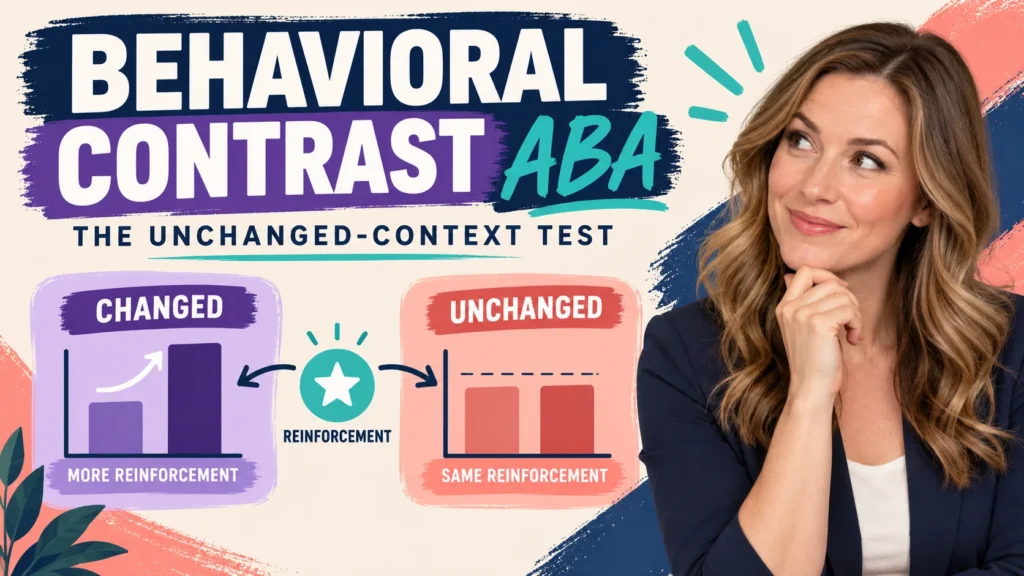
Behavioral contrast ABA questions become easier when you stop looking for a change in only one setting. The key is to track two components of a multiple schedule: one component changes, another stays unchanged, and the response in the unchanged component moves in the opposite direction.
Table of Contents
- What Behavioral Contrast ABA Means
- Map the Multiple-Schedule Components
- Positive Versus Negative Behavioral Contrast
- Contrast Versus Generalization, Relapse, and Setting Differences
- How to Solve a BCBA Exam Scenario
- Why the Distinction Matters in Applied ABA
- FAQ and Practice Next Step
- Take the Free BCBA Mock Exam
Short answer: behavioral contrast is an inverse change in responding in one component of a multiple schedule after the reinforcement conditions change in another component. If reinforcement becomes leaner or is removed in the changing component and responding rises in the unchanged component, that pattern is usually called positive behavioral contrast. If reinforcement is enriched in the changing component and responding falls in the unchanged component, it is negative behavioral contrast.
What Behavioral Contrast ABA Means
Behavioral contrast is not simply a difference between two classrooms, clients, or days. It is a relation between schedule components. A multiple schedule presents two or more simple schedules in alternation, with a discriminative stimulus signaling which component is operating. The Journal of Applied Behavior Analysis review of behavioral contrast describes the central pattern as a change in reinforcement rate in one context followed by an opposite change in behavior in an unchanged context. For a clean BCBA exam answer, ask four questions in order:
- Are there separate components? Look for different colors, rooms, signals, tasks, or stimuli that alternate within a multiple schedule.
- Which component changed? Identify the component where the reinforcement schedule, quality, amount, delay, or extinction condition was altered.
- Which component stayed unchanged? The contrast effect is evaluated in the comparison component whose programmed condition did not change.
- Did responding move in the opposite direction? The unchanged component must show an inverse response change relative to the reinforcement change in the altered component.
- Was the comparison made against a clear baseline? Without a meaningful baseline or stable component comparison, be cautious about labeling an ordinary fluctuation as contrast.
| Diagnostic element | What to locate in the scenario | Common false positive |
|---|---|---|
| Multiple-schedule structure | Two or more signaled components alternate over time | Two unrelated settings with no programmed component relation |
| Changing component | Reinforcement rate, quality, amount, delay, or extinction changes here | The target response changes, but the reinforcement condition was never identified |
| Unchanged component | The programmed contingency remains constant while the other component changes | The “comparison” component also changed, so the inverse relation is unclear |
| Opposite response shift | Responding in the unchanged component moves opposite to the reinforcement change elsewhere | Both components improve or decline together, which may reflect a general treatment effect |
Map the Multiple-Schedule Components
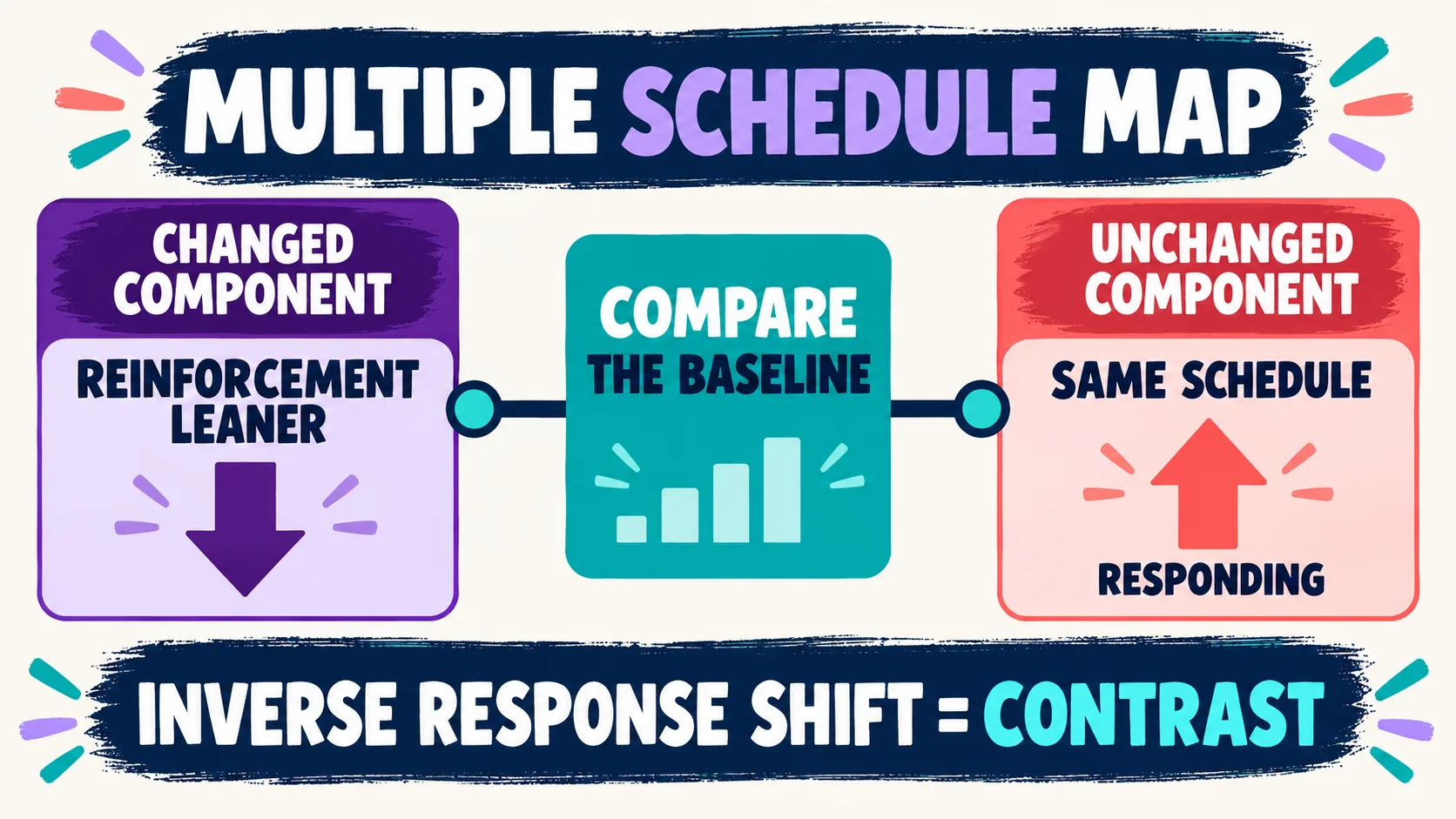
Imagine a learner responding to a communication opportunity under two signaled components. In the blue component, an appropriate request contacts reinforcement on a variable-interval schedule. In the orange component, the same response also contacts reinforcement on a variable-interval schedule. During baseline, the two components have comparable reinforcement arrangements.
Now change only the orange component: make its reinforcement schedule much leaner or place it on extinction. The blue component remains programmed exactly as before. If appropriate requesting in the blue component rises above its baseline level, the unchanged blue component shows positive behavioral contrast. The blue contingency did not become richer; the response changed because the learner is experiencing the relative change across components.
Reverse the direction. If the orange component becomes much richer while the blue component remains unchanged, and responding in blue falls below baseline, that is negative behavioral contrast. The word “positive” or “negative” describes the direction of responding in the unchanged component, not whether the intervention is morally good or bad and not whether the reinforcer is a positive or negative reinforcer.
| Step | Blue component | Orange component | Interpretation |
|---|---|---|---|
| Baseline | VI schedule; stable responding | VI schedule; stable responding | Establish the component comparison |
| Change | Unchanged VI schedule | Reinforcement becomes leaner or extinction is introduced | Orange is the changing component |
| Result | Responding increases above baseline | Programmed condition remains lean | Positive contrast in unchanged blue |
| Opposite result | Responding decreases below baseline | Reinforcement becomes richer | Negative contrast in unchanged blue |
The peer-reviewed analysis of behavioral-contrast definitions also warns that researchers have used both interschedule and intraschedule definitions. For exam purposes, do not get trapped by the label alone. Read the comparison being made: is the response being compared with an earlier schedule condition, or with a baseline inside the current multiple schedule?
Positive Versus Negative Behavioral Contrast
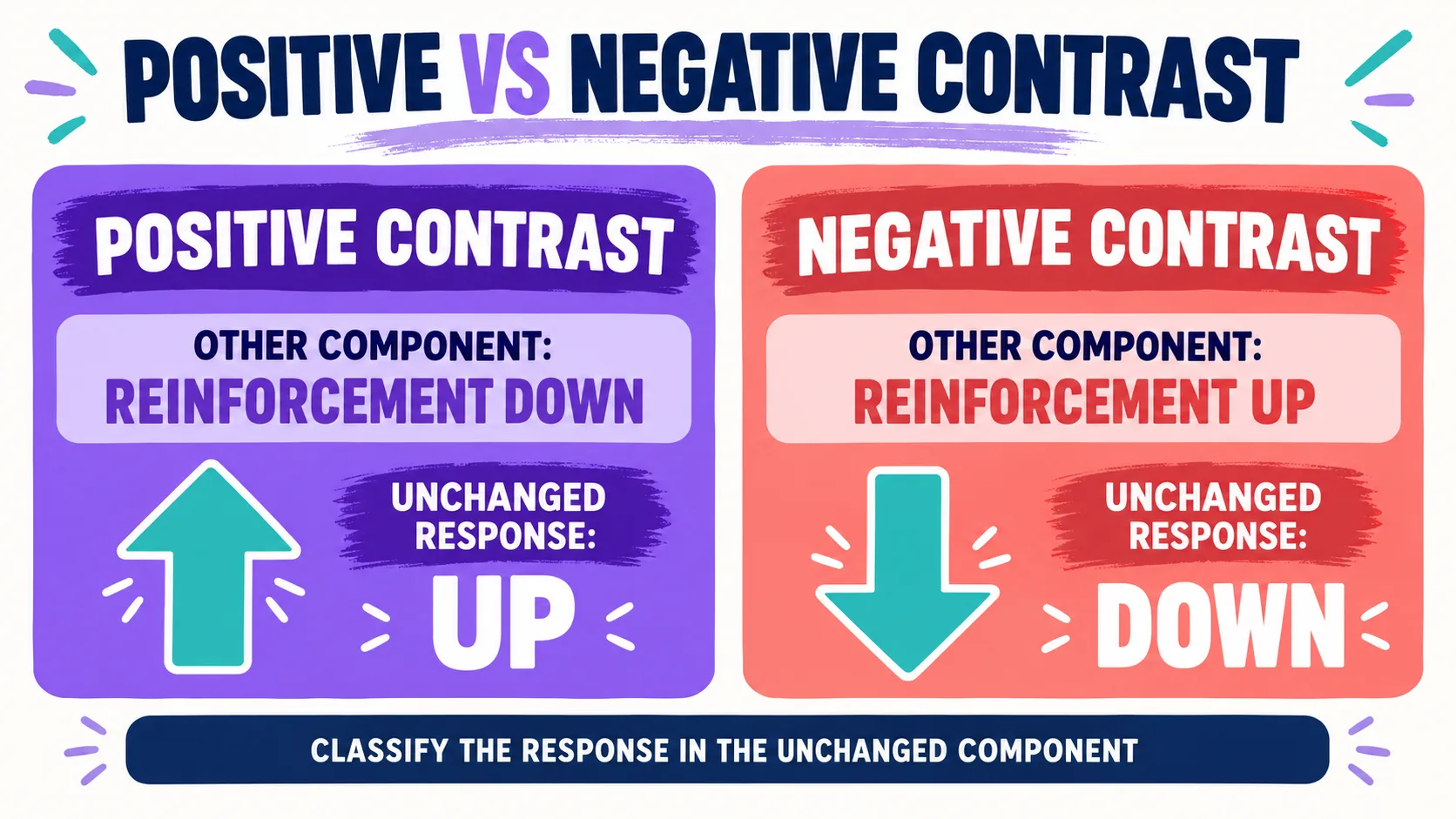
Use the direction of the response change in the unchanged component—not the everyday meaning of “positive” and “negative”—to classify the effect.
| Type | Change elsewhere | Response in unchanged component | Exam wording |
|---|---|---|---|
| Positive contrast | Reinforcement is reduced, delayed, or removed in the changing component | Responding increases | The unchanged component shows an increase after the other component worsens |
| Negative contrast | Reinforcement is increased, improved, or made more immediate in the changing component | Responding decreases | The unchanged component shows a decrease after the other component improves |
Do not translate positive contrast into “positive reinforcement” and negative contrast into “negative reinforcement.” Contrast is a pattern across schedule components. Reinforcement terminology describes the function of a consequence for a response; contrast terminology describes a relative change in responding across contexts. A scenario can contain positive reinforcement and positive contrast, but the two labels answer different questions.
Contrast Versus Generalization, Relapse, and Setting Differences
The fastest way to avoid a wrong answer is to identify what changed and when the response changed. Contrast requires a programmed comparison between components. Neighboring concepts use different evidence.
- Generalization: a learned response transfers across people, settings, materials, or stimuli, or new response forms appear. The defining feature is transfer, not an inverse response shift caused by a change in another schedule component.
- Relapse or resurgence: behavior returns after a treatment change, extinction, delay, or disruption. The question centers on a return of a previously reduced response, not on a stable unchanged component in a multiple schedule.
- Setting difference: responding differs between two locations or people, but no component was altered and no inverse relation was demonstrated. That is a difference, not enough evidence for contrast.
- Behavioral momentum: a response may be more resistant to disruption in a context with a stronger reinforcement history. Resistance to change is not automatically behavioral contrast.
For a practical check, write the scenario as a four-line record: baseline in component A, baseline in component B, the condition changed in A or B, and the response shift in the unchanged component. If you cannot fill in all four lines, choose a more cautious interpretation and look for the answer choice that names the actual evidence.
How to Solve a BCBA Exam Scenario
On a concept question, work from the variables rather than from the story’s emotional language. A client may be described as frustrated, motivated, or successful, but those descriptions do not establish behavioral contrast.
- Circle the signals. Identify the colors, people, rooms, tasks, or cues that signal different schedule components.
- Mark the baseline. Note the original response rate and reinforcement condition for each component.
- Underline the programmed change. Find the component where rate, quality, amount, delay, or extinction changed.
- Protect the unchanged component. Confirm that its programmed contingency did not also change.
- Compare the response direction. Increase after the other component worsens suggests positive contrast; decrease after the other component improves suggests negative contrast.
- Reject the nearest distractor. If the question describes transfer, return of behavior, or simple setting differences without the component relation, do not label it contrast.
One exam trap is to focus on the component where the intervention happened. Contrast is named from the response change in the unchanged component. Another trap is to assume the unchanged component must show a large effect. The safer answer is the one that identifies the inverse relation and states what evidence is missing if the baseline or component structure is incomplete.
Why the Distinction Matters in Applied ABA
Behavioral contrast matters because changing reinforcement in one context can alter behavior in another context that the practitioner did not intend to change. The applied research literature treats this as a reason to monitor behavior outside the immediate treatment component, not as a reason to assume that every cross-setting change is contrast. A 2023 applied study on discrimination training and mands for attention similarly emphasizes checking non-intervention components when interpreting treatment effects.
Use the current BACB task-list resources as the official exam-reference boundary, then connect the concept to measurement and interpretation: define the response, identify the relevant component, graph the data, and describe the relation without claiming more causation than the design supports. Before calling a pattern contrast in practice, check these safeguards:
- Define the target response and the measurement dimension clearly.
- Verify which reinforcement conditions actually changed and which stayed constant.
- Review data from the unchanged component instead of measuring only the treatment component.
- Consider client dignity, treatment effects, and the risk of creating an unnecessarily lean or unstable condition.
FAQ and Practice Next Step
What is the simplest behavioral contrast ABA definition? It is an inverse change in responding in an unchanged component after reinforcement conditions change in another component of a multiple schedule. What is an easy positive contrast example? If reinforcement is reduced or placed on extinction in one signaled component while the other component stays the same, and responding increases in the unchanged component, the pattern is positive contrast.
Does a change between home and school prove contrast? No. Two settings are not automatically multiple-schedule components, and a difference between settings is not enough. You need a clear programmed change and an inverse response change in the unchanged comparison component. Is behavioral contrast the same as generalization? No. Generalization describes transfer across stimuli, people, settings, or response forms. Contrast describes an inverse response change across schedule components after one component’s reinforcement condition changes.
After you can identify the components and direction of change, test the concept under timed conditions with our free BCBA mock exam. Treat it as a practice checkpoint: the goal is to explain why an answer fits the data, not to memorize the word “contrast” without locating the unchanged component.
Take the Free BCBA Mock Exam
When you are ready to apply the idea, use the free practice resource below for additional feedback. Take the Free BCBA Mock Exam



