
If you are asking how to become a bcba in virginia, plan two related but separate gates. First, you qualify for and pass the national BCBA certification process through the Behavior Analyst Certification Board. Then you use that certification to meet Virginia’s state licensure requirements before practicing as a behavior analyst. Treating those as one credential is the mistake that creates the most avoidable delay.
Table of Contents
- How to Become a BCBA in Virginia: Start With the Two Credential Gates
- Choose the 2026 or 2027 BACB Timing Path
- Choose Initial Licensure or Endorsement
- Build the Evidence Packet Before You Click Submit
- Move From Eligibility to BCBA Exam Preparation
- FAQ and Official-Source Boundaries
- Quick Review Checklist
- Take the Free BCBA Mock Exam
Short answer: choose your BACB education and fieldwork pathway, confirm whether your application will be reviewed under the 2026 or 2027 rules, pass the BCBA examination, and then follow the Virginia Board of Medicine’s initial-licensure or endorsement branch. Use the current official sources for the final application because dates, forms, fees, and evidence requirements can change.
How to Become a BCBA in Virginia: Start With the Two Credential Gates
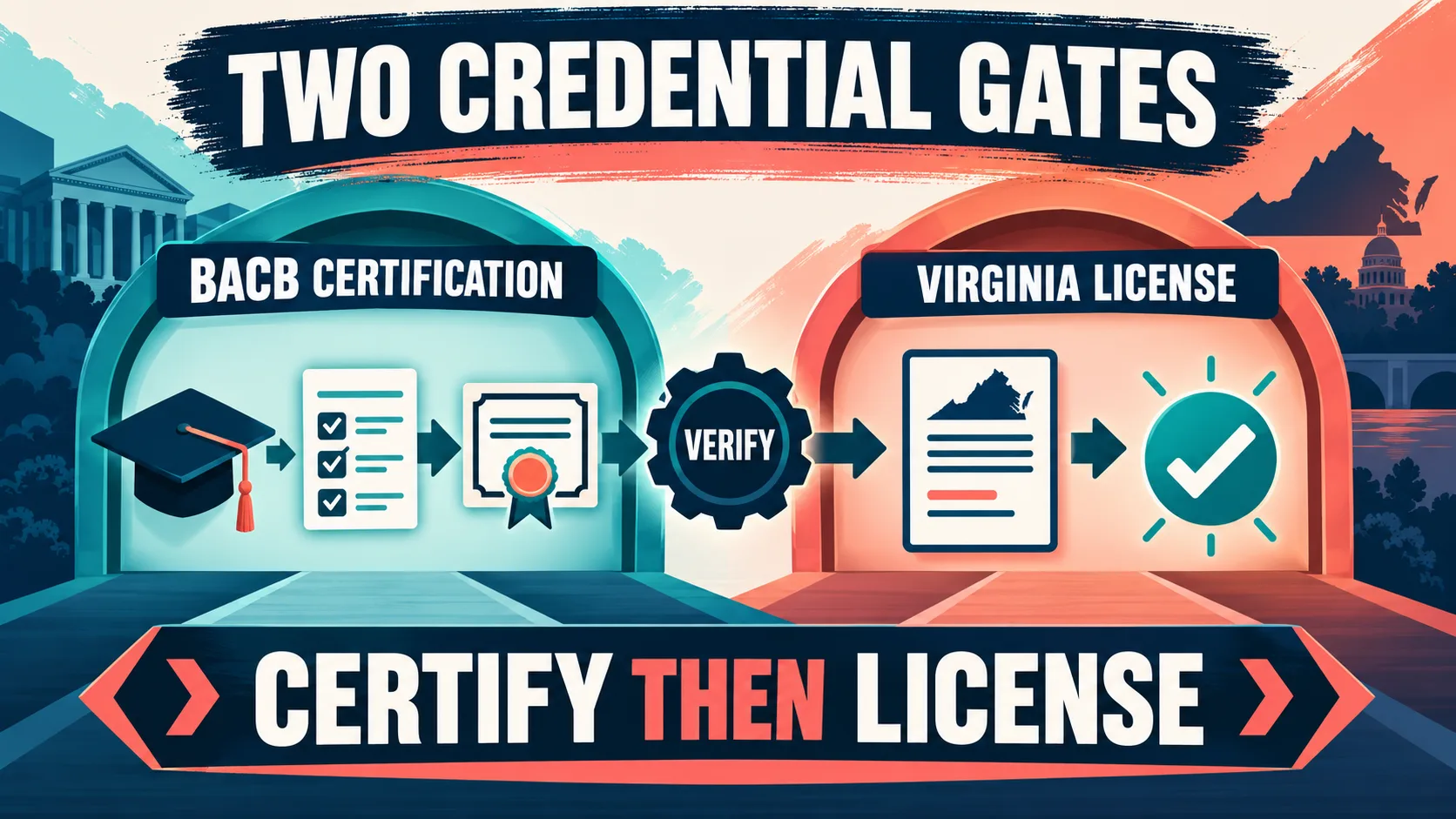
Virginia’s question is not simply “How do I get a BCBA?” The BCBA credential is national, while the legal authority to practice in Virginia is handled through the state’s behavior-analyst licensing system. The Virginia Administrative Code has a separate licensure framework, and the Board of Medicine’s application wizard asks candidates to choose the correct application route.
| Gate | Who controls it? | What you are proving | Common planning error |
|---|---|---|---|
| BCBA certification | BACB | Qualifying degree/coursework, supervised fieldwork, application, and a passing BCBA examination | Assuming a Virginia license can replace the national exam or certification |
| Virginia licensure | Virginia Board of Medicine | State application, current certification verification, and the evidence required for initial or endorsement licensure | Stopping after BCBA certification and overlooking the state license |
The order is usually national certification first, then Virginia licensure, but the exact application sequence should follow the Board’s current instructions. If you already hold a behavior-analyst license in another jurisdiction, do not assume you are a first-time Virginia applicant; the endorsement branch may require a different packet.
Choose the 2026 or 2027 BACB Timing Path
The date on your application matters. BACB’s transition notice says that a complete application, including payment and required documents, received by December 31, 2026 is reviewed under the current requirements. Significant changes take effect January 1, 2027. “I finished my hours” and “my complete application was received” are not automatically the same event, so build your timeline around the official submission rule rather than a personal target date.
| Planning question | 2026 review path | 2027 review path |
|---|---|---|
| When is the complete BACB application received? | By December 31, 2026, if it meets the transition notice’s complete-application condition | January 1, 2027 or later, under the 2027 requirements and current handbook |
| Education check | Confirm the requirements and pathway that apply to your application date | Review the 2027 pathway options, qualifying program/coursework rules, and handbook details |
| Fieldwork check | Audit the rule set and forms that govern the fieldwork you accrued | Use the 2027 fieldwork requirements and applicable monthly/final verification forms |
| Exam check | Prepare for the BCBA exam using the current test-content outline and application instructions | The BCBA examination remains based on the BCBA Test Content Outline (6th ed.) |
Do not pick a pathway because a third-party checklist uses a familiar number. Check the official 2027 requirements document and the transition guidance together. They describe degree or coursework conditions, supervised fieldwork, supervisor qualifications, observation, individual supervision, unrestricted activities, and verification forms. Your own application record must satisfy the full handbook, not just the summary table.
Choose Initial Licensure or Endorsement
After the national certification gate is clear, open the Virginia Board of Medicine behavior-analyst application wizard. It separates first-time applicants from people who have previously been licensed in another U.S. state, territory, or Canada. Choosing the wrong branch can produce the wrong document list.
| Your situation | Likely Virginia branch | Evidence to verify first |
|---|---|---|
| You have not held a behavior-analyst license in another jurisdiction | First-time or initial licensure | Application instructions, fee, BACB certification verification, and any practice or disclosure evidence requested by the Board |
| You hold a current behavior-analyst license elsewhere in good standing | Licensure by endorsement | Application and fee, employment chronology, license verification, NPDB self-query, and BACB verification |
| Your Virginia license is inactive or lapsed | Reactivation, renewal, or reinstatement—not a new initial application by default | Use the Board’s status-specific instructions and do not reuse the endorsement checklist automatically |
Virginia’s regulation also states that an applicant for behavior-analyst or assistant behavior-analyst licensure must hold current certification as a BCBA or BCaBA obtained through the BACB qualification and examination requirements. For a BCBA candidate, that makes certification verification a central handoff document, not an optional attachment.
Build the Evidence Packet Before You Click Submit
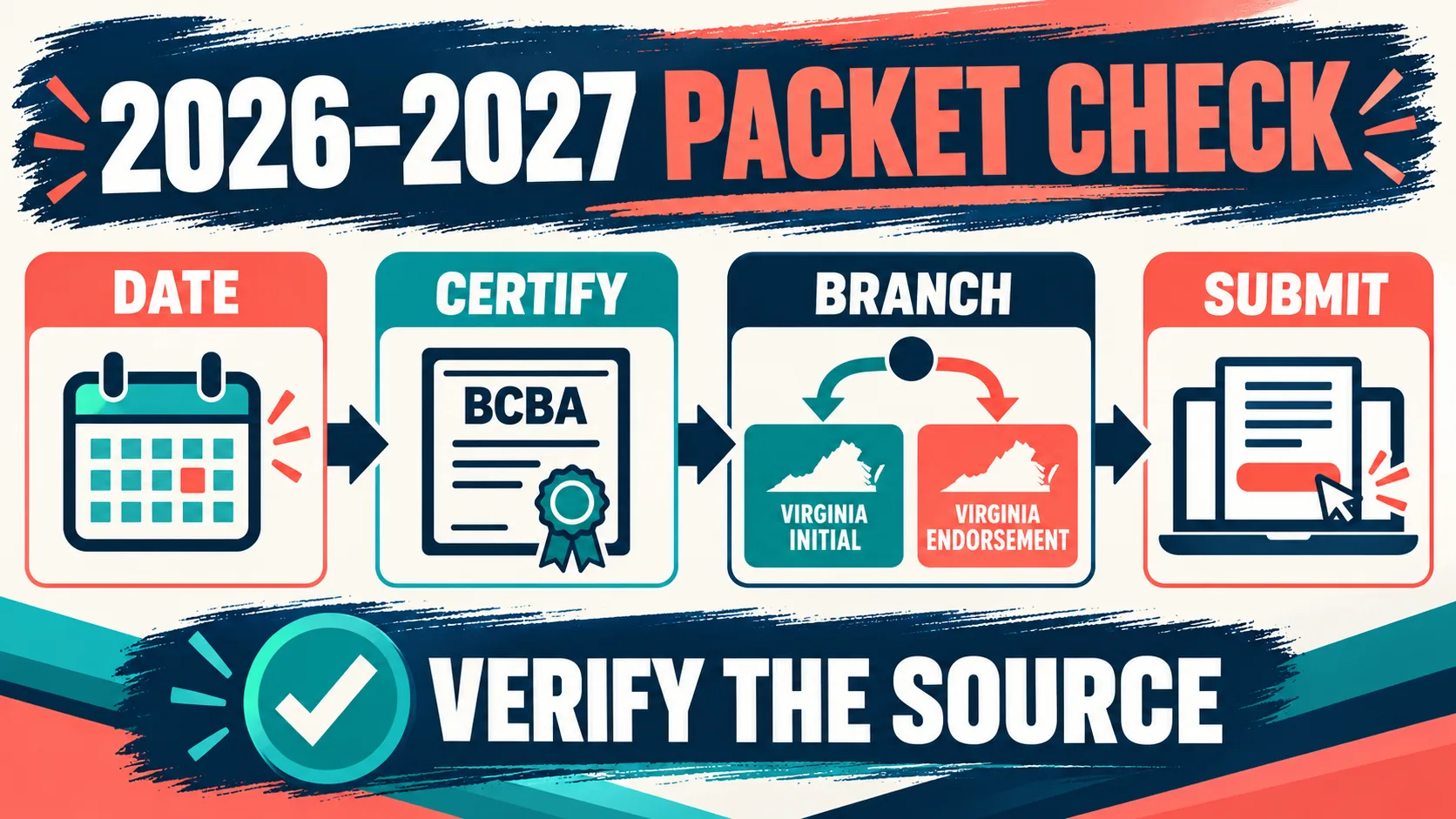
Make a packet folder that mirrors the official branch you selected. This is a planning checklist, not a substitute for the Board’s live application instructions. For a first Virginia license, start with the application, fee, and BACB verification. For endorsement, add the current out-of-state license verification, employment chronology, and NPDB self-query as listed by the Board. Keep a dated copy of every request and confirmation.
- Credential identity: write the exact certification name, certification number, and the source that will send or verify it.
- Application branch: record why you selected initial licensure, endorsement, reinstatement, or inactive-to-active processing.
- Timeline: note when your BACB application was complete, when certification was issued, and when the Virginia packet was submitted.
- Disclosure review: read the application questions early. If an answer needs supporting documentation, do not wait until the final submission day.
- Source check: save the official Virginia regulation, application instructions, and BACB handbook version you used, then recheck them before submitting.
Do not promise yourself a universal approval timeline. The official Virginia page tells applicants to review the laws, regulations, instructions, and checklist before beginning; it does not guarantee that a submission will be approved merely because the form was uploaded. Contact the Board when your situation does not fit the wizard.
Move From Eligibility to BCBA Exam Preparation
Exam preparation is the conversion point in this pathway, but it should begin with the correct gate. If your degree, coursework, fieldwork, supervisor, and application documents are still unresolved, a full mock exam may hide the real blocker. First make a credential audit. Then use the BCBA Test Content Outline to identify the domains that need practice.
Once your application path is clear, use our free BCBA mock exam as a readiness checkpoint. Treat missed items as a study route: a measurement miss calls for data and interpretation review, an ethics miss calls for professional-boundary review, and a supervision miss calls for the current handbook and transition guidance. The mock should move you forward, not replace the official eligibility documents.
FAQ and Official-Source Boundaries
Do I become a BCBA through Virginia? No. The BCBA certification is national through the BACB. Virginia separately regulates the license to practice as a behavior analyst. Plan for both gates. Can I apply for the Virginia license before passing the BCBA exam? Do not assume so. Virginia’s regulation requires current BACB certification for behavior-analyst licensure, and the Board’s application wizard asks for certification verification. Follow the current state instructions for your exact situation.
What if I already have a license in another state? Review the endorsement branch. The Board lists additional evidence such as employment chronology, professional-license verification, and an NPDB self-query. Your prior license does not remove the need to satisfy Virginia’s current application requirements.
Does the 2027 change create a Virginia-specific BCBA exam? No. The 2027 BACB changes affect national certification eligibility and maintenance. Virginia still has its own state licensure process, so keep the national and state checklists separate.
What is the safest planning rule? Use BACB documents for national eligibility and Virginia Board of Medicine documents for state licensure. Record the date of each source, keep your application evidence together, and recheck both official sites before submitting.
Bottom line: the cleanest answer to “how to become a BCBA in Virginia” is a two-gate plan: qualify and pass the national BCBA certification process, then select the correct Virginia licensure branch and submit the required evidence. The 2026–2027 transition makes the date and completeness of your BACB application especially important, so build the timeline before you build the study calendar. For targeted review, use our how to become a BCBA in Virginia practice questions to apply the concept in exam-style scenarios.
Quick Review Checklist
Use this final checklist to turn how to become a BCBA in Virginia into exam-ready reasoning. The goal is not to memorize a label in isolation; it is to identify the relevant evidence and explain why the best answer fits the scenario. Key ideas to review:
- State the central definition or decision point for how to become a BCBA in Virginia in your own words.
- Identify the detail that makes how to become a BCBA in Virginia different from its closest related ABA term.
- Separate the observable facts in a scenario from assumptions that are not supported by the facts.
- Write one example and one nonexample so you can recognize the concept in a new setting.
Exam application checks:
- Ask what the question is actually requesting before comparing the answer choices.
- Mark the antecedent, response, consequence, or other evidence that supports the selected answer.
- Look for a distractor that describes a related process but does not answer the specific question.
Final self-check:
- Explain how you would verify the interpretation with clear observations or data.
- Change one detail in the scenario and decide whether your answer should change.
- Give a one-sentence rationale that a supervisor or study partner could evaluate.
Take the Free BCBA Mock Exam
When you are ready to apply the idea, use the free practice resource below for additional feedback. Take the Free BCBA Mock Exam



