
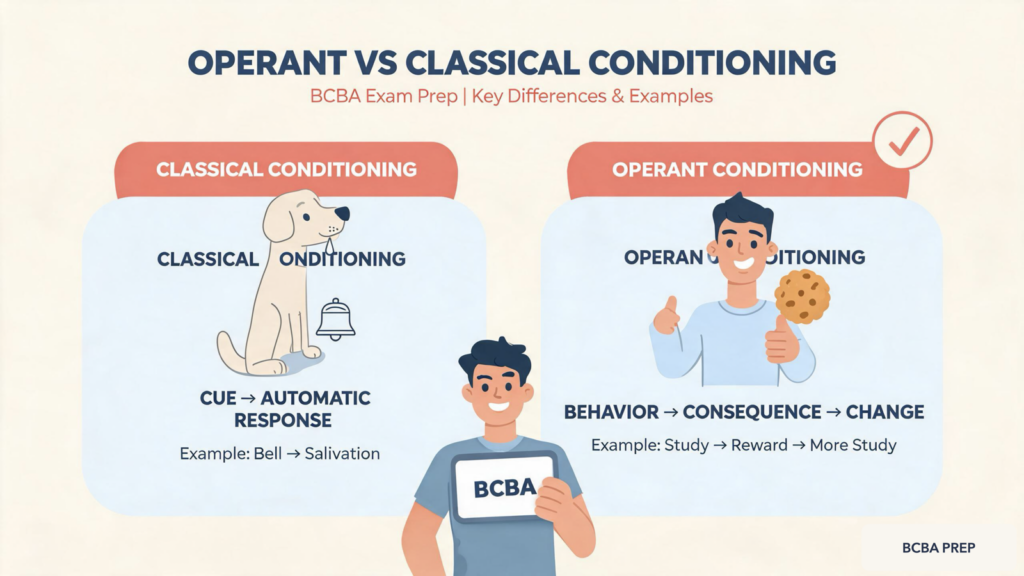
Why Distinguishing Operant and Classical Conditioning Matters for the BCBA Exam
As a BCBA candidate, you will encounter multiple questions that test your ability to differentiate operant vs classical conditioning. The BACB Task List emphasizes understanding both types of learning because they underlie many behavioral interventions. Misidentifying a respondent behavior as operant (or vice versa) can lead to incorrect function-based treatments.
Table of Contents
- Why Distinguishing Operant and Classical Conditioning Matters for the BCBA Exam
- Defining Operant and Classical Conditioning in Behavioral Terms
- Key Differences at a Glance
- Worked ABC Examples for the BCBA Exam
- Common Exam Traps and How to Avoid Them
- Quick Checklist: Operant vs Classical Conditioning
- Final Summary: Mastering the Distinction for Exam Day
This guide breaks down each type, provides clear examples, and highlights common traps to help you succeed on exam day.
Defining Operant and Classical Conditioning in Behavioral Terms
To master the distinction, you need precise definitions grounded in behavior analysis. Both processes involve learning, but the mechanism is fundamentally different.
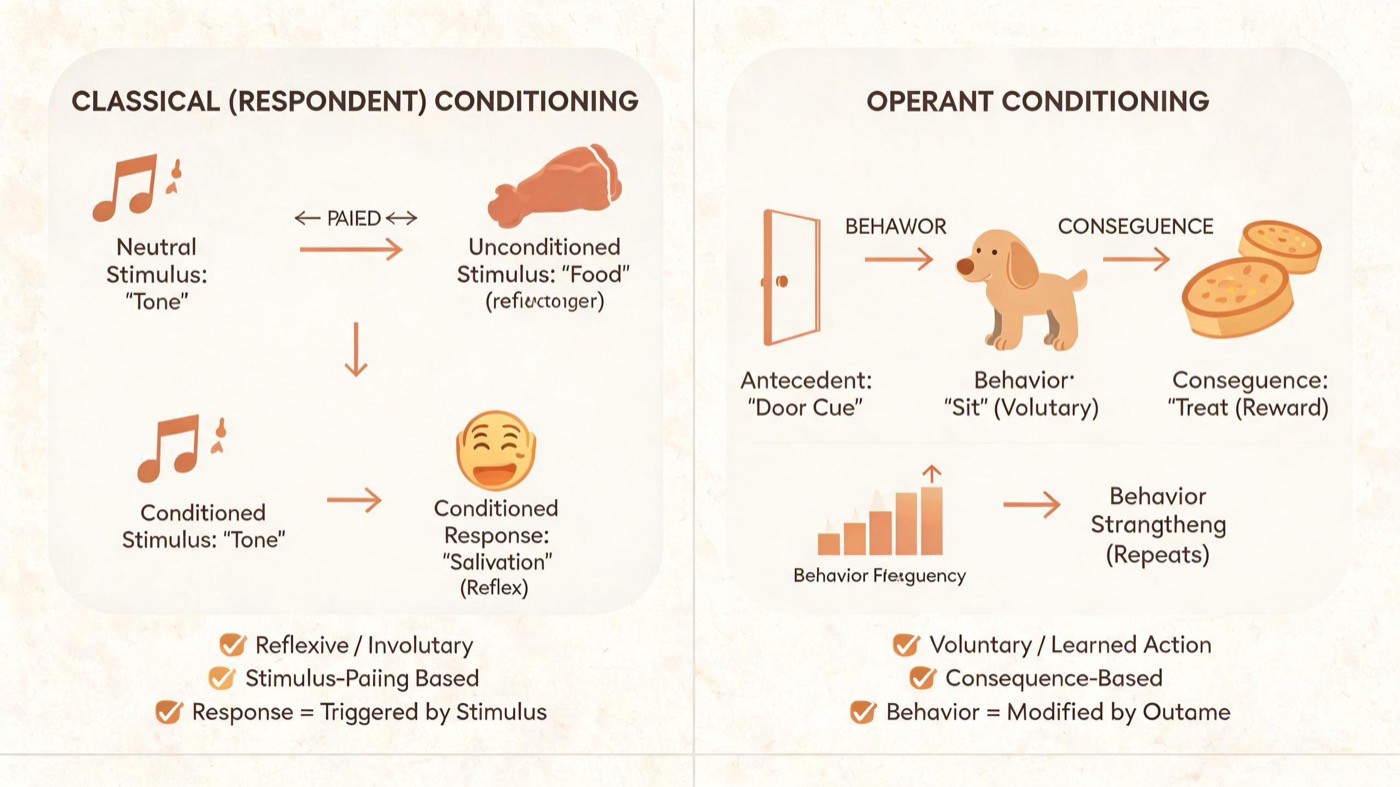
Classical Conditioning: Stimulus-Stimulus Learning
Classical conditioning (also called respondent conditioning) occurs when a neutral stimulus is paired with an unconditioned stimulus (US) that naturally elicits a response. After pairing, the neutral stimulus becomes a conditioned stimulus (CS) that elicits a conditioned response (CR). The key is that behavior is elicited by antecedent stimuli; consequences are not involved.
- Unconditioned Stimulus (US): A stimulus that naturally elicits a response (e.g., food, loud noise).
- Unconditioned Response (UR): The automatic response to the US (e.g., salivation, startle).
- Conditioned Stimulus (CS): A previously neutral stimulus that, after pairing, elicits a conditioned response.
- Conditioned Response (CR): The learned response to the CS, similar to the UR but elicited by the CS.
Operant Conditioning: Consequence-Controlled Behavior
Operant conditioning involves behavior that is emitted and shaped by its consequences. The three-term contingency (antecedent-behavior-consequence) is the core unit. Key processes include positive reinforcement, negative reinforcement, punishment, and extinction.
- Antecedent: A stimulus that precedes the behavior and sets the occasion for it (e.g., discriminative stimulus).
- Behavior: An action that operates on the environment.
- Consequence: A stimulus change following the behavior that increases or decreases its future occurrence.
Common terms: positive reinforcement (adding a stimulus to increase behavior), negative reinforcement (removing a stimulus to increase behavior), positive punishment, negative punishment.
Key Differences at a Glance
The table below summarizes the critical differences tested on the BCBA exam.
| Feature | Classical Conditioning | Operant Conditioning |
|---|---|---|
| Learner’s role | Passive; response is elicited | Active; behavior is emitted |
| Behavior type | Reflexive, involuntary | Voluntary, goal-directed |
| Role of consequences | None (pairing of stimuli drives learning) | Central (consequences alter frequency) |
| Rate of acquisition | Can be rapid (one pairing) | Gradual, shaped over time |
| Extinction procedure | Present CS without US | Withhold reinforcement |
Worked ABC Examples for the BCBA Exam
Exam questions often present a scenario and ask you to identify whether the behavior is operant or respondent. Practice with these examples.
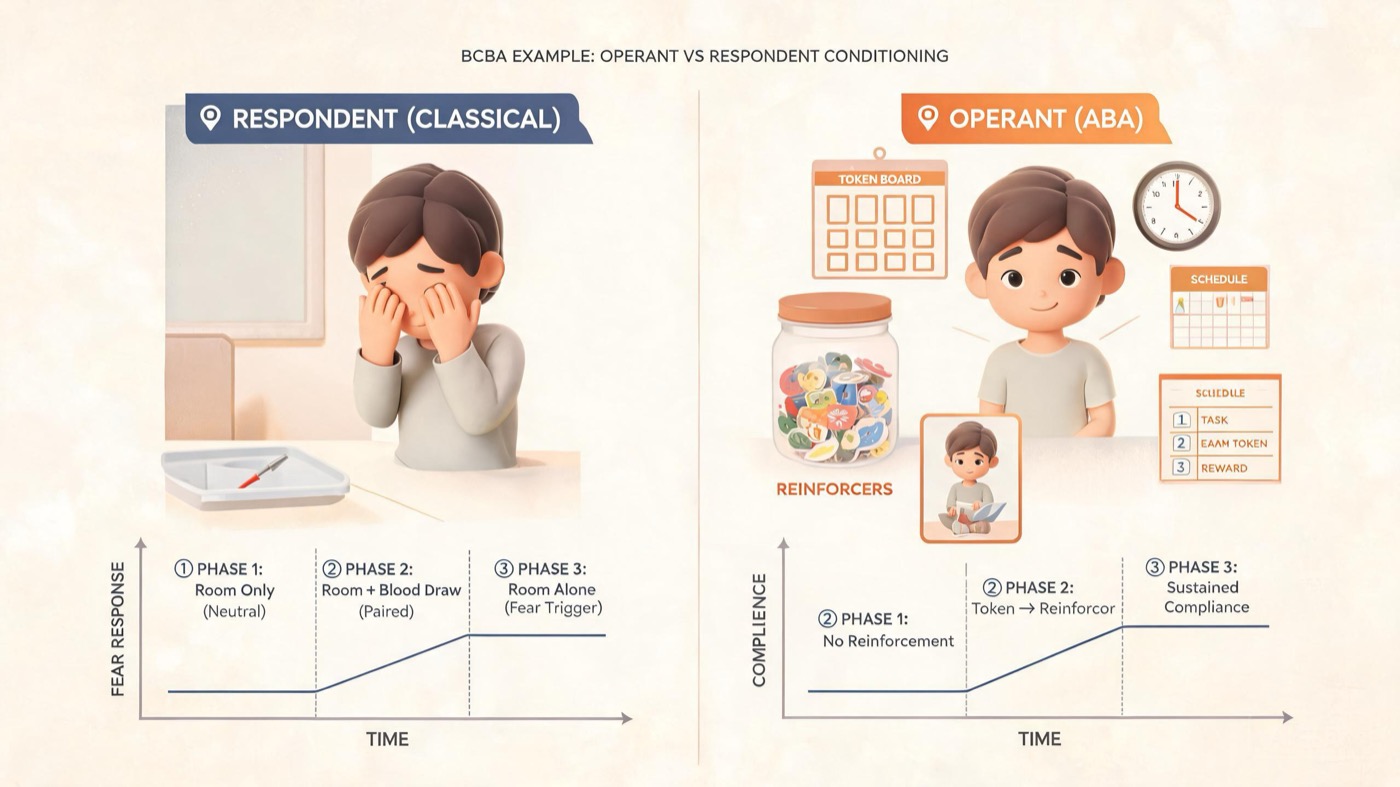
Example 1: Classical Conditioning in an ABA Setting
Scenario: A child with autism undergoes repeated medical procedures (e.g., blood draws) in a therapy room. Over time, the child begins to cry and show distress when entering the room, even before any procedure begins.
- US: The needle stick (pain)
- UR: Crying, flinching
- CS: The therapy room (neutral before pairing)
- CR: Crying and distress upon entering the room
The behavior is respondent behavior because it is elicited by the CS (room). No consequence is maintaining the crying; it is a conditioned emotional response.
Example 2: Operant Conditioning in Skill Acquisition
Scenario: During a math task, a student whines and pushes away the worksheet. The teacher removes the worksheet until the student is calm. Each time the student whines, the worksheet is removed. The behavior increases over time.
- Antecedent: Worksheet presented
- Behavior: Whining and pushing away
- Consequence: Worksheet removed (negative reinforcement)
This is operant behavior maintained by escape from a non-preferred task. The intervention would involve teaching a replacement behavior (e.g., asking for a break) and reinforcing appropriate requests.
Common Exam Traps and How to Avoid Them
Even experienced test-takers fall for these subtle pitfalls. Watch for the following.
- Confusing conditioned reinforcement with classical conditioning: A conditioned reinforcer (e.g., token) is learned through pairing, but the behavior it maintains is operant. The token serves as a consequence, not an eliciting stimulus.
- Misattributing emotional responses as operant: Fear, anxiety, or excitement that are elicited by a CS are respondent, even if they appear voluntary.
- Assuming all behavior that increases is operant: Respondent behavior can also increase in frequency if the CS is repeatedly paired; but it remains respondent.
Quick Checklist: Operant vs Classical Conditioning
Use this diagnostic checklist when analyzing exam scenarios.
- Is the behavior elicited by a preceding stimulus? If yes, consider classical conditioning.
- Is the behavior emitted and followed by a consequence that changes its future frequency? If yes, it is operant.
- Is there a clear US-UR relation? If the response is automatic (e.g., salivation, startle, pupil dilation), it is likely respondent.
- Can you identify a reinforcer or punisher maintaining the behavior? If yes, it is operant.
For more practice, try our free BCBA mock exam practice questions to test your understanding.
Final Summary: Mastering the Distinction for Exam Day
In summary, the key to differentiating operant vs classical conditioning lies in the unit of analysis: classical conditioning involves stimulus-stimulus pairings that elicit reflexive behavior, while operant conditioning involves behavior-consequence relations that shape voluntary actions. Remember these distinctions:
- Classical: US → UR; CS → CR. Behavior is respondent.
- Operant: Antecedent → Behavior → Consequence. Behavior is operant.
For further study, review the BACB Task List and practice with more examples. Our BCBA exam prep 2025 resources include additional comparisons and mock questions to solidify your skills.
Focus on the function of the behavior and the contingency arranged. With these tools, you will be ready to identify each type accurately on the BCBA exam.



