

What Is Aversive Conditioning?
Aversive conditioning is a respondent, or Pavlovian, learning arrangement in which a previously neutral stimulus acquires the capacity to elicit a conditioned response after being related to an aversive unconditioned stimulus. The procedure is defined by a stimulus–stimulus relation and an elicited response. It is not defined by a consequence changing the future frequency of an operant behavior.
Table of Contents
- What Is Aversive Conditioning?
- The Respondent Sequence: NS, US, UR, CS, and CR
- What Does “Aversive Stimulus” Mean?
- Aversive Conditioning Versus Operant Contingencies
- Escape and Avoidance Require Operant Evidence
- Defensible Examples and Limits
- Common Conceptual Traps
- Ethical Boundaries and Aversion Therapy
- Study Checklist and Original Practice
- Frequently Asked Questions
- Test the Distinction With a Free BCBA Mock Exam
- References
For example, a neutral tone may be paired with a sudden loud sound that already elicits a startle response. After effective pairings, the tone may function as a conditioned stimulus and elicit a conditioned startle response when presented alone. The unconditioned and conditioned responses do not have to be identical, and the exact effect must be demonstrated rather than inferred from labels such as “unpleasant” or “scary.”
Respondent conditioning, punishment, negative reinforcement, escape, and avoidance can occur in the same episode while remaining different processes. The BACB outline asks candidates to distinguish respondent from operant conditioning and reinforcement from punishment; it does not list “aversive conditioning” as a separate task.
The Respondent Sequence: NS, US, UR, CS, and CR
Start by diagramming the respondent sequence. Before conditioning, the unconditioned stimulus, or US, elicits an unconditioned response, or UR, without the specific learning history being analyzed. A neutral stimulus, or NS, does not yet reliably elicit the target conditioned response. During conditioning, the NS is presented in a defined relation with the US. After conditioning, the former NS is called a conditioned stimulus, or CS, if it can elicit a conditioned response, or CR.
- Before conditioning: US → UR. A sudden loud sound may elicit a startle response.
- Before conditioning: NS → no reliable target CR. A particular geometric symbol may have no demonstrated relation to startle.
- During conditioning: NS + US → UR. The symbol is presented in a consistent temporal relation with the loud sound.
- After conditioning: CS → CR. The symbol alone now elicits a measured conditioned response.
Pairing language by itself is not enough to prove conditioning. The analyst needs evidence that the stimulus relation changed responding. Timing, intensity, prior learning, number of trials, context, and the response measure can all influence the result. A single observation of distress in the presence of a stimulus does not establish which conditioning history produced it.
What Does “Aversive Stimulus” Mean?
Behavior-analytic writing has used aversive stimulus in related ways. In a functional operant usage, stimulus onset may function as positive punishment when contingent presentation decreases behavior, while offset may function as negative reinforcement when contingent removal increases behavior. Do not assume those effects are symmetrical or stable across contexts.
In respondent descriptions, an aversive US elicits a defined unconditioned response, and a conditioned aversive stimulus is a formerly neutral stimulus that comes to elicit a related CR. It is not automatically a conditioned punisher; that label requires contingent presentation to reduce future operant responding.
Do not classify a stimulus from appearance alone. State the measured relation, whether the response was elicited or emitted, and whether future operant behavior increased or decreased.
Aversive Conditioning Versus Operant Contingencies
The fastest way to separate these concepts is to identify the unit of analysis. Aversive conditioning concerns relations among stimuli and an elicited response. Punishment and negative reinforcement concern an operant response, the consequence that follows it, and a demonstrated change in the future probability of that response class.
- Aversive conditioning: A neutral stimulus is related to an aversive US and later elicits a CR. No operant response–consequence contingency is required for the defining respondent procedure.
- Positive punishment: A response is followed by stimulus presentation, and that response class decreases in the future. The procedure cannot be identified from the intent to punish or from the stimulus seeming unpleasant.
- Negative punishment: A response is followed by stimulus removal or loss, and that response class decreases in the future. An aversive stimulus need not be presented.
- Negative reinforcement: A response produces removal, reduction, or postponement of a stimulus, and that response class increases in the future.
- Conditioned punishment: A stimulus with a relevant learning history is presented contingent on a response and decreases future responding. Being a respondent CS does not by itself demonstrate this operant function.
Consider a clinic sound that elicits a conditioned physiological response after earlier pairings. That is a respondent relation. If a break request pauses a procedure and requests later increase, the request has contacted negative reinforcement. If a reprimand follows another response and that response later decreases, the demonstrated relation is punishment.
For a broader review, see our respondent versus operant behavior guide. Diagram respondent and operant relations separately.
Escape and Avoidance Require Operant Evidence
Escape occurs when a response terminates or reduces an event that is already present. If that consequence increases the future frequency of the response, the response has contacted negative reinforcement. An example would be a correctly measured break request that reliably pauses an ongoing task and becomes more likely under similar conditions.
Avoidance occurs when a response prevents or postpones contact with an event. In signaled avoidance, a warning stimulus may precede the event and the response may terminate the warning signal, postpone the event, or both. Unsignaled, or Sidman, avoidance procedures do not require a discrete warning CS. This is why it is too broad to say that every avoidance response depends on a conditioned aversive stimulus or that “the absence of the event” is always the only reinforcer.
Respondent and operant processes can interact. A warning signal may acquire respondent functions while responses in its presence are selected by consequences such as signal termination or event postponement. Identify the arranged contingency and measured behavior change before selecting an answer.
Defensible Examples and Limits
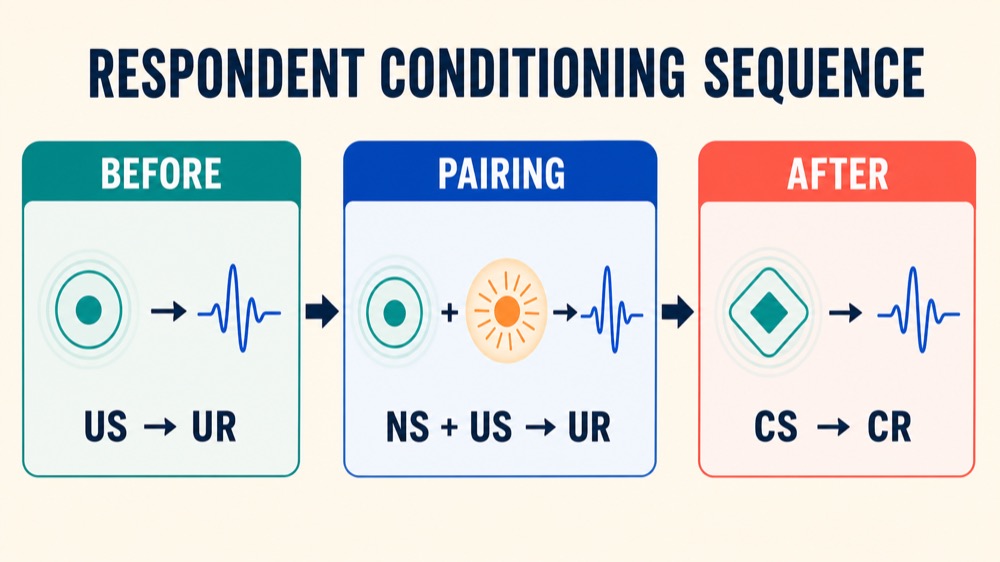
A laboratory example can clearly arrange and test the variables. A visual cue is initially neutral, a loud sound functions as the US, and startle is measured as the UR. The cue is then presented before the sound across trials. If the cue later elicits a measured response when presented alone, the data are consistent with aversive respondent conditioning.
Conditioned taste aversion is another respondent example. A novel flavor can become a CS after being followed by illness, and later contact can elicit nausea-related responses. Its distinctive timing means it should not support an absolute rule about trials or delay for every respondent procedure.
Applied examples require caution because learning histories are rarely controlled. A child may show physiological distress when entering a medical room after earlier uncomfortable procedures. That observation is compatible with respondent conditioning, but it does not by itself identify the exact US, pairings, or alternative explanations. Any separate refusal, request, or leaving response must be analyzed as operant behavior if the question concerns its consequences.
For an open-access overview of appetitive and aversive conditioning procedures, see the review of human conditioning paradigms. A behavior-analytic discussion of terminology and negative reinforcement is available in Motivating Operations and Negative Reinforcement.
Common Conceptual Traps
Name the measured relation before naming the stimulus function.
- Trap—“unpleasant” means punisher: Punishment requires a contingent consequence and a later decrease in the relevant response class.
- Trap—removal always means negative reinforcement: Negative reinforcement requires an increase in future responding; stimulus removal alone is insufficient.
- Trap—a CS is automatically an SD: A respondent CS elicits a CR. An SD signals a differential availability of reinforcement for an operant response.
- Trap—a conditioned aversive stimulus is automatically a conditioned punisher: Conditioned punishment requires demonstrated response suppression when presentation is contingent on behavior.
- Trap—avoidance is purely respondent: The warning cue may participate in respondent learning, but the avoidance response is operant when selected by its consequences.
- Trap—one applied observation proves the history: The stimulus roles and learning process require evidence; plausible labels are not functional demonstrations.
Ethical Boundaries and Aversion Therapy
Aversive conditioning is a descriptive learning concept, not a recommendation to use aversive procedures. Aversion therapy refers to planned treatment arrangements involving aversive events and should not be treated as a synonym for naturally occurring respondent conditioning. This article does not provide implementation instructions for such procedures.
The BACB Ethics Code requires assessment- and evidence-based interventions that prioritize positive reinforcement. Restrictive or punishment-based procedures are limited to the conditions specified in standard 2.15 and require applicable review, continual evaluation, documentation, and timely modification or discontinuation.
Professional decisions also require competence, informed consent when applicable, preferences, risk–benefit analysis, contextual fit, data, and governing requirements. See the current BACB Ethics Code, especially standards 2.14 and 2.15.
Study Checklist and Original Practice
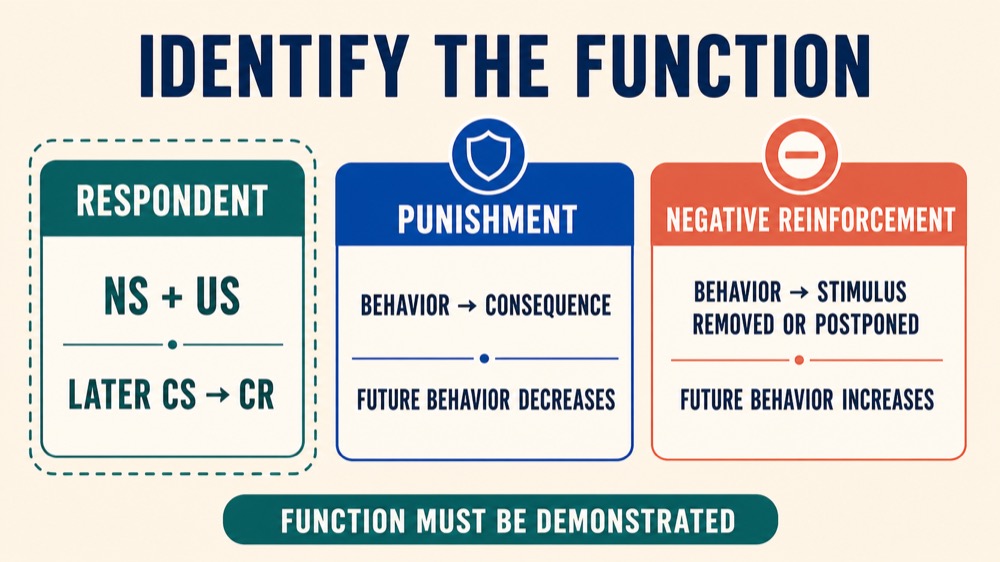
Use this checklist before labeling a scenario. These are original study examples, not recalled BACB exam items.
- Identify the candidate NS, US, UR, CS, and CR.
- Ask whether the question describes stimulus pairings or a response–consequence contingency.
- For punishment, verify a future decrease in the response class.
- For negative reinforcement, verify a future increase in the response class.
- Separate an elicited physiological response from any emitted escape or avoidance response.
- Do not infer that a stimulus is a punisher, reinforcer, CS, or SD from its appearance alone.
- State what evidence is missing when an applied vignette does not establish the learning history.
Scenario A: A tone is repeatedly followed by a loud sound that elicits startle. Later the tone alone elicits startle. This demonstrates a respondent conditioning relation. Scenario B: A learner requests a pause, the ongoing task stops, and pause requests increase. This demonstrates negative reinforcement if the measured increase is reliable. Scenario C: A response is followed by a reprimand, but no later response data are supplied. Punishment has not yet been demonstrated.
Frequently Asked Questions
Is aversive conditioning the same as punishment?: No. Aversive conditioning is a respondent stimulus–stimulus procedure assessed through elicited responding. Punishment is an operant relation in which a consequence follows behavior and that behavior decreases in the future.
Can the same stimulus participate in respondent and operant relations?: Yes. A stimulus may elicit a conditioned response in one relation and also participate in an operant contingency. Each function must be demonstrated from the arrangement and behavior change; one label does not automatically establish the other.
Does every avoidance example require a warning signal?: No. Signaled avoidance includes a warning stimulus, while unsignaled avoidance procedures can operate without a discrete warning cue. Analyze what the response postpones or terminates and whether responding increases.
Test the Distinction With a Free BCBA Mock Exam
The safest study strategy is to diagram the relation before naming it. Mark stimulus pairings for respondent conditioning and mark antecedent–behavior–consequence relations for operant conditioning. Then use future behavior change to distinguish reinforcement from punishment. Apply that process in our Free BCBA Mock Exam and review why each alternative does or does not fit the stated contingency.
References
- Behavior Analyst Certification Board. BCBA Test Content Outline (6th ed.).
- Behavior Analyst Certification Board. Ethics Code for Behavior Analysts.
- Baron, A., & Galizio, M. Motivating Operations and Negative Reinforcement.
- LeDoux, J. E., et al. Avoidance Learning: A Review of Theoretical Models and Recent Developments.



