

A practical ABA terminology list organized around observation, measurement, analysis, behavior change, and the decisions that appear in BCBA-style scenarios. If you are looking for an ABA terminology list, a long alphabetized glossary is only the starting point. The useful skill is recognizing what a term means in context, separating it from a related term, and choosing the next defensible action. This guide groups core terms into a decision chain: define → recognize → differentiate → apply.
Table of Contents
- What an ABA Terminology List Should Help You Do
- Start With the Current BCBA Scope
- Study Terms in Four Connected Layers
- Move From Term to Scenario to Decision
- Related Terms Students Commonly Confuse
- Turn the List Into an Active Study Routine
- Use Terminology Accurately in Notes and Practice
- Check Your Terms With Practice Questions
- Frequently Asked Questions
- Quick Review Checklist
- Take the Free BCBA Mock Exam
Use the list as a study map, not as a replacement for the current BACB materials, your coursework, supervision, or jurisdiction-specific guidance. The BACB examination information page and the current BCBA Test Content Outline should remain your source of truth for examination scope.
Important boundary: Definitions below are study explanations. Always check the official BACB materials, course text, supervisor guidance, client context, and applicable law or policy before using a term to make a clinical, employment, billing, or safety decision.
What an ABA Terminology List Should Help You Do
A term is not fully learned when you can repeat a definition. It is learned when you can use it to describe observable information and make a justified distinction. For each entry, ask four questions:
- Define: What does the term mean in behavior-analytic language?
- Recognize: What would you see, hear, or measure if the term were present?
- Differentiate: Which nearby term could be confused with it, and what feature separates them?
- Apply: What decision would the term support, and what information is still missing?
For example, reinforcement is not simply “something rewarding.” The relevant question is whether a consequence increases the future probability of a behavior. Negative in negative reinforcement describes the removal or reduction of a stimulus; it does not mean bad. An operational definition describes a target in observable, measurable terms so that different observers can identify it consistently.
This approach also protects you from a common study error: memorizing a word while losing the data clue that gives the word meaning. A scenario about a learner’s response, the immediate consequence, and a later change in responding is more useful than a flashcard that contains only a sentence fragment.
Start With the Current BCBA Scope
An ABA terminology list should be broad enough to support exam preparation but organized around the work a BCBA is expected to reason through. The current BACB outline is the better organizing boundary than an old internet glossary. Use the categories below to decide where a term belongs and what kind of question it can answer.
| Layer | Terms to connect | Study question |
|---|---|---|
| Measurement | Frequency, rate, duration, latency, percentage, interval recording, and interobserver agreement. | What dimension is being measured, and does the method fit the behavior? |
| Assessment and analysis | ABC data, function, antecedent, consequence, motivating operation, discriminative stimulus, and stimulus control. | What pattern is supported by the data, and what remains a hypothesis? |
| Behavior change | Reinforcement, punishment, extinction, prompting, shaping, chaining, generalization, and maintenance. | What contingency or teaching arrangement explains the change? |
| Professional practice | Competence, informed consent, confidentiality, documentation, supervision, scope, and referral. | What protects the client and keeps the decision within the professional boundary? |
When you add a new word to your notes, place it in one of these layers and write one link to another layer. For instance, “latency” belongs to measurement, but it may help you evaluate a skill-acquisition target; “motivating operation” belongs to analysis, but it may explain why the value of a reinforcer changed. The links are what make the list useful in a case question.
Study Terms in Four Connected Layers
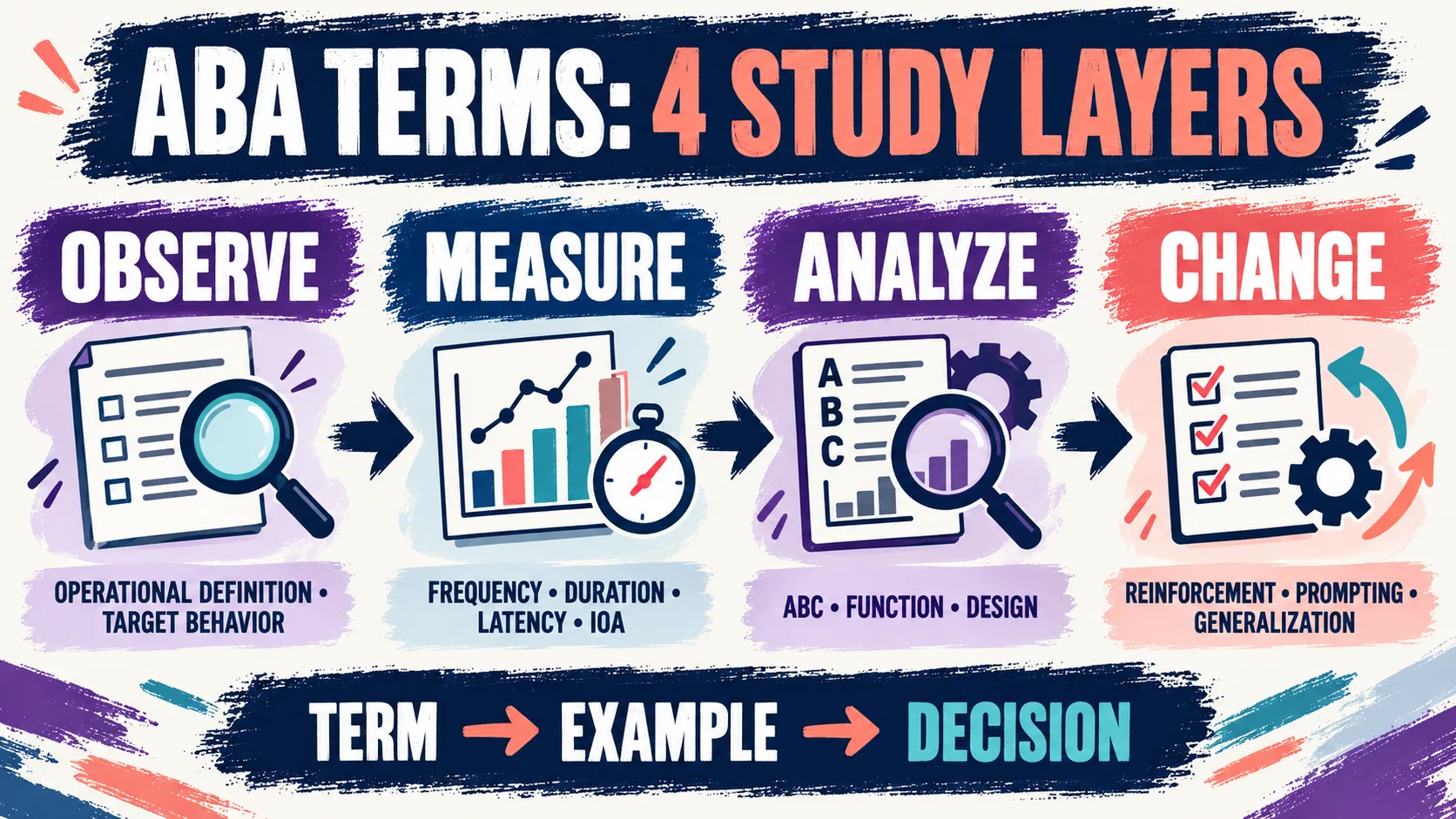
The following four-layer map keeps a glossary from becoming a pile of isolated definitions. Begin with what can be observed, select a measurement, interpret the pattern cautiously, and then connect the interpretation to a behavior-change decision.
| Study layer | Core vocabulary | Prompt to ask yourself |
|---|---|---|
| 1. Observe | Behavior, target behavior, response, antecedent, consequence, operational definition. | Can another observer tell exactly what happened without guessing intent? |
| 2. Measure | Frequency, rate, duration, latency, percentage, permanent product, interval recording, IOA. | What dimension, observation window, and scoring rule make the result interpretable? |
| 3. Analyze | ABC pattern, function, motivating operation, discriminative stimulus, stimulus control, functional relation. | What does the pattern support, and what would be premature to conclude? |
| 4. Change | Reinforcement, extinction, prompting, shaping, chaining, generalization, maintenance, social validity. | What should change, for whom, under which conditions, and how will you know? |
Do not treat the arrows as a rigid clinical protocol. They are a study sequence that helps you notice missing information. If a question jumps directly from a vague label to an intervention, pause and ask whether the behavior was defined, measured, and analyzed well enough first.
Move From Term to Scenario to Decision
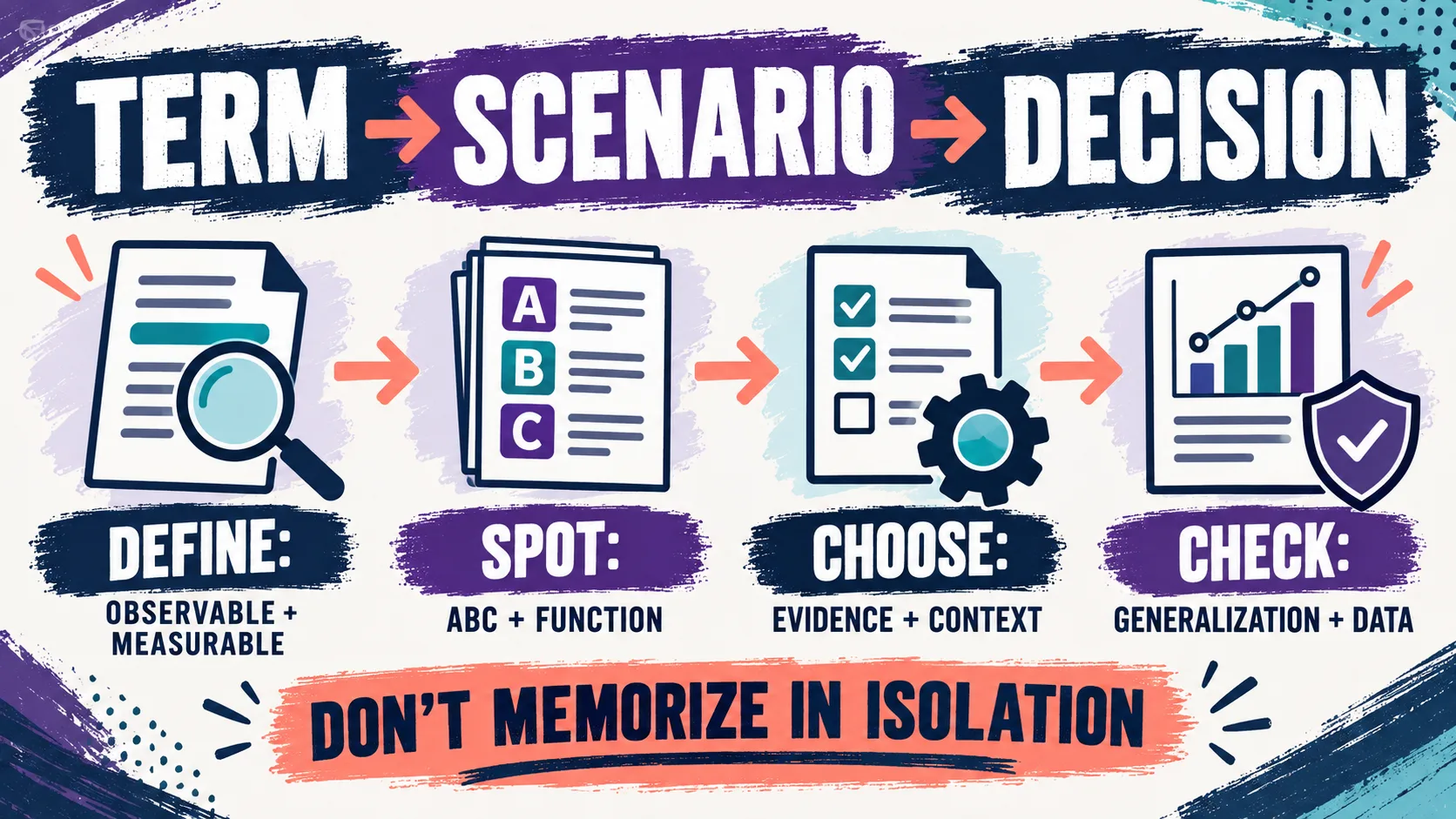
For every important term, create a three-line note. Line one gives a plain definition. Line two describes a short scenario with observable details. Line three names the decision the term helps you make and the evidence you would still seek.
| Term | Scenario clue | Decision use |
|---|---|---|
| Operational definition | “Refusal” is replaced with an observable rule such as turning away, pushing the item, or saying “no” within a specified interval. | Improve measurement agreement and clarify which responses belong in the data. |
| Negative reinforcement | A demand is removed after a response, and that response becomes more likely during later demands. | Check the effect on future responding; do not label a consequence from “removed” alone. |
| Latency | The question is how long it takes from an instruction or opportunity to the start of the response. | Choose a time-based measure and define both the start event and response onset. |
| Generalization | A learned response occurs with new people, materials, settings, or examples beyond training conditions. | Plan varied practice and test whether the skill transfers rather than assuming it will. |
This format also makes your notes easier to revise. If the scenario does not contain enough information to identify the term, write “insufficient data” instead of forcing a label. In an exam item, that pause can distinguish a defensible answer from an attractive but unsupported one.
Related Terms Students Commonly Confuse
Many wrong answers come from choosing a word that sounds close but does not match the consequence, measurement dimension, or evidence described. Compare terms by the feature that changes the decision.
| Pair | Distinguishing feature | Quick check |
|---|---|---|
| Negative reinforcement vs. punishment | Both concern a consequence, but the defining outcome is whether future behavior increases or decreases; “negative” only identifies removal. | What happened to the future rate or probability of the behavior? |
| Frequency vs. rate | Frequency is a count; rate relates the count to a unit of time, which matters when observation periods differ. | Were the observation windows the same length? |
| Extinction vs. forgetting | Extinction is a planned change in a maintaining contingency; forgetting is a decline that may have other explanations. | What contingency changed, and was that change documented? |
| Prompt vs. stimulus control | A prompt is added to evoke or guide a response; stimulus control describes responding differently in the presence or absence of an antecedent stimulus. | Is the extra cue being faded, or is the natural discriminative stimulus controlling responding? |
| Reliability vs. validity | Reliability concerns consistency; validity concerns whether the measure or conclusion represents what it is intended to represent. | Can a measure be consistent and still measure the wrong thing? |
Turn the List Into an Active Study Routine
A terminology list works best when it is used for retrieval and discrimination, not passive rereading. A short routine can produce better feedback than highlighting another page of definitions:
- Retrieve: Hide the definition and explain the term in plain language from memory.
- Discriminate: Name one related term and state the single feature that separates it.
- Apply: Write a two-sentence scenario with an observable behavior, relevant context, and a data clue.
- Check: Compare your answer with the official outline, course source, or supervisor feedback. Mark uncertainty rather than guessing.
- Space: Revisit difficult pairs across several sessions and mix measurement, analysis, behavior-change, and ethics terms.
For a 20-minute session, choose five terms. Spend five minutes retrieving definitions, five minutes comparing pairs, seven minutes solving a short scenario, and three minutes recording what evidence was missing. On the next session, begin with the terms you missed. This creates a study record that shows whether the problem is vocabulary, measurement selection, reading the scenario, or applying a professional boundary.
Keep separate notes for “definition,” “example,” and “not enough information.” The third category matters. A question may include an appealing label but omit the observation window, consequence effect, or client context needed to justify it.
Use Terminology Accurately in Notes and Practice
Precise wording is part of good professional communication. Avoid using a diagnosis, presumed function, or casual label as if it were directly observed. Write what happened, how it was measured, what pattern the data support, and what remains a hypothesis. When you correct a definition in your study notes, preserve the source and date so you know which version you reviewed.
The BACB ethics resources are useful when a terminology question touches competence, confidentiality, informed consent, records, supervision, or conflicts. An accurate term does not automatically make an action appropriate. Context, scope, evidence, client welfare, and communication still control the decision.
For each professional-practice term, add one boundary sentence to your notes: “This term helps me recognize ___, but I still need ___ before acting.” For example, recognizing a possible motivating operation does not by itself authorize a change to a client’s program; you still need appropriate assessment, documentation, collaboration, and oversight.
Check Your Terms With Practice Questions
Once you can define and discriminate a set of terms, test whether you can use them under time pressure. Choose questions that require you to identify the behavior, measurement, contingency, or professional issue before selecting an answer. After each question, write why the tempting alternatives do not fit.
Use the Free BCBA Mock Exam as a practice check. Treat the result as study data, not as a certification decision or a substitute for current BACB requirements. If you miss an item, return to the term → scenario → decision note and identify exactly where your reasoning changed course.
Frequently Asked Questions
Is there one official ABA terminology list?: There is not one universal internet glossary that replaces the current BACB examination materials, coursework, or supervision. Use the current BCBA outline to set the scope, then verify individual definitions against authoritative course and professional sources. Different resources may organize terms differently, so study the concept and its application rather than relying on a page title.
Should I study ABA terms alphabetically?: Alphabetical review can help you find a word, but it is not the most useful first structure for exam reasoning. Group terms by measurement, assessment and analysis, behavior change, and professional practice; then connect each term to an example and a related-term distinction.
How many terms should I learn at a time?: There is no meaningful universal number. Five well-tested terms in a short session can be more useful than fifty terms read once. Increase the set only when you can define, differentiate, and apply the earlier terms without collapsing similar concepts.
How can I remember difficult ABA terminology?: Use retrieval, contrast, short scenarios, spaced review, and feedback. When two terms feel interchangeable, write the outcome or measurement feature that separates them. When a scenario is ambiguous, practice stating what data or context is missing instead of forcing a conclusion.
Bottom line: The best ABA terminology list is a decision map, not a word bank. Start with observable behavior, connect the right measurement, interpret patterns cautiously, distinguish related terms, and apply the concept within professional boundaries. That sequence makes vocabulary more durable and more useful when a BCBA-style question asks what to do next.
Quick Review Checklist
Use this final checklist to turn aba terminology list into exam-ready reasoning. The goal is not to memorize a label in isolation; it is to identify the relevant evidence and explain why the best answer fits the scenario. Key ideas to review:
- State the central definition or decision point for aba terminology list in your own words.
- Identify the detail that makes aba terminology list different from its closest related ABA term.
- Separate the observable facts in a scenario from assumptions that are not supported by the facts.
- Write one example and one nonexample so you can recognize the concept in a new setting.
Exam application checks:
- Ask what the question is actually requesting before comparing the answer choices.
- Mark the antecedent, response, consequence, or other evidence that supports the selected answer.
- Look for a distractor that describes a related process but does not answer the specific question.
Final self-check:
- Explain how you would verify the interpretation with clear observations or data.
- Change one detail in the scenario and decide whether your answer should change.
- Give a one-sentence rationale that a supervisor or study partner could evaluate.
Take the Free BCBA Mock Exam
When you are ready to apply the idea, use the free practice resource below for additional feedback. Take the Free BCBA Mock Exam



