

Introduction to Automaticity
Have you ever noticed biting your nails while watching a movie or humming a tune without realizing it until later? That is automaticity at work. In everyday life, automaticity refers to behaviors that occur without conscious effort or deliberate thought. In applied behavior analysis (ABA), the automaticity definition is more precise: it describes behavior that is maintained by its own sensory consequences, without the involvement of another person.
Table of Contents
- Introduction to Automaticity
- Understanding Automaticity in ABA
- ABC Examples of Automaticity
- Why Automaticity Matters for the BCBA Exam
- Quick Checklist: Automaticity
- Summary and Next Steps
- References
Understanding automaticity is crucial for BCBA candidates because it appears frequently on the exam and is often confused with related terms like automatic reinforcement. This guide breaks down the definition, provides practical examples, and offers study tips to help you master this topic.
Understanding Automaticity in ABA
A Deeper Definition
In ABA, automaticity is not a separate type of reinforcement; it is a characteristic of behavior that is maintained by automatic reinforcement. When a behavior produces its own reinforcing consequence directly (e.g., the sensory feeling of scratching an itch), the behavior is said to occur automatically. The key is that no social mediation (another person) is required to deliver the reinforcer.
Automatic reinforcement can be either positive or negative. In automatic positive reinforcement, the behavior produces a desirable sensory stimulus (e.g., visual stimulation from hand flapping). In automatic negative reinforcement, the behavior removes or reduces an aversive stimulus (e.g., hair twirling that reduces anxiety). Automaticity refers to the fact that the behavior occurs fluidly and without conscious planning, often because it has a long history of automatic reinforcement.
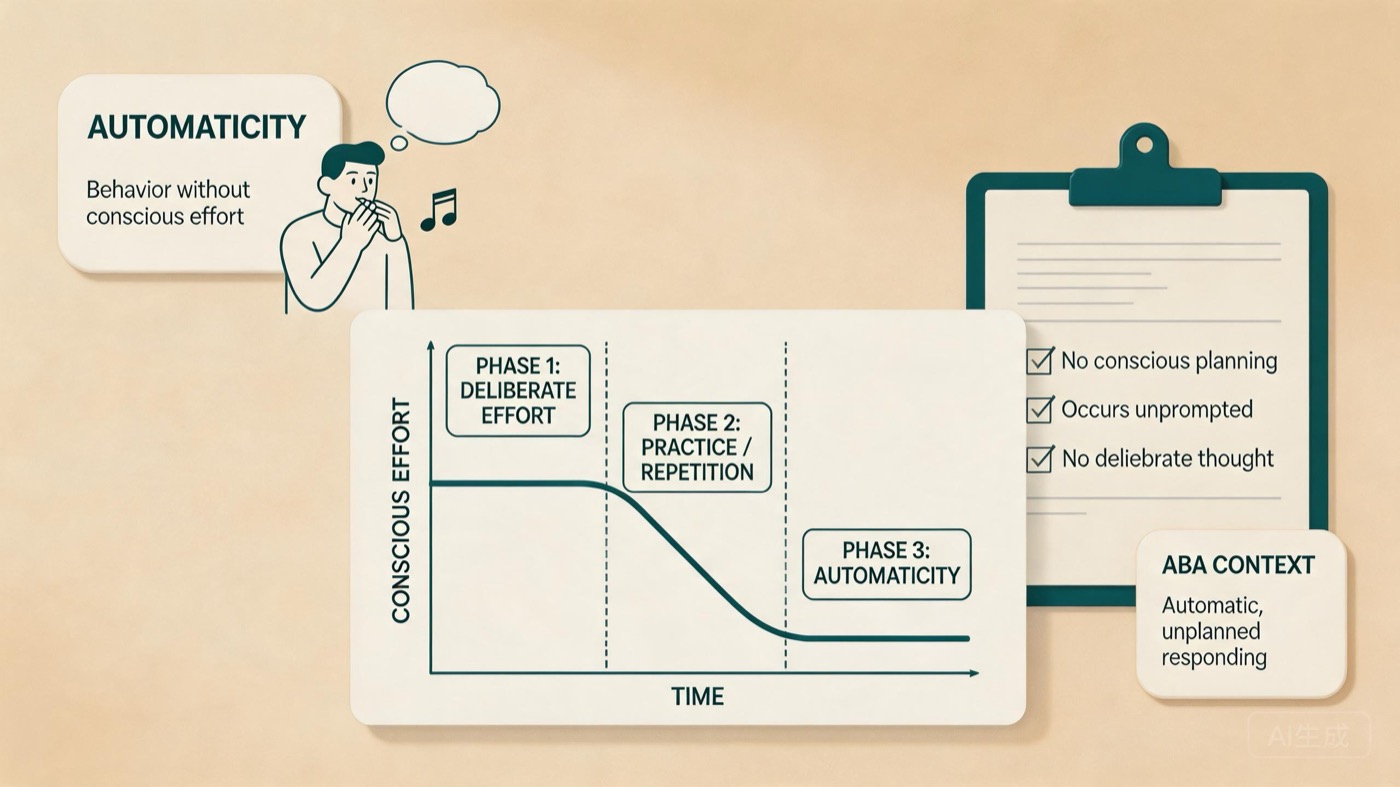
Automatic Reinforcement vs. Automaticity
A common exam trap is using these terms interchangeably. Remember: automatic reinforcement is the mechanism that maintains the behavior, while automaticity describes how the behavior is performed (smoothly, without deliberation). All automatically reinforced behaviors can become automatic with practice, but not all automatic behaviors are necessarily maintained by automatic reinforcement (some may be maintained by socially mediated reinforcement but have become habitual).
Relation to Socially Mediated Reinforcement
Some behaviors that appear automatic (e.g., tying shoes) are actually maintained by socially mediated reinforcement (e.g., praise from a parent). The automaticity here comes from repeated practice, not from the source of reinforcement. For BCBA exam questions, always check whether the consequence is delivered by another person or by the behavior itself.
ABC Examples of Automaticity
Example 1: Nail Biting (Automatic Positive Reinforcement)
- Antecedent: Sitting idle, feeling bored.
- Behavior: Biting nails.
- Consequence: Sensory stimulation from the act (tactile, auditory).
- Hypothesized function: Automatic positive reinforcement (sensory stimulation).
Example 2: Hand Flapping (Automatic Positive Reinforcement)
- Antecedent: Waiting for a preferred activity.
- Behavior: Flapping hands in front of face.
- Consequence: Visual and proprioceptive feedback.
- Hypothesized function: Automatic positive reinforcement.
Example 3: Hair Twirling (Automatic Negative Reinforcement)
- Antecedent: Feeling anxious or overstimulated.
- Behavior: Twirling hair around fingers.
- Consequence: Temporary reduction in tension or anxiety.
- Hypothesized function: Automatic negative reinforcement.
Example 4: Scratching an Insect Bite (Automatic Negative Reinforcement)
- Antecedent: Presence of an itchy insect bite on the arm.
- Behavior: Scratching the bite with fingernails.
- Consequence: Temporary relief from the itch (removal of aversive sensation).
- Hypothesized function: Automatic negative reinforcement. This example is particularly useful because the reinforcing consequence (itch relief) is immediate and directly produced by the behavior, with no social mediation involved.
Why Automaticity Matters for the BCBA Exam
The BCBA exam often tests your ability to identify the function of behavior, especially when the reinforcer is not socially mediated. Automaticity is a concept that links directly to assessment and intervention: if a behavior is maintained by automatic reinforcement, you cannot simply withhold praise or attention. Instead, you might use sensory extinction or differential reinforcement of alternative behavior (DRA) that provides acceptable sensory input. For related study strategies, check out our BCBA exam prep overview.
Common Exam Traps to Avoid
- Confusing automaticity with automatic reinforcement: Automaticity is how the behavior occurs; automatic reinforcement is why it persists.
- Mixing up positive vs. negative automatic reinforcement: Positive adds a stimulus; negative removes one.
- Assuming all repetitive behaviors are automatically reinforced: Some may have social functions (e.g., attention). Always conduct a functional assessment.
- Forgetting to consider automatic negative reinforcement: Behaviors that reduce discomfort (e.g., scratching, rocking) are often maintained by removal of an aversive stimulus, not by addition of a pleasant one.
How to Answer Automaticity Questions Correctly
When you see a behavior that appears repetitive or sensory-based, ask: Is the reinforcing consequence delivered by another person? If no, the function is likely automatic. Then decide whether a stimulus is added (e.g., visual pattern) or removed (e.g., pain). Use the ABC format to track the consequence. Practice with our free BCBA mock exam questions to reinforce this skill.
Additional Exam Trap: Overlooking Automatic Reinforcement in Escape-Maintained Behaviors
Another common mistake is assuming that any behavior that results in escape from a task is socially mediated. For example, a student might cover their ears to escape a loud noise produced by a machine. Here, the escape is automatic (reducing auditory stimulation) even though the antecedent was environmental. The key is whether the escape requires another person’s action. If the behavior itself directly alters the sensory environment, the function is automatic, not social.
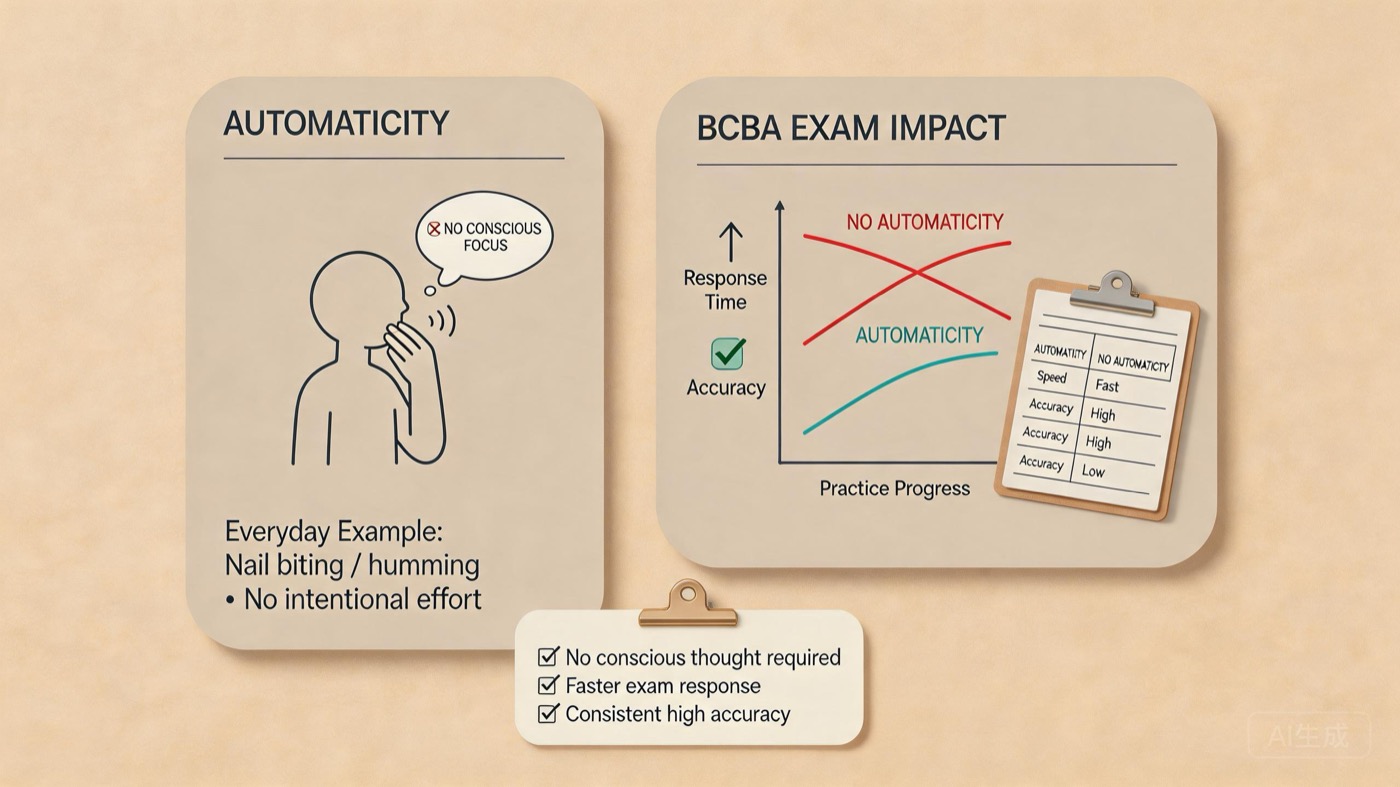
Quick Checklist: Automaticity
- ☐ Behavior occurs without conscious deliberation.
- ☐ Reinforcing consequence is not socially mediated.
- ☐ Determine if it is automatic positive or negative reinforcement.
- ☐ Differentiate from socially maintained behaviors that have become automatic through practice.
- ☐ Identify appropriate intervention: sensory extinction, DRA, or environmental enrichment.
- ☐ Avoid assuming all repetitive behaviors are automatically reinforced; rule out social functions first.
Summary and Next Steps
Automaticity is a key concept in ABA that describes behavior occurring smoothly and maintained by its own sensory consequences. The automaticity definition is essential for functional assessment and intervention design. To master this topic for the BCBA exam, practice identifying the function in ABC scenarios and avoid common traps like confusing automatic reinforcement with automaticity. Review our guide on automatic reinforcement for deeper understanding. Finally, take a mock exam to test your skills and build confidence.



