
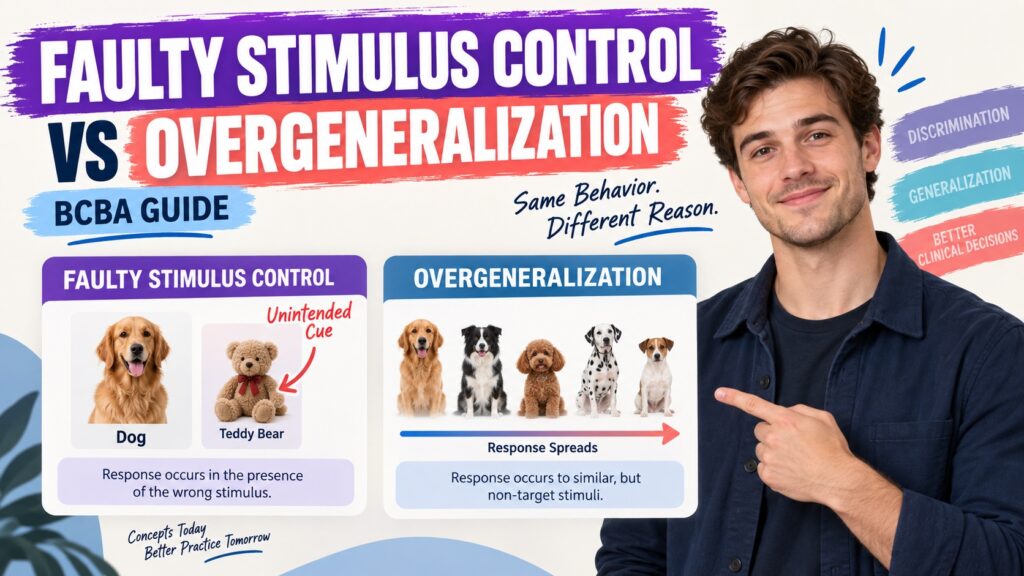
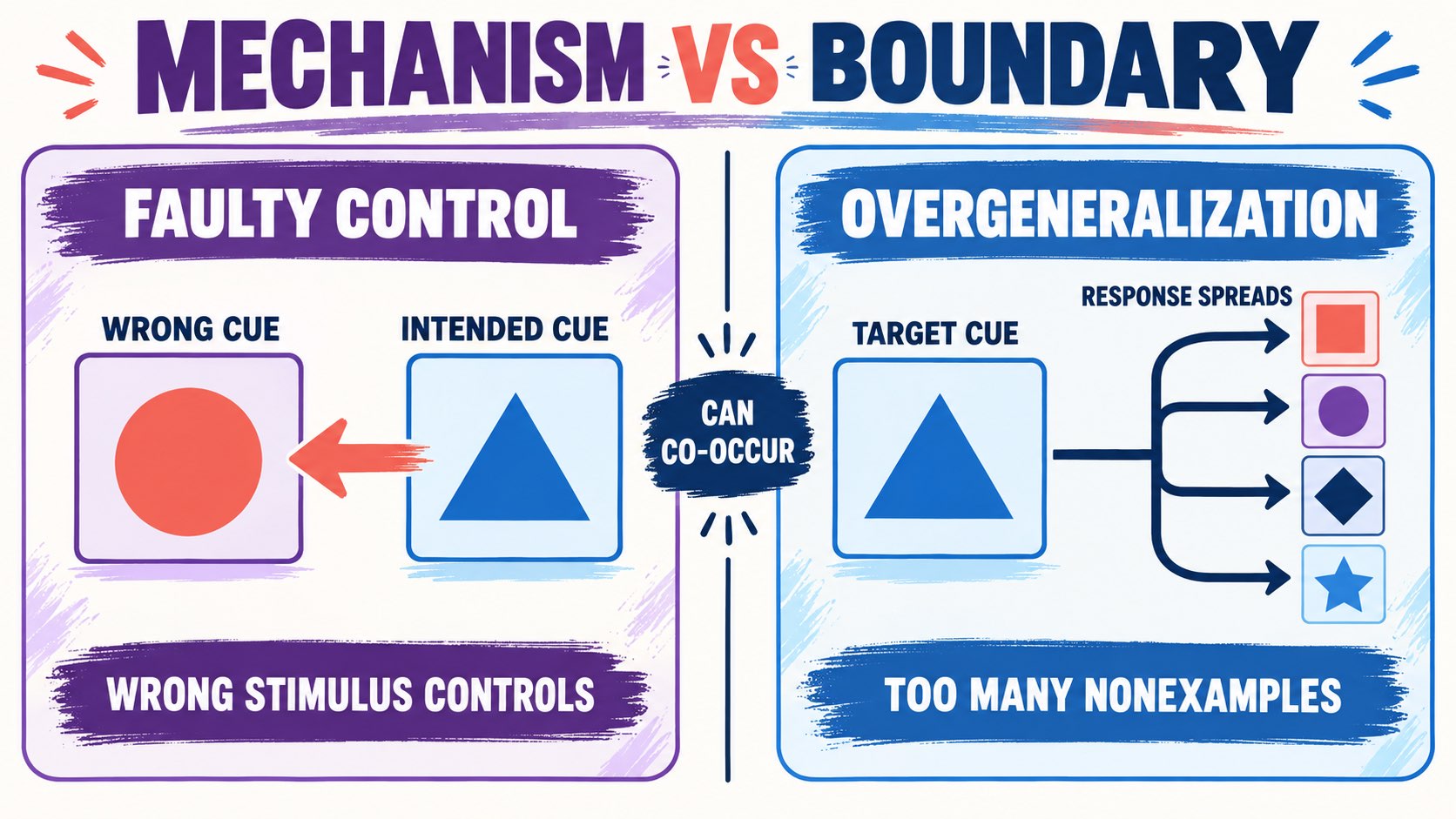
Short answer: Faulty stimulus control vs overgeneralization is a comparison between two different questions. Faulty stimulus control is a problem with what is controlling the response: an irrelevant feature, prompt, position, or other unintended antecedent controls behavior instead of the intended stimulus. Overgeneralization is a problem with where or to which stimuli the response occurs: the response spreads beyond the programmed range. They can happen together, but they are not synonyms. Faulty control describes the controlling variable; overgeneralization describes an overly broad response pattern.
Table of Contents
- What is faulty stimulus control vs overgeneralization?
- What is faulty stimulus control?
- What is overgeneralization?
- How do the concepts compare?
- What do the patterns look like in ABA?
- What data help you tell them apart?
- How can teaching reduce the problem?
- What are the BCBA exam traps?
- Faulty stimulus control vs. overgeneralization FAQ
- Take the Free BCBA Mock Exam
For example, a learner may be taught to select a picture of a cat but touch every black-and-white card. That is overgeneralized responding to non-cat stimuli. If the data show that the black-and-white feature, rather than the animal picture, is driving selection, the pattern also reflects faulty stimulus control. The BCBA exam often tests the distinction by changing one feature in the scenario and asking what the error reveals. Table of Contents
What is faulty stimulus control vs overgeneralization?
Faulty stimulus control means the response is controlled by the wrong antecedent feature; overgeneralization means the response occurs across stimuli, people, settings, or examples beyond the intended boundary. One focuses on the source of control. The other focuses on the breadth of responding.
That distinction matters because the same visible error can have different explanations. A learner who selects a red item when asked for a stop sign may be overgeneralizing to the color red. But the learner may also be under the faulty control of color, position, or a familiar outline. You need an arrangement that tests the competing features rather than assigning a label from one trial. For the exam scope, consult the current BACB BCBA Test Content Outline; for the research context behind faulty stimulus control vs overgeneralization, focus on how stimulus control and reinforcement shape generalization.
What is faulty stimulus control?
Faulty stimulus control occurs when a behavior comes under the restricted or unintended control of an irrelevant antecedent stimulus. The learner may appear to know the task under one arrangement, but the response changes when an irrelevant feature changes. Common examples include selecting the top-left card, responding to a prompt instead of the natural cue, or labeling every object that shares a background color.
Suppose a therapist teaches a learner to touch a picture of a cup when the instruction is “Touch cup.” During training, the cup card is always on the left and all distractor cards are on the right. If the learner later touches the leftmost card even when it is a shoe, the position has acquired control. The learner’s error is not simply that the response is too broad; the response is being evoked by a specific irrelevant arrangement.
- Intended stimulus: the cue or feature that should occasion the response, such as the picture of a cup.
- Irrelevant stimulus: a position, color, border, instructor prompt, or other feature that should not determine the response.
- Observed pattern: accuracy changes when the irrelevant feature changes, even though the intended stimulus stays the same.
Faulty control can be narrow rather than broad. A learner may respond only when a specific prompt, person, or card format is present. In that case the response does not generalize to the intended natural cue. The term is therefore about an inaccurate control relation, not about low ability or motivation.
What is overgeneralization?
Overgeneralization occurs when a learned response extends to stimuli or contexts that should not evoke it under the current goal. Generalization is often desirable when it allows a skill to work with new examples, people, materials, or settings. Overgeneralization is the boundary problem: the response spreads to nonexamples or to conditions where the response is not appropriate.
Imagine that a learner is taught to say “dog” when shown a dog. If the learner labels every four-legged animal as “dog,” the response has generalized too broadly across animal examples. If the learner says “dog” to any picture with a brown background, the background may be an irrelevant controlling feature as well. The broad response pattern is overgeneralization; the analysis of the brown background as the source of control is faulty stimulus control. Overgeneralization can occur across several dimensions:
- Stimuli: responding to nonexamples that share only a superficial feature.
- People: using a response with a person or communication partner for whom it is not appropriate.
- Settings: carrying a behavior into a context with a different contingency.
- Situations: responding to a cue when the relevant motivating operation or consequence is absent.
- Response forms: using one learned response in place of a more precise response distinction.
How do the concepts compare?
The following table separates the question “What is controlling the response?” from the question “How far has the response spread?”
| Question | Faulty stimulus control | Overgeneralization |
|---|---|---|
| Main focus | Which antecedent feature or cue controls the response? | Across which stimuli, people, settings, or situations does the response occur? |
| Typical error | The learner responds to position, color, prompt, or another irrelevant cue. | The learner responds to nonexamples or uses the skill outside the intended boundary. |
| Can they co-occur? | Yes. An irrelevant feature can produce a broad or narrow response pattern. | Yes. Overgeneralized responding may be maintained by an unintended feature. |
| Best first probe | Vary the suspected irrelevant feature while holding the intended cue constant. | Present planned nonexamples and new contexts while keeping the target definition clear. |
| Exam shorthand | Wrong stimulus controls behavior. | Response generalizes too far. |
What do the patterns look like in ABA?
Example 1: card position. A learner is taught to select a picture of a spoon from a three-card array. The spoon is always placed in the middle, and the learner receives reinforcement for touching the middle card. When the spoon is moved to the left, accuracy drops and the learner continues touching the middle card. The middle position is a plausible faulty controlling variable. The next probe should rotate positions while holding the target and distractors constant.
Example 2: broad label. A learner is taught to label a dog. During a probe, the learner says “dog” for a cat, fox, and horse. The response is overgeneralized across animal examples. To determine whether an irrelevant feature is also controlling, vary color, size, background, and picture style. If the learner says “dog” mainly to brown animals, brown color may be the faulty cue.
Example 3: verbal prompt dependence. A learner requests a break only after an adult says, “What do you want?” When the learner sees the break card without the question, the request does not occur. This is not automatically overgeneralization. It is evidence that the verbal prompt may control the response and that control has not fully transferred to the natural communication cue. The data point toward a stimulus-control transfer problem.
Example 4: desirable generalization. A learner stops at several red traffic signs, in different locations and with different fonts, but does not stop at red posters or red toys. This is appropriate stimulus generalization with a discriminated boundary, not overgeneralization. The learner responds across relevant examples and withholds the response for planned nonexamples.
What data help you tell them apart?
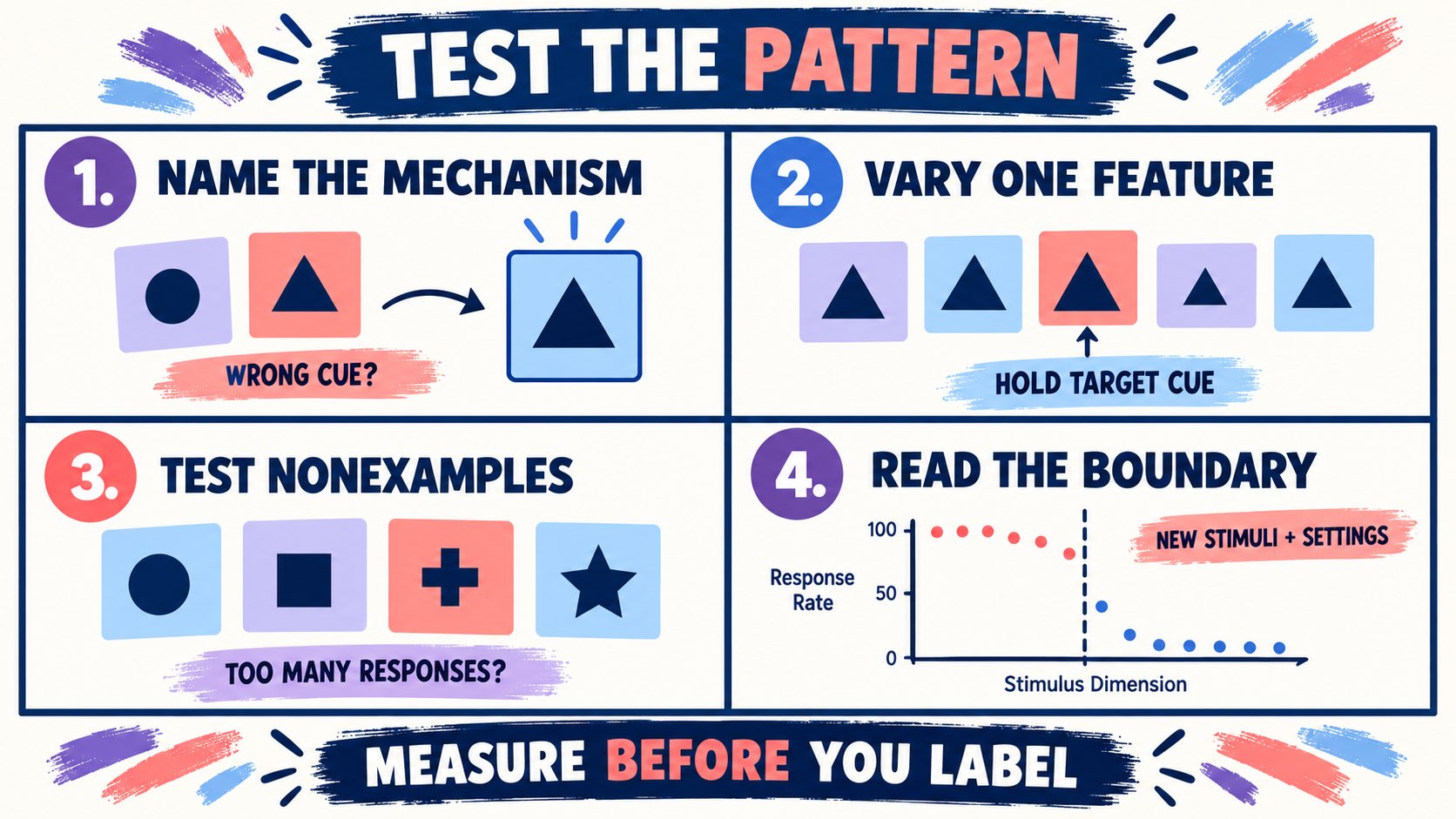
Do not label the behavior from a single error. Use a small test matrix that changes one dimension at a time. First define the target response and the intended controlling stimulus. Then arrange probes that let you compare the target feature with possible irrelevant features.
- Hold the intended cue constant and vary one irrelevant feature: move the target card, change its border, or alter its background while keeping the relevant item the same.
- Hold the suspected irrelevant feature constant and vary the intended cue: use the same position or color with several different target and nonexample stimuli.
- Include nonexamples: test whether the response occurs when the defining feature or contingency is absent.
- Probe new examples and settings: check whether the response generalizes appropriately rather than simply disappearing outside the training arrangement.
- Record error patterns: note accuracy, latency, prompt level, stimulus arrangement, and the exact antecedent present before the response.
A simple interpretation rule is useful: if changing an irrelevant feature changes the response while the intended cue stays the same, suspect faulty stimulus control. If the response occurs to many nonexamples despite varied arrangements, suspect overgeneralization. If both happen, document both the broad response pattern and the likely source of control rather than choosing only one label.
Measurement must also respect the learner’s communication and context. A response that appears “incorrect” in a contrived array may be functional in the natural environment, while a response that scores correct in one teaching format may fail in the setting where the skill matters. Use the individualized goal, operational definition, and socially valid outcome to interpret the probe.
How can teaching reduce the problem?
Prevention begins before errors appear. Arrange varied exemplars, rotate positions, vary instructors and materials, and avoid making an irrelevant prompt perfectly correlated with reinforcement. When a learner already shows restricted control, use an individualized plan to broaden control of the relevant stimulus features and to fade prompts systematically.
- Vary noncritical features: change size, color, position, voice, and materials while preserving the target relation.
- Teach relevant nonexamples: show what should not evoke the response and reinforce appropriate discrimination.
- Use multiple exemplars: do not let one picture, person, or room stand in for the whole skill.
- Fade prompts deliberately: measure prompt level so the response comes under the intended natural cue.
- Plan generalization probes: test new examples, people, settings, and times instead of assuming transfer.
- Check assent and fit: keep the goal meaningful, accessible, and compatible with effective communication methods.
Research on stimulus control and generalization supports analyzing what features have acquired control, but it does not prescribe a universal correction protocol. If the pattern involves safety, communication access, or a complex clinical history, use appropriate supervision and individualized assessment. The goal is not to force responding across every context; it is to establish useful, discriminated behavior that works where it is supposed to work.
What are the BCBA exam traps?
- Treating the terms as synonyms: faulty control asks what is controlling; overgeneralization asks how far responding spreads.
- Calling every correct response generalization: generalization is appropriate when responding transfers to relevant new examples while discriminating nonexamples.
- Ignoring an irrelevant feature: position, color, prompt wording, or background may be the actual controlling variable.
- Assuming broad responding means no stimulus control: overgeneralized responding can still be controlled by an overly broad or irrelevant cue.
- Confusing prompt dependence with overgeneralization: failure to respond without a prompt may indicate incomplete transfer, not a response that spread too far.
- Choosing an intervention before analyzing data: first identify the intended cue, likely competing cues, and the conditions under which the response changes.
- Using diagnosis as the explanation: describe the observable stimulus-response relation and the data pattern rather than attributing the error to a vague trait.
Quick review: Faulty stimulus control is a mechanism problem: the wrong antecedent feature controls the response. Overgeneralization is a boundary problem: the response occurs to too many stimuli or contexts. Vary one feature at a time, test nonexamples, and use the data to decide whether the error is narrow control, broad generalization, or both. For additional scenario practice, try the free BCBA mock exam. It is a study resource and does not claim to reproduce official BACB questions.
Faulty stimulus control vs. overgeneralization FAQ
Can faulty stimulus control and overgeneralization happen at the same time? Yes. A learner can respond too broadly because an irrelevant feature, such as color or position, has acquired control. Report the broad response pattern and the suspected controlling variable separately.
Is stimulus generalization always a problem? No. Appropriate generalization is a goal when the learner responds to relevant new examples, people, and settings while discriminating nonexamples. It becomes overgeneralization when the response crosses the intended boundary.
What is the fastest exam question to ask myself? Ask, “Is the stem testing what controls the behavior, or where the behavior occurs?” The first points toward stimulus control; the second points toward generalization. Then look for the feature or boundary that makes the distinction precise.
How do I test for faulty stimulus control? Keep the intended stimulus relation constant while varying a suspected irrelevant feature, such as position, color, prompt, or background. If performance follows the irrelevant feature, the data support a faulty-control hypothesis.
Take the Free BCBA Mock Exam
When you are ready to apply the idea, use the free practice resource below for additional feedback. Take the Free BCBA Mock Exam



