
Short answer: A licensed behavior analyst is a behavior professional who is authorized under a state’s law or regulatory system to practice within that jurisdiction. That status is not automatically identical to holding BCBA certification, although many licensed behavior analysts also hold the BCBA credential. The exact relationship depends on the state, the person’s current BACB status, the employer setting, and the services being provided.
Table of Contents
- What Is a Licensed Behavior Analyst?
- How Is a Licensed Behavior Analyst Different From a BCBA?
- What Requirements Usually Appear in the Path?
- How Does State Licensure Change the Answer?
- What Can the Title Tell You About Scope?
- How Can You Verify a Licensed Behavior Analyst?
- What Does This Mean for Students and Job Seekers?
- Licensed Behavior Analyst FAQ
- Key Takeaway
- Take the Free BCBA Mock Exam
That distinction matters when you are choosing a provider, applying for a job, planning a BCBA pathway, or deciding whether a title on a website proves permission to practice. Use the current BACB resources and your state board’s rules together. A credential can be national; a license is a state practice permission; an employer title may be neither.
What Is a Licensed Behavior Analyst?
The phrase describes a person whose behavior-analytic practice is regulated by a state or other authorized jurisdiction. The state may use a title such as licensed behavior analyst, behavior analyst, or another protected title. The legal definition, allowed services, exemptions, renewal rules, and supervision requirements are not identical everywhere.
The BACB consumer resources explain that many, but not all, U.S. states require behavior analysts to hold a state license. They also direct consumers to verify certification in the BACB Certificant Registry and licensure with the relevant state authority. That two-source check is more reliable than assuming that a provider’s website, job title, or social-media profile is current.
In ordinary conversation, people sometimes use “licensed behavior analyst” as if it were another name for BCBA. It is safer to treat the terms as related but separate. BCBA is a certification issued by the Behavior Analyst Certification Board. Licensure is a state-level authorization that may incorporate BCBA certification, additional application steps, fees, background checks, supervision rules, or renewal obligations.
How Is a Licensed Behavior Analyst Different From a BCBA?
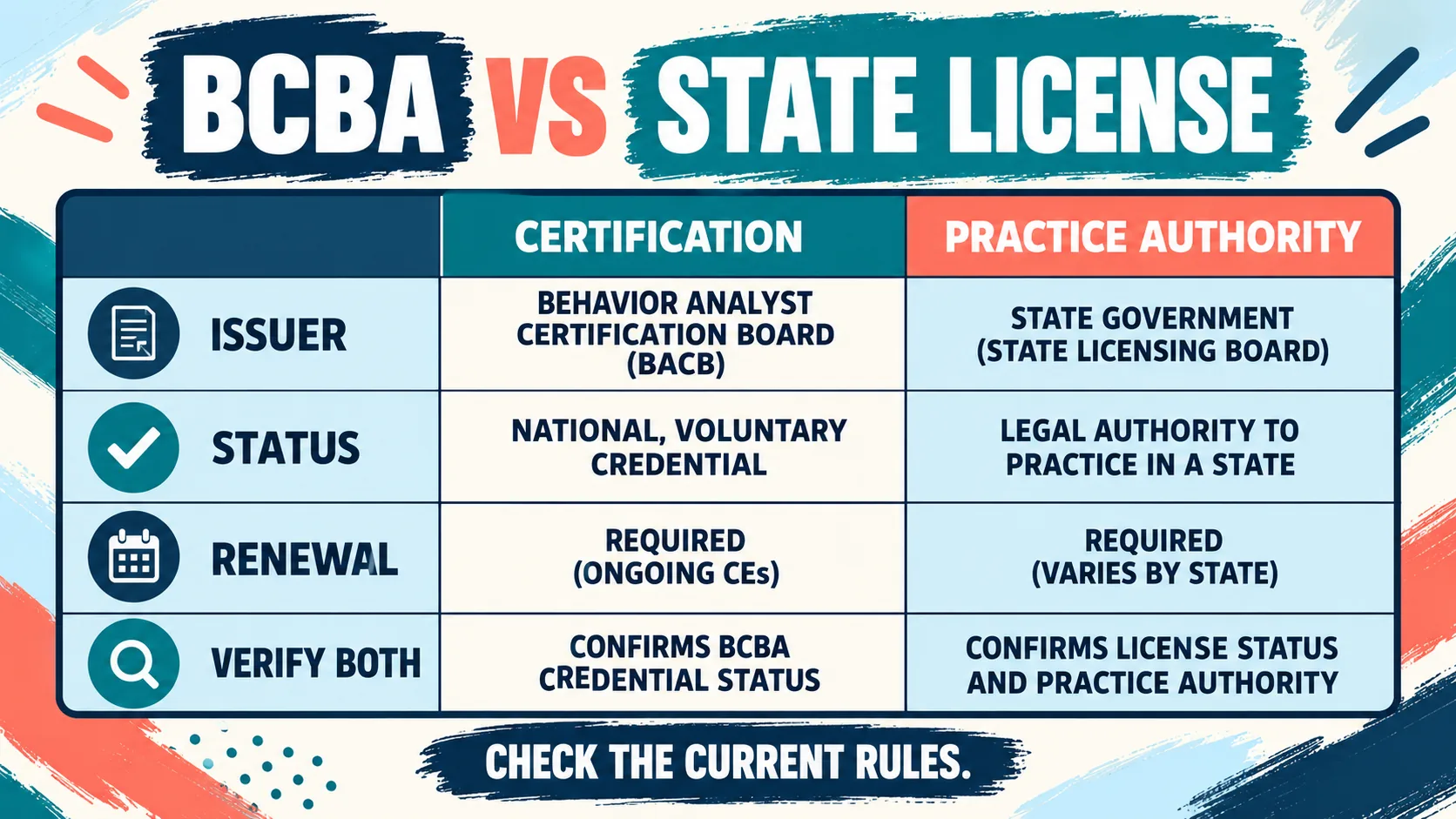
A BCBA is a graduate-level professional certification. A license is permission to practice under a state’s law. One person may hold both, but the two records answer different questions. The BCBA record asks whether the person has met the BACB’s certification requirements and maintained that certification. The state record asks whether the person may practice under that state’s current rules.
| Question | BCBA certification | State licensure |
|---|---|---|
| Who issues it? | The Behavior Analyst Certification Board | A state board, department, or other authorized regulator |
| What does it answer? | Whether certification requirements are met and maintained | Whether practice is permitted under that state’s current law |
| Does it travel automatically? | Certification is not a substitute for each state’s practice rules | Usually tied to the jurisdiction, with state-specific exceptions and processes |
| What should you verify? | Current status and any reportable disciplinary information | License number, status, expiration, restrictions, and scope |
The safest conclusion is not “BCBA versus licensed behavior analyst.” It is “which certifications and licenses does this person currently hold, and do they cover the service and location involved?” This also prevents a common mistake: treating the word “analyst” in an employer’s title as proof of independent practice authority.
What Requirements Usually Appear in the Path?
Requirements vary, but a typical pathway may include graduate education, behavior-analytic coursework, supervised fieldwork, an examination, a certification application, and state licensure paperwork. The BACB BCBA page describes BCBA certification as graduate-level and points applicants to the current handbook, ethics requirements, and transition guidance.
Do not build a multi-year plan from a blog post written for an earlier rule set. The BACB has published a 2027 BCBA requirements page and transition guidance. The relevant application date, degree pathway, coursework evidence, fieldwork documentation, and examination rules should be checked against the handbook that applies to your intended application.
- Education: Confirm the degree level, program status, and coursework pathway that apply to your application date.
- Fieldwork: Confirm who may supervise you, how hours must be documented, and whether the experience meets current BACB rules.
- Examination: Treat exam eligibility and state practice permission as separate checkpoints.
- State application: Check whether the state requires an additional application, background check, jurisprudence step, supervision agreement, or fee.
- Renewal: Track both BACB maintenance requirements and state renewal deadlines; one does not necessarily renew the other.
How Does State Licensure Change the Answer?
State law determines whether a license is required, which title is protected, what services are regulated, and who may provide them. The BACB U.S. licensure resource is a useful starting point, but it is not a replacement for the state’s current statute, board rules, or license lookup.
Pay special attention when services cross state lines. A clinician who lives in one state may serve a client in another through telehealth, consultation, school work, or travel. The relevant practice location and service type can affect which authorization is needed. A current BCBA credential does not by itself answer that jurisdictional question.
State rules can also distinguish between independent practice, supervised implementation, consultation, assessment, and services delivered by technicians. That is why a job posting or clinic page should not be used as the final source for scope. Ask the regulator or a qualified compliance adviser when the situation involves a new state, telehealth, a protected title, or an unusual service arrangement.
What Can the Title Tell You About Scope?
The title can suggest a role, but it does not tell you everything about the person’s training, current status, supervision arrangement, or authority in a particular setting. The person may work in a clinic, school, home, community program, research environment, or administrative role. Their permitted activities may depend on state law, employer policy, payer rules, and the individual’s competence.
- Ask which credential and state license are active today.
- Ask whether the person is the responsible clinician, a supervisor, an implementer, or a consultant.
- Ask who reviews assessments, treatment goals, data, and changes to the plan.
- Ask how consent, assent, privacy, complaints, and emergency escalation are handled.
- Ask whether the service is covered by the payer and whether the provider meets that payer’s network rules.
The BACB Ethics Code resources are relevant because applicants and certificants have professional obligations that go beyond displaying a title. A responsible practice makes it possible for consumers and team members to understand who is accountable for decisions and how concerns can be raised.
How Can You Verify a Licensed Behavior Analyst?
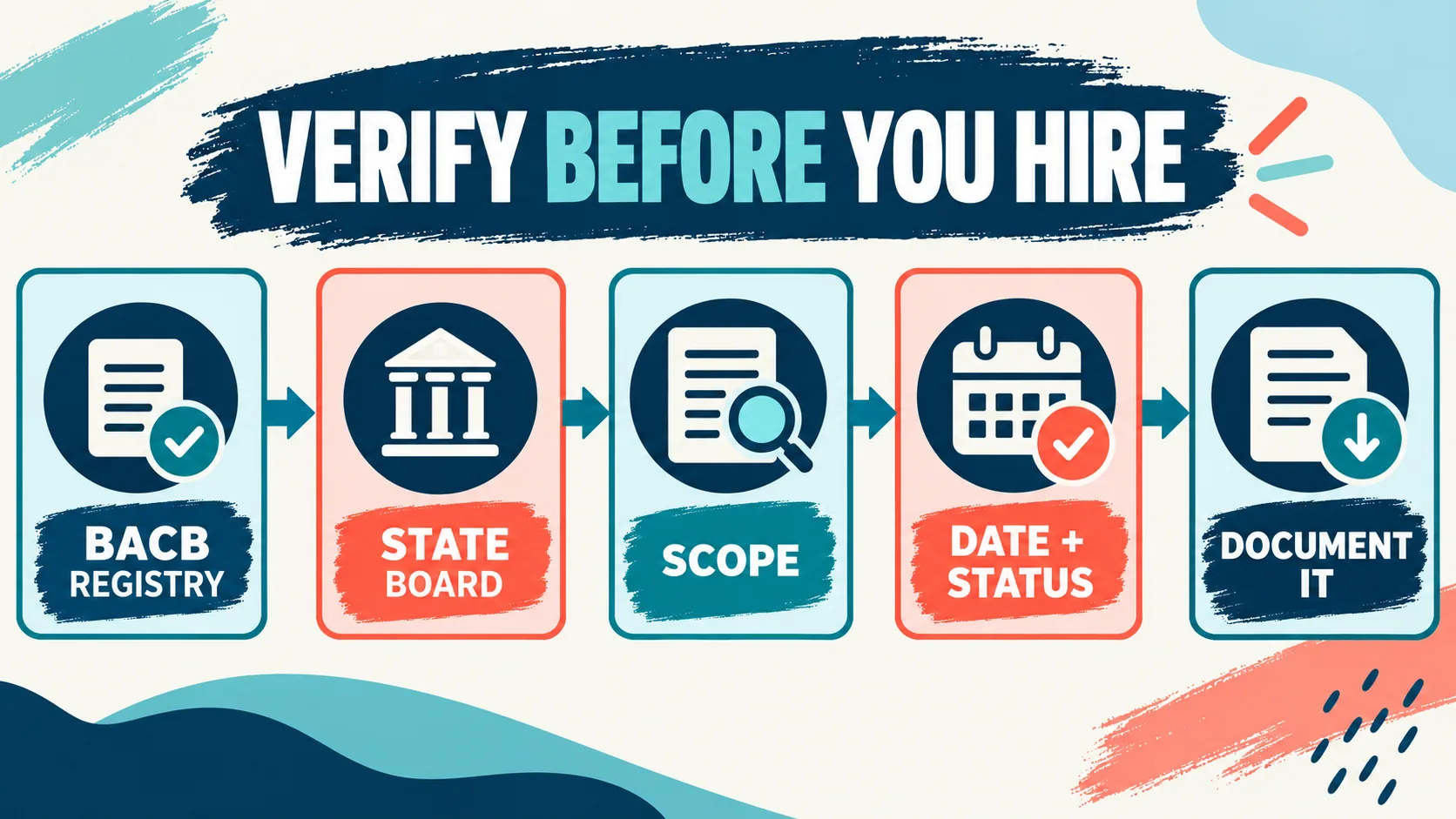
Use a two-part verification process. First, check the BACB Certificant Registry for the person’s certification status and any information the registry makes available. Second, use the state’s official license lookup or contact the relevant board to confirm the state license. Match the person’s legal name, credential number, status, expiration date, and any restrictions.
| Check | Evidence | Why it matters |
|---|---|---|
| Identity | Name and credential numbers match the provider | Avoids relying on a similar name or outdated profile |
| BACB status | Current registry result | Confirms certification status at the time checked |
| State status | Official state lookup, expiration, and restrictions | Confirms practice authorization in the relevant jurisdiction |
| Service fit | Written explanation of role, supervision, and payer requirements | Connects a status record to the actual service being requested |
Save the date you performed the check and the page or record you reviewed. Status can change. If a result is unclear, do not fill the gap with assumptions; contact the board, organization, or provider for clarification. This is especially important before starting services, signing a supervision agreement, hiring someone into a regulated role, or moving across state lines.
What Does This Mean for Students and Job Seekers?
If you are planning a career, begin with the credential you want and the states where you expect to work. You do not need to call every entry-level ABA job a licensed role. Some positions involve direct implementation under supervision; others involve graduate training, fieldwork, analysis, or independent practice. Read the job description for the actual responsibilities, supervisor, required credential, and state.
When studying for the BCBA exam, use practice questions to build retrieval and application skills, but keep the current BACB handbook as the authority for eligibility and certification. Our free BCBA mock exam can help you rehearse exam-style decisions. It does not grant certification, state licensure, or permission to use a protected professional title.
- Choose a target state before assuming a credential will transfer.
- Confirm the current BACB pathway before paying for coursework or supervision.
- Keep fieldwork records contemporaneously and review them with the responsible supervisor.
- Ask employers how they handle state licenses, telehealth, supervision, and renewal.
- Recheck both certification and licensure before accepting a regulated position.
Licensed Behavior Analyst FAQ
Is every BCBA a licensed behavior analyst?: No. A BCBA may be certified by the BACB but work in a state or setting with different licensure rules, exemptions, or employer requirements. Check the relevant state authority instead of treating certification as an automatic license.
Can someone be licensed without being a BCBA?: It depends on the state’s law and license category. Some jurisdictions may recognize an equivalent credential or create different regulated roles. The state board’s current rules control the answer.
Does a license in one state transfer to another?: Do not assume it does. States may have endorsement, reciprocity, application, or additional examination processes, and some may not use the same title. Check the destination state before practicing or advertising services there.
What is the fastest way to verify a provider?: Use the BACB registry when the provider claims BACB certification and the official state license lookup for practice authorization. Match the records to the person and the service location, record the date, and ask for clarification if either status is missing or unclear.
Key Takeaway
A licensed behavior analyst is defined by state practice authority, while a BCBA is defined by a national professional certification. Many professionals hold both, but the records should still be checked separately. Start with official BACB and state sources, confirm the scope and jurisdiction, and keep exam preparation, certification, licensure, and employer titles as distinct parts of the decision.
Take the Free BCBA Mock Exam
When you are ready to apply the idea, use the free practice resource below for additional feedback. Take the Free BCBA Mock Exam



