
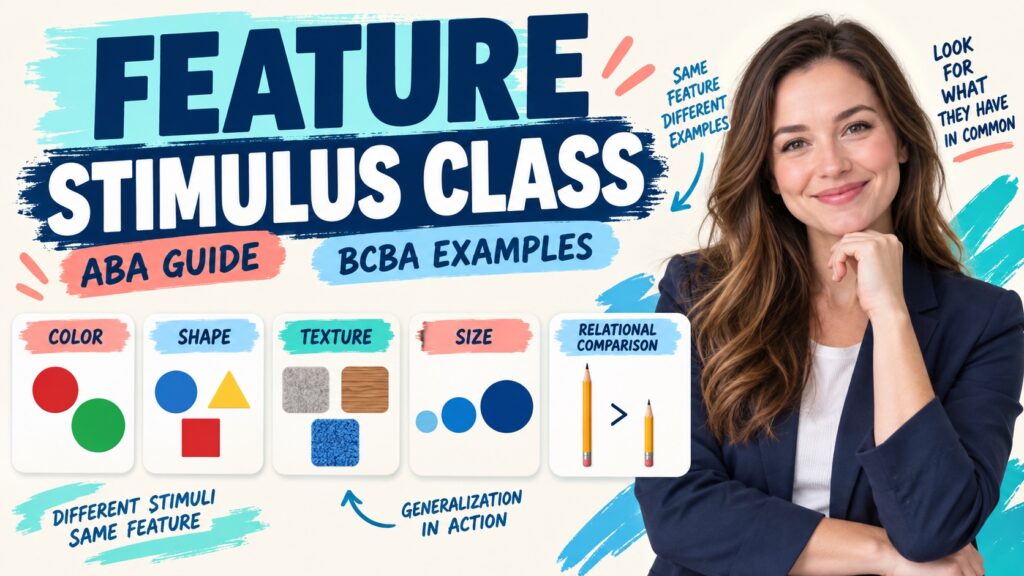
Short answer: A feature stimulus class is a group of stimuli that share a relevant physical form, structure, or relative relationship. The members do not have to be identical. A learner may respond similarly to several objects because they share a feature such as color, shape, texture, size, or a relation such as “larger than” or “next to.” The key question is: What property do the stimuli share, and how does that shared property relate to the response?
Table of Contents
- What is a feature stimulus class?
- Which features can define the class?
- What are clear ABA examples?
- How is it different from other stimulus classes?
- How does it relate to generalization and teaching?
- How should you solve a BCBA exam question?
- What are the common mistakes?
- Feature stimulus class FAQ
- Take the Free BCBA Mock Exam
For BCBA study, keep the definition tied to observable stimulus properties. A feature stimulus class is not simply “anything that causes the same behavior,” and it is not automatically an arbitrary stimulus class. A functional class is organized by a shared effect on behavior; an arbitrary class is connected through a learned relation without a necessary physical resemblance. A feature class starts with a common form, structure, or relation that can be described before the learner responds. Table of Contents
What is a feature stimulus class?
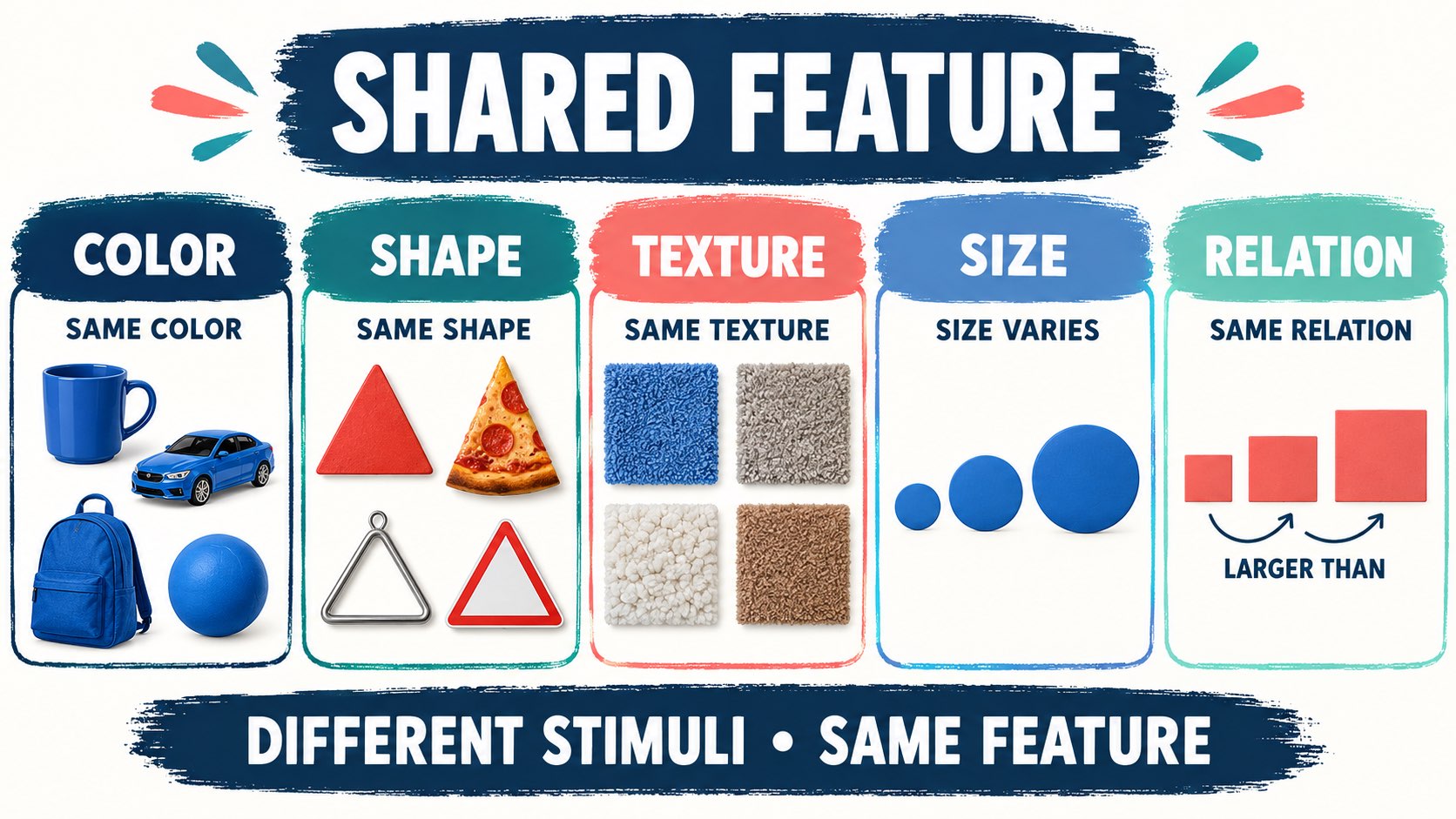
A feature stimulus class is a set of stimuli that share one or more common physical forms, structures, or relative relationships. The shared property is the feature that makes the items relevant to the same classification. For example, a blue square, a blue cup, and a blue notebook can be grouped by the feature blue. They differ in shape and function, but the color is a common physical property.
Another example uses a relative relationship instead of a single color or shape. A learner may be taught to select the object that is larger than a comparison object. The individual items can change, but the relation between them remains relevant. The class is not the particular red block or particular toy; it is the set of stimuli arranged in the same relevant relation.
This definition is useful because it separates the stimulus property from the response. The learner’s pointing, matching, touching, or labeling is behavior. The colors, shapes, objects, positions, and relations are stimulus features. If you describe the class by the behavior alone, you may be describing a response class or a functional stimulus class instead.
Stimulus classes are behavior-analytic descriptions, not invisible categories that must be assumed to exist independently of teaching and testing. Research on stimulus-class formation emphasizes the importance of the training history and the tests used to show that stimuli function together. In practice, describe the property, arrange the relevant exemplars, and probe whether the learner responds consistently when the feature changes or is shared by new examples.
Which features can define the class?
The word feature is broad, so a good answer names the exact property. Common feature dimensions include the following:
- Color: red items, blue cards, or objects with a particular color pattern.
- Shape: circles, objects with four sides, or forms with a specified outline.
- Size: small items, tall items, or stimuli that are larger than a comparison.
- Texture or material: rough surfaces, wooden objects, or items with a specific tactile property.
- Arrangement: objects next to, above, inside, or between other stimuli.
- Relative relation: hotter than, heavier than, closer than, or higher than another stimulus.
One item can belong to more than one possible class. A large blue circle could be a member of a “blue” class, a “large” class, and a “circle” class. The relevant class depends on the task and on which feature has been correlated with reinforcement or the response requirement. If a learner is reinforced for selecting all blue items, color is the programmed feature. If the same learner is reinforced for selecting circles, shape is the programmed feature.
Do not assume that every visible property is controlling behavior. A learner may select a correct card because of its position, a border, a particular instructor, or a vocal prompt rather than the intended feature. That is why varied exemplars and generalization probes matter. The feature named in the goal should be tested against irrelevant features that could accidentally become correlated with reinforcement.
What are clear ABA examples?
Imagine a matching program with three cards: a red circle, a red square, and a blue circle. If the instruction is to “find blue” and reinforcement follows selection of the blue circle, the programmed relevant feature is color. If later the learner selects a blue triangle and a blue book without direct training on those exact items, the new performance may show generalization across members that share the color feature. The result should still be interpreted from the teaching history and the probe arrangement, not from one correct trial alone.
In a receptive-language program, a practitioner may teach the learner to respond to “rough” with several safe objects that differ in color, shape, and size but share a tactile feature. The teaching goal is not to memorize one rough object. It is to contact the relevant property across examples. If the learner responds only to the first object, the intended feature may not yet control responding.
Here is a second example involving a relative relation. A learner is taught to identify the item that is under a reference object. The items may change, but the spatial relationship stays constant. The controlling relation is not the specific color or brand of either item. It is the arrangement that makes one item “under” the other.
- Identify the candidate property: write the feature in observable language, such as blue, rough, four-sided, or next to.
- Vary irrelevant dimensions: change size, position, material, or exemplar while preserving the target feature.
- Teach and test: reinforce the defined response during training, then probe new examples without assuming mastery from a familiar item.
- Check the boundary: present stimuli that share the irrelevant feature but not the target feature to see whether responding is selective.
How is it different from other stimulus classes?
Many BCBA questions become easier when you classify the relation before looking at the answer choices. The same stimulus can participate in different classes under different learning histories, so use the property described in the stem rather than relying on the object’s name.
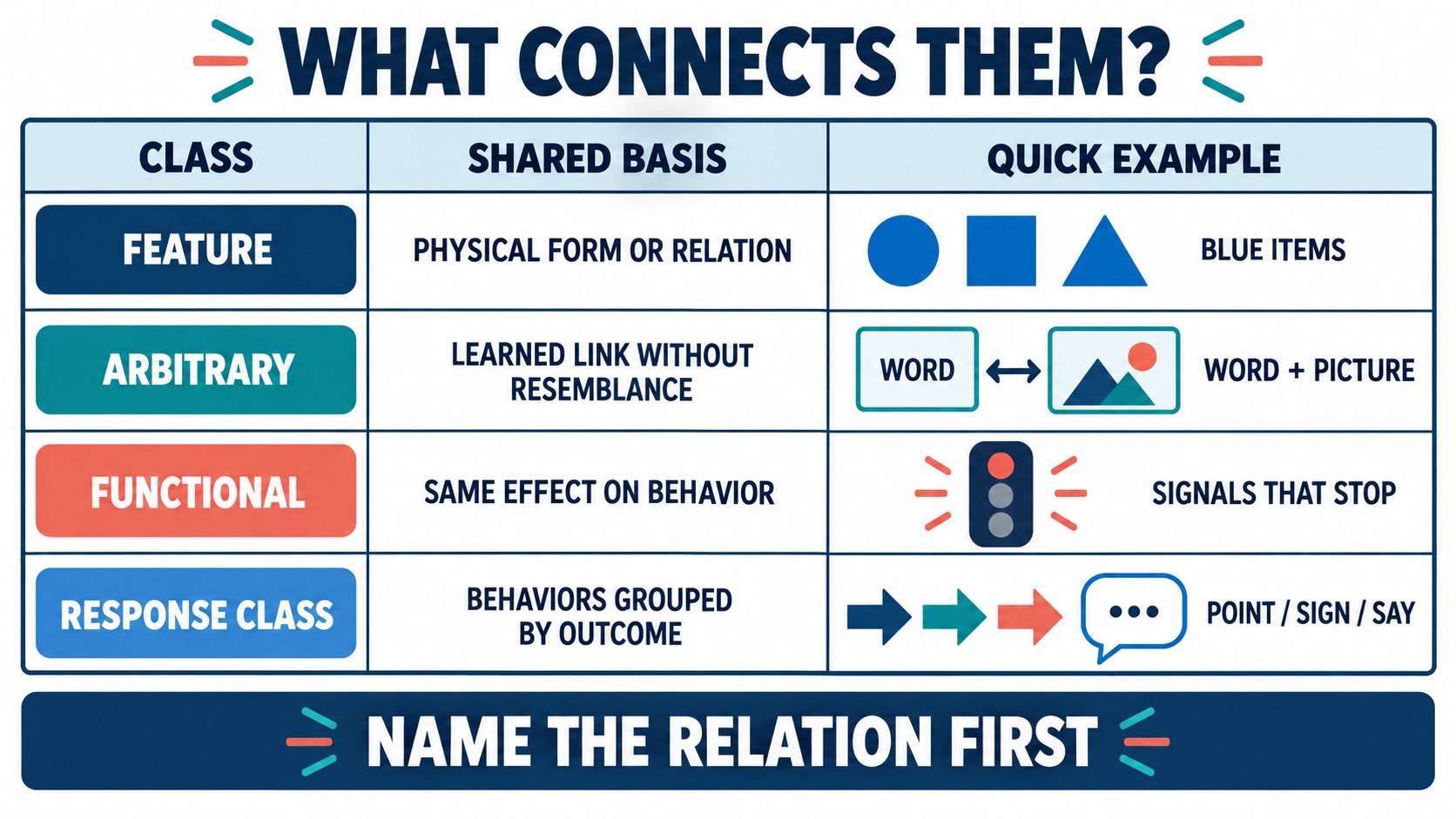
| Class or term | What connects the stimuli? | Example | BCBA clue |
|---|---|---|---|
| Feature stimulus class | A shared physical form, structure, or relative relationship | Blue items, rough items, or stimuli that are next to a reference | Ask what observable property is shared |
| Arbitrary stimulus class | A learned relation without required physical resemblance | A printed word, spoken word, and picture linked through training | Look for learned symbolic or conditional relations |
| Functional stimulus class | Stimuli share an effect on behavior or evoke the same response under a relevant history | Different signals that all occasion a learner to stop at a crossing | Focus on the shared behavioral function, not appearance |
| Response class | Different responses grouped by a common outcome or function | Pointing, signing, or saying “break” when each accesses a break | The items being grouped are behaviors, not stimuli |
Terminology can vary across study resources. Some materials use “formal,” “physical,” or “feature” in overlapping ways, while others reserve each label for a slightly different taxonomy. When a question gives a definition, use that definition. When it gives examples, identify the observable relation first. That method is safer than trying to memorize a label without checking what the stimuli share.
How does it relate to generalization and teaching?
Feature classes are closely related to stimulus generalization because a learner may respond to new stimuli that share a relevant property with the trained stimulus. A careful teaching arrangement varies noncritical features while preserving the target feature. For example, if the goal is to respond to “red,” use red items that differ in shape, size, texture, and location. If the learner responds only to a red circle in the top-left position, the program may have produced narrow or faulty stimulus control.
Generalization is not automatic. A practitioner may need to plan multiple exemplars, vary instructors and settings, and test novel examples. The target response should also be operationally defined. “Understands rough” is not enough; specify what the learner does when presented with a set of stimuli and what consequence follows a correct selection. Use these teaching checks:
- Preserve the target feature while changing irrelevant features.
- Present both positive examples and close nonexamples.
- Rotate stimulus positions so location does not become the shortcut.
- Probe untrained exemplars and record whether responding remains accurate.
- Review prompt fading and reinforcement so the intended feature, not an adult cue, controls the response.
Peer-reviewed stimulus-class research also cautions against treating a class as a mental container that exists independently of evidence. A defensible description says what training and testing showed: for example, “responding generalized across stimuli sharing the programmed color feature under these probe conditions.” That wording keeps the interpretation tied to observable behavior.
How should you solve a BCBA exam question?
Use a four-step decision rule:
- List the stimuli: identify the items, events, or relations being grouped.
- Circle the shared property: is it color, shape, texture, size, position, or a relation such as “larger than”?
- Separate the response: do not confuse the learner’s pointing, matching, or labeling with the stimulus class itself.
- Check the alternative: if the members do not physically resemble each other and are linked through learning, consider arbitrary or functional relations instead.
Mini-scenario: A teacher reinforces a student for selecting a triangle whether it is large, small, red, or green. The question asks what class is being taught. The best clue is the shared shape, not the colors or sizes. If the teacher instead reinforces selecting a red item regardless of shape, color is the relevant feature. If the teacher links a picture, spoken word, and printed word through conditional-discrimination training, the question is describing a learned relation rather than a simple physical-feature class.
The current BCBA Test Content Outline places stimulus and stimulus-class distinctions within the concepts-and-principles scope. It is useful exam context, but it does not prescribe one clinical teaching script. In a question about implementation, still read for measurement, prompting, generalization, and the learner’s individualized context.
What are the common mistakes?
- Calling every group with the same label a feature class: a common verbal label may reflect a learned arbitrary or equivalence relation; inspect the physical and relational properties.
- Confusing a response class with a stimulus class: saying, pointing, and signing are responses, even when they contact the same consequence.
- Assuming one correct trial proves generalization: use multiple exemplars and planned probes.
- Ignoring position bias: a learner may select the top-left card rather than the intended color or shape.
- Describing every visible feature as controlling: only call a property relevant when the teaching and testing arrangement supports that interpretation.
- Using “formal” and “feature” as empty synonyms: if the stem defines the terms, follow the stem; if not, explain the observable property.
- Overstating research: a study of stimulus-class formation supports a bounded interpretation, not a universal guarantee for every learner.
Quick review: A feature stimulus class groups stimuli by a shared physical form, structure, or relative relationship. Name the feature, vary irrelevant dimensions, distinguish the stimulus class from the response, and test whether the learner generalizes to new exemplars. When you are ready to apply the distinction to exam-style scenarios, use the free BCBA mock exam. It is a study resource and does not claim to reproduce official BACB questions.
Feature stimulus class FAQ
What is the simplest definition of a feature stimulus class? It is a group of stimuli that share a relevant physical feature, structure, or relative relationship, such as color, shape, texture, or “larger than.” Is a feature stimulus class the same as an arbitrary stimulus class? No. A feature class is organized around an observable shared property or relation. An arbitrary class depends on a learned relation that does not require the members to look alike.
Can one stimulus belong to more than one feature class? Yes. A large blue circle can participate in classes based on size, color, and shape. Which class matters depends on the programmed task and the feature correlated with reinforcement. How can a BCBA test feature-based generalization? Train across varied examples, change irrelevant dimensions, present novel exemplars, rotate positions, and record whether the operationally defined response occurs under the intended feature conditions.
Take the Free BCBA Mock Exam
When you are ready to apply the idea, use the free practice resource below for additional feedback. Take the Free BCBA Mock Exam



