
Parent ABA training is structured coaching that helps a parent or caregiver use behavior-analytic strategies during ordinary routines. The goal is not to turn a caregiver into an RBT or to hand a family a generic list of techniques. A well-designed plan identifies a meaningful client or family goal, teaches the caregiver a specific implementation skill, provides rehearsal and feedback, and uses data to decide what to keep, change, or fade.
Table of Contents
- What Is Parent ABA Training and Why Does It Matter?
- What Should a Parent ABA Training Goal Target?
- How Does Behavioral Skills Training Make Parent Coaching Practical?
- What Topics Can Parent ABA Training Cover?
- How Should a BCBA Measure Caregiver Implementation?
- How Can a BCBA Plan a Parent Training Session?
- What Are Common Parent ABA Training Mistakes?
- Parent ABA Training FAQ
- Take the Free BCBA Mock Exam
For a BCBA candidate, the key question is not whether a parent attended a meeting. It is whether the training produced an observable caregiver skill that supports the learner’s program and can generalize beyond the treatment room. For a family, the key question is whether the coaching is respectful, feasible, and useful in the routines that actually matter. This guide connects both perspectives without promising one universal schedule or outcome.
What Is Parent ABA Training and Why Does It Matter?
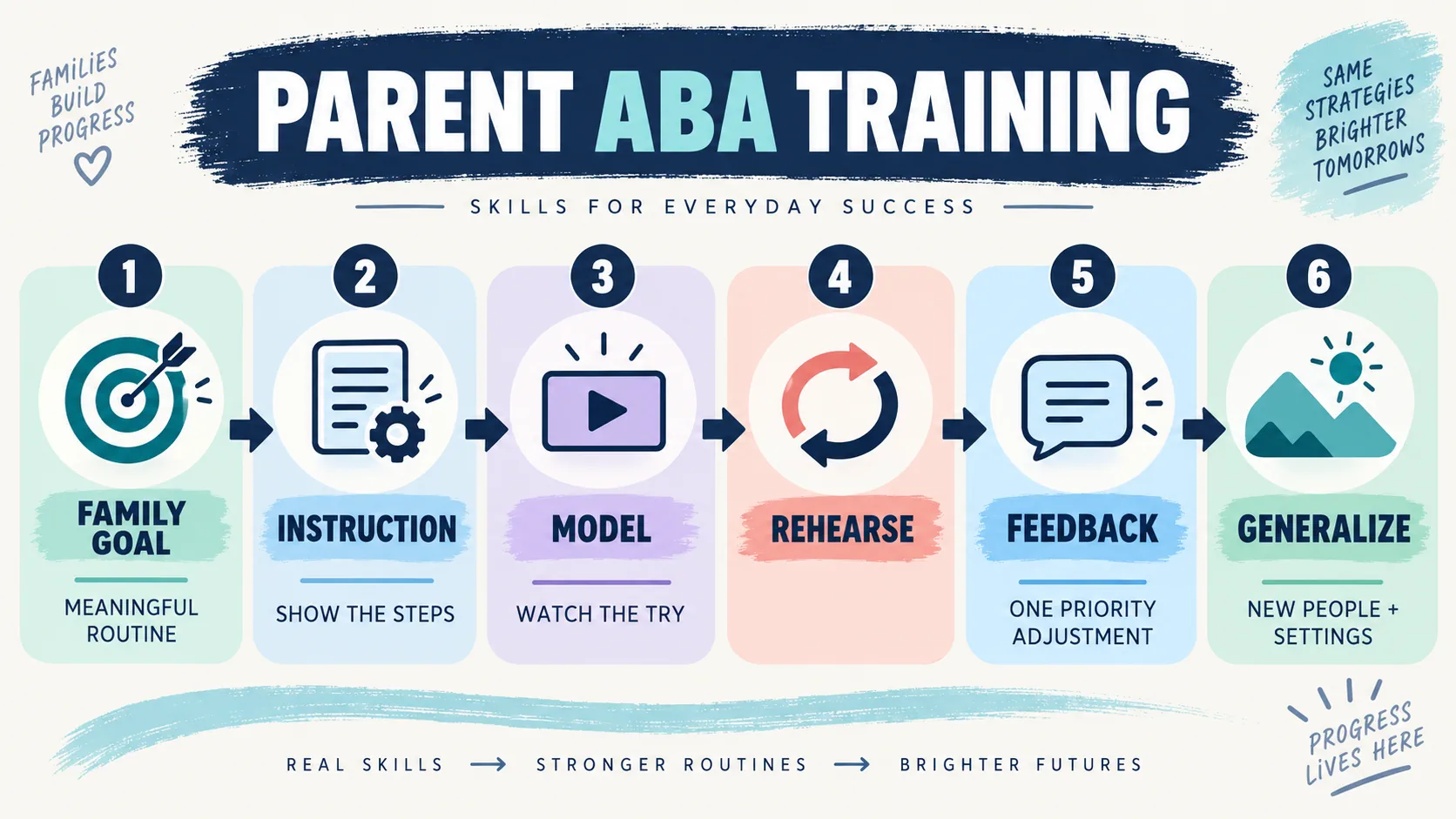
Parent ABA training, also called caregiver training or caregiver coaching, is a behavior-analytic service in which a qualified professional helps a caregiver understand and implement selected procedures. The caregiver may learn to arrange an antecedent, prompt a communication response, deliver reinforcement, respond to a replacement behavior, collect a small amount of data, or support generalization across settings.
The phrase training can make the process sound like a lecture. In practice, effective coaching is usually active. The BCBA clarifies the goal, explains the relevant contingency in plain language, demonstrates the step, watches the caregiver try it, and gives specific feedback. The sequence is adapted to the caregiver’s language, resources, culture, schedule, and comfort. A strategy that cannot be used during breakfast, homework, bedtime, or community routines is not automatically a good strategy just because it looks precise on paper.
Current BACB materials are useful for setting professional boundaries. The BCBA Handbook lists training staff and caregivers on behavior-analytic programs or content as an example of an unrestricted fieldwork activity. The BCBA Test Content Outline also places behavior-change procedures, assessment, ethics, and intervention selection inside the exam’s scope. These sources do not create one mandatory number of parent-training minutes for every case. The service should be individualized, documented, and tied to client and stakeholder needs.
- It teaches an implementation skill: the caregiver learns what to do, when to do it, and how to know whether it worked.
- It transfers behavior change: the learner can contact the same contingencies in more than one person, place, or routine.
- It protects clinical clarity: the caregiver’s performance and the learner’s response are measured separately.
- It supports collaboration: the family’s priorities and practical limits become part of treatment planning rather than an afterthought.
What Should a Parent ABA Training Goal Target?
A useful goal describes the caregiver’s behavior in observable terms. “Parent will understand reinforcement” is difficult to score because understanding is not directly visible. A stronger goal might say: “During snack and play opportunities, the caregiver will deliver the programmed reinforcer within five seconds of the defined replacement response in at least 80% of scored opportunities across three sessions.” The exact criterion depends on the learner, the risk, and the procedure, but the logic is the same: define the behavior, context, opportunity, consequence, and mastery rule.
Caregiver goals should not be written as a disguised demand for perfect compliance. A BCBA should consider the caregiver’s readiness, available time, language access, competing responsibilities, and ability to practice safely. The target may be a small first step, such as identifying the replacement response or arranging one predictable transition, before the plan asks for a more complex routine.
| Goal type | Observable caregiver action | Possible measure |
|---|---|---|
| Antecedent support | Offers a visual cue or choice before the defined transition. | Percent of planned opportunities with the cue delivered correctly. |
| Communication teaching | Prompts and reinforces the agreed request without adding extra prompts. | Independent versus prompted responses and prompt level. |
| Consequence fidelity | Delivers the programmed consequence after the replacement response. | Correct implementation percentage or trial-by-trial agreement. |
| Generalization | Uses the plan during a second routine or with a second caregiver. | Performance across people, settings, materials, or times. |
Notice the difference between a caregiver goal and a child outcome. “Caregiver implements the prompting sequence with 80% fidelity” measures implementation. “Learner independently requests a break in 70% of opportunities” measures the learner’s response. Both may be important, but combining them into one score hides where the plan is succeeding or failing.
How Does Behavioral Skills Training Make Parent Coaching Practical?
Behavioral Skills Training, or BST, is a useful teaching framework for parent ABA training and the four-part BST sequence. The sequence is instruction, modeling, rehearsal, and feedback. It is not a script that must look identical in every family; it is a way to make the teaching process observable and active.
- Instruction: describe the target skill, the cue for using it, the expected response, the consequence, and the safety boundary. Use examples and nonexamples in language the caregiver actually uses.
- Modeling: demonstrate the complete sequence at a realistic pace. If the goal involves a transition, show how the cue, prompt, wait, response, and reinforcement fit together.
- Rehearsal: let the caregiver practice through role-play or a natural routine. Rehearsal reveals whether the written plan is understandable and feasible.
- Feedback: describe the specific step that was correct, identify one priority adjustment, and give the caregiver another chance to practice. Feedback should shape accuracy without turning coaching into a performance judgment.
When a caregiver struggles, first inspect the teaching arrangement. The issue may be an unclear definition, too many steps, a reinforcer that is not available, a prompt that is difficult to deliver, or a goal that does not fit the routine. Repeating the same explanation more loudly or assigning more homework does not solve a design problem.
What Topics Can Parent ABA Training Cover?
The topic should come from assessment and the family’s priorities, not from a generic curriculum that is delivered whether or not it is relevant. Common targets include:
- Communication: arranging opportunities for functional requests, teaching a response form, and reinforcing communication efficiently.
- Antecedent strategies: choices, visual supports, transition warnings, task interspersal, environmental arrangement, or high-probability sequences when they are part of the plan.
- Reinforcement: identifying what is valuable in the moment, delivering it promptly, and avoiding accidental reinforcement of the target problem behavior.
- Prompting and fading: using the least intrusive effective prompt identified by the program and transferring control to the natural cue.
- Replacement behavior: responding consistently to a safer or more efficient behavior that serves the learner’s need.
- Data collection: recording only the information needed for the clinical decision, with clear examples of what counts as an opportunity and a response.
- Generalization: practicing with different materials, people, locations, and routines while keeping the essential contingency stable.
Training should not imply that the caregiver is responsible for fixing every behavior alone. The BCBA remains responsible for assessment, program design within competence, supervision, review of risk, and adapting the plan when the data do not support the current approach. The BACB Ethics Code for Behavior Analysts emphasizes responsibility to clients and stakeholders, informed professional decision-making, and clear service relationships.
How Should a BCBA Measure Caregiver Implementation?
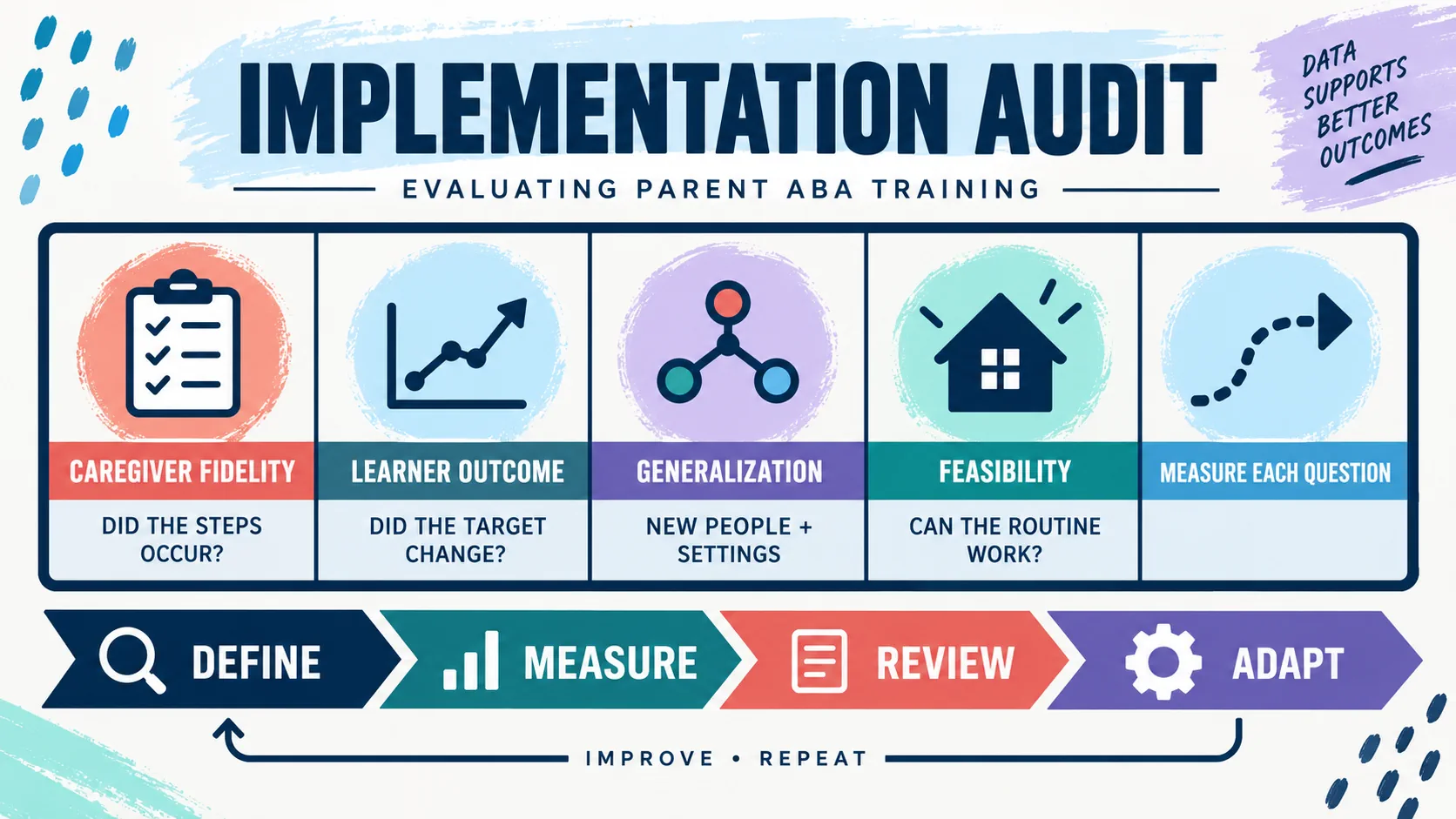
Measurement begins with the decision the team needs to make. If the question is “Did the caregiver use the teaching sequence correctly?”, a fidelity measure is appropriate. If the question is “Did the learner’s communication improve?”, collect learner data. If the question is “Can the family use the skill during bedtime instead of only in clinic?”, sample the new routine. A single satisfaction rating cannot answer all three questions.
| Question | Data to consider | Interpretation guardrail |
|---|---|---|
| Did the caregiver complete the steps? | Task analysis or checklist fidelity. | Define which steps are essential and which can be adapted. |
| Did the learner contact the programmed outcome? | Frequency, rate, duration, latency, or opportunity percentage. | Match the dimension to the response and observation time. |
| Does the skill transfer? | Samples across people, settings, routines, and materials. | Do not call a skill generalized after one familiar practice trial. |
| Is the plan workable? | Caregiver report, completion barriers, and social-validity discussion. | Preference data inform decisions but do not replace outcome data. |
Keep data collection proportionate. A family may not need a lengthy form for every routine. A short tally, a defined opportunity sample, or a weekly fidelity probe may be enough when it answers the active clinical question. If the data show low implementation, the next step is often better training or a simpler plan—not a conclusion that the caregiver is unmotivated.
How Can a BCBA Plan a Parent Training Session?
A practical session has a beginning, a practice block, and a decision at the end. The exact duration is individualized; the sequence matters more than a universal clock.
- Set the agenda: ask what routine matters today and state one teachable target.
- Review the last data: look at the caregiver implementation measure and the learner outcome without blaming either person.
- Explain the why: connect the procedure to the assessment hypothesis and the family’s meaningful goal.
- Teach and model: show the steps, the natural cue, the prompt, the consequence, and the safety stop.
- Rehearse: have the caregiver practice while the BCBA records the defined steps.
- Plan the next probe: agree on when and where the skill will be used, what minimal data will be collected, and when the team will review it.
Use plain language and confirm understanding by asking the caregiver to describe or demonstrate the plan, not by asking only “Does that make sense?” When an interpreter or communication accommodation is needed, build it into the training rather than treating it as a last-minute translation task. The person implementing the procedure should have a genuine opportunity to ask questions, decline an unsafe step, and request a revision that preserves the clinical goal.
What Are Common Parent ABA Training Mistakes?
- Teaching a generic technique without a defined goal: every strategy should connect to a target response, routine, and decision rule.
- Measuring attendance instead of performance: being present at training does not show that the caregiver can implement the skill.
- Collecting only child data: if caregiver implementation is the intervention variable, measure it directly.
- Giving too many steps: reduce the task to the essential sequence, then build complexity after successful practice.
- Ignoring feasibility: a plan that requires unavailable materials, long preparation, or constant timing may fail for practical reasons.
- Confusing caregiver coaching with RBT training: the audience, role, scope, and responsibility are different even when some teaching methods overlap.
- Promising an outcome: parent training can support implementation and generalization, but the data must show whether the learner’s target outcome changes.
Parent ABA Training FAQ
Is parent ABA training the same as RBT training?: No. RBT training prepares a credentialed technician for a defined role and competency requirements. Parent ABA training teaches a caregiver selected skills for a specific learner and routine. A caregiver is not being asked to become an RBT simply because the BCBA uses instruction, modeling, rehearsal, and feedback.
What should a parent learn first?: Start with the smallest skill that can improve a meaningful routine and can be practiced safely. That may be recognizing a communication opportunity, delivering reinforcement for a replacement response, or using one transition support. The assessment, family priorities, and baseline data should determine the order.
How do you know parent training is working?: Look at two linked but separate measures: caregiver implementation and learner outcome. Then sample whether the skill occurs with different people, routines, or settings. If implementation is accurate but the learner outcome does not change, reassess the hypothesis or procedure. If the outcome improves only when the BCBA is present, plan for generalization.
Does every family need the same amount of parent training?: No. The amount and format should depend on the learner’s goals, risk, caregiver skill, treatment setting, available resources, and funding or organizational requirements. A quality plan explains why the training is needed, what will be taught, how it will be measured, and when the team will review or fade support.
Strong parent ABA training is a measurable teaching process, not a handout and not a judgment of a family’s effort. Define the caregiver skill, use active practice and feedback, measure both implementation and learner outcomes, and test the plan in the routines where it must work. For more BCBA-style application practice, use our free BCBA mock exam to practice selecting the right procedure, measurement, and ethical boundary from a scenario.
Take the Free BCBA Mock Exam
When you are ready to apply the idea, use the free practice resource below for additional feedback. Take the Free BCBA Mock Exam



