
Quick answer: Extinction is not a fixed-ratio, variable-ratio, fixed-interval, or variable-interval schedule of reinforcement. Extinction is a procedure or condition in which a previously reinforced response no longer produces the consequence that maintained it. To answer an extinction schedule of reinforcement question, identify the reinforcement schedule that operated before extinction, then ask what consequence is being withheld.
Table of Contents
- Is extinction a schedule of reinforcement?
- Extinction schedule of reinforcement: what happens when a response contacts extinction?
- How does extinction compare with reinforcement schedules?
- What do the timelines look like?
- What are the common BCBA exam traps?
- Can you solve an extinction-schedule question?
- How should you study the distinction?
- Extinction schedule FAQ
- Sources for further study
- Take the Free BCBA Mock Exam
For example, if every request for a break previously produced a break, the acquisition arrangement was continuous reinforcement or FR 1. If the break was delivered after an unpredictable number of requests, the prior arrangement was variable ratio. When the maintaining break is no longer delivered after the response, the response is placed on extinction; it is not placed on a new “extinction schedule.”
This distinction matters because a BCBA question may place the words extinction and schedule in the same stem. The correct answer depends on the timeline: what consequence followed the behavior before, what is withheld now, and what changes in responding are observed. This article uses that timeline to separate the terms without turning the page into another broad extinction definition guide. Table of Contents
Is extinction a schedule of reinforcement?
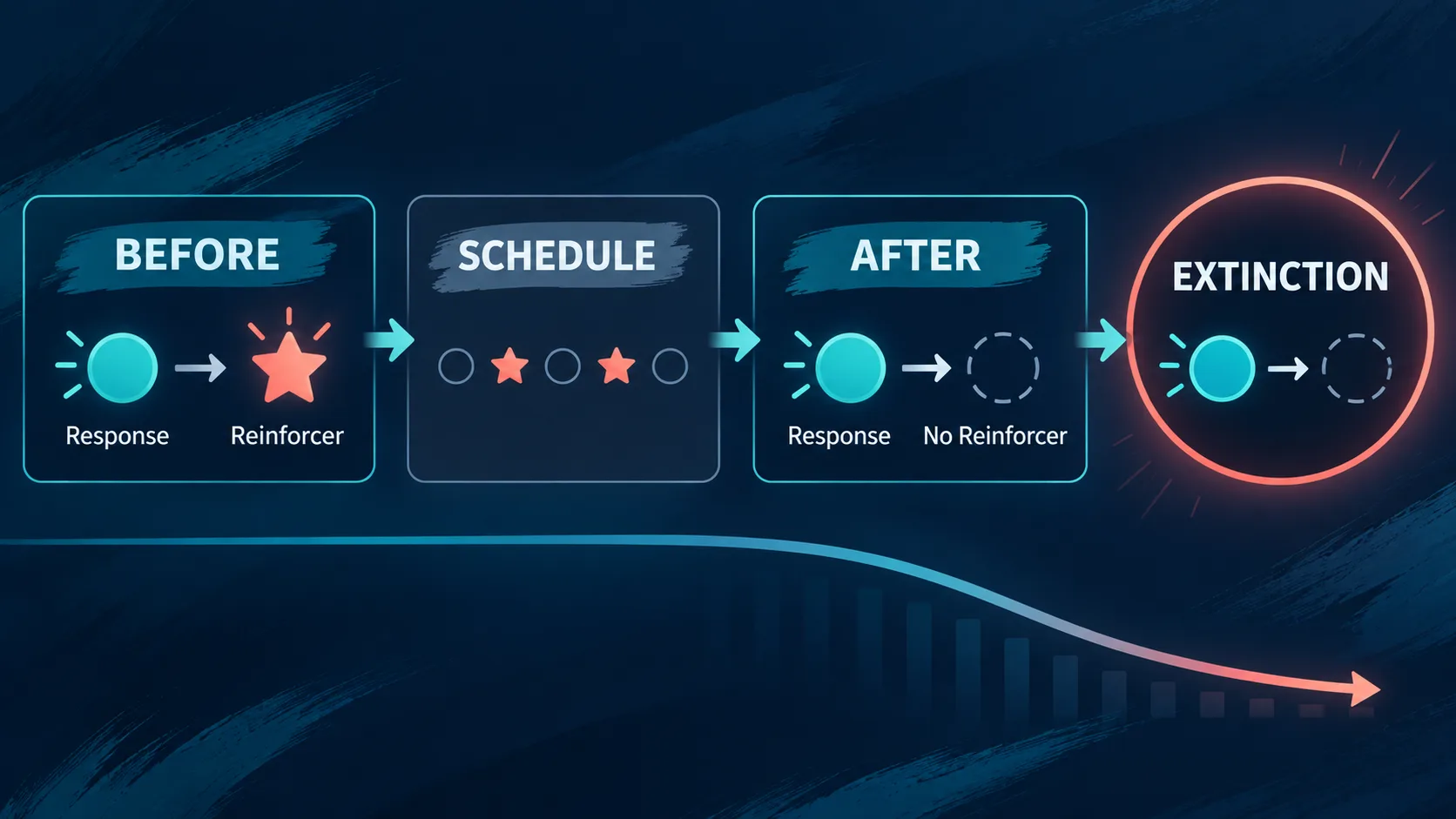
No. A reinforcement schedule describes how often or under what response or time requirement a consequence is delivered after a behavior. Extinction describes the discontinuation of a consequence that previously reinforced the behavior. The two terms can appear in the same treatment history, but they answer different questions.
| Term | What it describes | Question to ask |
|---|---|---|
| Reinforcement schedule | The relation between responding and delivery of a reinforcer. | When does the response produce the consequence? |
| Extinction | The maintaining reinforcer is no longer delivered for the target response. | What previously reinforced the response, and is it now withheld? |
| Extinction test condition | A period in which the response–reinforcer relation is interrupted for observation or intervention. | What happens to responding after the contingency changes? |
Therefore, “extinction schedule” can be understandable informal wording, but it is a risky answer when the question asks you to classify FR, VR, FI, or VI. Say “the behavior was previously maintained on a [schedule] and is now on extinction” when that is what the history supports.
Extinction schedule of reinforcement: what happens when a response contacts extinction?
Operant extinction begins with a known response–reinforcer relation. The analyst must know, or have strong evidence about, which consequence maintained the response. Then that consequence is withheld following the target response while the rest of the plan is implemented consistently and ethically. The first few moments may not look like immediate improvement.
- Extinction burst: responding may temporarily increase in frequency, intensity, duration, or variation.
- Variability: the learner may try different forms of the response or related behaviors.
- Decreasing trend: if the contingency is implemented consistently and the function is correctly identified, the target response may decline over time.
- Relapse risk: resurgence, renewal, spontaneous recovery, or reinstatement may occur under some conditions.
These effects do not turn extinction into a variable schedule. They describe changes after reinforcement is discontinued. They also do not authorize a reader to implement extinction independently; real cases require assessment, consent, safety planning, replacement behavior, and professional oversight. For the broader concept, compare this focused extinction schedule of reinforcement explanation with the full extinction guide, then return to the timeline in this article.
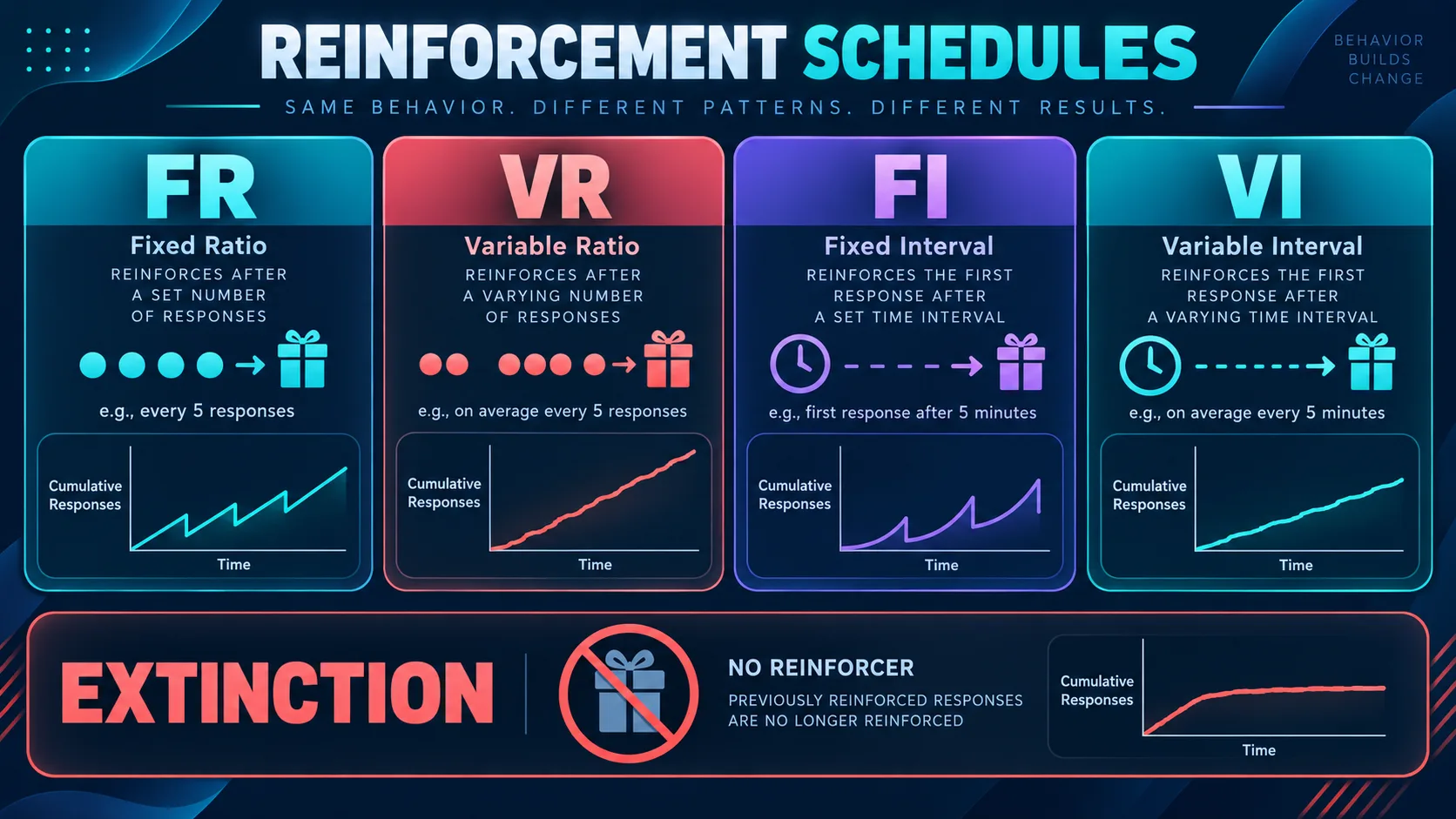
How does extinction compare with reinforcement schedules?
Use the schedule label for the period in which the response produced reinforcement. Use extinction for the later period in which the identified reinforcer no longer follows the response.
| Prior schedule | What was reinforced? | What changes under extinction? |
|---|---|---|
| FR 1 / continuous | Every qualifying response. | No maintaining reinforcer follows the target response. |
| Fixed ratio | A set number of responses. | The set response requirement is no longer honored for the target behavior. |
| Variable ratio | An unpredictable average number of responses. | The previously available reinforcer is withheld rather than delivered unpredictably. |
| Fixed or variable interval | The first response after a time requirement. | The time-based availability no longer produces the maintaining consequence after the target response. |
A schedule can affect persistence during extinction. Behavior reinforced intermittently may continue for longer than behavior reinforced continuously, depending on the learning history and context. That observation does not create a new “extinction schedule”; it describes how prior reinforcement history can influence responding after the contingency is discontinued.
What do the timelines look like?
Timeline thinking is more reliable than memorizing labels. Here are three original study examples. Example 1: Every request produced a break: During skill acquisition, a learner requests a break and receives a brief break after each qualifying request. This is a continuous or FR 1 arrangement. If the break is later withheld after the same request, the new condition is extinction for that request. Calling the new condition “FR 0” is not the usual BCBA classification; the key answer is extinction.
If the learner begins requesting more often or with greater intensity immediately after the change, that pattern may be an extinction burst. The prior FR 1 history helps explain the change, but it does not rename the procedure as a different reinforcement schedule.
Example 2: A response was reinforced after an unpredictable count: Suppose a learner previously earned access after a variable number of completed tasks. The response requirement averaged five tasks, but the exact number changed. That is a variable-ratio description. If access is then no longer delivered after completing the target tasks, the target response is exposed to extinction. The words “variable” and “extinction” describe different periods in the timeline. On an exam, select variable ratio when the stem asks about the prior arrangement or describes the unpredictable response requirement. Select extinction when it asks about the later withholding of the reinforcer.
Example 3: A time-based history is followed by nonreinforcement: A person may have learned that the first response after a certain amount of time produces a check-in, making the arrangement interval-based. If the check-in is later withheld following the response, the extinction condition begins. The relevant issue is not whether the wait was fixed or variable after extinction; it is whether the formerly maintaining consequence still follows the response.
What are the common BCBA exam traps?
- Treating extinction as “no schedule” and stopping there: identify the schedule that operated before the reinforcer was withheld.
- Calling intermittent reinforcement extinction: occasional delivery is still reinforcement if the consequence increases future responding; extinction means the maintaining consequence is not delivered.
- Confusing omission with extinction: one missed reinforcer does not automatically establish an extinction condition without the relevant history and consistent contingency change.
- Assuming the behavior must immediately decrease: an extinction burst or variability may occur first.
- Ignoring function: withholding attention does not place an escape-maintained response on extinction if escape remains available after that response.
- Using an extinction plan without safeguards: the current BCBA outline includes mitigating unwanted effects and making data-based decisions about intervention effectiveness.
Use the phrase “schedule before, extinction after” as a quick memory cue. Then name the exact consequence: attention, escape, tangible access, automatic stimulation, or another reinforcer supported by the case information.
Can you solve an extinction-schedule question?
Mini question: A learner previously received a token after every three completed worksheets. The token was later exchanged for computer time. During a new phase, the learner completes three worksheets but receives no token or computer time after the response. Which statement is best?
- The new phase is a variable-ratio schedule because the learner may try different numbers of worksheets.
- The prior phase was FR 3, and the new phase is extinction for the token-maintained response.
- The new phase is fixed interval because worksheets take time to complete.
- The new phase is continuous reinforcement because every response is measured.
Best answer: 2. The prior contingency required three responses per token, so it was fixed ratio 3. When the token and its exchangeable consequence are withheld after the target response, the new phase is extinction. The duration of a worksheet does not make a schedule interval-based, and measuring every response does not make a procedure continuous reinforcement.
How should you study the distinction?
Build a four-column timeline for every practice stem:
- Before: What response was occurring, and what consequence maintained it?
- Schedule: Was the consequence delivered every response, after a response count, after time, or unpredictably?
- Change: What exactly stopped following the response?
- After: What happened to frequency, intensity, variability, or persistence?
Use the current BACB test-content page and BCBA Test Content Outline for exam-scope language. The outline places reinforcement, extinction, maintenance, and mitigation of unwanted effects in the behavior-change context; it is not a replacement for a case-specific assessment.
After you can classify the timeline, use our free BCBA mock exam as a timed practice step. It is a study aid for feedback, not official BACB questions, an official partnership, or a passing-score guarantee.
Extinction schedule FAQ
Is there an FR 0 schedule of reinforcement?: Do not use FR 0 as the standard answer for extinction. In BCBA exam language, say that the previously reinforced response is on extinction when the maintaining reinforcer is withheld. Then identify the prior schedule if the stem provides it.
Does intermittent reinforcement prevent extinction?: No. Intermittent reinforcement can affect persistence and resistance to extinction, but extinction can still be implemented when the maintaining reinforcer is no longer delivered for the target response. The two labels describe different parts of the history.
Is extinction the same as punishment?: No. Extinction withholds a reinforcer that previously maintained the response. Punishment involves a consequence that decreases future responding. A procedure can produce distress or rapid behavior change without fitting both definitions.
Sources for further study
- BACB Test Content Outlines
- BCBA Test Content Outline, 6th edition
- Extinction of Instrumental (Operant) Learning
- Worked extinction-in-operant-conditioning explanation
- Operant versus respondent extinction comparison
Bottom line: Extinction is a procedure in which a previously reinforcing consequence is withheld; it is not a fixed or variable reinforcement schedule. Reconstruct the history, label the prior schedule, identify the missing consequence, and then interpret the change in responding.
Take the Free BCBA Mock Exam
When you are ready to apply the idea, use the free practice resource below for additional feedback. Take the Free BCBA Mock Exam



