
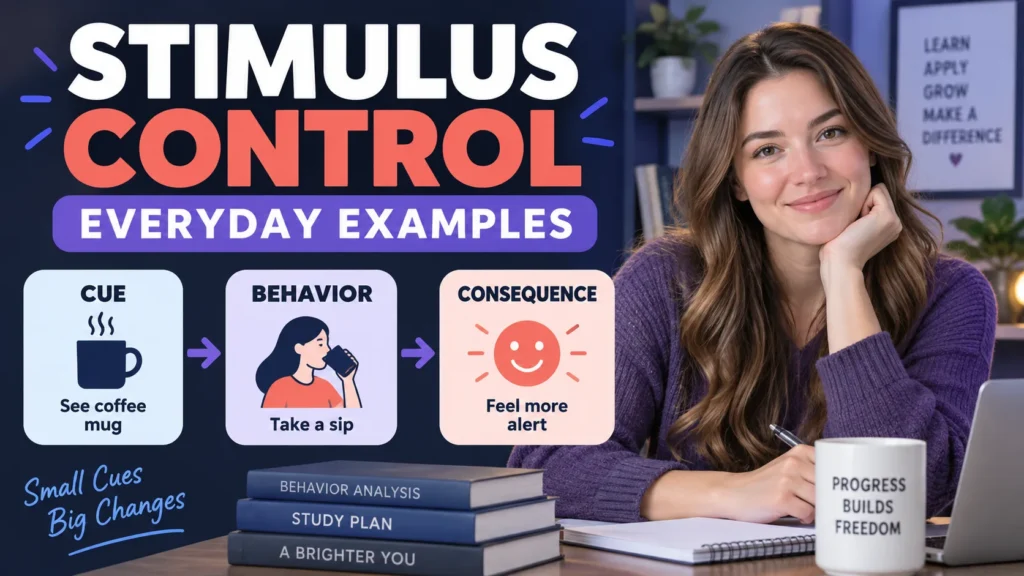
Quick answer: The best examples of stimulus control in everyday life show a cue that makes a behavior more likely because that cue has a history of signaling a consequence. The cue is not magic, and it does not have to force the behavior. In an operant example, a discriminative stimulus (SD) signals that reinforcement is available for a particular response; the response is then more likely in that stimulus condition than in another condition.
Table of Contents
- What is stimulus control?
- How does a cue gain control over behavior?
- What are examples of stimulus control in everyday life?
- How is it different from related concepts?
- What are the common BCBA exam traps?
- Can you solve a stimulus-control question?
- How should you study the concept?
- Stimulus control FAQ
- Sources for further study
- Take the Free BCBA Mock Exam
A phone notification can signal that checking the device may produce a message. An “open” sign can signal that entering a store may produce access to shopping or assistance. A green walk signal can signal that crossing is permitted. These are only candidate examples, however. To analyze them behaviorally, ask what response occurs, what consequence has followed that response, and whether the cue changes responding compared with another stimulus condition.
This guide explains examples of stimulus control in everyday life with original cue-behavior-consequence maps. It also separates stimulus control from respondent elicitation, stimulus generalization, and simple preference so you can recognize the difference on a BCBA-style question without turning an ordinary observation into a clinical conclusion. Table of Contents
What is stimulus control?
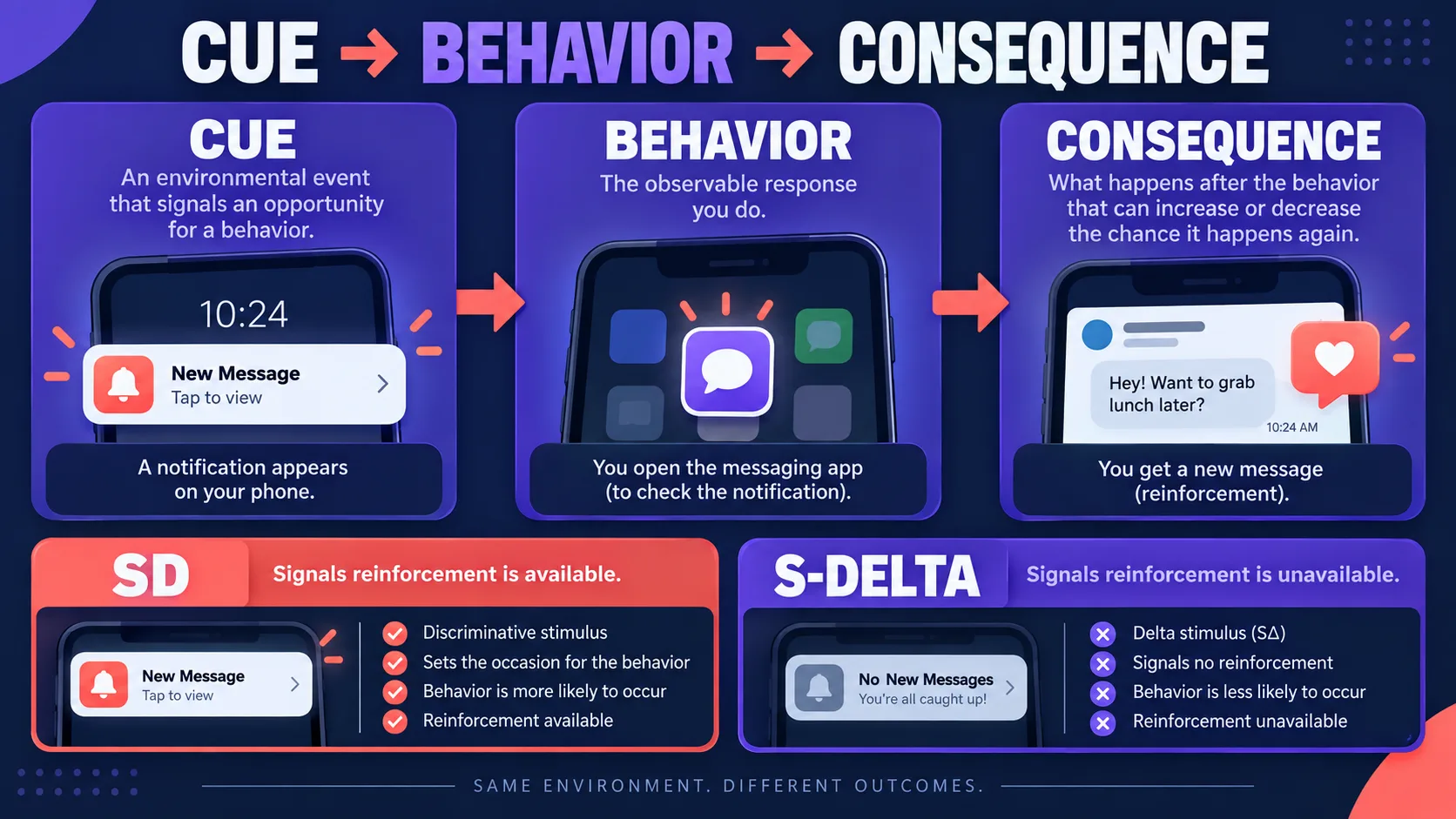
Stimulus control describes the extent to which behavior is influenced by different stimulus conditions. In behavior analysis, a stimulus is said to control an operant response when responding is more likely, or occurs at a different rate or topography, in the presence of that stimulus because of a reinforcement history. The common exam pattern is an SD–response–reinforcer relation:
- The SD is present and signals that a particular consequence is available.
- The person emits a response that has produced that consequence in the past.
- The consequence follows under the relevant conditions.
- Future responding is more likely when the SD is present than when it is absent or replaced by an S-delta condition.
“Control” does not mean the person has no choice or that the response must occur every time. It means the stimulus condition helps predict when a response will contact reinforcement. A strong answer identifies the behavior and the consequence instead of describing only the color, sound, or object.
How does a cue gain control over behavior?
A neutral cue can become an SD through repeated differential reinforcement. For example, imagine that a learner asks for help when a tutor is wearing a blue badge. The tutor responds with assistance when the badge is present but does not arrange that same consequence when the badge is absent. Over time, the blue badge may set the occasion for asking. The badge did not cause the vocal response in a mechanical sense; the reinforcement contingency made the cue informative.
| Part of the analysis | Question to ask | Example answer |
|---|---|---|
| Stimulus condition | What cue is present? | A notification banner appears on the phone. |
| Response | What behavior changes? | The person opens the message app. |
| Consequence | What follows the response? | Access to social information or a requested update. |
| Discrimination | Does responding differ under another cue? | The person opens the app less often when no notification is present. |
This is why stimulus control is relational. The same object can control one person’s behavior and have little effect on another person’s behavior because their reinforcement histories differ. A BCBA should not infer a controlling relation from visual salience alone.
What are examples of stimulus control in everyday life?
Each example below names the cue, the response, and the consequence that makes the cue informative. The point is not that every daily routine has been formally tested; the point is to practice the logic of an SD.
1. A phone notification signals a message: A notification banner or sound appears after someone sends a message. The person opens the relevant app, and the consequence is access to social information, a reply, or another meaningful update. If the person opens the app much more often when the notification appears than when the phone is silent, the notification may function as an SD for opening the app.
Do not stop at “the sound causes checking.” The behavior-analytic analysis asks what has reinforced checking in that context. If the alert is often followed by spam or no useful information, the response may weaken. If different sounds signal different apps, those sounds may establish different stimulus-control relations.
2. An open sign signals access to a store: A person sees an “open” sign, enters a store, and receives access to products, information, or staff assistance. The sign can function as an SD when entering or approaching the counter has a history of producing that access during open hours. The same person may walk past the store without entering when the sign is absent because the relevant consequence is not available in that condition.
The sign does not guarantee entry. Rain, time pressure, money, or a competing motivation can change responding. Stimulus control is about relative probability under specified conditions, not a promise that behavior will occur every time the cue is visible.
3. A green walk signal sets the occasion for crossing: A green pedestrian signal appears, a person crosses at the marked location, and the consequence is progress toward the destination under a permitted traffic condition. Repeated contact with safe and efficient crossing outcomes can make the signal relevant to the crossing response. A red signal, by contrast, may function as an S-delta for that response in the same setting because crossing is not reinforced or permitted under that condition.
This example is not a claim that a traffic signal “reinforces” safety in one simple step. Real-world behavior is influenced by rules, social consequences, risk, and context. For an exam item, use the explanation supplied by the stem and identify whether it describes a discriminative stimulus, a rule, a motivating operation, or a different process.
How is it different from related concepts?
Many incorrect answers use a nearby term. Compare the learning history and the type of behavior described.
| Concept | What the stem emphasizes | Fast sorting rule |
|---|---|---|
| Stimulus control | Behavior is more likely under one cue because reinforcement is available there. | Find the cue-behavior-consequence relation. |
| Respondent conditioning | A stimulus elicits a reflexive or emotional response after pairing. | Look for elicitation and a respondent learning history, not an emitted operant followed by a consequence. |
| Stimulus generalization | A response occurs across stimuli that share relevant features. | Similarity and spread are the focus; the cue need not uniquely signal reinforcement. |
| Preference | A person selects one option or reports liking it. | Preference alone does not demonstrate a discriminative stimulus relation. |
What are the common BCBA exam traps?
- Calling a visible cue an SD without a consequence: the stem should show, or reasonably imply, a reinforcement history.
- Confusing an SD with a motivating operation: an SD signals the availability of a consequence; an MO changes the value of that consequence and evokes behavior related to it.
- Assuming “more likely” means “guaranteed”: stimulus control changes probability, not certainty.
- Calling every alarm or sound respondent control: check whether the response is elicited reflexively or emitted because it has produced a consequence.
- Using generalization when the stem describes discrimination: if responding differs across cue conditions, look for stimulus control and differential reinforcement.
- Ignoring the S-delta: the comparison condition often reveals why the cue matters.
A useful memory sentence is “The cue says when the payoff is available.” Then ask what the learner does and what consequence historically follows. That three-part map is usually more reliable than memorizing examples such as phones, stores, or traffic lights.
Can you solve a stimulus-control question?
Mini question: During training, a learner asks for a break when a blue card is displayed. Breaks are delivered after the request. When a red card is displayed, the same request does not produce a break and the learner rarely asks. Which concept best explains the blue card’s role?
- Stimulus control, because the blue card signals that reinforcement for requesting is available.
- Stimulus generalization, because blue and red are both colors.
- Respondent conditioning, because the card automatically elicits asking.
- Preference assessment, because the learner likes blue.
Best answer: 1. The blue card is correlated with the availability of a break following a request, and responding is lower under the red card. The stem describes an operant discrimination and a differential reinforcement history; it does not say that the card elicits a reflexive response or that the learner simply prefers blue.
How should you study the concept?
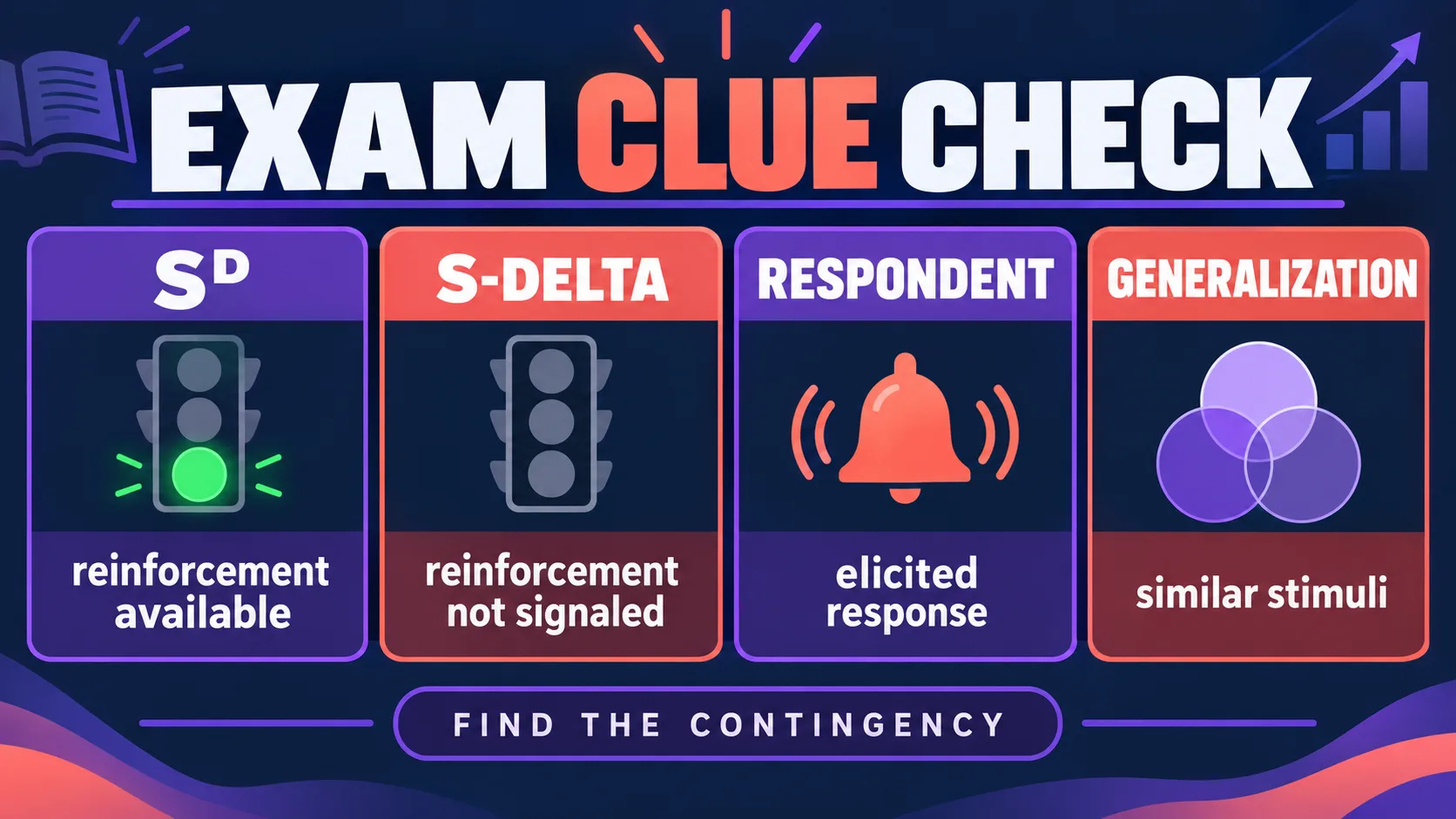
For each example, write four short lines before you choose an answer:
- Underline the stimulus condition that changes across situations.
- Circle the behavior that is more likely or changes in rate or form.
- Write the consequence that is available or has followed the response.
- Name the comparison condition, such as no cue, a red cue, or an S-delta.
The APA Dictionary definition of stimulus control is useful for the broad concept. For exam scope, consult the current BACB test-content page and the BCBA Test Content Outline. The outline links stimulus-control work to discriminative stimuli, simple and conditional discriminations, prompting, and generalization; it should not be used to claim that every everyday example is a named test question.
Once you can map the contingency, use our free BCBA mock exam as a timed practice step. It is a study aid for feedback, not official BACB questions, an official partnership, or a passing-score guarantee.
Stimulus control FAQ
Does stimulus control mean the stimulus causes behavior?: No. In an operant analysis, the stimulus condition signals a contingency and changes the probability of a response because of a history of differential reinforcement. It does not mechanically force the person to respond.
Can a person have stimulus control without knowing the rule?: Yes. A person may respond differently under a cue because of direct contact with contingencies, even if they cannot state a verbal rule. If the stem specifically describes an instruction, analyze the role of the rule as well.
Is an SD the same as a prompt?: Not always. A prompt is an added stimulus used to assist a response, while an SD signals that reinforcement is available for a particular response. A prompt may be faded, and a stimulus can sometimes acquire control through training, but the terms describe different functions.
Sources for further study
- APA Dictionary of Psychology: stimulus control
- BACB Test Content Outlines
- BCBA Test Content Outline, 6th edition
- Stimulus Control Research and Practice
- Toward an explicit analysis of generalization
Bottom line: Examples of stimulus control in everyday life are strongest when the cue, behavior, and consequence are all visible. Find the stimulus condition, identify the response that changes, locate the reinforcement history, and compare the cue with a condition where that consequence is not available.
Take the Free BCBA Mock Exam
When you are ready to apply the idea, use the free practice resource below for additional feedback. Take the Free BCBA Mock Exam



