
Quick answer: BCBA licensure requirements are not one universal national checklist. The BACB controls BCBA certification, while a state licensing board may separately regulate the right to practice behavior analysis in that jurisdiction. A candidate should verify both layers, plus any employer or payer requirements, before assuming that passing the BCBA examination alone completes the process.
Table of Contents
- What are BCBA licensure requirements in practice?
- How is certification different from state licensure?
- What should a candidate verify first?
- Which requirements belong to the BACB?
- Which requirements belong to the state?
- How should you plan for the 2027 transition?
- What mistakes delay an application?
- How can you turn the requirements into a study plan?
- BCBA licensure requirements FAQ
- Official sources for further verification
- Take the Free BCBA Mock Exam
The practical question is therefore not simply, “What degree do I need?” It is, “Which authority is asking for which evidence, and when?” Your certification pathway may involve a degree, behavior-analytic coursework, supervised fieldwork, an application, and the BCBA examination. Your state may add an application, fee, background check, jurisprudence step, supervision documentation, or renewal rules.
Because regulations change, use this article as a planning framework rather than a legal determination. Start with the current BACB handbook and the official licensing board for the state where you will practice. Record the page date, required forms, and the application deadline. That small audit prevents a common error: preparing a complete national certification file while overlooking a separate state permission to practice. Table of Contents
What are BCBA licensure requirements in practice?
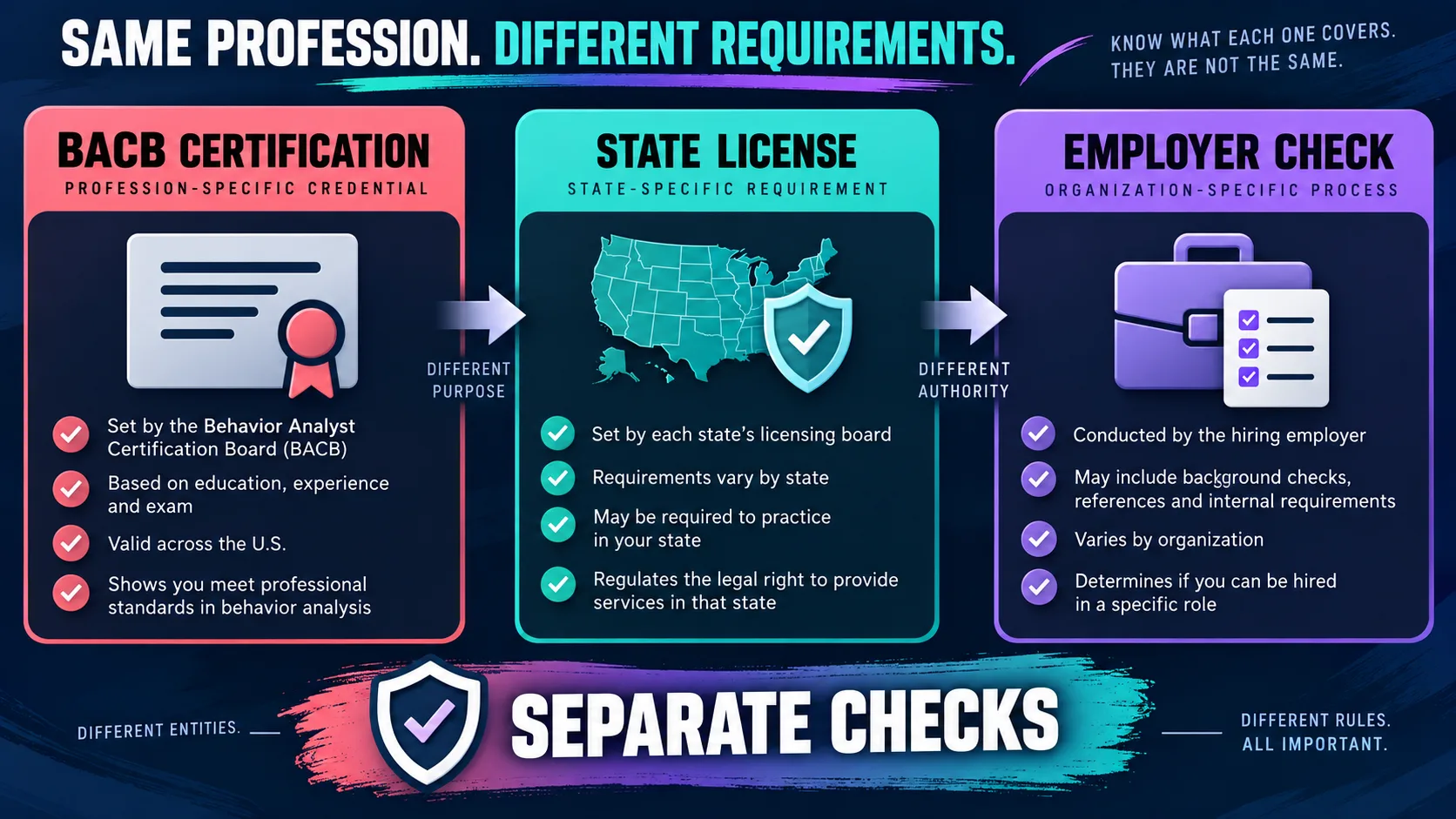
In practice, the requirement set has three separate owners. The BACB evaluates eligibility for the national BCBA credential. A state agency or board determines whether behavior analysts must hold a state license or meet a state-specific exemption. An employer, payer, or contracting organization can request additional documentation. These layers may overlap, but one approval does not automatically replace the others.
- Identify the state, jurisdiction, service setting, and role you intend to enter.
- Read the current BCBA Handbook and confirm which BACB eligibility pathway fits your education and fieldwork history.
- Check the BACB’s U.S. licensure map, then open the controlling state board page rather than relying on a summary.
- Build two document folders: one for BACB certification and one for state licensure or registration.
- Confirm renewal, continuing-education, supervision, background-check, and jurisprudence rules before accepting a start date.
The exact answer can differ for a candidate who is still accruing fieldwork, a BCBA moving across state lines, and a certificant returning to practice after an inactive period. Treat the phrase “licensed BCBA” as a prompt to investigate the jurisdiction, not as proof that the national credential and state license are the same document.
How is certification different from state licensure?
Certification is a credential issued by a professional certification board after an applicant meets its published eligibility and examination requirements. Licensure is a legal or regulatory authorization created by a jurisdiction. The BACB explains that behavior analysts should review the relevant state requirements, because states can regulate the profession differently and may include exemptions or separate application systems.
| Layer | Typical decision | Where to verify |
|---|---|---|
| BACB certification | Whether your education, coursework, fieldwork, application, and examination satisfy BCBA certification rules. | BACB BCBA application resources and the current BCBA Handbook. |
| State licensure | Whether you may practice a regulated behavior-analytic role in that state, including state forms and exceptions. | BACB state map and the state board or agency named there. |
| Employer or payer | Whether an organization will hire, credential, bill, or contract with you under its own documentation rules. | The written offer, credentialing packet, payer manual, or contracting contact. |
This boundary also explains why a national exam-preparation website should not promise that a passing score guarantees a license. A candidate can be eligible for the BCBA examination yet still need a state application. Conversely, a state may describe its own qualifications while requiring the applicant to maintain an active BACB credential. The controlling sources are the authorities, not a generalized checklist.
What should a candidate verify first?
Before you collect documents, write down the decision variables below. The goal is to discover which checklist applies to you, not to complete every possible form. If an answer is unclear, mark it as “verify” and contact the relevant board or program advisor. Do not infer a legal exemption from a coworker’s experience or from an old application packet.
- Jurisdiction: Which state, district, territory, or other authority will regulate your services?
- Role: Are you applying as a BCBA, another behavior-analytic professional, or a supervised trainee?
- Credential status: Are you a new applicant, an active certificant, moving from another state, or returning after a lapse?
- Practice setting: Will you work in a school, clinic, home-based service, hospital, telehealth setting, or another environment?
- Application date: Will you submit before or after a published rule-change date?
- Document owner: Which institution must send the transcript, attestation, verification, background report, or supervision form?
Then compare your notes with the official sources. The BACB’s licensing page is useful for locating state boards, but it does not replace a board’s current application instructions. Likewise, a state board page may explain practice permission without deciding whether your degree or coursework satisfies BACB certification rules. Keep the two questions in separate columns while planning.
Which requirements belong to the BACB?
The BACB side generally covers the national certification pathway. The exact pathway and form version depend on when you apply and which requirements you meet. A candidate should use the current handbook and application resources for the controlling details, because the BACB can revise coursework, fieldwork, documentation, examination, maintenance, and application-processing instructions.
- Degree evidence that fits the selected eligibility pathway.
- Behavior-analytic coursework or an accepted program-based attestation when required.
- Supervised fieldwork records completed under the applicable fieldwork rules.
- An approvable certification application, payment, and official documentation.
- Examination authorization and a passing BCBA examination result.
- Ongoing certification maintenance, ethics, continuing education, and renewal obligations.
Do not treat a transcript review, an application submission, or an exam authorization as interchangeable milestones. Each answers a different question. The BACB’s processing notice also cautions that applications are reviewed after the required paid application and official transcripts are received, and that the BACB cannot determine every individual’s eligibility outside its formal review. That is a reason to keep a dated evidence trail.
Which requirements belong to the state?
State requirements vary because licensure laws, boards, exemptions, application portals, and renewal rules are jurisdiction-specific. A state may ask for proof of an active BCBA certification, an application and fee, a background check, professional references, a jurisprudence or rules examination, supervision information, or continuing education. Another state may use different names or regulate a narrower role.
| Question | Evidence to locate | Why it matters |
|---|---|---|
| Is the role regulated? | Statute, rule, board scope page, or official state map. | It determines whether a license, registration, or exemption analysis is needed. |
| What must be submitted? | Current application, fees, verification forms, background instructions, and board checklist. | Missing state evidence can delay practice even when the BACB file is complete. |
| How is the credential maintained? | Renewal cycle, CE rules, supervision requirements, reporting duties, and expiration notices. | National certification renewal and state license renewal may use different dates. |
For a state-by-state orientation, use the site’s state-by-state BCBA licensure overview, then verify the current board source before acting. That link is a navigation aid, not a substitute for the statute, regulation, board application, or written response from the regulator.
How should you plan for the 2027 transition?
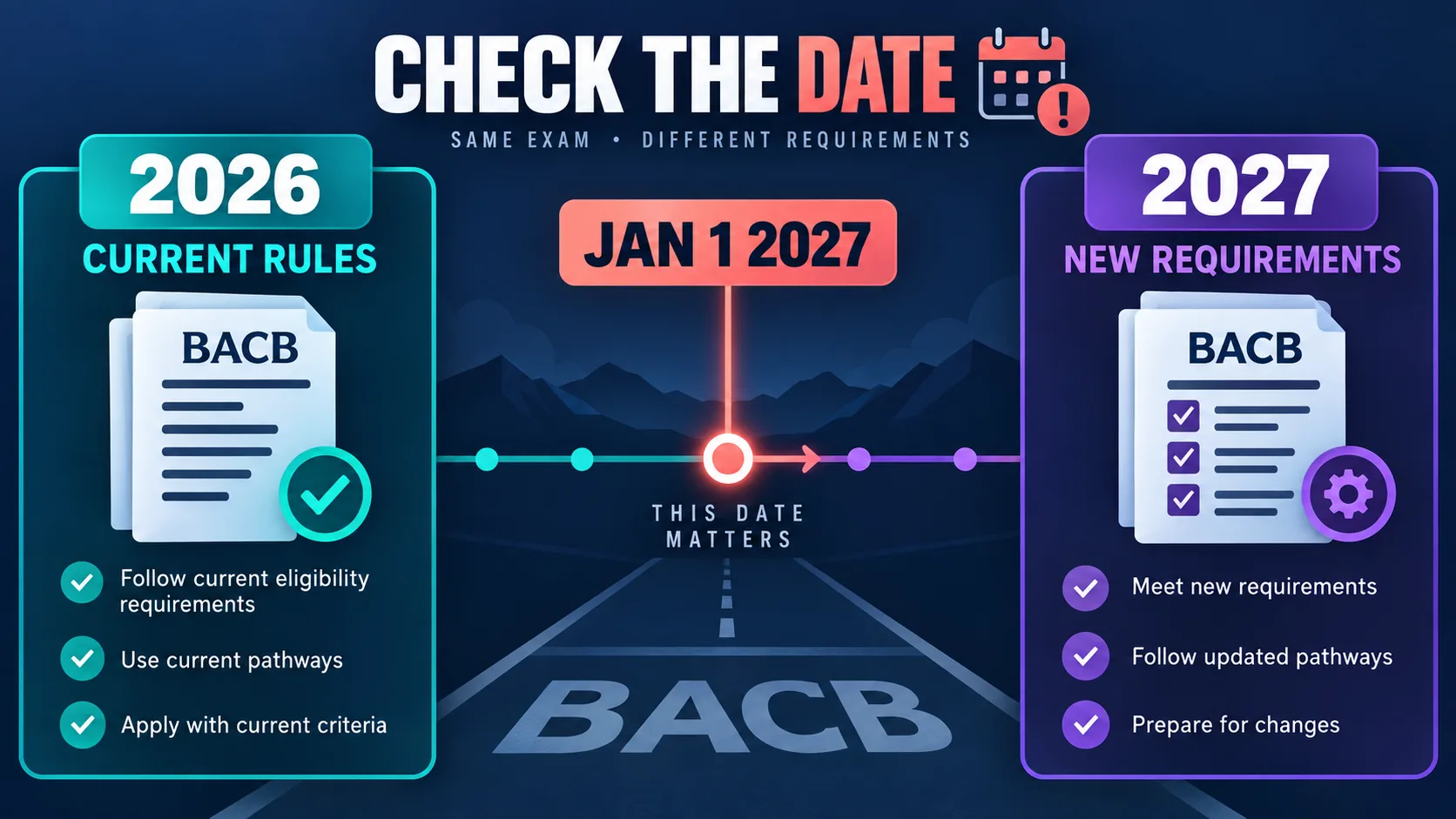
January 1, 2027 is an important BACB certification transition date, but it is not a universal state-licensure effective date. The BACB’s published 2027 requirements describe revised eligibility and maintenance requirements, including two eligibility pathways beginning in 2027 and the discontinuation of pathways 3 and 4. The BACB also states that a complete application, including payment and required documents, must be received by December 31, 2026 to be reviewed under current requirements.
| Planning question | Action |
|---|---|
| Could I apply under current rules? | Compare your complete evidence with the current handbook and ask your program or supervisor whether the file can be submitted on time. |
| Will I apply on or after January 1, 2027? | Use the 2027 requirements and transition guidance, especially the pathway, coursework, and fieldwork changes. |
| Does my state change too? | Check the state board separately; a BACB transition date does not automatically amend state law. |
Do not rush an incomplete application merely to beat a date. The relevant question is whether the application and required documents meet the BACB’s published submission standard. If your timeline is uncertain, create two plans: a current-rule plan with a document deadline and a 2027-rule plan with the revised coursework or pathway evidence. Label every source with the date you checked it.
What mistakes delay an application?
- Using “certified” and “licensed” as synonyms: the authorities and legal effects are different.
- Reading only a state summary: a secondary page may be out of date or omit an exemption.
- Keeping one combined folder: separate BACB forms from state forms so the document owner is visible.
- Ignoring the application date: a transition can change which pathway or coursework standard applies.
- Assuming a job offer proves legal permission: employer credentialing is not the same as board approval.
- Forgetting renewal calendars: BACB and state dates can differ and may require separate reporting.
How can you turn the requirements into a study plan?
Use the requirements audit to make your BCBA exam study more targeted. First, write down the certification pathway and the examination task list that applies to your current application plan. Next, separate knowledge gaps from paperwork gaps. A practice score can reveal a content gap; it cannot tell you whether a transcript, attestation, or state form is missing.
- Create a one-page pathway map with degree, coursework, fieldwork, application, and examination milestones.
- Mark every item as complete, in progress, or verify with an official source.
- Use retrieval practice for the concepts and a document checklist for the administrative tasks.
- Schedule a weekly review of the BACB change page and your state board’s notices while your application is pending.
- Use the free BCBA mock exam as a practice-and-feedback step, not as proof of eligibility or a guarantee of a passing score.
The phrase BCBA licensure requirements is useful as a search starting point, but your final checklist should name the BACB and the state authority separately. That distinction makes your study plan more realistic: you can prepare for the examination while another document owner reviews licensure evidence.
BCBA licensure requirements FAQ
Does passing the BCBA exam automatically give me a state license?: No. Passing the examination is one part of BCBA certification. If the jurisdiction regulates behavior analysts, you may still need a separate state application, fee, verification, background process, or other requirement. Check the state board for the role and setting in which you intend to practice.
Do all states use the same BCBA licensure requirements?: No. States can differ in whether a role is regulated, which board receives the application, what exemptions exist, and how renewal or continuing education works. The BACB state map helps you locate the relevant authority, but the current state statute, rule, and application instructions control.
What should I do if my application date crosses January 1, 2027?: Compare both the current and 2027 BACB requirements, then confirm which standard applies to a complete application received by the relevant deadline. Keep state licensure research separate because the BACB transition does not automatically change state law. When uncertain, ask the BACB, your program, supervisor, or state board a specific written question.
Official sources for further verification
- BACB: U.S. Licensure of Behavior Analysts
- BACB: How to Obtain and Maintain BCBA Certification
- BACB: 2027 BCBA Requirements
- BACB: Recent and Upcoming Changes
- BACB: Application Processing Updates
Bottom line: BCBA licensure requirements are a coordination problem, not a single test score. Confirm the BACB certification pathway, identify the state authority, build separate document and renewal checklists, and recheck the official sources around the 2027 transition. Then use practice questions to improve exam readiness while keeping eligibility and licensure decisions with the responsible authorities.
Take the Free BCBA Mock Exam
When you are ready to apply the idea, use the free practice resource below for additional feedback. Take the Free BCBA Mock Exam



