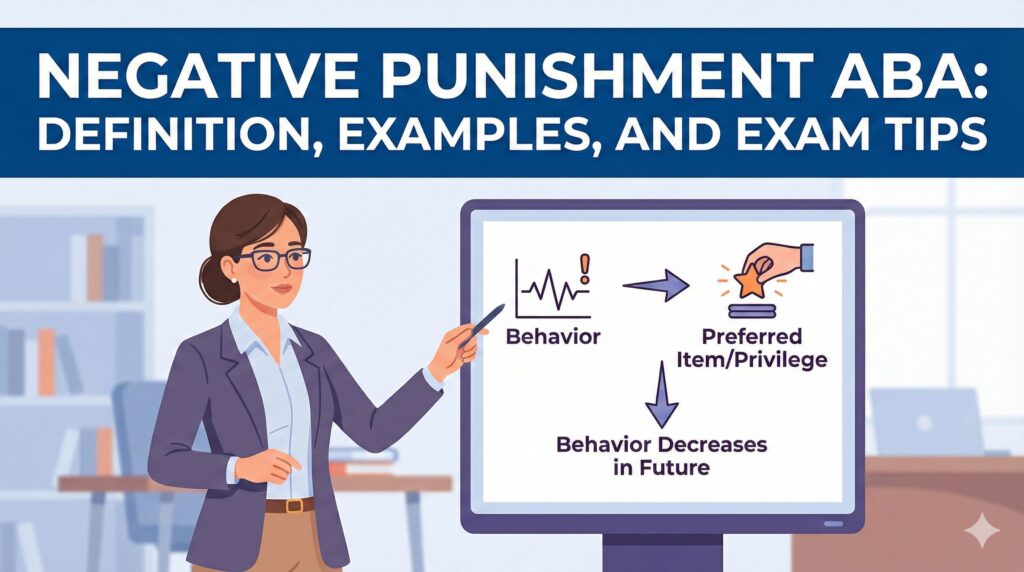
Operant extinction in ABA is a process in which behavior decreases because its maintaining reinforcer is no longer delivered after the response. The response may still occur; identify the consequence before deciding what to withhold. Extinction differs from ignoring, punishment, blocking, or removing an item.
If whining has produced tablet access, extinction stops delivering the tablet after whining. A functionally equivalent communication response may still produce access. The procedure depends on function, safety, replacement skill, and treatment integrity.
What Is Operant Extinction in ABA?
Operant extinction changes a contingency: a response that previously produced reinforcement no longer does. The response is not defined by physical blocking; the maintaining reinforcer is withheld under the written plan, and responding may decrease over time.
The definition is functional. A behavior is not on extinction merely because it is ignored or an item is removed. Identify the maintaining consequence and how it will no longer follow. Attention, escape, tangible, and automatic extinction differ.
| Element | Question | Example |
|---|---|---|
| Target response | What behavior is defined in observable terms? | Whining statements after a tablet is visible. |
| Maintaining consequence | What consequence previously strengthened the response? | Access to the tablet followed whining. |
| Extinction change | What will no longer follow the target response? | The tablet is not delivered following whining. |
| Replacement | What appropriate response can contact the relevant outcome? | A taught request produces tablet access under the planned schedule. |
| Expected process | What may happen as the contingency changes? | Temporary variability, burst, or emotional responding may occur. |
The BACB BCBA Test Content Outline, 6th edition requires distinguishing operant and respondent extinction, including side effects, integrity, and data-based intervention decisions.
How Operant Extinction Changes a Contingency
Before extinction, an antecedent, target response, and reinforcer form the sequence. During extinction, the response may still occur but the maintaining reinforcer is withheld. A replacement response may contact the same function more safely.
The withheld consequence must match the function. Withholding a tangible is not attention extinction; allowing a break after escape-maintained behavior continues the contingency. For automatic reinforcement, social ignoring may have little effect.
| Phase | Target response | Consequence path |
|---|---|---|
| Prior contingency | The response occurs in a relevant context. | The maintaining reinforcer follows and strengthens future responding. |
| Extinction contingency | The response may still occur. | The maintaining reinforcer no longer follows the target response. |
| Replacement contingency | A functionally equivalent alternative occurs. | The alternative contacts the planned reinforcer when criteria are met. |
| Maintenance plan | Appropriate responding continues across contexts. | Reinforcement is thinned or transferred to natural consequences as appropriate. |
Extinction does not promise immediate stopping. Effects depend on history, schedule, effort, competing consequences, consistency, and the function hypothesis. A short-term increase requires safety monitoring and plan review.
Operant Extinction Versus Respondent Extinction
Operant extinction discontinues the reinforcer after behavior strengthened by its consequences. Respondent extinction repeatedly presents a conditioned stimulus without the unconditioned stimulus, so the conditioned response may decrease. The learning arrangements differ.
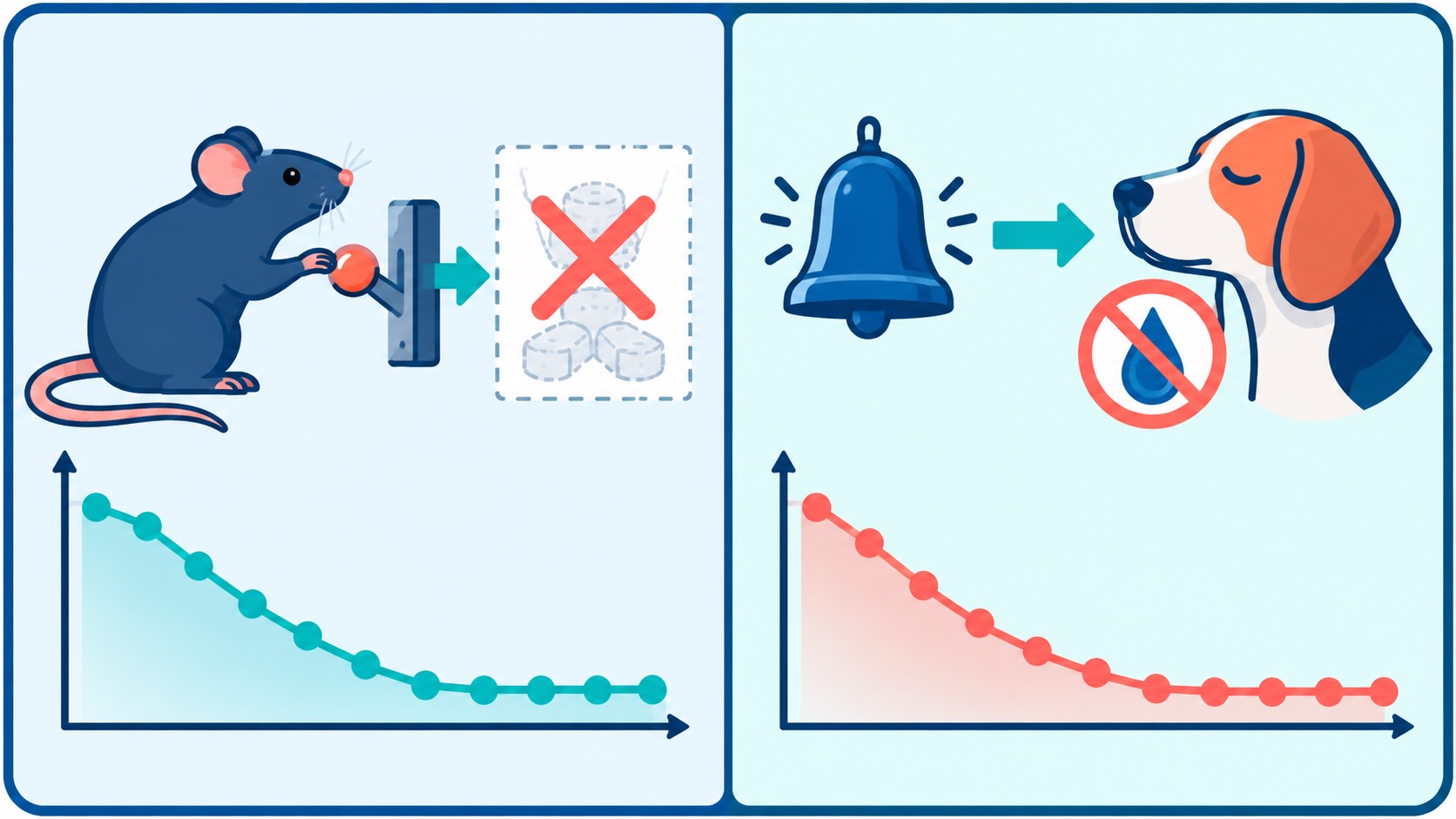
| Feature | Operant extinction | Respondent extinction |
|---|---|---|
| Behavior relation | Behavior has been selected by its consequences. | A conditioned response has been elicited by a conditioned stimulus. |
| What changes? | The maintaining reinforcer no longer follows the response. | The conditioned stimulus is presented without the unconditioned stimulus. |
| Example | Whining no longer produces attention or a tangible. | A tone is presented without the event it previously predicted. |
| Exam clue | “The response no longer produces the reinforcer.” | “The conditioned stimulus is no longer paired with the US.” |
| Common error | Calling any reduction in behavior operant extinction. | Calling the withholding of a social consequence respondent extinction. |
See the site’s respondent versus operant behavior guide when a vignette mixes elicited and emitted behavior. Classify the process, then identify what changed.
Operant Extinction by Behavioral Function
Function-based extinction requires a defensible hypothesis about what maintains the response. FBA may include interviews, direct observation, descriptive analysis, or an authorized functional analysis. Identify the consequence to discontinue while teaching a safer equivalent response.
| Function | Extinction component | Replacement direction |
|---|---|---|
| Attention | Do not deliver the maintaining attention after the target response, within the safety plan. | Teach an attention request and reinforce it efficiently. |
| Tangible or activity | Do not deliver the identified item or activity after the target response. | Teach a request, waiting response, or tolerance skill. |
| Escape or avoidance | Do not allow the target response to produce the maintaining escape, unless safety or clinical criteria require a different plan. | Teach a break request, help request, or task-related alternative. |
| Automatic reinforcement | Interrupt or alter the automatic consequence only when the plan is safe, feasible, and functionally matched. | Provide competing stimulation, enrichment, or a functionally relevant alternative. |
| Multiple functions | Address each maintaining consequence rather than withholding an unrelated outcome. | Teach alternatives that contact the relevant outcomes across contexts. |
Safety changes the decision. For dangerous behavior, pure extinction may be inappropriate or unsafe; blocking, protection, environmental changes, differential reinforcement, or another intervention may be needed. Never withhold a break, food, attention, or safety response without an individualized plan and supervision.
Common Effects of Operant Extinction
Extinction can produce side effects or relapse. Prepare the team, teach a replacement, monitor risk, and use data to decide whether the plan remains appropriate.
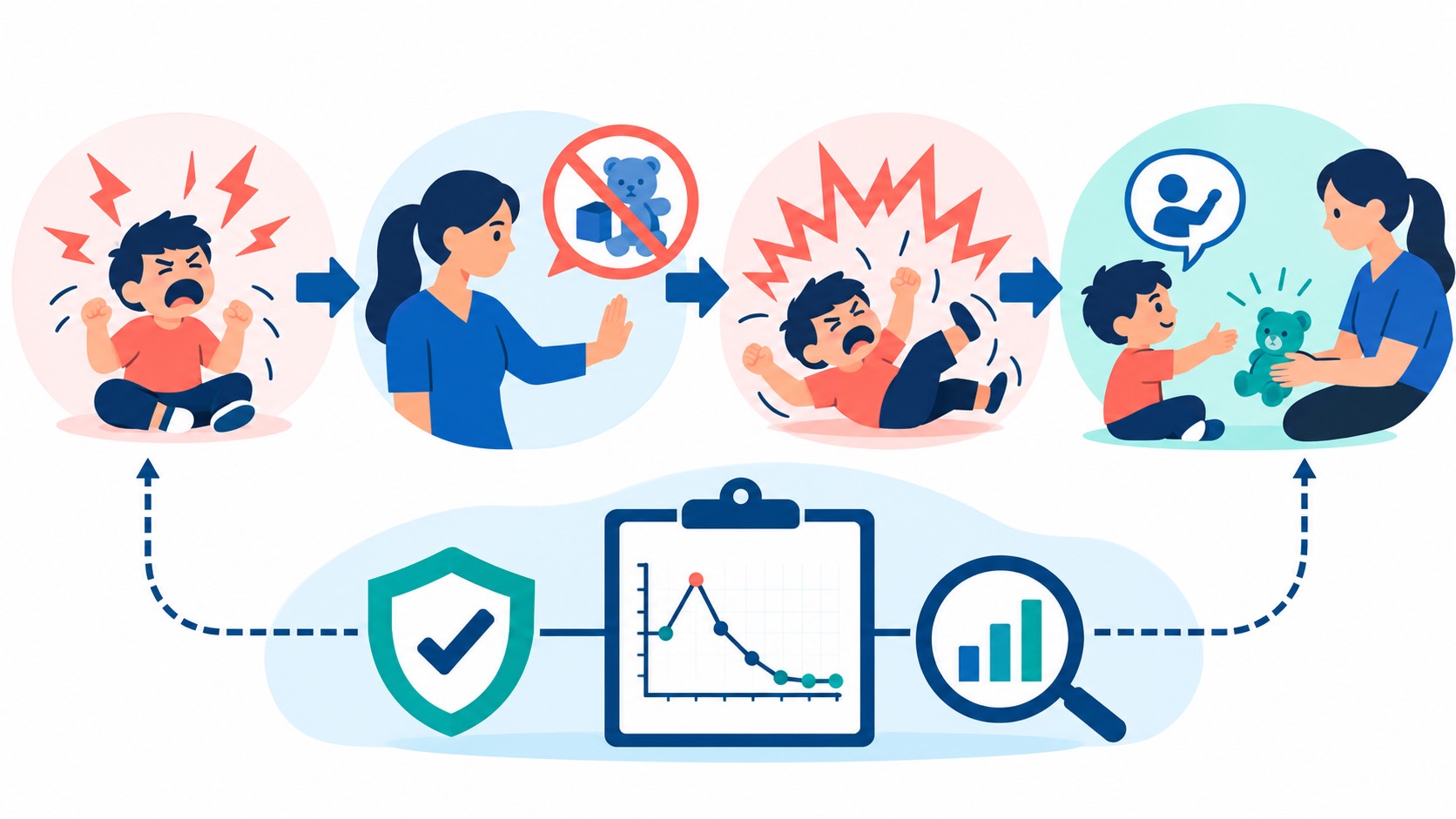
| Effect | What it means | Planning response |
|---|---|---|
| Extinction burst | A temporary increase in frequency, intensity, or duration after reinforcement is first withheld. | Prepare for risk, verify integrity, and monitor whether the effect is safe to tolerate. |
| Response variability | New forms or topographies may appear as the learner contacts other ways to produce the outcome. | Define the response class, assess safety, and reinforce the appropriate alternative. |
| Emotional responding | Crying, aggression, protest, or other changes may occur when the contingency changes. | Review assent, communication, environmental fit, and safety rather than escalating automatically. |
| Spontaneous recovery | The response may briefly reappear after a pause or time away from the extinction context. | Continue the planned contingency and monitor across time and settings. |
| Resurgence | An older response may return when reinforcement for a replacement response is discontinued or thinned too quickly. | Plan durable reinforcement and thin schedules gradually with data. |
| Renewal or reinstatement | Behavior may return in a new context or after the reinforcer is presented independently. | Plan generalization, relapse prevention, and context-specific monitoring. |
These patterns differ: an extinction burst is an early increase; resurgence is an older response returning when alternative reinforcement drops; reinstatement follows independent reinforcer presentation; renewal occurs in a new setting. Name the event and trigger.
Extinction Versus Punishment, Blocking, and NCR
Procedures may reduce behavior through different operations. Extinction withholds the previous reinforcer; punishment presents or removes a contingent consequence; blocking prevents the response path; NCR delivers a consequence noncontingently.
| Procedure | Defining change | Question to ask |
|---|---|---|
| Operant extinction | Maintaining reinforcement is withheld after the target response. | What reinforcer previously followed the behavior? |
| Punishment | A contingent consequence is added or removed and behavior decreases. | What consequence is contingent on the response? |
| Response blocking | The response is prevented or interrupted. | Does the target response complete or contact the consequence? |
| NCR | A consequence is delivered independent of the target response. | Is access time-based rather than response-contingent? |
| DRA or FCT | An alternative response is reinforced, often with extinction for the target. | What response is taught to contact the relevant function? |
A package may combine procedures but should label them accurately. FCT may reinforce a break request while extinction targets problem behavior; NCR may reduce motivation without being extinction. See the differential-reinforcement guide.
Function-Based and Ethical Implementation
Before implementation, define the response, confirm function, identify a socially valid replacement, and plan for safety events. Specify what to do when the replacement is prompted, independent, delayed, or absent.
Extinction can be difficult for learners and staff. Inconsistent implementation can create intermittent reinforcement and persistence. Training, rehearsal, feedback, and supervision support a contingency change that preserves communication, dignity, and safety.
| Safeguard | Implementation question | Evidence to record |
|---|---|---|
| Function match | Is the withheld consequence the one that maintains the response? | Assessment summary and operational hypothesis. |
| Replacement skill | Can the learner contact the same function through an easier, safer response? | Definition, prompt plan, and reinforcement rule. |
| Safety plan | What happens if the behavior escalates or creates immediate risk? | Stop criteria, protective steps, and escalation contacts. |
| Team training | Can implementers identify the target, replacement, and consequence? | Training checklist, rehearsal, and competency data. |
| Client impact | Is the procedure acceptable, respectful, and socially valid? | Assent or preference signals, caregiver input, and review notes. |
| Review rule | When will data trigger continuation, modification, or discontinuation? | Decision rules and supervisor review dates. |
Never use extinction to withhold basic needs, medical care, or a safety response. Dangerous behavior may require protection and a different design. Use the escape-extinction guide for study, not as clinical supervision.
Data Collection and Treatment Integrity
Data should show target change, whether the maintaining reinforcer was withheld, and whether the replacement increases. A lower rate is hard to interpret if delivery, definitions, or consequences changed.
Match measurement to the question: frequency or rate for requests, duration for episodes, and latency for replacement initiation. Record context and safety events because behavior may return in another setting.
| Data stream | What to measure | Interpretation benefit |
|---|---|---|
| Target behavior | Frequency, rate, duration, latency, intensity, or percentage of opportunities. | Shows the change in the behavior of interest. |
| Maintaining consequence | Whether attention, escape, tangible access, or automatic consequence followed. | Checks whether extinction was actually implemented. |
| Replacement response | Independent and prompted alternative behavior. | Shows whether the learner is acquiring a functional path. |
| Context | People, setting, schedule, task, materials, and motivating events. | Identifies renewal, generalization, and competing variables. |
| Integrity | Whether each treatment step occurred as written. | Separates treatment effects from implementation drift. |
| Risk and impact | Escalation, injury risk, distress, assent, and quality-of-life signals. | Supports ethical continuation or rapid modification. |
Graph target and replacement data together. A successful plan reduces the target while increasing access to a safer, socially valid response. If communication also drops, behavior may be suppressed without building repertoire.
BCBA Exam Traps and Decision Path
On the BCBA exam, identify the consequence no longer available after the response. Do not choose extinction merely because behavior decreases; punishment, satiation, blocking, opportunity, or measurement changes may explain it. Extinction can occur during a temporary burst.
| Exam wording | Likely concept | Reasoning move |
|---|---|---|
| “The response occurs, but the reinforcer is no longer delivered.” | Operant extinction | Identify the withheld maintaining consequence. |
| “A stimulus is repeatedly presented without the US.” | Respondent extinction | Identify the changed stimulus-pairing relation. |
| “The response is stopped before it reaches the outcome.” | Response blocking | Ask whether the response was prevented rather than reinforced. |
| “A consequence is added after the response and the behavior decreases.” | Positive punishment | Classify the contingent consequence and future effect. |
| “The behavior briefly increases after reinforcement is withheld.” | Extinction burst | Recognize a temporary pattern, then check safety and integrity. |
| “The old response returns after the alternative is no longer reinforced.” | Resurgence | Identify the trigger involving the replacement response. |
See the site’s extinction-burst guide and free BCBA mock exam. A strong answer names the operation, consequence, risk, and ethical next step.
Operant Extinction Checklist and FAQ
Use this checklist before labeling a scenario as operant extinction:
- Define the target response and its function in observable terms.
- Identify the reinforcer that previously followed the response.
- Confirm that the extinction component withholds that reinforcer.
- Teach and reinforce a functionally equivalent replacement.
- Prepare for burst, variability, emotional responding, and relapse.
- Specify safety limits, stop criteria, and supervision.
- Track target behavior, replacement behavior, consequence delivery, and integrity.
- Review generalization, maintenance, dignity, assent, and quality of life.
- Distinguish extinction from punishment, blocking, and NCR.
- Check whether the plan remains function-based and safe.
| Question | Short answer |
|---|---|
| What is operant extinction in ABA? | A process in which a behavior decreases because its maintaining reinforcer no longer follows that behavior. |
| Does extinction block the response? | No. Blocking prevents or interrupts the response; extinction changes the consequence after the response. |
| Is extinction the same as punishment? | No. Extinction withholds reinforcement; punishment uses a contingent consequence that decreases future behavior. |
| What is an extinction burst? | A temporary increase or change in responding after the maintaining reinforcer is first withheld. |
| What should be taught with extinction? | A safe, efficient replacement that contacts the relevant function when appropriate. |
| When may extinction be inappropriate? | When the function is uncertain, risk is high, the response cannot be safely tolerated, or a less restrictive plan is needed. |
Operant extinction changes a response–reinforcer contingency; a responsible plan pairs it with function-based teaching, safety monitoring, integrity data, and maintenance planning.