
Differential reinforcement always includes what two principles of behavior? The standard BCBA study answer is reinforcement for one response class, combined with extinction or a lower reinforcement criterion for another response class. The exact contingency changes across DRA, DRO, DRI, DRL, and DRH, so the exam-ready move is to identify what earns reinforcement and what no longer earns the same outcome.
Table of Contents
- What Is the Short Answer?
- Why Are Reinforcement and Extinction Paired?
- How Do the Two Principles Appear in Common DR Procedures?
- How Do You Solve the Exam Scenario?
- What Are the Common Traps?
- What Should a BCBA Define Before Implementation?
- Differential Reinforcement FAQ
- Quick Review Checklist
- Take the Free BCBA Mock Exam
This is a narrow question, not a request for another generic differential-reinforcement overview. The site’s broader guide can help with the family of procedures. This page focuses on the two principles, how they appear in a vignette, and why “reinforcement plus punishment” is usually the wrong answer.
The current BCBA Test Content Outline provides examination context, but it does not turn this study answer into an official released question or a universal treatment protocol. A real plan must be individualized, supervised, measured, and consistent with current professional requirements. Table of Contents
What Is the Short Answer?
The direct answer is reinforcement and extinction. Differential reinforcement strengthens one response, response class, rate, or absence of behavior while making reinforcement unavailable for another response under the defined condition. In many textbook descriptions, that second part is extinction: the reinforcer that previously maintained the target behavior is no longer delivered for that behavior.
For example, a learner screams to escape a difficult task. A DRA plan may teach a functional break request and reinforce that request while the team does not deliver the escape contingency following screaming, provided the plan is safe and clinically appropriate. The new response contacts reinforcement; the old response no longer produces the same programmed outcome. That is the two-part logic.
Do not answer “positive and negative reinforcement.” Those are two forms of reinforcement, not the defining pair in the question. Do not answer “reinforcement and punishment” merely because the target behavior decreases. Extinction removes a previously effective reinforcer; punishment adds or removes a consequence because the behavior decreases. The contingency, not the emotional tone of the procedure, decides the label.
Why Are Reinforcement and Extinction Paired?
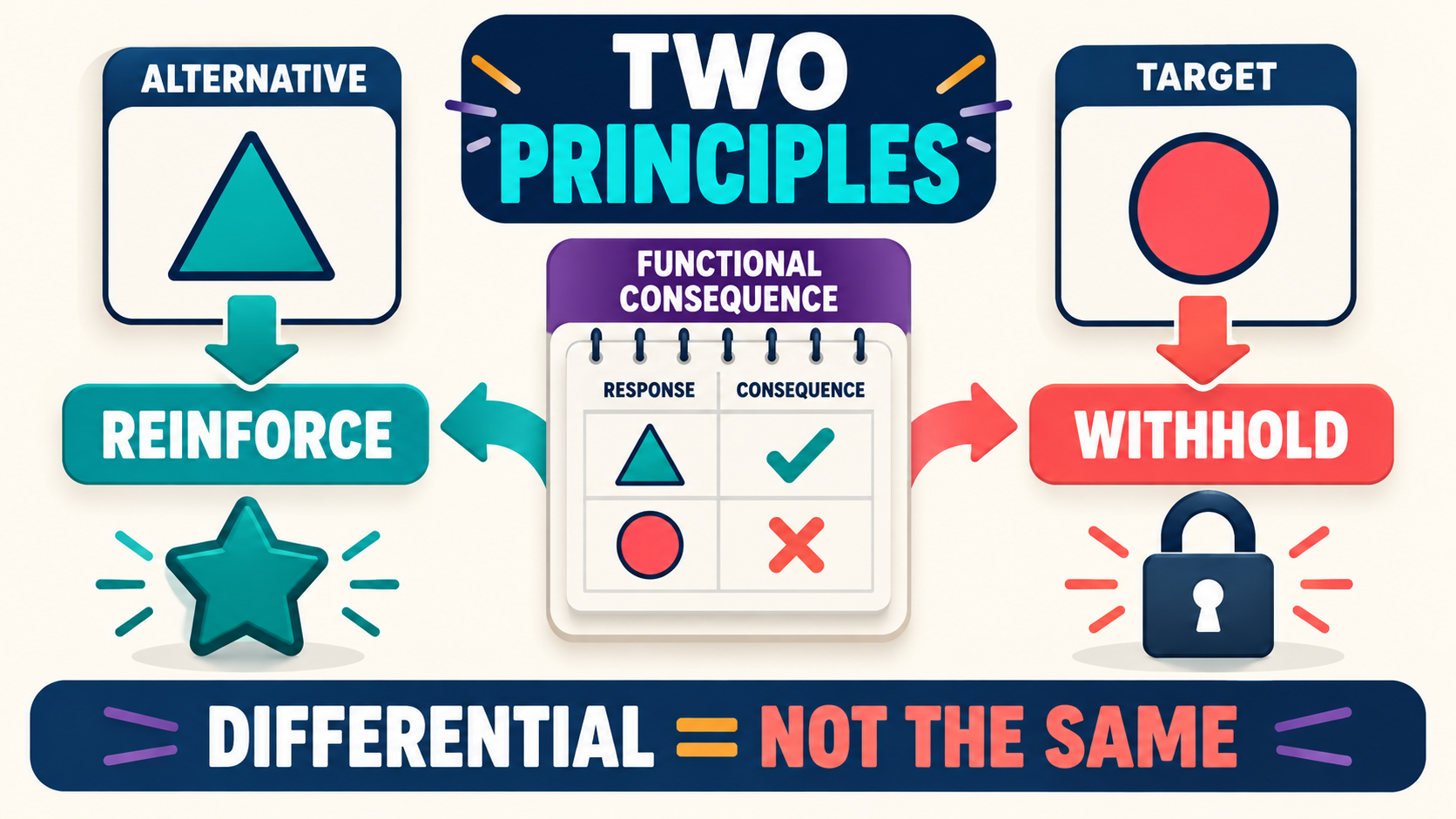
Reinforcement explains why the selected alternative, incompatible response, high or low rate, or absence of the target behavior is more likely to occur in the future. Extinction explains why the competing response no longer contacts the reinforcer that previously maintained it. Differential reinforcement is therefore “differential”: the consequences are not the same for all responses. The two principles are easiest to see by asking two questions:
- What response gets the reinforcer? Identify the response or response class that the plan is trying to strengthen, such as an appropriate request, a behavior incompatible with the target, or a response that occurs below a rate criterion.
- What response stops getting that reinforcer? Identify the target response, rate, or interval condition for which the reinforcer is withheld, delayed, or delivered under a different criterion.
Sometimes a program uses a lower or different reinforcement criterion rather than pure extinction. DRL, for example, can reinforce a reduced rate while allowing some responding to continue. The question may still be teaching the same broad discrimination: reinforcement is differentially arranged across responses or rates. Read the stated contingency instead of forcing every procedure into a pure DRA-plus-extinction script.
How Do the Two Principles Appear in Common DR Procedures?
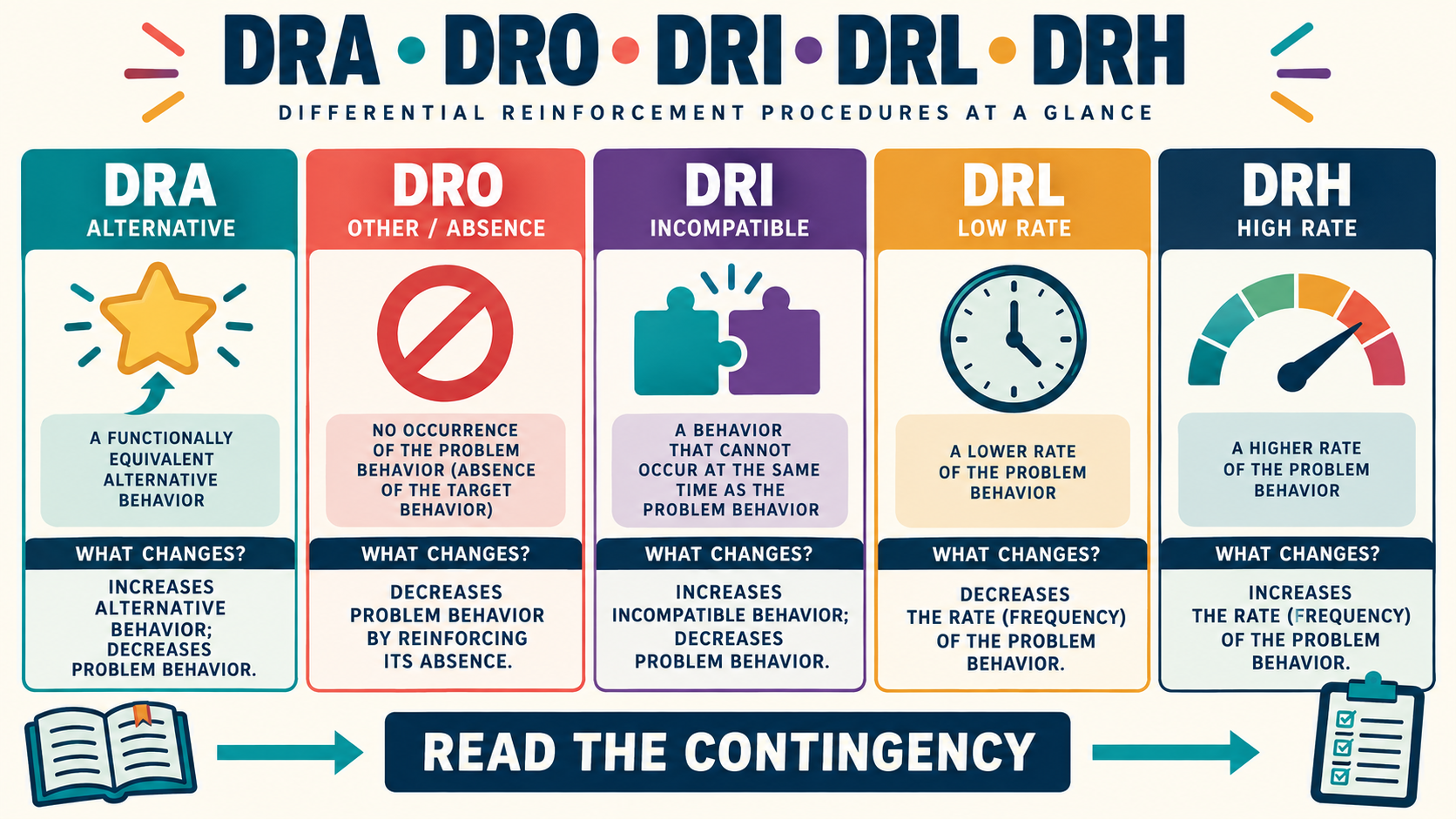
The acronym tells you what receives differential reinforcement, but the scenario tells you the actual contingency. Use the table as a study map, not as permission to implement a procedure without assessment and supervision.
| Procedure | What is reinforced? | What is withheld or held to another criterion? |
|---|---|---|
| DRA | An alternative response that can contact the same or a functionally relevant outcome. | The target problem response no longer produces that programmed reinforcer under the plan. |
| DRI | A response that cannot occur at the same time as the target. | Reinforcement is not delivered for the incompatible target response. |
| DRO | The absence of the target behavior for a defined interval or opportunity. | The target occurs during the interval, so the absence criterion is not met. |
| DRL | A lower, specified rate or spacing pattern of the target response. | The higher or faster rate no longer meets the reinforcement criterion. |
| DRH | A higher rate of a desired response within the defined time window. | Lower rates do not meet the high-rate criterion, even though some responding occurred. |
The common thread is not the acronym alone. It is the contrast between the response or rate that contacts reinforcement and the response or rate that does not contact the same outcome, or must meet a different criterion. If the vignette only describes adding a consequence after behavior and never contrasts response classes or rates, it may be describing punishment or ordinary reinforcement instead.
How Do You Solve the Exam Scenario?
Translate the vignette into a two-column contingency before looking at the answer choices. Write “reinforced” on one side and “not reinforced / different criterion” on the other. Then ask whether the consequence is being added or removed because the behavior changes, or whether a previously effective reinforcer is simply no longer delivered.
Scenario 1: An alternative request: A learner drops materials to obtain a break. The plan teaches the learner to hand over a break card. The break follows the card, while dropping no longer produces the break. The answer is DRA: reinforcement for an alternative response plus extinction of the old escape response, assuming the plan includes safe prompting and a feasible way to request. Exam clue: the replacement response has a clear functionally relevant reinforcer. The word “alternative” identifies the response class; the consequence pattern identifies the two principles.
Scenario 2: A lower rate: A student calls out 20 times during a 30-minute lesson. The teacher provides a point when call-outs stay at or below three. The student may still call out, but the high rate does not earn the point. This is a DRL-style rate criterion, not necessarily pure extinction of every call-out. Exam clue: the target response is not absent and is not replaced by a physically incompatible response. The critical difference is the rate requirement.
Scenario 3: Reinforcement plus punishment?: A plan gives praise for completing a task and removes a token after refusal. The first contingency may be reinforcement for task completion; the token loss may be response cost, a negative-punishment procedure. It is not automatically differential reinforcement simply because one response earns praise and another response loses a token. Look for a differential response-class or rate criterion and identify the specific contingency described. Exam clue: “behavior decreased because a preferred item was removed” points toward punishment. “The old response no longer produces the reinforcer that maintained it” points toward extinction.
What Are the Common Traps?
- Confusing extinction with punishment: extinction withholds a previously reinforcing consequence; punishment changes behavior because a consequence is added or removed after the response.
- Confusing reinforcement with reward: a preferred item is not automatically a reinforcer. Reinforcement is defined by an increase in future behavior.
- Ignoring the response class: DRA reinforces an alternative response, while DRO reinforces the absence of the target during a criterion period.
- Calling every DR procedure extinction: DRL and DRH use rate criteria; the target may still occur or may fail only because it misses the criterion.
- Assuming “always” means every real-world plan is pure: the direct study answer is reinforcement plus extinction, but the written contingency and safety constraints control actual practice.
- Choosing an answer from the acronym only: read what happens before, during, and after the response. Timing and consequence are stronger clues than a memorized label.
A second trap is treating the question as an official BACB item. Search-result flashcards can reveal wording and intent, but they do not establish official authorship or current exam content. Use current BACB materials for the exam framework, then use the contingency described in the question to reason.
What Should a BCBA Define Before Implementation?
A BCBA should define the target response, alternative or absence criterion, functional reinforcer, schedule, prompting arrangement, data system, and decision rule before asking an implementer to run differential reinforcement. The plan should state what happens when the target occurs, what happens when the alternative occurs, and how the team will monitor side effects such as extinction bursts, resurgence, frustration, or prompt dependence.
- Use an operational definition that a second observer can score.
- Confirm the proposed alternative is efficient, accessible, and functionally relevant.
- Specify whether extinction is full, modified, delayed, or not clinically appropriate.
- Protect communication, assent, dignity, safety, and access to essential needs.
- Collect data on both the target and the reinforced alternative or rate.
- Review treatment integrity before concluding that the contingency failed.
Do not apply a generic differential-reinforcement script to a dangerous behavior, a communication need, or a medically complex situation without qualified assessment and supervision. A study guide can teach the logic of the two principles; it cannot authorize individualized treatment.
Differential Reinforcement FAQ
What is the one-sentence answer? Differential reinforcement uses reinforcement for one response, response class, rate, or absence condition while extinction or a different reinforcement criterion applies to another. Is the answer positive and negative reinforcement? No. Those are two categories of reinforcement. The question is asking about the paired contingency in differential reinforcement: reinforcement plus extinction or a contrasting criterion.
Does every differential-reinforcement plan use extinction? Many textbook examples pair reinforcement of the desired response with extinction of the target, especially DRA. Some applied plans use a lower or different rate criterion, safety modification, or another carefully defined arrangement. Read the actual plan.
What should I memorize for the BCBA exam? Memorize the contrast: what is reinforced, what is withheld or held to another criterion, and whether the target is replaced, absent, lower-rate, or higher-rate. Then practice identifying those features in scenarios. For a final study checkpoint, use the free BCBA mock exam. It is an independent preparation resource, not an official BACB product, a released question bank, or a guarantee of certification.
Remember the compact rule: reinforce the response you want, and stop delivering the same reinforcer for the response you are replacing—or apply the stated rate criterion. That is the reasoning behind the answer to “differential reinforcement always includes what two principles of behavior?”
Quick Review Checklist
Use this final checklist to turn differential reinforcement into exam-ready reasoning. The goal is not to memorize a label in isolation; it is to identify the relevant evidence and explain why the best answer fits the scenario. Key ideas to review:
- State the central definition or decision point for differential reinforcement in your own words.
- Identify the detail that makes differential reinforcement different from its closest related ABA term.
- Separate the observable facts in a scenario from assumptions that are not supported by the facts.
- Write one example and one nonexample so you can recognize the concept in a new setting.
Exam application checks:
- Ask what the question is actually requesting before comparing the answer choices.
- Mark the antecedent, response, consequence, or other evidence that supports the selected answer.
- Look for a distractor that describes a related process but does not answer the specific question.
Final self-check:
- Explain how you would verify the interpretation with clear observations or data.
- Change one detail in the scenario and decide whether your answer should change.
- Give a one-sentence rationale that a supervisor or study partner could evaluate.
Take the Free BCBA Mock Exam
When you are ready to apply the idea, use the free practice resource below for additional feedback. Take the Free BCBA Mock Exam



