
Efficient ABA staff scheduling is not just filling a calendar. It is a repeatable way to match authorized services, qualified staff, client priorities, travel or setting limits, and real-world changes before the schedule is published.
Table of Contents
- What Does Efficient ABA Staff Scheduling Actually Mean?
- What Should a Schedule Control—and What Should It Not Control?
- How Do You Define Demand Before Assigning Staff?
- How Should You Match Staff to Sessions?
- How Do You Verify Hours, Authorizations, and Documentation?
- How Should a Clinic Handle Cancellations and Callouts?
- Why Does Human Review Still Matter?
- Which Metrics Show Whether Scheduling Is Working?
- What Does a 20-Minute Schedule Review Look Like?
- What Belongs on an ABA Staff Schedule Audit?
- How Does This Connect to BCBA Exam Preparation?
- Efficient ABA Staff Scheduling FAQ
- Take the Free BCBA Mock Exam
A schedule can look full and still be fragile. A provider may be double-booked, a client’s authorized hours may be exceeded, a supervision block may disappear, or a last-minute callout may leave a family without a useful plan. The goal is a schedule that people can understand, carry out, document, and revise without losing sight of the learner. This guide is an operations and study resource, not a payer rulebook, legal opinion, or individualized treatment plan. Table of Contents
What Does Efficient ABA Staff Scheduling Actually Mean?
Efficient ABA staff scheduling means creating the most workable plan from the constraints that matter, then checking the plan before anyone relies on it. “Efficient” does not mean squeezing every person into the maximum number of billable hours. It means reducing avoidable conflicts while protecting service continuity, accurate documentation, staff capacity, and client-informed priorities.
- Start with demand: know which clients need sessions, supervision, assessment, meetings, or make-up planning.
- Match qualified people: assign staff based on role, competency, availability, setting, and the plan that governs the service.
- Verify the hours: check authorization limits, appointment length, travel or location rules, and documentation expectations.
- Protect continuity: avoid unnecessary provider changes and keep the learner’s routine understandable.
- Plan for change: use a visible process for cancellations, callouts, substitutions, and unresolved gaps.
- Review before publishing: a person with appropriate responsibility should catch exceptions that an automated calendar cannot interpret safely.
What Should a Schedule Control—and What Should It Not Control?
A schedule can control timing, location, assigned role, communication, and the handoff of information. It can make the next action visible. It cannot decide whether a goal is socially meaningful, replace clinical judgment, or turn an unqualified person into an authorized provider. The treatment plan, supervision arrangement, payer contract, state requirements, and organizational policy remain separate sources of authority.
That boundary matters because scheduling pressure can quietly change services. For example, moving a session to an easier time may help operations but may not fit the learner’s routine. Filling a gap with the first available person may protect utilization but may ignore competency, continuity, or supervision needs. A good scheduler surfaces the conflict so the responsible professional can decide; it does not hide the conflict behind a green calendar cell.
How Do You Define Demand Before Assigning Staff?
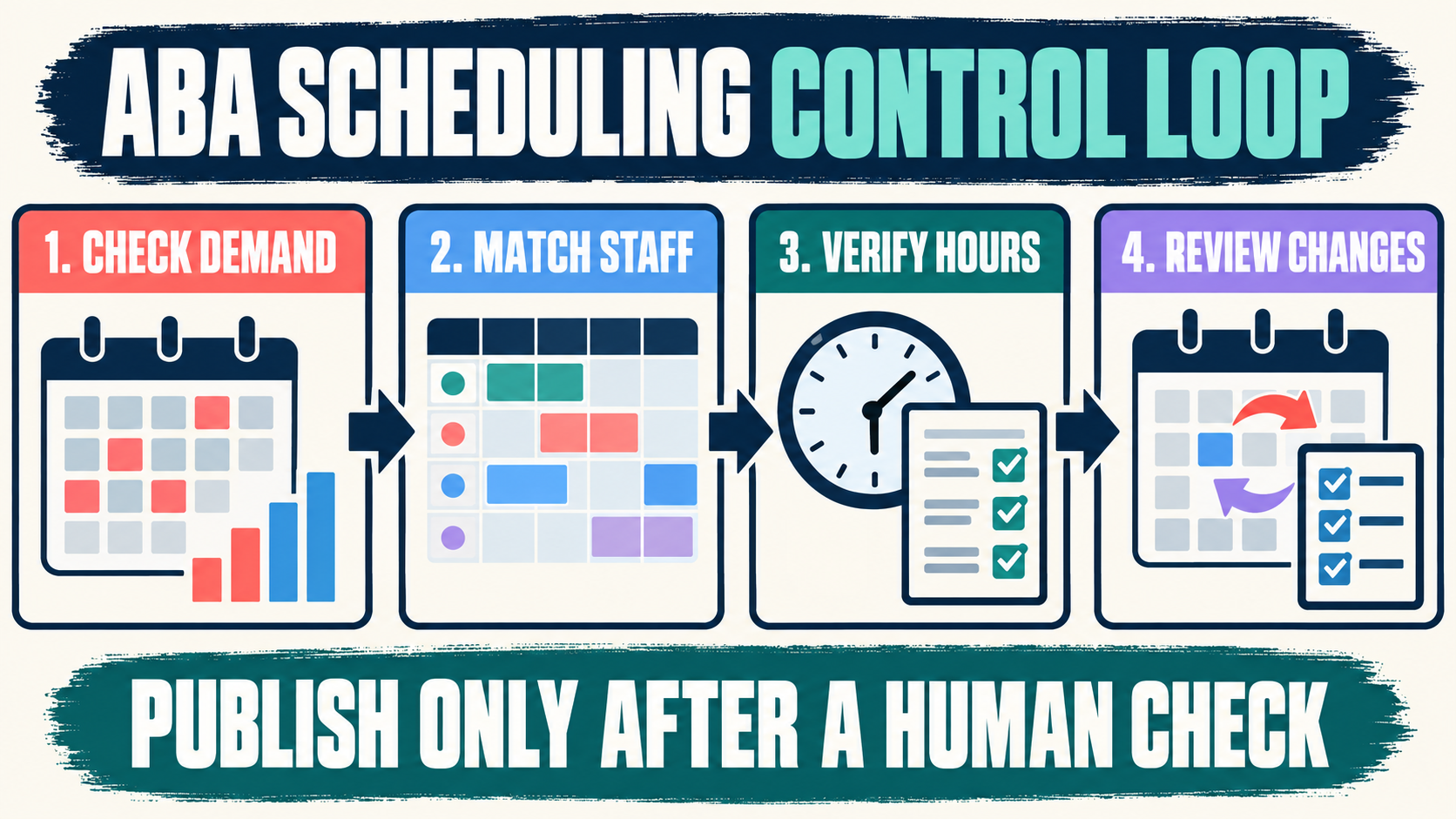
Make the work visible before you match people to it. Create a demand list that separates direct sessions from supervision, assessment, caregiver meetings, documentation time, team meetings, travel, and planned make-up opportunities. If everything is labeled simply “appointment,” the schedule can look complete while the non-session work required to deliver services disappears.
| Input to define | Question to ask | Why it protects the schedule |
|---|---|---|
| Service need | What type of session or task is actually required? | Prevents a direct-service slot from replacing supervision, assessment, or a required meeting. |
| Time window | Which times are realistic for the learner, family, staff, and setting? | Reduces preventable cancellations and unrealistic back-to-back travel. |
| Required support | What competency, supervision, credential, or access condition applies? | Makes hard constraints visible before a person is assigned. |
| Priority | What must happen first if capacity is limited? | Creates a defensible decision rule instead of last-minute favoritism. |
How Should You Match Staff to Sessions?
Use hard constraints first and preferences second. A hard constraint is a condition that must be true for the assignment to be workable, such as the person’s role, competence, availability, location, or required supervision. A preference may improve the match, such as continuity with a familiar technician or a staff member’s preferred time. If the system treats every preference as equal to a safety or authorization constraint, it becomes difficult to explain why an assignment was made. A practical matching sequence is:
- Remove people who are unavailable or not authorized for the task.
- Check the setting, travel time, overlapping appointments, and required supervision.
- Compare continuity, client and caregiver preferences, language or cultural fit, and staff response effort.
- Assign the strongest available match and record the reason for an exception.
- Show the staff member what changed and how to report a conflict.
This is also where a simple calendar and an operations system differ. A calendar stores times. A scheduling process stores decisions, constraints, and the next person responsible for resolving an exception.
How Do You Verify Hours, Authorizations, and Documentation?
Verify the source of each limit instead of relying on a copied number in a spreadsheet. Authorization periods, service codes, unit definitions, supervision rules, payer policies, and state requirements can differ. The current payer or program document controls; a general online article cannot establish what a specific client may receive.
Before publishing a recurring schedule, check whether the planned service type and duration fit the current authorization, whether the assigned role is permitted for that service, and whether the time can be documented accurately. If a change creates a possible billing or compliance question, flag it for the person responsible for payer and clinical review. Do not “solve” the problem by silently shortening a session or relabeling the service.
For the same reason, track the difference between scheduled hours, delivered hours, canceled hours, and authorized hours. Those numbers answer different questions. Combining them into one utilization percentage can hide a gap that needs attention.
How Should a Clinic Handle Cancellations and Callouts?
Build the fallback process before the first emergency. A good change workflow tells the coordinator who receives the notice, how quickly the family and staff are contacted, which alternatives can be offered, and when the responsible professional must decide whether the session should be rescheduled, changed in format, or canceled.
- Log the change: record the time, affected client, service, staff member, and reason using the organization’s privacy-safe system.
- Check safe alternatives: review qualified availability, continuity, authorization, location, and supervision before offering a replacement.
- Communicate one clear version: update the people who need the information and avoid parallel texts that create conflicting schedules.
- Close the loop: document what happened, what was delivered, and what follow-up remains.
Do not use “anyone available” as a replacement rule. A fast assignment that does not fit the learner, role, authorization, or supervision plan is not an efficient assignment; it is deferred risk.
Why Does Human Review Still Matter?
Automation is useful for sorting availability, finding overlaps, sending reminders, and showing open hours. It cannot independently determine whether an unusual assignment is clinically appropriate, culturally responsive, consistent with the learner’s priorities, or allowed by a payer and state context. The final review should look for exceptions rather than reread every ordinary appointment.
Use an exception queue such as: missing authorization, credential mismatch, unconfirmed location, travel overlap, excessive consecutive hours, missing supervision, abrupt provider change, or a recurring cancellation pattern. Each exception needs an owner and a next action. If no one owns the exception, the schedule is not ready to publish.
Which Metrics Show Whether Scheduling Is Working?
Choose a small dashboard that measures reliability, not only filled time. Review trends over a consistent period and pair quantitative data with staff and family feedback.
| Metric | What it can reveal | Question after the trend |
|---|---|---|
| Unfilled authorized hours | Capacity, matching, or intake bottlenecks | Is the constraint staff, timing, authorization, or communication? |
| Last-minute changes | Fragile staffing, poor confirmation, or unrealistic blocks | Which recurring cause can be addressed upstream? |
| Continuity rate | How often the planned staff relationship is maintained | Are changes necessary, or are they caused by avoidable scheduling choices? |
| Documentation exceptions | Whether the plan is workable after the appointment ends | Does the workflow leave enough time and clear responsibility? |
What Does a 20-Minute Schedule Review Look Like?
Use a short review cycle at the start or end of a planning block. The point is not to stare at a calendar longer; it is to ask the same high-value questions every time.
- Minutes 1–4: scan tomorrow’s demand, new referrals, cancellations, and unfilled authorized hours.
- Minutes 5–9: filter for hard-constraint exceptions: role, availability, location, supervision, and authorization.
- Minutes 10–14: review continuity, staff workload, travel, and the effect of substitutions on the learner.
- Minutes 15–18: assign an owner and deadline for each unresolved issue; do not leave “check later” without a name.
- Minutes 19–20: publish one current version and communicate only the changes that people need to act on.
What Belongs on an ABA Staff Schedule Audit?
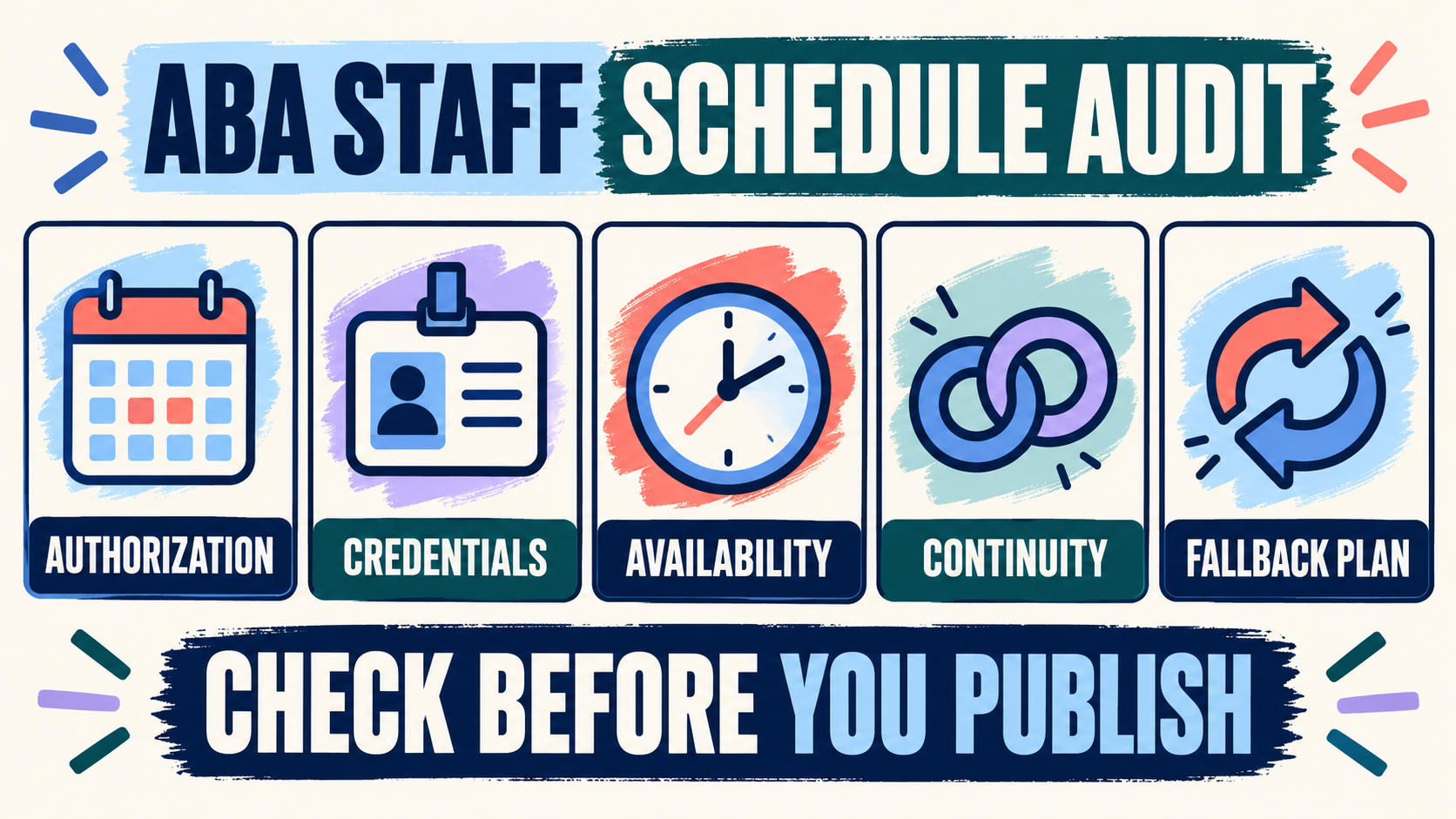
Use the audit image above as a quick pre-publish screen. It is intentionally short; a checklist should expose the most important exceptions, not pretend to replace the organization’s policy or payer review.
- Authorization: does the planned service fit the current source document and period?
- Credentials and competence: is the assigned person qualified and appropriately supervised for the task?
- Availability: are time, location, travel, breaks, and other appointments realistic?
- Continuity: does the assignment respect the learner’s routine and documented preferences where possible?
- Fallback plan: if the appointment changes, is there a clear safe next action and an owner?
- Human review: has an appropriate person checked the exceptions before the calendar is treated as final?
How Does This Connect to BCBA Exam Preparation?
Efficient ABA staff scheduling is a useful application topic because it brings together measurement, ethics, supervision, and intervention context. The current BCBA Test Content Outline includes personnel supervision and management, ethical and professional issues, measurement, and selecting and implementing interventions. A practice question may ask you to identify the most defensible next step when the schedule creates a competency, continuity, or data problem.
Study the decision rule rather than memorizing a software feature. Ask: What is the observable problem? Which constraint is hard? What information is missing? Who has the authority to decide? What data would show whether the change helped? The BACB Ethics Code information is the official place to check current ethics requirements; scheduling convenience should never be used as a substitute for those requirements.
When you are ready to test the reasoning pattern, use efficient ABA staff scheduling practice questions as feedback. Focus on why one option protects the client and the service context better than the distractors. A mock score is a study signal, not a certification decision.
Efficient ABA Staff Scheduling FAQ
What is the biggest scheduling mistake in an ABA clinic?: A common mistake is treating filled time as the same thing as a workable service plan. A full calendar can still contain a credential mismatch, authorization problem, missing supervision, impossible travel, or an unowned cancellation. Review exceptions and outcomes, not just the number of colored blocks.
Should an ABA scheduler decide which staff member is clinically best?: The scheduler can apply documented constraints and surface options. The responsible clinical professional should decide questions that require clinical judgment, treatment-plan interpretation, or a change in supervision. Keep the role boundary visible in the workflow.
Can scheduling software replace human review?: No. Software can reduce arithmetic and communication errors, but it does not replace professional judgment, payer verification, privacy safeguards, or the need to consider client-informed priorities. Use automation to make exceptions easier to see, then assign a human owner.
How often should ABA staff schedules be reviewed?: Review recurring schedules on a predictable cadence and review exceptions whenever a cancellation, callout, authorization change, or supervision change occurs. The correct interval depends on the organization’s size and volatility; the key is that the process is defined before a crisis.
Bottom line: efficient ABA staff scheduling is a human-reviewed control loop: define demand, match qualified staff, verify hours, protect continuity, plan for changes, and measure what happened. A calendar becomes useful when the people using it can trust the decisions behind it.
Take the Free BCBA Mock Exam
If you want a low-pressure way to check your recall, use the free practice resource below. Take the Free BCBA Mock Exam



