

Ethical dilemmas in applied behavior analysis examples are not just dramatic cases involving obvious misconduct. They can appear when client welfare, informed choice, confidentiality, competence, organizational pressure, and professional boundaries pull a behavior analyst in different directions. The right response is usually a disciplined process: identify the conflict, consult the current standard, protect the client, document the facts, and involve the appropriate supervisor or authority.
Table of Contents
- What Makes an Ethical Dilemma in ABA?
- How Can You Recognize the Ethical Conflict?
- What Are Ethical Dilemmas in Applied Behavior Analysis Examples?
- How Should a Behavior Analyst Respond?
- How Is an Ethical Dilemma Different From a Clinical Disagreement?
- What Should You Avoid When Studying Ethics Cases?
- How Are Ethical Scenarios Tested on the BCBA Exam?
- ABA Ethical-Dilemma Checklist
- Take the Free BCBA Mock Exam
An ethical dilemma is also not the same as a routine clinical disagreement. Two competent professionals may prefer different teaching procedures while agreeing on the client’s rights and the evidence. A dilemma exists when important obligations or values compete, and the practitioner must decide how to proceed without quietly sacrificing a person’s welfare or autonomy.
This guide uses fictional study scenarios. It does not reproduce the current BACB Ethics Code resources, predict the result of a complaint, or provide legal advice. For a live concern, verify the exact current standard, follow organizational procedures, and seek qualified supervision or legal/regulatory guidance when appropriate. Table of Contents
What Makes an Ethical Dilemma in ABA?
An ethical dilemma occurs when a practitioner faces competing responsibilities and cannot make a safe decision by following a vague instinct alone. In ABA, the conflict may involve a learner’s assent or participation, a caregiver’s request, an employer’s productivity goal, a supervisor’s instruction, the analyst’s competence, or a behavior-change plan that produces progress while creating an unacceptable burden.
The presence of disagreement does not automatically prove that someone has violated the Code. Ethical reasoning begins with facts. What happened? Who is affected? What information is missing? What standard, law, contract, policy, or scope-of-practice boundary applies? What immediate action protects the client while the question is reviewed?
The current BACB resources explain that the Ethics Code for Behavior Analysts applies to BCBA and BCaBA certificants and applicants, and the Code can change through official revisions. That is why a study answer should not rely on an old blog list or an isolated memorized number. Use the current BACB framework for ethical dilemmas in applied behavior analysis examples as the controlling reference, then reason from the facts of the scenario.
How Can You Recognize the Ethical Conflict?
Before choosing an action, translate the story into an ethical question. Four signals are especially useful:
- Potential harm or loss of benefit: Is a plan exposing a client to unnecessary risk, ignoring deterioration, or continuing without meaningful progress?
- Choice and participation: Is the person’s assent, communication, preference, privacy, or right to ask questions being ignored?
- Competence and role boundaries: Is someone being asked to practice outside training, make an unsupported diagnosis, or change a plan without the required oversight?
- Truthfulness and accountability: Are data being changed, omitted, backdated, exaggerated, or presented in a way that could mislead a client, payer, employer, or public audience?
These signals are prompts for investigation, not automatic verdicts. For example, a missed data point may be an honest documentation error, a systemic training problem, or intentional falsification. The next step depends on facts, risk, and the applicable current requirements.
What Are Ethical Dilemmas in Applied Behavior Analysis Examples?
The examples below are fictional and simplified for study. In real practice, the correct response can depend on the person’s communication, age, setting, risk level, state or local law, employer policy, and the exact current Ethics Code language.
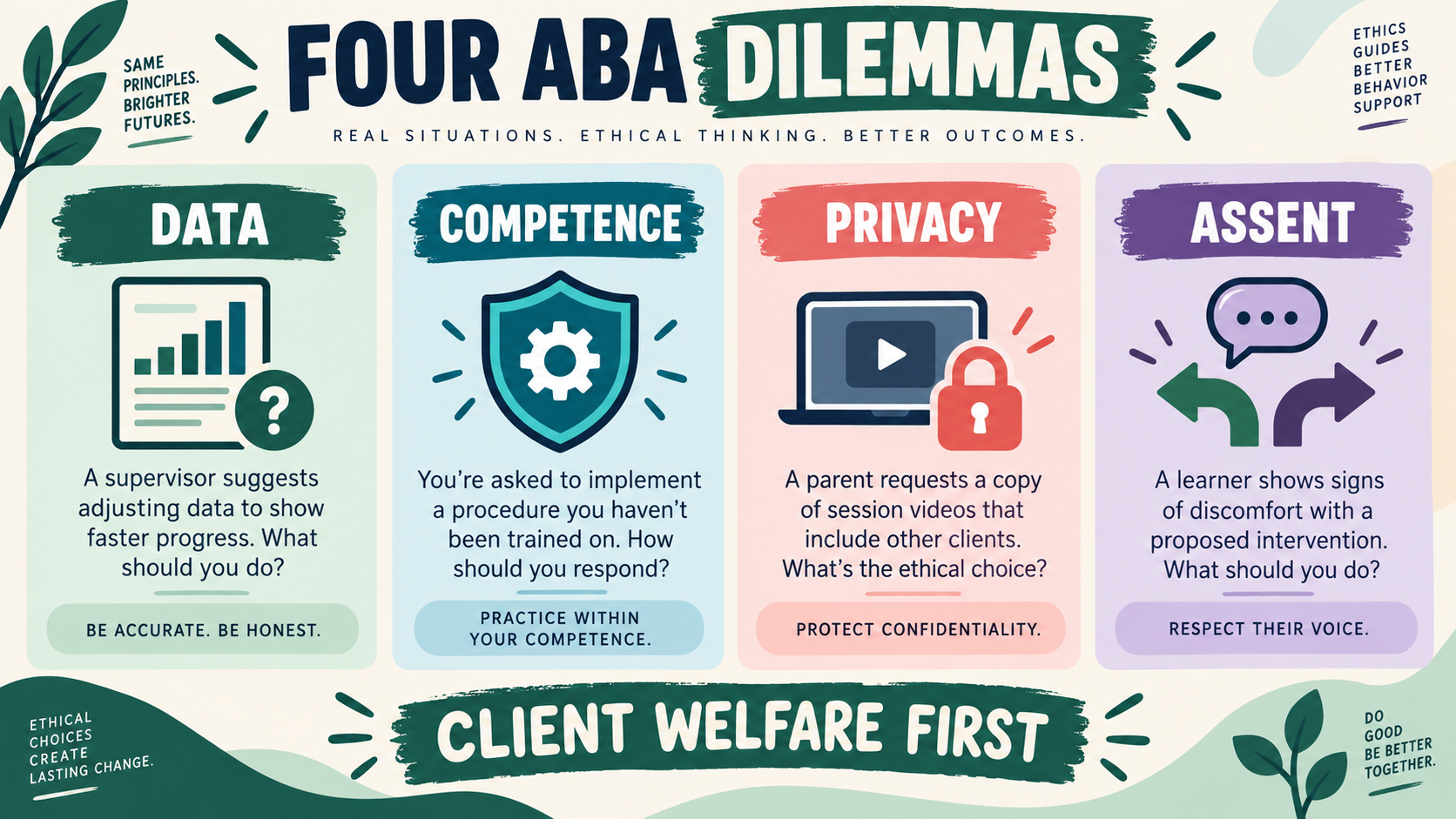
Scenario 1: Progress data are being polished: A supervisor asks a trainee to remove several low sessions from a progress graph before a meeting because “the family will lose confidence.” The trainee knows the sessions occurred and that the graph will look better without them.
The ethical issue is not merely a graphing preference. It concerns the accuracy and completeness of records, the risk of misleading stakeholders, and the client’s right to decisions based on valid information. A defensible first response is to preserve the original data, ask what correction is being requested, and bring the concern to the appropriate supervisor or compliance channel. If there is immediate risk to the client or pressure to falsify records, the practitioner should not quietly comply.
Scenario 2: A procedure is outside current competence: A BCBA is asked to design an intervention involving a complex communication device that the BCBA has never assessed or implemented. The agency promises a bonus for accepting the case quickly, and a colleague says the BCBA can “learn as they go.”
The conflict involves competence, client welfare, and organizational pressure. A safer response is to disclose the limitation, seek training or qualified consultation, involve the relevant communication professionals, and avoid presenting unsupported expertise. The decision is not solved by adding a disclaimer after starting an unsuitable program. The client needs a competent plan and a clear path for supervision or referral.
Scenario 3: A caregiver requests a private video: A caregiver asks the analyst to send a session video to a family group chat so relatives can see progress. The video includes another learner in the background, and no release has been confirmed for that person.
The ethical concern involves confidentiality, authorization, and the privacy of everyone shown. The analyst should pause the transfer, clarify who has permission to receive the recording, follow the organization’s secure communication process, and avoid treating a convenient app as an approved disclosure method. A request from one authorized person does not automatically authorize sharing another client’s identifiable information.
Scenario 4: The plan works but the learner resists: A procedure increases task completion, but the learner repeatedly communicates refusal and becomes distressed. The team says the improvement proves that the procedure should continue unchanged because the numbers look better.
The dilemma involves the relationship between outcome data, assent or participation, dignity, and the least intrusive effective approach. The analyst should review the learner’s communication, the target’s social significance, the treatment burden, possible alternatives, and stakeholder input. Improvement in one metric does not erase the need to evaluate quality of life, acceptability, and adverse effects.
How Should a Behavior Analyst Respond?
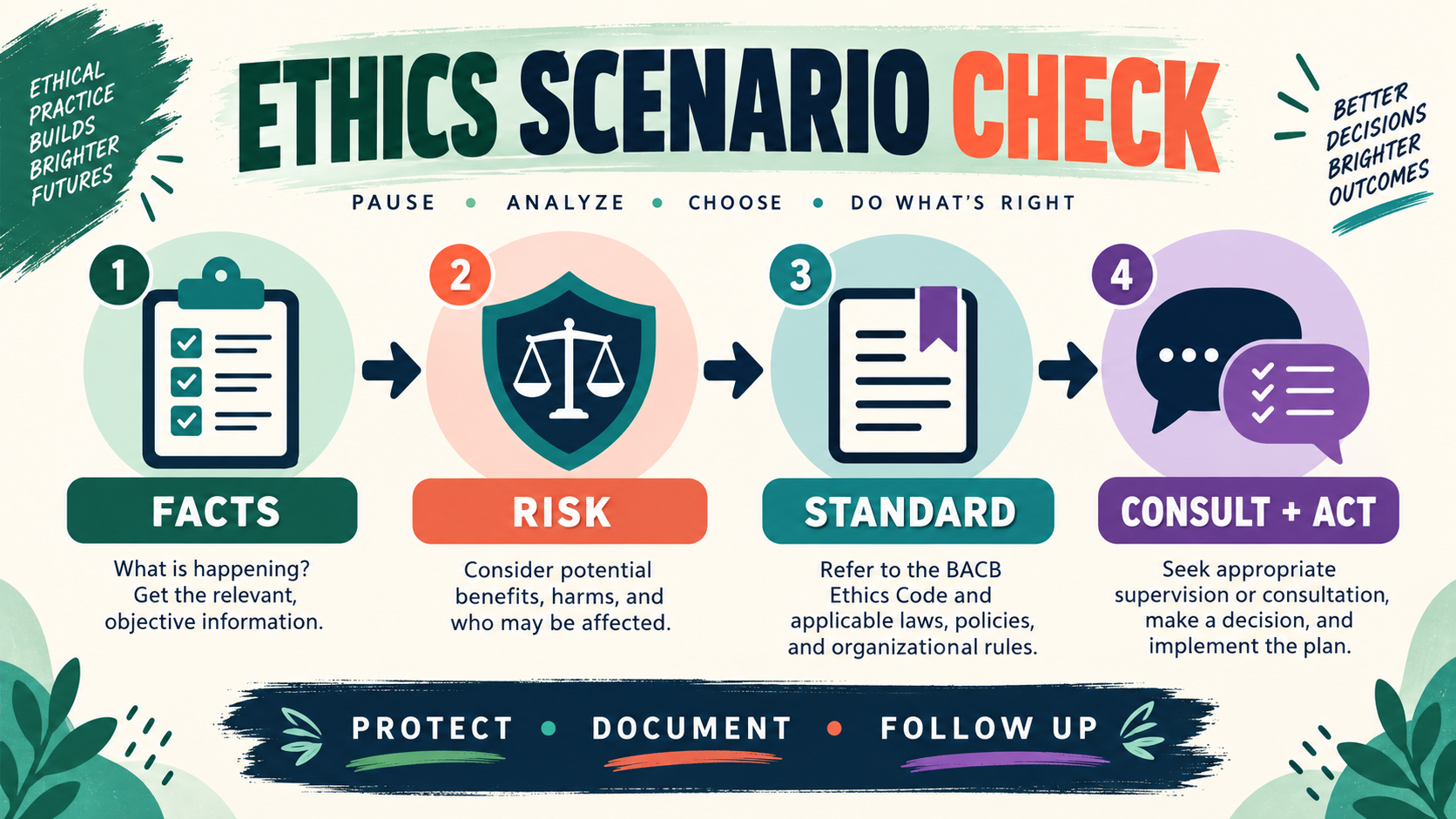
A repeatable response process helps prevent both impulsive action and passive delay. Use this sequence for study cases:
- Stabilize immediate safety. If there is current risk of harm, protect the client and obtain urgent help within the practitioner’s role.
- Describe facts, not accusations. Record dates, people involved, observations, data, communications, and the decision that is needed. Separate what was observed from what is inferred.
- Identify the competing duties. Name the client-welfare, consent/assent, confidentiality, competence, documentation, boundary, or public-statement issue that may apply.
- Check the current sources. Review the current BACB Ethics Code, applicable law or regulation, contract, payer rule, and organizational policy. Do not rely on a screenshot of an old code.
- Consult through the right channel. Speak with the supervisor, ethics or compliance lead, qualified colleague, or other authority with relevant competence. Protect confidentiality while seeking help.
- Choose and document the least harmful defensible action. State what will happen now, who is responsible, what information remains missing, and when the decision will be reviewed.
- Follow up. Monitor whether the action reduced risk, protected the client, and resolved the underlying problem. Escalate when the normal channel is conflicted, unavailable, or ineffective.
| Question | Weak response | Stronger response |
|---|---|---|
| What happened? | “This feels wrong.” | Record observable facts, dates, data, and communications. |
| Who may be affected? | Focus only on the employee who made the request. | Consider the client, family, team, other clients, and public trust. |
| What governs the decision? | Use a remembered code number or social-media advice. | Check current BACB, legal, payer, contract, and organizational requirements. |
| What happens next? | Wait indefinitely or confront someone publicly. | Protect safety, consult, document, act, and review the result. |
How Is an Ethical Dilemma Different From a Clinical Disagreement?
A clinical disagreement asks which intervention, measurement system, or teaching arrangement is most appropriate. An ethical dilemma asks how to act when obligations, rights, risks, or professional duties conflict. The two can overlap, but they should not be collapsed.
| Feature | Clinical disagreement | Ethical dilemma |
|---|---|---|
| Core question | Which evidence-based option best fits the case? | Which action protects rights, welfare, and professional duties? |
| Evidence needed | Assessment data, treatment data, context, and clinical expertise. | Facts plus current code, law, policy, consent, risk, and consultation. |
| Typical next step | Compare options and monitor the selected plan. | Protect the client, consult the right channel, document, and escalate if needed. |
A team can have a respectful clinical disagreement without an ethical violation. Conversely, everyone can agree that a plan improves a target measure and still need to address confidentiality, assent, competence, or unnecessary burden.
What Should You Avoid When Studying Ethics Cases?
Avoid treating ethics as a multiple-choice trick in which the most dramatic option is always correct. Common errors include:
- Jumping straight to public reporting: Immediate safety or a conflicted internal channel may change the escalation path, but many cases first require fact gathering and consultation.
- Assuming intent: Poor documentation, bias, or an error still matters, but the response should distinguish a mistake from deliberate deception.
- Ignoring the client because data improved: Progress is important, but it does not cancel autonomy, dignity, privacy, or adverse-effect concerns.
- Using old code numbers: Standards and official guidance can be revised. Open the current BACB source when the exact requirement matters.
- Giving legal conclusions: A study article can identify a question and recommend appropriate consultation; it cannot decide a jurisdiction-specific legal outcome.
How Are Ethical Scenarios Tested on the BCBA Exam?
On an exam, first identify the most immediate risk and the professional responsibility at stake. Then eliminate answers that hide data, ignore the client, exceed competence, disclose private information, or skip required consultation.
- Find the vulnerable interest: client welfare, privacy, informed participation, accurate records, competence, or truthful representation.
- Look for the least assumptive action: preserve safety and facts, consult the appropriate person, and avoid irreversible escalation unless the scenario requires it.
- Respect role and scope: do not solve a legal, medical, or specialized communication issue by pretending to have expertise that the scenario does not establish.
- Choose an answer that can be documented: strong responses explain what will happen, why, who will be involved, and how follow-up will occur.
If two answers both sound compassionate, choose the one that protects the client while using the current standard and the correct chain of consultation. “Be nice,” “do what the supervisor says,” and “report immediately” are not complete ethical analyses without the facts and risk level.
ABA Ethical-Dilemma Checklist
Use this short checklist when reviewing ethical dilemmas in applied behavior analysis examples:
- What observable facts are known, and what is still an assumption?
- What client right, welfare concern, or professional duty may be in conflict?
- Is there an immediate safety or confidentiality risk that must be stabilized?
- Which current BACB, legal, payer, contract, or organizational source applies?
- Who has the competence and authority to consult or decide?
- What will be documented, what action will be taken now, and when will it be reviewed?
For additional exam practice after studying the reasoning process, use the free BCBA mock exam as a separate study aid. It is not official BACB guidance and does not replace the current Ethics Code, supervision, or legal advice.
The goal of an ethics article is not to memorize a list of bad outcomes. It is to practice disciplined reasoning: protect the client, describe the facts, check the current standard, consult appropriately, document the decision, and follow up. That process is more reliable than treating any single ethical dilemma as a shortcut to a universal answer.
Take the Free BCBA Mock Exam
When you are ready to apply the idea, use the free practice resource below for additional feedback. Take the Free BCBA Mock Exam



