

BCBA credential California usually means the national BCBA certification used by someone who wants to study, work, or provide behavior-analytic services in California. The credential itself is issued by the Behavior Analyst Certification Board (BACB), not by a California university, employer, or Medi-Cal office. California may add role-specific, employer, payer, or program requirements, so a candidate should keep the BACB certification plan separate from California practice and enrollment questions.
Table of Contents
- BCBA credential California: the short answer
- Which organization controls which requirement?
- How do you earn the BCBA credential?
- What is different about working in California?
- How does California Medi-Cal QAS enrollment fit in?
- What should candidates know about the 2027 BACB changes?
- Which checklist should you follow?
- Common BCBA California mistakes
- How should you study for the BCBA exam?
- BCBA credential California FAQ
- Take the Free BCBA Mock Exam
The practical sequence is simple: confirm the BACB pathway that applies to your application date, complete the required graduate education and supervised fieldwork, pass the BCBA examination, then check the California requirements attached to the job, payer, or service setting you want. If Medi-Cal behavioral health treatment is part of your plan, review the California Department of Health Care Services (DHCS) Qualified Autism Service (QAS) enrollment rules instead of assuming that a BCBA certificate alone completes enrollment. Table of Contents
BCBA credential California: the short answer
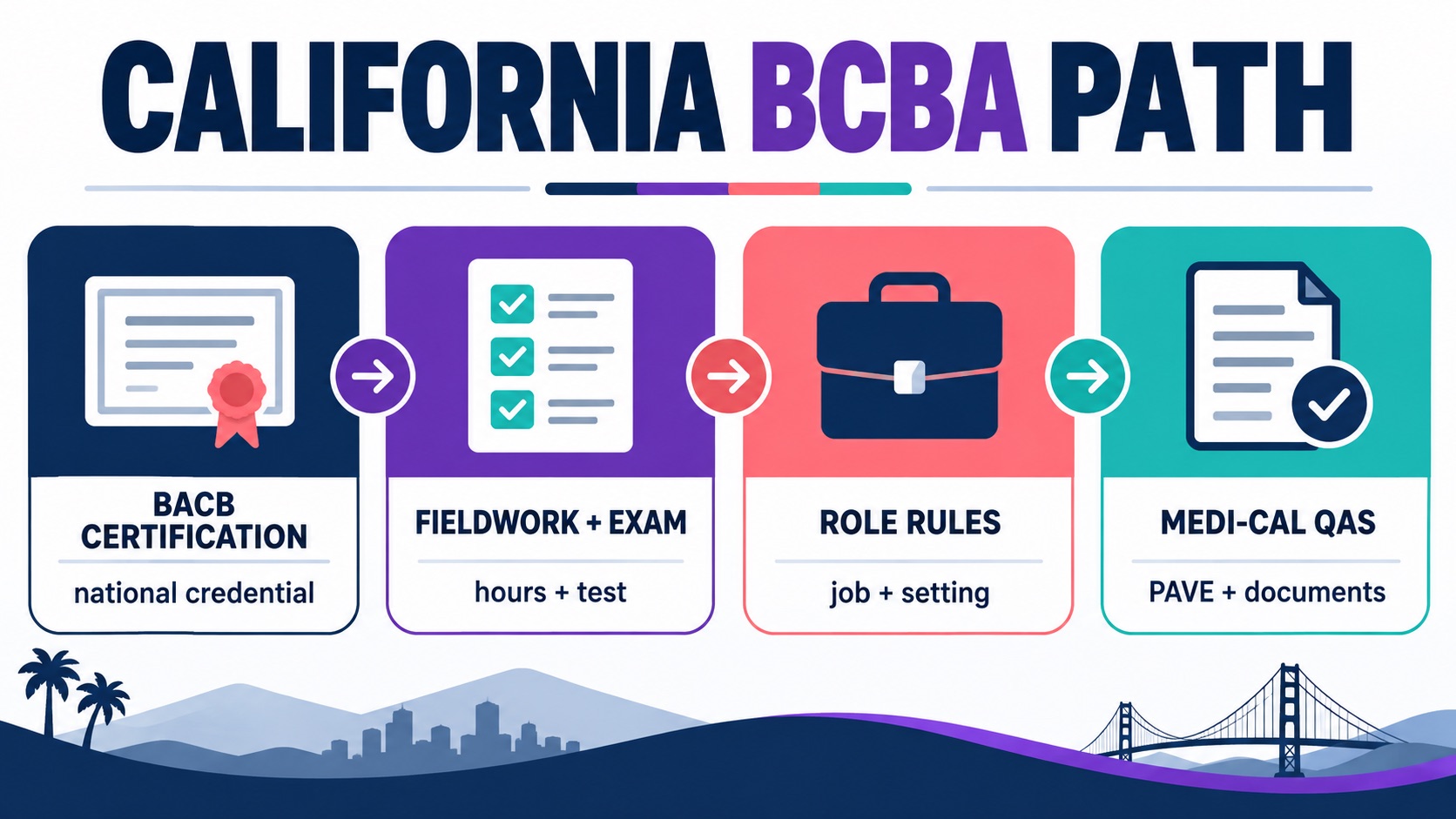
There are four layers to keep separate:
- BCBA certification: a graduate-level national certification administered by the BACB.
- Education and fieldwork: the degree, behavior-analytic coursework or qualifying program, supervised fieldwork, documentation, and application requirements used to become eligible.
- California role requirements: the rules attached to the position, employer, service system, or regulated setting where you will work.
- Payer or program enrollment: an additional process, such as DHCS QAS enrollment for eligible Medi-Cal behavioral health treatment providers.
A BCBA certificate does not automatically enroll you with every California payer, authorize every job function, or replace a requirement imposed by an employer or state program. At the same time, a California program requirement should not be mistaken for a different BACB certification. When comparing schools or job offers, write down which layer each requirement belongs to and which organization is responsible for verifying it.
Which organization controls which requirement?
The fastest way to avoid confusion is to map the question to the right decision-maker. The table below is a planning tool, not a substitute for the current handbook, state instructions, or a payer contract.
| Layer | What it controls | What you should verify |
|---|---|---|
| BACB | BCBA eligibility, examination, certification, ethics, and maintenance | Current BCBA Handbook and official requirements page |
| California agency or program | Role-specific or service-system rules that may apply in California | The current agency instructions for your role and setting |
| DHCS Medi-Cal | Enrollment and billing conditions for covered behavioral health treatment services | QAS application, PAVE instructions, supporting documents, and attestations |
| Employer or payer | Hiring, credentialing, network, supervision, and documentation expectations | The written offer, contract, credentialing checklist, or provider manual |
The BACB describes BCBA certification as a graduate-level credential. BCBAs are independent practitioners who may provide behavior-analytic services and supervise RBTs, BCaBAs, and other professionals who implement behavior-analytic interventions. That description explains the national certification; it does not answer every California employment or billing question.
How do you earn the BCBA credential?
Start with the official BACB BCBA page and the current BCBA Handbook. Your pathway depends on your degree, coursework, program status, fieldwork arrangement, and the date of your application. In broad terms, the process includes:
- Confirming that you hold the type of graduate degree required by the pathway available to you.
- Completing qualifying behavior-analytic coursework or graduating from an applicable accredited or recognized program.
- Arranging supervised fieldwork with a qualified supervisor before counting hours.
- Tracking fieldwork totals, supervision, contacts, observations, individual supervision, unrestricted activities, and forms.
- Submitting the application and required documentation to the BACB.
- Scheduling and passing the BCBA examination after the application process allows you to test.
- Maintaining certification through recertification, continuing education, ethics, and self-reporting requirements.
Do not choose a California graduate program only because its title contains “ABA.” Ask the program which BACB pathway its curriculum supports, who the program contact is, how fieldwork is arranged, and what documentation students receive. A school can be a good academic fit while still requiring you to arrange a separate supervision site.
What is different about working in California?
California questions are often really employment or service-delivery questions. A candidate may be asking, “Can I use the BCBA title?”, “Can I work for this provider?”, “Can I bill Medi-Cal?”, or “Will this employer accept my credential?” Those questions do not all have the same answer. Before accepting a role, ask the employer or program administrator:
- Which credential or license is required for this specific job title?
- Is the role clinical, educational, administrative, supervisory, or payer-facing?
- Does the organization require a current BACB registry status or additional background documentation?
- Will the employer handle payer credentialing, or must the individual complete an enrollment application?
- Which documentation, supervision, and service-location rules apply to the caseload?
Use current California instructions for the exact role rather than relying on a general blog statement such as “California requires” or “California does not require.” Rules can differ by setting and can change independently of BACB certification rules. If the answer affects a contract, billing decision, or legal status, ask the responsible agency or qualified professional for confirmation.
How does California Medi-Cal QAS enrollment fit in?
DHCS states that QAS provider organizations and individuals offering behavioral health treatment services may apply to enroll in the Medi-Cal program through the PAVE online enrollment portal, with supporting documentation. The DHCS page specifically identifies individual BCBAs and educational psychologists as applicants who may use the QAS application, subject to the Medi-Cal enrollment requirements and the applicable State Plan rules. This creates an important distinction:
- BCBA certification answers whether you meet the BACB’s national certification requirements.
- QAS enrollment answers whether an eligible individual or organization is enrolled for the relevant Medi-Cal behavioral health treatment services.
- Service qualifications and supervision determine whether the people providing services meet the program’s reporting and supervision conditions.
DHCS also says that an enrolling QAS individual or organization must attest that individuals providing services are reported to DHCS and meet the qualifications and supervision requirements listed for behavioral health treatment services. Therefore, do not promise a client, employer, or trainee that “having a BCBA” automatically solves Medi-Cal billing. Confirm whether the enrollment is individual or organizational, what documents are required, and who is responsible for the application.
What should candidates know about the 2027 BACB changes?
The BACB’s published 2027 overview says that important BCBA eligibility and maintenance changes take effect January 1, 2027. Beginning in 2027, applicants may use one of two broad pathways: an accredited or recognized program pathway, or a behavior-analytic coursework pathway. The exact handbook requirements still control.
| 2027 planning item | Published overview |
|---|---|
| Degree and coursework | Pathway 1 uses an eligible accredited or recognized program; Pathway 2 uses a qualifying master’s degree plus behavior-analytic coursework. |
| Fieldwork totals | 2,000 hours of Supervised Fieldwork or 1,500 hours of Concentrated Supervised Fieldwork. |
| Monthly range | 20–160 fieldwork hours per supervisory period. |
| Supervision | 5% for Supervised Fieldwork and 7.5% for Concentrated Supervised Fieldwork, with at least 50% of supervised hours individual. |
| Unrestricted activities | At least 60% of total supervised fieldwork hours. |
| Fieldwork forms | Applicants after January 1, 2027, use the published 2027 monthly and final verification forms. |
The published overview also says the BCBA examination is based on the sixth edition of the BCBA Test Content Outline, which took effect January 1, 2025. It lists 315 instructional hours for the 2027 coursework pathway across the required content areas. Those numbers are useful for planning, but candidates should read the full handbook before choosing a program or assuming that a prior course will be accepted.
Which checklist should you follow?
Use this order before you spend money on a program or begin counting fieldwork:
- Write down your target application date and identify the BACB rule version that may control it.
- Choose the eligible education pathway based on your degree and program—not on a school’s marketing language.
- Ask the program or supervisor how your fieldwork will be documented from the first month.
- Confirm supervisor qualifications, contracts, client access, observations, and unrestricted activities.
- Decide whether your intended California job involves employer credentialing, payer enrollment, or both.
- If Medi-Cal is involved, read the current DHCS QAS instructions and identify who submits the PAVE application.
- Keep a source folder containing the handbook version, forms, contracts, transcripts, monthly records, and correspondence.
Common BCBA California mistakes
- Calling BCBA a California-issued certificate: the BCBA is a BACB certification.
- Confusing certification with licensure or enrollment: a payer or employer may require additional verification.
- Using an old 2026 number for a 2027 plan: the headline totals may look familiar while the monthly details change.
- Counting fieldwork before the arrangement is ready: a job title alone does not create qualifying supervised fieldwork.
- Choosing a school without checking its pathway: “online” or “California-based” does not automatically mean BACB eligibility.
- Assuming DHCS enrollment is automatic: QAS enrollment has its own application, documentation, and attestation process.
How should you study for the BCBA exam?
Study the official rules as decision rules, not as isolated numbers. Make a comparison sheet for education pathway, fieldwork total, monthly range, supervision percentage, observations, unrestricted activities, forms, and application date. Then practice questions that ask you to identify which organization controls the answer. That method is especially useful for California questions because the stem may combine BACB certification with employer or payer facts.
After reviewing the source documents, use the free BCBA mock exam to practice under time pressure. When you miss a question, label the error as a certification-pathway error, fieldwork error, 2027-transition error, California-program error, or terminology error. The practice exam is educational support; it is not BACB approval, legal advice, licensure advice, or a guarantee of a passing score.
BCBA credential California FAQ
Is the BCBA credential issued by California?: No. BCBA is a national graduate-level certification administered by the BACB. California employers, agencies, and payers may add requirements for particular roles or services. Can a BCBA work in California after passing the exam?: Passing the exam is one part of obtaining BACB certification. Whether you can perform a particular job or bill a particular program depends on the role, employer, payer, and current California requirements. Verify those conditions before beginning services.
Does a California BCBA automatically qualify for Medi-Cal?: No automatic assumption is safe. DHCS identifies individual BCBAs as potential QAS applicants, but enrollment involves an application, supporting documents, and attestations. Review the current DHCS instructions and confirm whether the individual or organization is responsible.
Should I follow current or 2027 BCBA requirements?: That depends on the rules and transition guidance applicable to your application date. The BACB’s published 2027 overview takes effect January 1, 2027. Do not mix current and 2027 monthly requirements without confirming which version controls your application.
The safest way to interpret BCBA credential California is to separate the national BACB certification from California role and payer requirements. Start with the current official handbook, document fieldwork carefully, verify the California setting you intend to enter, and use the official DHCS instructions when Medi-Cal is involved. That approach gives you a clearer education decision and prevents a certificate, a job requirement, and an enrollment status from being treated as if they were the same thing.
Take the Free BCBA Mock Exam
When you are ready to apply the idea, use the free practice resource below for additional feedback. Take the Free BCBA Mock Exam



