
Short answer: A phonemic prompt ABA example is a brief vocal cue that gives part of a target word or phrase, such as its first sound or syllable, to help evoke a vocal response. It is less complete than saying the entire answer. For example, if a learner is being taught to request water and does not respond, a practitioner might provide “/w/” or “wa—” rather than model the whole word “water.” The learner’s response is then measured as independent or prompted, and the cue is faded when the learner can respond without it.
Table of Contents
- What is a phonemic prompt in ABA?
- Why use a phonemic prompt?
- How is a phonemic prompt different from other prompts?
- Worked ABA example: requesting water
- How to record prompted and independent responding
- How prompt fading fits the teaching plan
- Common BCBA exam traps
- Quick review and practice question
- Phonemic prompt ABA FAQ
- Take the Free BCBA Mock Exam
The important BCBA exam distinction is that the phonemic prompt is a response prompt. It is not the same thing as the discriminative stimulus, motivating operation, reinforcer, or target response. A prompt changes the support delivered after an opportunity is presented; it does not automatically explain why the behavior occurs. Current applied research describes partial echoic or phonemic prompts as one way to fade a full vocal model while building a mand repertoire, but the exact procedure still depends on the learner, target, data, and supervision context. Table of Contents
What is a phonemic prompt in ABA?
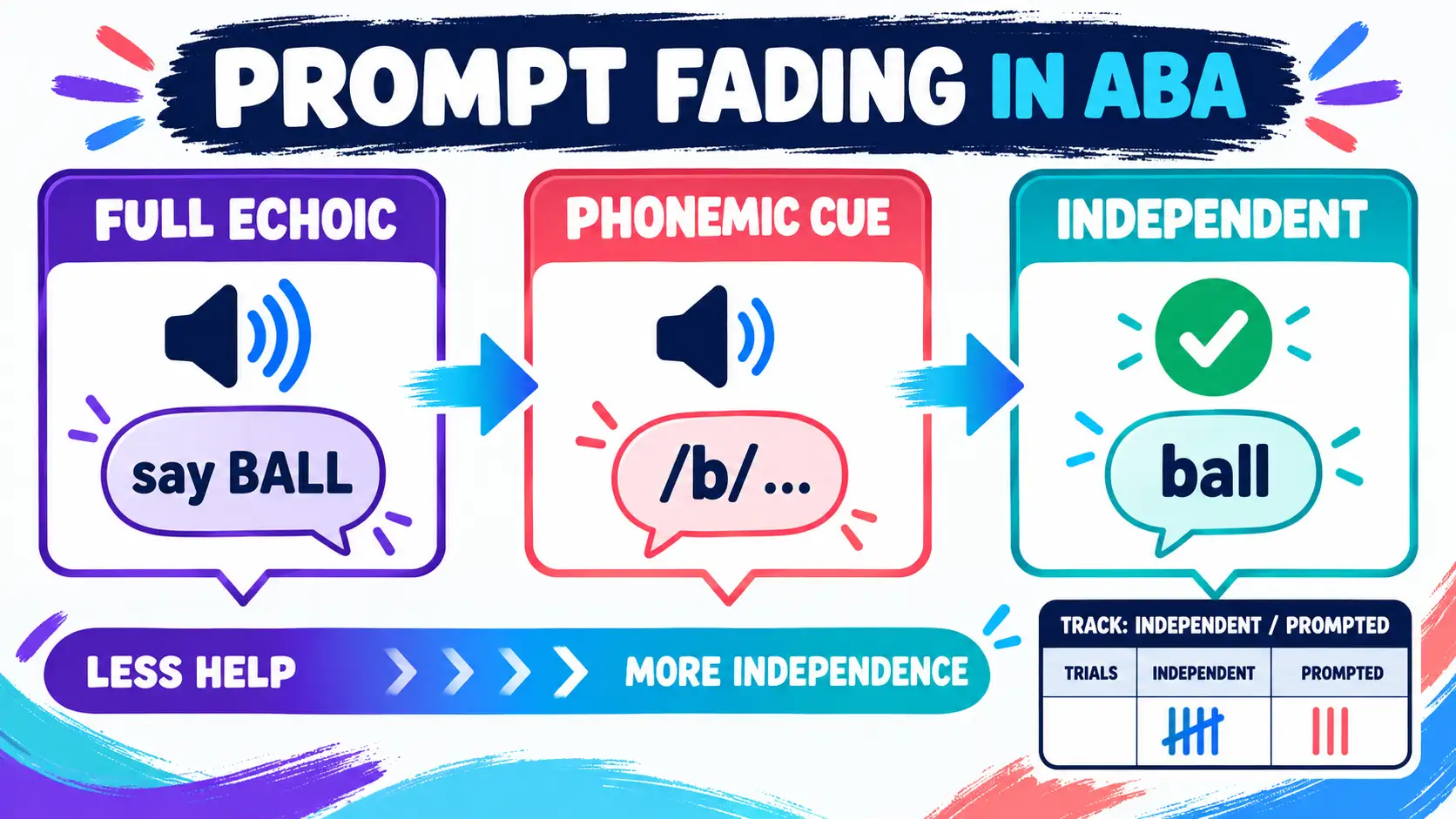
A phonemic prompt is a partial vocal or echoic prompt that supplies a small part of a spoken target, often an initial phoneme, sound, or syllable. The cue is intended to evoke the learner’s response without providing the complete answer. In a mand lesson, an adult might hold up a preferred item, wait for an attempt, and then provide the first sound of the item’s name. In an intraverbal lesson, the adult might give the first sound of a response after asking a question.
“Phonemic” describes the form of the cue, not a guarantee that the learner will respond independently. If the adult says “/b/” and the learner says “ball,” the response followed a phonemic prompt. If the adult says “ball” and the learner repeats it, the response followed a full echoic model. Both may be vocal prompts, but they provide different amounts of response information.
What the label tells you—and what it does not: The label identifies a prompt dimension: how much of the vocal response was supplied. It does not tell you whether the teaching arrangement was effective, whether the learner has mastered the target, or whether the prompt should be used forever. Those conclusions require a defined response, a consistent opportunity, and data that separate independent from prompted performance.
- Prompt form: a sound, phoneme, or partial syllable is supplied.
- Target: the learner is expected to emit a defined vocal response.
- Opportunity: an instruction, question, or motivating context precedes the response opportunity.
- Measurement: record whether the response occurred independently, after the prompt, or not at all.
Why use a phonemic prompt?
The practical reason is to reduce the amount of help while preserving a useful chance to respond. A full vocal model can make a response possible, but it may also give the learner the entire answer. A phonemic prompt can provide just enough support to start the word while leaving more of the response for the learner. Research on mand training has described a progression from a full echoic prompt to a partial echoic or phonemic prompt as one possible fading arrangement.
That does not make a phonemic prompt automatically “better.” A learner may need a full model, a visual cue, a gesture, a sign, an AAC response, or no prompt at all. The correct teaching decision depends on the operational definition, communication mode, response effort, error pattern, and current data. The BCBA exam is more likely to reward identifying the controlling variable and measurement plan than repeating a fixed prompt hierarchy.
| Question | Useful reasoning |
|---|---|
| Is the target vocal? | A phonemic prompt supplies a sound-based cue, so first confirm that the defined response is vocal or otherwise sound-based. |
| Is a full model more help than needed? | A partial cue may reduce response information, but only data can show whether it supports responding. |
| Can independence be measured? | Define the prompt level and response interval before interpreting improvement. |
| Is the prompt being faded? | The teaching goal is useful, independent communication—not a permanent dependence on the first sound. |
How is a phonemic prompt different from other prompts?
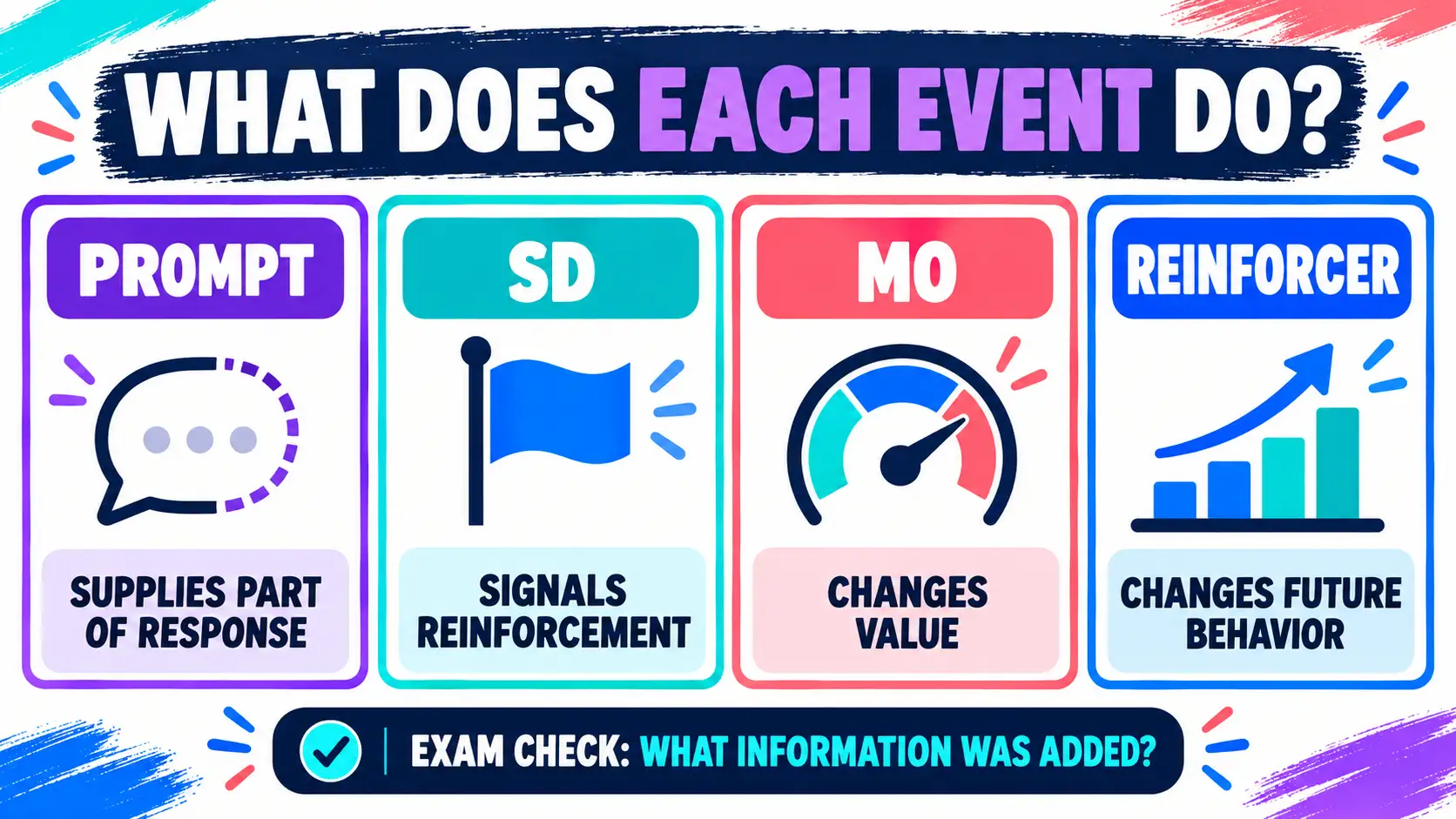
Several answer choices may sound plausible in a BCBA scenario. The fastest way to separate them is to ask what information the adult supplied and what role that event played in the contingency. A phonemic prompt supplies part of a response. An SD signals that a particular response is likely to contact reinforcement. An MO changes the value of a consequence and momentarily changes behavior. A reinforcer follows behavior and changes its future probability.
| Event | What it does | Question to ask |
|---|---|---|
| Phonemic prompt | Supplies part of a vocal response to evoke the target. | What part of the answer was given? |
| SD | Signals that reinforcement is available for a response. | What cue signals the response–reinforcer relation? |
| MO | Changes the value of a consequence and the momentary likelihood of related behavior. | What changed the value of the consequence? |
| Reinforcer | Follows a response and increases its future probability when the effect is demonstrated. | What consequence changed future responding? |
A prompt can occur near an SD, but proximity does not make the prompt an SD. For example, the adult may present a picture of a drink as the opportunity, wait, and then say “w—” as a phonemic prompt. The picture, the motivating context, the partial sound, the learner’s vocal response, and the later access to the drink are different events. Keep them separate when identifying the contingency.
Worked ABA example: requesting water
Imagine a learner who can say “water” in some contexts but does not consistently request it when the drink is visible. The instructional goal is defined as an audible approximation or spoken word within five seconds of the arranged opportunity. The practitioner presents the opportunity, waits according to the teaching plan, and records the learner’s first response. If no response occurs, the practitioner provides the planned prompt, such as the initial /w/ sound, and records what happens next.
- Opportunity: the drink is available in a context where requesting is relevant.
- Wait: the practitioner allows the defined response interval before prompting.
- Phonemic cue: the practitioner gives the initial sound or partial syllable, not the full word.
- Response: the learner says an approximation or the complete word.
- Consequence: the programmed or naturally relevant consequence follows according to the plan.
- Data: the trial is coded as independent, phonemically prompted, fully modeled, incorrect, or no response—as defined in advance.
If the learner only responds after “w—,” that is not the same as independent mastery. If the learner begins saying “water” before any sound is supplied, the trial is different. The practitioner should not combine those outcomes into one percentage if the purpose is to evaluate independence. The prompt level, delay, approximation criteria, and reinforcement arrangement must be described clearly enough that another trained observer could score the trial.
How to record prompted and independent responding
Prompt data answer a measurement question: did the learner emit the target response under the intended antecedent conditions, or only after extra help? A useful data system makes that distinction visible. It can also show whether a learner is moving from a full model to a partial cue, from a partial cue to an approximation, and from an approximation to an independent response.
- Define the target response in observable terms, including acceptable approximations.
- Define the response interval and when the prompt may be delivered.
- Record the lowest prompt level that produced the response.
- Separate independent trials from prompted trials in the summary.
- Graph prompt dependence and independent responding separately when that distinction matters.
- Review errors and nonresponses before changing the prompt.
For BCBA exam questions, look for the measurement detail that the stem gives you. “Correct” may mean prompted or independent depending on the question. A learner who says the word after a partial sound has demonstrated a prompted response, not necessarily stimulus control by the natural communication opportunity. The correct interpretation depends on the stated mastery criterion.
How prompt fading fits the teaching plan
Prompt fading is the planned reduction of assistance so the intended antecedent, rather than the prompt, controls the response. A phonemic prompt may be one intermediate step in a fading sequence, but it is not a universal final step. The prompt might be shortened, delayed, delivered less often, or replaced with another support based on the data and the learner’s response pattern.
Keep the goal concrete: a learner should access a useful communication response under relevant conditions with as little unnecessary support as possible. If the learner waits for the first sound every time, the prompt may have become part of the controlling arrangement. That does not mean the prompt was “wrong”; it means the data should guide the next fading decision. Review the broader prompt fading in ABA guide for the larger transfer-of-control concept.
Common BCBA exam traps
Phonemic prompt questions are often difficult because the stem includes several events that happen close together. Use these checks before choosing an answer:
- Do not label a full model as phonemic. Saying the entire target word is an echoic or verbal model, not a partial sound cue.
- Do not call the cue the SD. The partial sound helps evoke the response; it is not automatically the stimulus that signals reinforcement availability.
- Do not confuse an approximation with independence. The response form and prompt level must be read together.
- Do not assume one hierarchy fits every learner. The question may be testing individualized, data-based decision-making.
- Do not measure prompted success as mastery by default. Look for the stated criterion and the condition under which the response occurred.
- Do not confuse phonemic prompting with phonemic-awareness instruction. A phonemic prompt is a cue in a response-teaching arrangement; phonemic awareness is a broader language or literacy construct.
Quick review and practice question
Quick rule: if the adult supplies only part of a spoken target to evoke the rest of the vocal response, think phonemic prompt. Then ask whether the response was independent, what consequence followed, and whether the prompt is being faded. Mini question: During a mand opportunity, a learner does not respond. The practitioner says “/b/,” and the learner says “ball.” Which description is most precise?
- The /b/ sound was a reinforcer.
- The /b/ sound was a phonemic response prompt.
- The /b/ sound was the motivating operation.
- The learner’s prompted “ball” proves independent mastery.
Answer: 2. The initial sound supplied part of the vocal response, so it functioned as a phonemic prompt in that trial. The answer does not by itself tell you whether the mand will occur independently later; that requires additional data under the defined teaching conditions. For more scenario-based review, use the prompting response ABA guide and then try the free BCBA mock exam. It is a study resource and does not claim to reproduce official BACB questions.
Phonemic prompt ABA FAQ
Is a phonemic prompt the same as an echoic prompt? Not exactly. A phonemic prompt is usually a partial vocal or echoic cue, while an echoic prompt may provide a full vocal model for the learner to repeat. Read the amount of response information supplied in the scenario.
Can a phonemic prompt be used for a mand? It can be described in mand-training research as one possible partial vocal prompt. Whether it is appropriate for a particular learner depends on the communication goal, response form, data, and individualized teaching plan.
Should the first sound always be used? No. The exact prompt and fading plan should not be treated as a universal rule. A different prompt or communication mode may be more appropriate, and the planned procedure should be supervised and evaluated with data.
How do I know whether a response is independent? Define what counts as independent before the trial begins, including the response interval and any prompt that disqualifies independence. Then record prompted and unprompted performance separately.
Why does this matter on the BCBA exam? The concept tests whether you can distinguish a response prompt from other parts of an ABA contingency and interpret prompt-dependent versus independent responding. Focus on what event supplied information, what event changed value, what consequence followed, and what the data demonstrate.
Source note: The article uses peer-reviewed ABA research on partial echoic prompts and the current BACB test-content outline as reference points. Sources explain concepts and scope; they do not replace individualized supervision or the current official BACB handbook.
Take the Free BCBA Mock Exam
When you are ready to apply the idea, use the free practice resource below for additional feedback. Take the Free BCBA Mock Exam



