
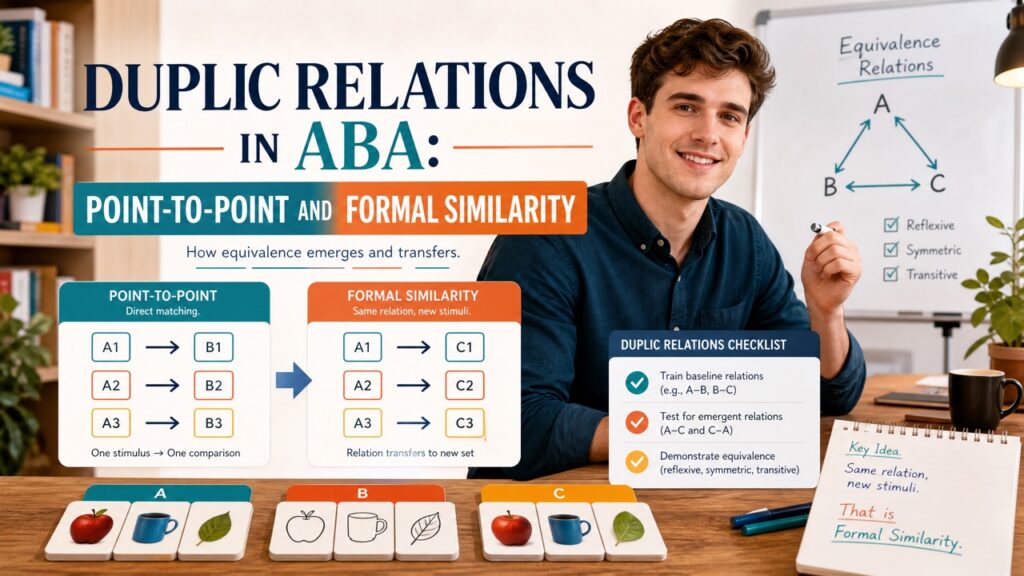
In applied behavior analysis, the term duplic aba refers to a specific class of verbal relations in which a response duplicates its controlling antecedent stimulus. This guide explains the two defining properties of duplic relations—point-to-point correspondence and formal similarity—and shows how to distinguish them from codic relations and other verbal operants. You will also find original examples, a practical identification rule, and a free mock exam to test your understanding. Table of Contents
Table of Contents
- What Is a Duplic Relation in ABA?
- Point-to-Point Correspondence
- Formal Similarity
- Duplic vs. Codic Relations
- Duplic vs. Other Verbal Operants
- Echoic and Copying Text as Duplic Relations
- Practical Examples and Identification Rule
- Why This Matters for Practice
- Test Your Knowledge
- References
What Is a Duplic Relation in ABA?
A duplic relation is a verbal stimulus-response relation in which the response has both point-to-point correspondence and formal similarity with the antecedent verbal stimulus. In other words, the response is a copy of the stimulus in form and in the way its parts align. This definition is functional: it is based on the controlling variables and the properties of the response product, not on surface resemblance alone. For example, repeating a spoken word can exemplify an echoic duplic when the spoken word is the controlling antecedent and the response matches it in sound and structure.
Duplic relations are part of B.F. Skinner’s analysis of verbal behavior, which classifies language by function rather than by form. The BACB’s BCBA Test Content Outline includes verbal behavior concepts, and understanding duplic relations is essential for analyzing language and designing interventions. However, the outline does not specify that duplic relations are guaranteed or frequently tested; rather, it lists verbal behavior as a content area. Therefore, this guide focuses on conceptual accuracy and practical application.
Point-to-Point Correspondence
Point-to-point correspondence means that the response can be divided into parts, and each part corresponds to a specific part of the antecedent stimulus. For example, when a learner hears the spoken word “cat” and says “cat,” the response contains the same phonemes in the same order. If the learner said “cap,” the final sound would not correspond, violating point-to-point correspondence. This property is not about exact physical equality but about a formal unit-by-unit match.
Point-to-point correspondence alone is not sufficient for a duplic relation. For instance, when a learner sees the printed word “cat” and says “cat,” there is point-to-point correspondence between the visual letters and the spoken sounds, but the response is not duplic because it lacks formal similarity. This example is a codic relation, specifically textual responding. Similarly, when a learner hears “cat” and writes “cat,” there is point-to-point correspondence between the spoken word and the written letters, but again no formal similarity; this is taking dictation, another codic relation.
Formal Similarity
Formal similarity requires that the stimulus and the response product share the same sense mode and physically resemble each other. For an echoic, both the stimulus and the response are auditory-vocal: the spoken word sounds like the response. For copying text, the stimulus is visual text and the response is written text; they share the visual mode and physically resemble each other in letter shapes. Thus, copying text can be a duplic relation when the controlling relations are present, even though it is often discussed as a codic relation in some contexts. The key is to check both properties.
Formal similarity is what distinguishes duplic from codic relations. Codic relations have point-to-point correspondence but not formal similarity. For example, textual responding (reading a printed word aloud) has point-to-point correspondence between the visual letters and the spoken sounds, but the stimulus is visual and the response is auditory, so they do not share the same sense mode. Taking dictation (hearing a word and writing it) also has point-to-point correspondence but the stimulus is auditory and the response is visual-motor, so formal similarity is absent. In contrast, an echoic has both properties because the stimulus and response are both auditory-vocal.
Duplic vs. Codic Relations
Understanding the difference between duplic and codic relations is crucial for accurate classification. Both have point-to-point correspondence, but only duplic relations have formal similarity. Here are some examples to illustrate:
- Echoic (duplic): Hearing “dog” and saying “dog” – both auditory-vocal, formal similarity, point-to-point.
- Copying text (duplic): Seeing “dog” and writing “dog” – both visual, formal similarity, point-to-point.
- Textual responding (codic): Seeing “dog” and saying “dog” – point-to-point but no formal similarity (visual vs. auditory).
- Taking dictation (codic): Hearing “dog” and writing “dog” – point-to-point but no formal similarity (auditory vs. visual-motor).
This distinction matters in practice. If you misclassify a codic relation as duplic, you may select an inappropriate teaching procedure. For example, teaching textual responding as if it were an echoic would not address the different stimulus control. Always verify both properties before labeling a relation.
Duplic vs. Other Verbal Operants
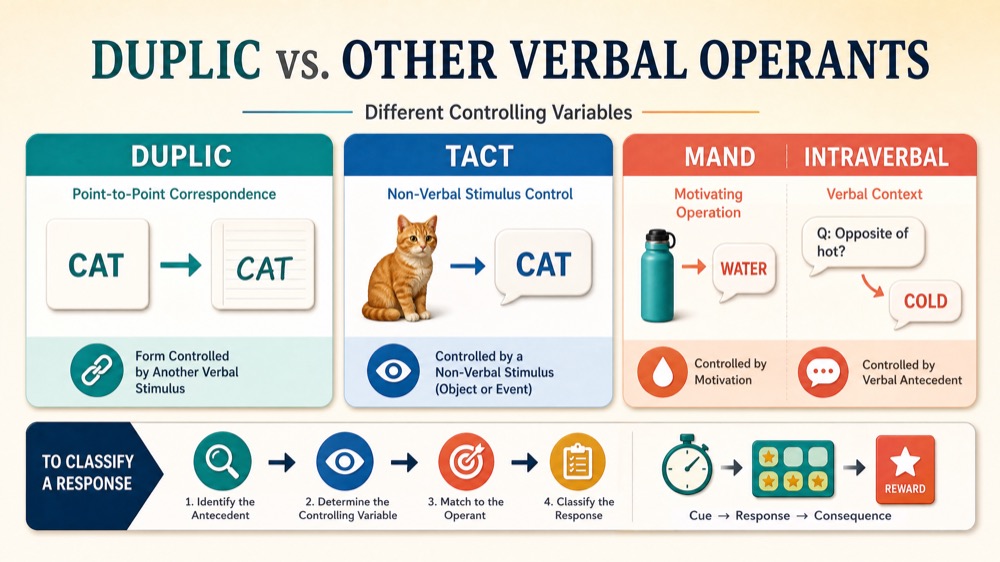
Duplic relations are often confused with tacts, mands, and intraverbals, but the controlling variables are different. A tact is controlled by a non-verbal stimulus, such as an object or event, and does not have point-to-point correspondence or formal similarity with that stimulus. For example, seeing a dog and saying “dog” is a tact, not a duplic, because the visual stimulus does not formally resemble the vocal response. A mand is controlled by a motivating operation, such as when deprivation increases the value of a cookie and the response produces access to it; saying “cookie” is a mand, not a duplic, because the response does not duplicate the motivating operation. An intraverbal is controlled by a verbal stimulus but lacks point-to-point correspondence and formal similarity; for example, answering “What says meow?” with “cat” is an intraverbal because the response does not match the question in form.
To classify a response, identify the antecedent and check whether it is a verbal stimulus and whether the response has both properties. Do not guess from the response form alone. For instance, a child saying “ball” could be an echoic, tact, mand, or intraverbal depending on the context. Only when the antecedent is a verbal stimulus and the response duplicates it in form and point-to-point correspondence is it a duplic.
Echoic and Copying Text as Duplic Relations
Echoic is the most commonly discussed duplic relation. In an echoic, the antecedent is a spoken word, and the response is a vocal imitation of that word. For example, a therapist says “ball” and the learner says “ball.” This is a duplic because the response has point-to-point correspondence and formal similarity with the spoken stimulus. Echoics are foundational for language development and are often taught early in intervention programs.
Copying text can also be a duplic relation when the controlling relations are present. For example, a learner sees the written word “ball” and writes “ball.” The stimulus and response are both visual, and the response physically resembles the stimulus, so formal similarity is present. However, copying text is sometimes classified as a codic relation in the literature because it involves a visual stimulus and a motor response. The distinction depends on whether you consider the response product (the written word) to share the same sense mode as the stimulus. In this guide, we follow the definition that requires both point-to-point correspondence and formal similarity, so copying text can be duplic if the response product is visual and resembles the stimulus.
It is important to note that ordinary motor imitation is not automatically a duplic. For example, if a therapist claps their hands and the learner claps their hands, this is motor imitation, but it is not a verbal duplic because the antecedent is not a verbal stimulus. Duplic relations are specifically verbal relations, meaning the antecedent must be a verbal stimulus (e.g., a spoken word, a written word, or a sign). Motor imitation may share formal similarity and point-to-point correspondence, but it is not a duplic unless it is under the control of a verbal stimulus.
Practical Examples and Identification Rule
Here are some original examples to help you apply the concepts:
- Echoic: A teacher says “apple” and the student says “apple.” This is a duplic because the response matches the spoken stimulus in form and point-to-point.
- Copying text: A student sees the word “apple” on a card and writes “apple” on paper. This is a duplic if the response product is visual and resembles the stimulus.
- Textual responding: A student sees the word “apple” and says “apple.” This is a codic because the stimulus is visual and the response is auditory, lacking formal similarity.
- Taking dictation: A teacher says “apple” and the student writes “apple.” This is a codic because the stimulus is auditory and the response is visual-motor, lacking formal similarity.
- Tact: A student sees an apple and says “apple.” This is a tact because the antecedent is a non-verbal stimulus, not a verbal one.
- Mand: A student says “apple” when apple deprivation increases the value of apple and the response produces access to it. This is a mand because it is controlled by a motivating operation, not by a verbal stimulus.
- Intraverbal: A teacher asks “What fruit is red?” and the student says “apple.” This is an intraverbal because the response does not duplicate the question.
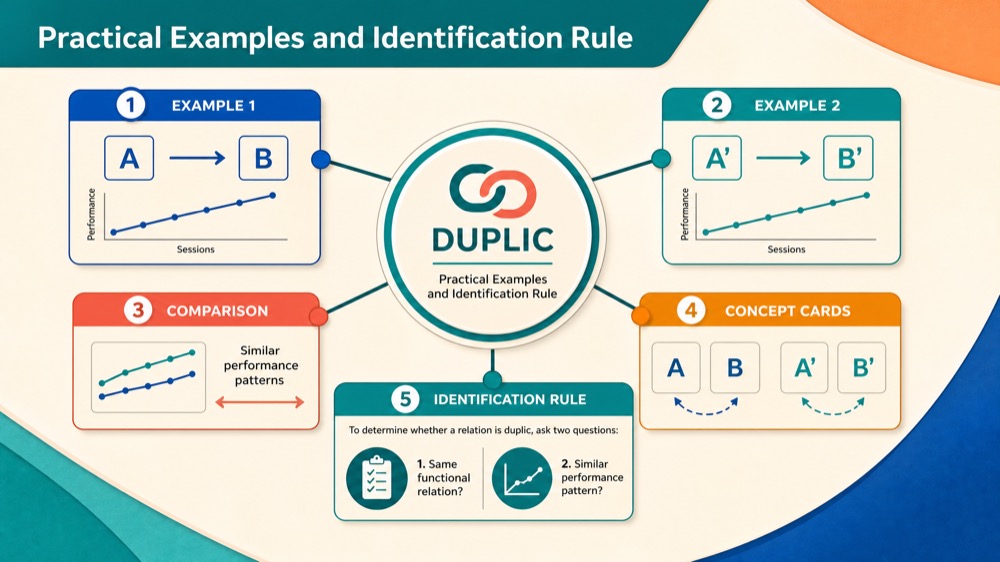
To determine whether a relation is duplic, ask two questions:
- Is there point-to-point correspondence between the stimulus and the response?
- Is there formal similarity between the stimulus and the response product?
If both answers are yes, the relation is duplic. If only the first is yes, it is codic. If neither is yes, it is likely a tact, mand, or intraverbal.
Why This Matters for Practice
Accurate classification of verbal operants is essential for designing effective interventions. For example, if a learner has difficulty with echoics, you might focus on teaching imitation of vocal sounds. If a learner can echo but cannot tact, you might transfer stimulus control from the echoic to the object. Understanding duplic relations helps you select appropriate teaching procedures and measure progress. For more on related concepts, see our guides on stimulus control in ABA and stimulus generalization in ABA. These topics are closely related to how duplic relations are acquired and maintained.
Test Your Knowledge
Now that you have a clear framework, practice applying it with our free BCBA mock exam. The mock exam provides practice questions and feedback to help you solidify your understanding of verbal behavior and other ABA concepts. It does not guarantee that this exact topic will appear, but it is a valuable tool for self-assessment.
Remember, duplic relations are defined by both point-to-point correspondence and formal similarity. Use the two-question rule to classify any verbal relation accurately. With practice, you will be able to identify duplic relations quickly and correctly.
References
Next step for BCBA exam prep
Turn this topic into exam-day practice
Use this topic as a focused review, then test it in exam-style conditions with a free mock before deciding whether five full-length mocks are the right next step.
Start the Free BCBA Mock Exam
Continue with Five Full-Length Mocks — $99
Review the included materials and access details before ordering. No pass guarantee is implied.



