
ABA goals for adults should describe meaningful skills that an adult wants or needs to use in daily life, not simply list behaviors that make other people more comfortable. A strong goal connects a person-centered priority to an observable response, a realistic condition, a measurement system, and a criterion for progress. The goal may address communication, independent living, work, community participation, safety, or self-advocacy.
Table of Contents
- What ABA Goals for Adults Are Designed to Do
- Common Goal Areas for Adults
- How to Write an Observable, Measurable Goal
- Person-Centered Assessment and Choice
- How to Measure Adult ABA Goals
- Prompt Fading, Maintenance, and Generalization
- How the Topic Appears on BCBA-Style Questions
- Common Mistakes
- FAQ
- Quick Review Checklist
- Take the Free BCBA Mock Exam
Adult ABA goals are individualized. Age alone does not determine what belongs in a program, and a diagnosis does not tell a team which goals are important. The adult’s preferences, communication method, support needs, culture, environment, and informed choices should shape the assessment and teaching plan. This article explains how to think about adult goals in an ABA or BCBA exam context; it is educational information, not a treatment recommendation. Table of Contents
What ABA Goals for Adults Are Designed to Do
An adult ABA goal translates a meaningful life priority into a skill that can be taught and evaluated. “Be more independent” is a valuable direction, but it is not yet a behavior-analytic goal. A usable goal identifies what the person will do, when or where the response should occur, and how the team will know whether progress is occurring.
For example, an adult may identify preparing a simple lunch as a priority. A goal could describe completing a visual sequence, gathering the needed items, using a safe appliance routine, and requesting assistance when a step is unclear. The goal should reflect the person’s preferred foods, motor access, communication system, living arrangement, and desired level of support. The point is not to force one “normal” routine; it is to increase access, choice, participation, or safety in a way that matters to the person.
The BACB BCBA Test Content Outline links this reasoning to several examinable skills: developing intervention goals in observable and measurable terms, recommending interventions that fit assessment results and client preferences, selecting socially valid alternative behavior, evaluating effectiveness, and collaborating with others. Adult-goal questions therefore test decision-making, not just the ability to memorize examples.
Common Goal Areas for Adults
The following areas are common starting points, not a checklist that every adult should receive. A BCBA should prioritize the goals supported by assessment, the adult’s input, and the context in which the skill will be used.
| Goal area | Possible skill | What makes it meaningful |
|---|---|---|
| Communication | Request help, decline, ask for clarification, or share a preference using the person’s chosen communication method. | More control over routines, relationships, services, and decisions. |
| Daily living | Complete a personal-care, meal-preparation, cleaning, or scheduling routine. | Greater access to preferred activities and less reliance on unnecessary prompts. |
| Work and community | Follow a work routine, navigate a familiar route, or use a community resource. | Participation, employment, learning, and independent access to the community. |
| Self-advocacy and safety | State a boundary, report a concern, identify a safety signal, or request a support. | More choice, dignity, safety, and ability to influence what happens next. |
Some goals may involve reducing a behavior that creates serious risk or blocks participation. When that happens, the plan should also teach a socially valid replacement response. “Reduce refusal” is incomplete by itself; the team should define what the adult can do instead, such as requesting a break, negotiating a change, or communicating “not now.”
How to Write an Observable, Measurable Goal
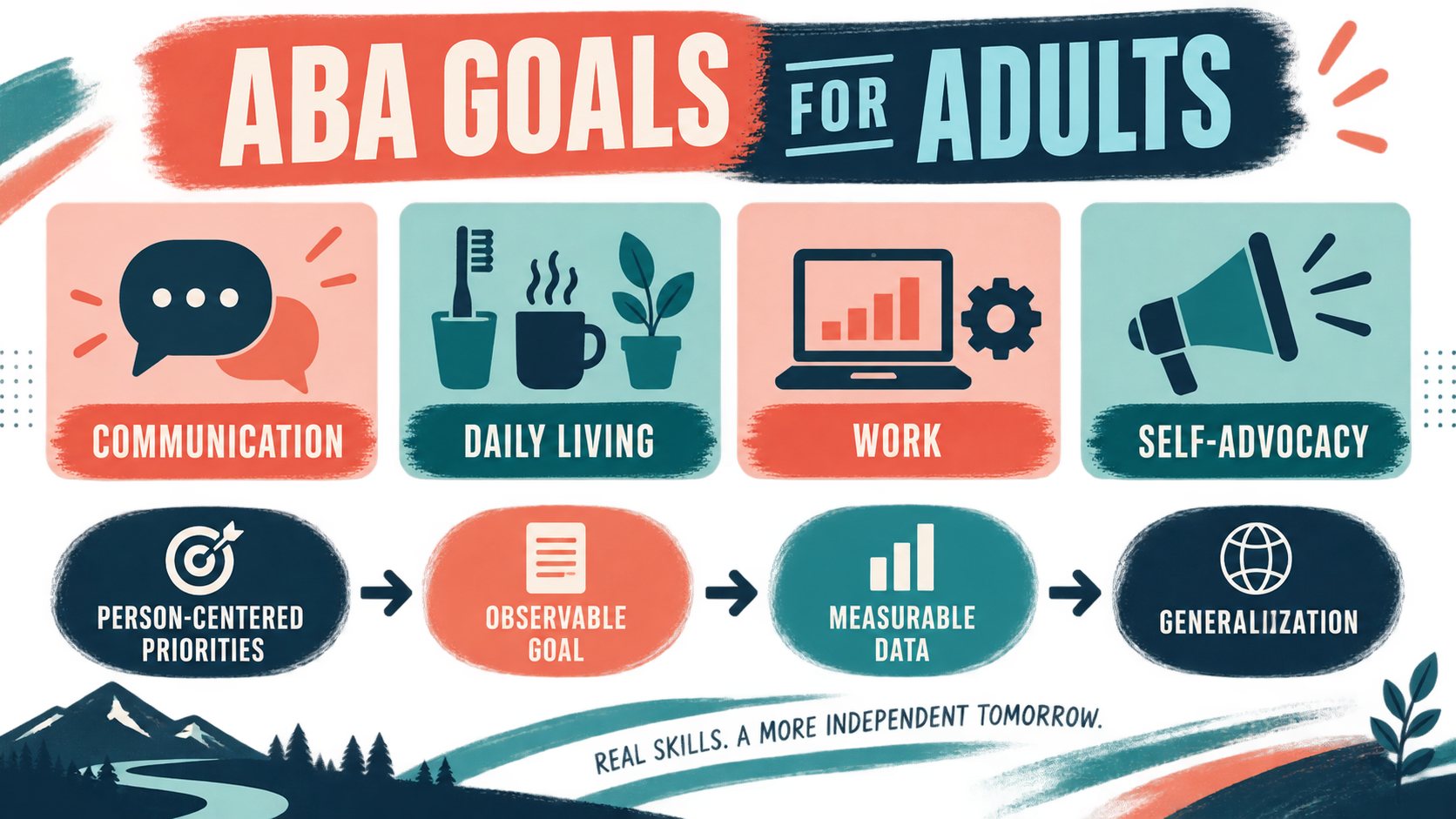
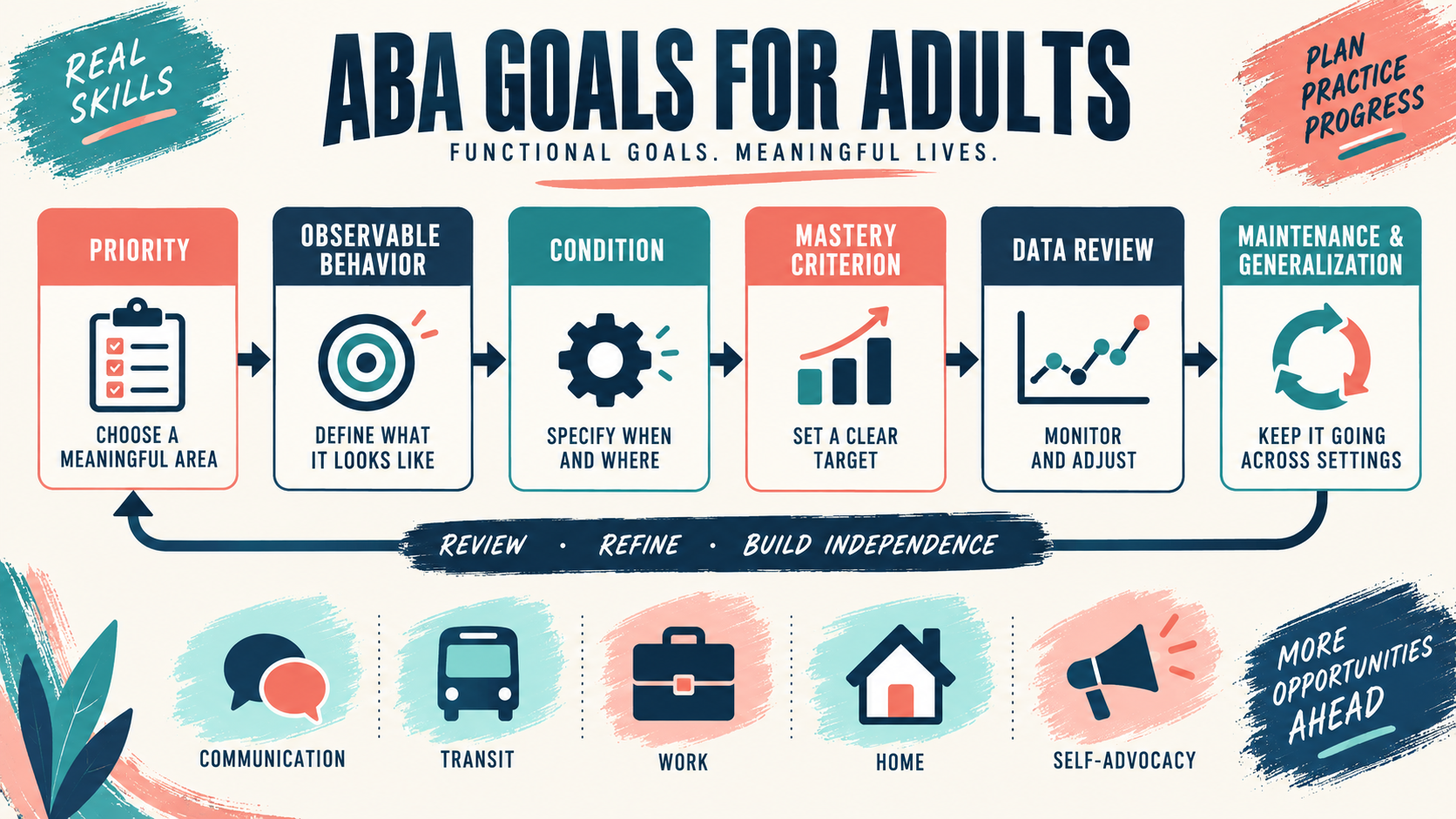
A practical goal-writing sequence is: identify the priority, define the observable response, specify the condition, choose the measurement, and set a mastery criterion. The condition should be realistic enough to resemble the environment in which the skill matters. The criterion should be challenging but not arbitrary. Compare these examples:
- Vague: “The adult will improve communication and be more independent.”
- More precise: “When a planned task becomes unclear, the adult will use speech, AAC, text, gesture, or another selected response to request clarification within two minutes, in at least four of five opportunities across three sessions.”
The second version still needs individualization. The team must confirm that the response is accessible, that “unclear” can be operationalized, and that the opportunity count is feasible. If the person prefers text or a device, requiring speech would measure compliance with a communication preference rather than the target skill.
| Part | Question to ask | Example |
|---|---|---|
| Priority | What outcome matters to the adult? | Using public transportation to reach a preferred activity. |
| Behavior | What will an observer see or hear? | Check the route, board the selected bus, and signal for the planned stop. |
| Condition | When, where, and with what supports? | On the familiar route, with the agreed visual or digital support available. |
| Criterion | What level counts as progress or mastery? | Complete the sequence with no more than one agreed prompt in four of five trips. |
Write the goal so another trained observer could recognize the response and score it consistently. Avoid goals that merely describe an internal state, such as “feel confident,” unless the team has identified an observable, person-approved way to assess the related skill or choice.
Person-Centered Assessment and Choice
Good adult ABA goals start before the goal statement. Assessment should identify strengths, barriers, preferences, communication access, routines, and the environments in which the skill will be useful. Ask the adult what they want to change, what support feels acceptable, and how they want success represented. A caregiver, employer, support person, or other professional may add important information, but their priorities should not silently replace the adult’s voice.
The BHCOE standards emphasize individualized recommendations, meaningful input in goal selection, data collection, treatment fidelity, maintenance, and generalization. Those principles help prevent an adult program from becoming a collection of convenience goals. A goal can be clinically measurable and still be a poor choice if it has little social validity or ignores the person’s preferences.
Context matters too. A goal that is practical in a clinic may not transfer to a noisy workplace, a shared apartment, or a changing community route. Examine response effort, sensory conditions, available supports, cultural expectations, and the skills of the people who will implement the plan. The final goal should fit the real setting rather than requiring the adult to perform in an artificial environment.
How to Measure Adult ABA Goals
Choose a measurement system that captures the important dimension of the skill without creating unnecessary burden. Frequency may fit a request or safety response; percentage of opportunities may fit a teaching sequence; duration may fit sustained work or participation; latency may fit starting a routine; and task analysis data may show which step requires support.
Record a baseline before interpreting change. Then review level, trend, variability, prompting, and the context of each observation. A higher percentage does not automatically mean a better outcome if opportunities were easier, the adult had more support, or the measure ignored choice and quality. A useful review asks whether the skill is happening with the right people, materials, locations, and naturally available reinforcement.
For example, if an adult is learning to request a break, record the communication response, the task context, the prompt level, and whether the break was honored according to the plan. If the adult only requests when a therapist is present, the team has not yet shown generalization. If the adult stops using the response when a support person changes, the next decision may be to adjust the teaching arrangement rather than declare the goal failed.
Prompt Fading, Maintenance, and Generalization
Adult goals should include a plan for reducing unnecessary prompts and contacting reinforcement that can occur in everyday life. Prompt fading is not a race to zero support. The goal is the least intrusive support that allows the adult to access the skill, make choices, and participate safely. Some people will appropriately continue to use a visual schedule, device, checklist, or other accommodation.
Maintenance asks whether the response continues over time. Generalization asks whether it occurs with different people, materials, settings, or examples. A goal for preparing a meal in a teaching kitchen may need to be sampled in the person’s own kitchen. A communication response practiced with one therapist may need to be supported with a coworker, family member, or service coordinator when appropriate and consented.
Plan for changes in the environment and for relapse or skill loss. The BCBA TCO specifically includes procedures to promote generalization and maintain behavior change, as well as decisions about intervention effectiveness and modification. That is why a final mastery percentage without context is an incomplete answer on an exam and an incomplete description of progress in practice.
How the Topic Appears on BCBA-Style Questions
BCBA-style questions may present an adult who wants a practical outcome, a caregiver who suggests a different target, and data showing that performance changes across settings. The best answer usually follows a sequence: honor the client-informed priority, define the response objectively, select a measurement that fits the behavior, evaluate contextual fit, and collaborate with the people who will implement the plan.
- If the option says “increase independence” without defining a response or criterion, it is incomplete.
- If the option requires speech when the adult uses AAC or text, check whether the response requirement is actually justified.
- If data improve only in the clinic, consider generalization and maintenance before declaring mastery.
- If a behavior is reduced, look for a functionally appropriate replacement response and a plan for safety.
- If a caregiver’s priority conflicts with the adult’s stated goal, the question may be testing collaboration, assent, social validity, and respectful assessment.
A strong exam answer is rarely the most ambitious goal. It is the option that is observable, measurable, socially meaningful, supported by assessment, and appropriate for the actual environment.
Common Mistakes
- Using age-based assumptions. Adults should not be assigned child-oriented goals simply because they receive ABA services.
- Writing a compliance goal instead of a meaningful outcome. “Follows every instruction” does not automatically improve communication, safety, or quality of life.
- Ignoring the communication method. The target is the functional communication response, not a preferred modality chosen by the staff.
- Measuring only the final product. A finished task may hide excessive prompts, unsafe steps, or lack of choice.
- Declaring mastery from one setting. Plan maintenance and generalization before closing the goal.
FAQ
What are examples of ABA goals for adults?: Examples include requesting help or a break, communicating a preference, completing a personal-care or meal routine, following a work sequence, navigating a familiar community route, reporting a safety concern, and self-advocating during a service or appointment. Each example must be individualized and written with observable criteria.
How do you make an adult ABA goal measurable?: Define the observable response, specify the condition, select a fitting measurement such as frequency, percentage, duration, latency, or task-analysis steps, and set a clear criterion. Include the prompt level or support conditions when they affect the meaning of the performance.
Should adult ABA goals focus on independence?: Independence can be meaningful, but it should not mean “doing everything without support.” A better goal may be access, choice, safety, communication, or participation with the least intrusive and preferred support. Some accommodations should remain in place.
How can I practice this topic for the BCBA exam?: Practice identifying the priority, observable response, condition, measurement, and generalization issue in each scenario. You can also use the free BCBA mock exam to work through additional data-based and intervention-selection questions.
Effective ABA goals for adults begin with a person’s meaningful priorities and end with data that support useful decisions. Define the skill clearly, respect communication and choice, measure the right dimension, and plan for maintenance across real settings. That combination is clinically more useful and closely aligned with the reasoning BCBA exam questions are designed to assess.
Quick Review Checklist
Use this final checklist to turn aba goals for adults into exam-ready reasoning. The goal is not to memorize a label in isolation; it is to identify the relevant evidence and explain why the best answer fits the scenario. Key ideas to review:
- State the central definition or decision point for aba goals for adults in your own words.
- Identify the detail that makes aba goals for adults different from its closest related ABA term.
- Separate the observable facts in a scenario from assumptions that are not supported by the facts.
- Write one example and one nonexample so you can recognize the concept in a new setting.
Exam application checks:
- Ask what the question is actually requesting before comparing the answer choices.
- Mark the antecedent, response, consequence, or other evidence that supports the selected answer.
- Look for a distractor that describes a related process but does not answer the specific question.
Final self-check:
- Explain how you would verify the interpretation with clear observations or data.
- Change one detail in the scenario and decide whether your answer should change.
- Give a one-sentence rationale that a supervisor or study partner could evaluate.
Take the Free BCBA Mock Exam
If you want a low-pressure way to check your recall, use the free practice resource below. Take the Free BCBA Mock Exam



