

Knowing the right questions to ask your BCBA supervisor can protect more than your schedule. A supervisor may influence how you document fieldwork, practice clinical reasoning, receive feedback, prepare for the BCBA exam, and respond to ethical situations. The goal of the first conversation is not to conduct an interrogation. It is to learn whether the supervision relationship is qualified, structured, transparent, and appropriate for the experience you need.
Table of Contents
- What Questions to Ask Your BCBA Supervisor Before You Commit?
- How Do You Verify a BCBA Supervisor’s Qualifications?
- What Does the Supervision Structure Look Like?
- How Will Feedback and Case Review Work?
- How Will Ethics, Privacy, and Boundaries Be Handled?
- What Should the Agreement and Records Cover?
- What Should You Ask About the 2027 Transition?
- What Are the Red Flags?
- How Does Supervisor Selection Connect to BCBA Exam Preparation?
- Frequently Asked Questions
- Sources for Further Study
- Take the Free BCBA Mock Exam
Use the questions below before you commit to a supervision arrangement, especially if supervision is connected to employment or a paid package. Ask for clear answers, compare them with the current BACB documents, and keep a written record of the agreement. A polished website or a promise to “sign hours” is not enough. High-quality supervision should help you develop competence, not merely accumulate a number in a tracker.
What Questions to Ask Your BCBA Supervisor Before You Commit?
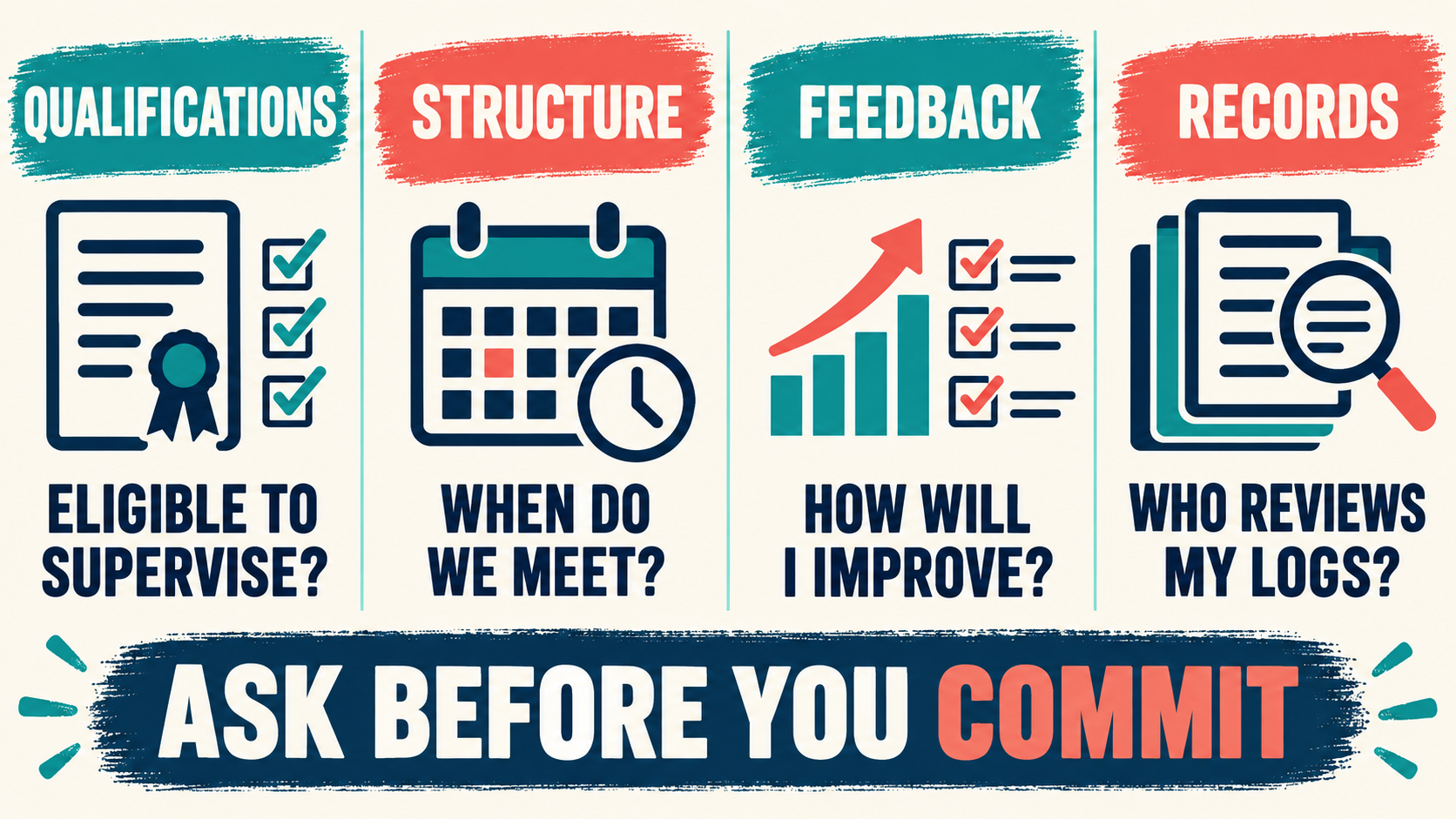
Start with questions that reveal how the relationship actually works. Instead of asking only, “Do you provide supervision?” ask what you will do, how often you will meet, who will observe your work, how feedback will be documented, and what happens when a concern is identified. These questions turn a vague offer into a set of expectations that you can compare.
| Area | Question to ask | What a useful answer includes |
|---|---|---|
| Qualifications | Are you currently eligible to supervise my fieldwork? | A verifiable credential, applicable BACB documentation, and a clear explanation of the supervisor’s role |
| Structure | How often will we meet and how will direct observation occur? | A recurring schedule, observation plan, cancellation process, and method for recording contacts |
| Learning | How will you evaluate my developing competence? | Behavior-specific feedback, case review, opportunities to practice, and data-based follow-up |
| Records | Who reviews and retains my fieldwork documentation? | Clear ownership, review timing, correction steps, signatures, privacy safeguards, and an exit plan |
How Do You Verify a BCBA Supervisor’s Qualifications?
Ask the supervisor for the information you need to verify the relationship, then check the current BACB source yourself. The BACB’s supervision-and-training resources explain that supervisors of people acquiring BCBA or BCaBA fieldwork must meet the applicable standards and complete the required supervision training before providing supervision. The details can change, so the current handbook and official forms should control your decision. Useful questions include:
- What is your current BCBA certification status and BACB identification information?
- Are you permitted to supervise the specific fieldwork pathway I am using?
- Have you completed the supervision training required for the role?
- How many trainees do you currently supervise, and how do you protect time for individual feedback?
- Will you supervise me directly, or will another person observe, train, or review parts of my work?
A supervisor’s years of experience are worth discussing, but a long résumé does not answer every qualification question. Ask about experience with the population, service setting, assessment procedures, caregiver collaboration, and the kinds of cases you will actually encounter. If the supervisor cannot explain how their experience fits your learning goals, the arrangement may be technically eligible but educationally weak.
What Does the Supervision Structure Look Like?
Structure is one of the most important things to clarify before you begin counting hours. Ask how individual and group supervision will be scheduled, how direct observation will happen, and how the supervisor will handle cancelled sessions. A plan that depends on “we will find time later” creates a documentation risk and can leave you without timely clinical feedback. Ask for specifics:
- Meeting frequency: How often will we meet, and what counts as a completed supervision contact?
- Observation: When will you observe my client-facing or analytic work, and will observation be in person, live online, or through an approved recording process?
- Agenda: Will meetings include cases, data, ethics, professional tasks, and exam-related concepts rather than only administrative updates?
- Availability: How should I contact you when a clinical or ethical question cannot wait until the next meeting?
- Coverage: What happens if you are unavailable, change employers, or cannot continue supervising?
Frequency alone does not define quality. A short meeting can be valuable if it includes specific observation, feedback, practice, and follow-up. A long meeting can be weak if it consists only of signing a log. Ask what evidence will show that you are improving and how the supervisor will respond if the data do not show progress.
How Will Feedback and Case Review Work?
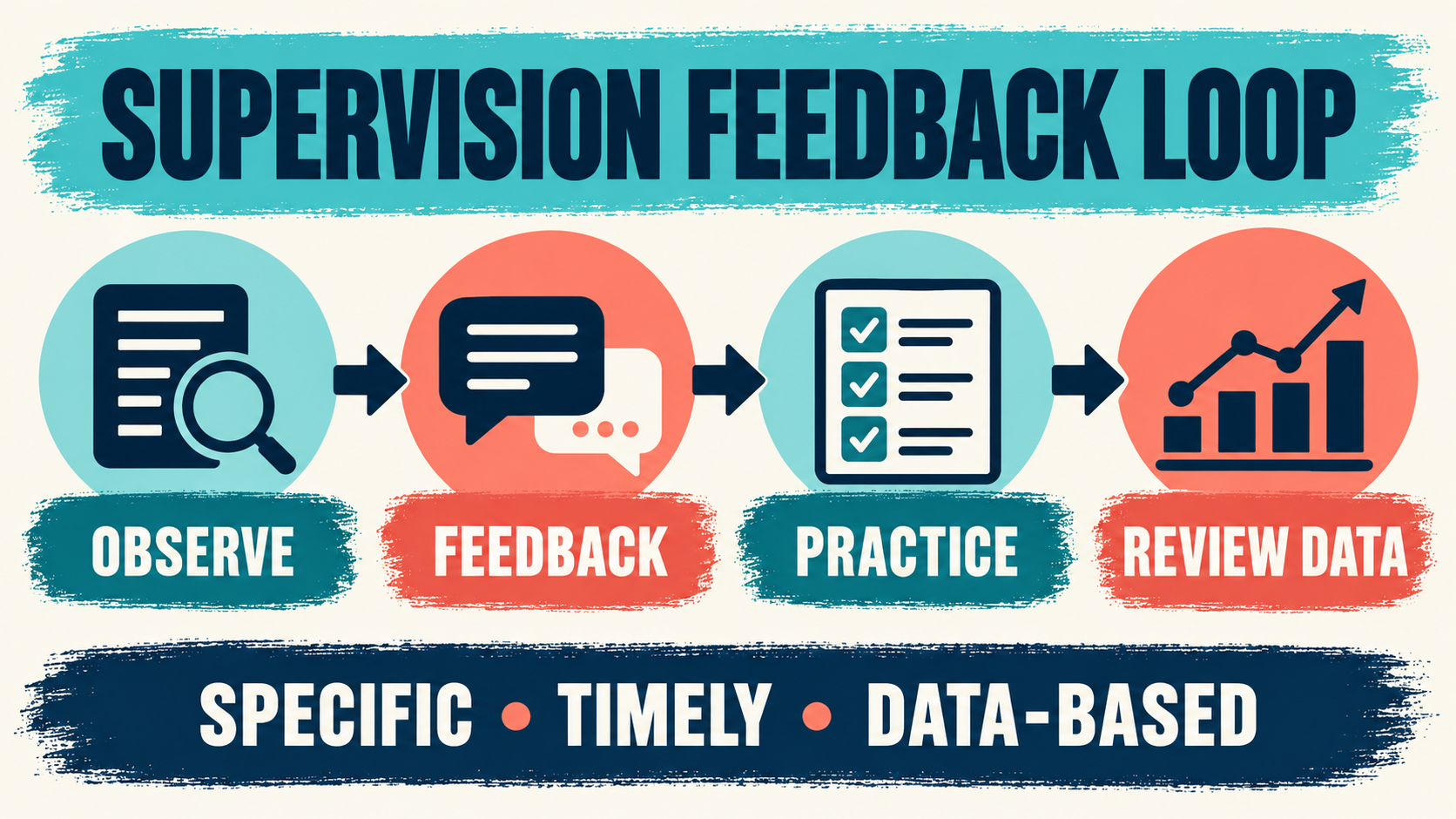
Good supervision makes performance visible. Ask how your supervisor will assess your definitions, measurement systems, graphs, functional assessments, behavior plans, staff training, caregiver collaboration, and professional writing. The answer should include direct examples of what you will do, what the supervisor will observe, and how you will know whether a correction worked. Questions that reveal the feedback process include:
- Will you observe my implementation and give feedback on what I actually did?
- How quickly will I receive feedback after an observation or case presentation?
- Will feedback be behavior-specific, written when appropriate, and connected to a measurable performance target?
- How will we decide whether I need modeling, rehearsal, additional practice, or a change in the training arrangement?
- How will you respond if I disagree with a recommendation or believe a client’s needs are not being addressed?
Ask whether you will be expected to explain your decisions, not only repeat procedures. A developing BCBA needs practice with assessment selection, data interpretation, treatment integrity, stakeholder communication, and ethical judgment. Supervision that never asks you to reason through a case may leave a gap between completing fieldwork tasks and practicing independently.
How Will Ethics, Privacy, and Boundaries Be Handled?
Bring ethical and privacy questions into the first conversation. Ask how client information will be stored, whether virtual supervision uses an approved secure platform, who can access recordings or case documents, and what you should do if a confidentiality concern arises. Do not send identifiable client information through an unapproved personal channel simply because it is convenient. Also clarify professional boundaries:
- How will employment decisions be separated from supervision feedback?
- Who is responsible for client care if the supervisor and employer disagree?
- How will conflicts of interest, dual relationships, or pressure to record questionable hours be handled?
- What is the process for raising a concern without retaliation?
- How will assent, dignity, cultural responsiveness, and stakeholder priorities be included in case decisions?
A supervisor should be able to discuss these questions without treating them as disloyalty. Ethical supervision includes a clear path for consultation and correction. It also includes the possibility that a supervisor will decline to sign documentation that does not meet the applicable requirements. That is a safeguard, not automatically a problem.
What Should the Agreement and Records Cover?
Read the supervision agreement before you rely on it. It should explain the people involved, the supervision format, the expected schedule, eligible activities, fees if any, documentation procedures, feedback responsibilities, privacy expectations, and what happens when the relationship ends. If the agreement is silent on an important issue, ask for clarification in writing. Ask these record questions:
- Which activities may count toward my fieldwork, and who decides when an activity is eligible?
- When will monthly records be reviewed and corrected?
- Who stores the signed documents, and how can I obtain copies?
- What happens if an entry is missing, inaccurate, late, or disputed?
- What final documentation will be completed if I change supervisors?
- How long should records be retained, and how will privacy be protected?
Keep your own organized copies of agreements, hour logs, feedback, verification forms, and relevant communications. This is not a sign that you distrust the supervisor. It is a normal professional record-keeping habit and makes reconciliation easier when several people, employers, or settings are involved.
What Should You Ask About the 2027 Transition?
If you expect your application or fieldwork to cross the 2027 transition, ask the supervisor which BACB requirement set and forms apply to your timeline. The BACB’s transition guidance distinguishes certification-requirement changes from BCBA examination and Test Content Outline updates. Do not assume that a change to fieldwork forms means the exam blueprint changed at the same time. Ask:
- Which requirement pathway am I using, and what event determines the form edition I should use?
- Will we document both the current and transition-period records if the BACB guidance recommends it?
- Which monthly or final verification form applies to my supervisor structure?
- Where will we check the official BACB update if a rule or form changes?
- How will we audit my records before I apply so that the transition does not create a preventable delay?
These are date-sensitive questions. Link to the current BACB guidance, record the date you checked it, and revisit the answer when your application plan changes. A blog post or a supervisor’s memory should not override the official document in force for your situation.
What Are the Red Flags?
One warning sign is not always decisive, but several should make you pause. Be cautious if a potential supervisor:
- Promises that all hours will be signed before explaining what work qualifies.
- Cannot describe a recurring meeting and observation schedule.
- Refuses to explain credentials, supervision training, or record ownership.
- Provides only generic praise and no behavior-specific feedback.
- Discourages questions about ethics, privacy, fees, or the transition rules.
- Asks you to share identifiable client information through an insecure channel.
- Has no clear process for correcting records or ending supervision.
A low fee is not automatically a red flag, and a high fee is not proof of quality. Compare what the fee covers, how much direct feedback is included, and whether the supervisor’s availability matches the agreement. The best choice is the arrangement that is qualified, clear, educationally meaningful, and realistic for your setting.
How Does Supervisor Selection Connect to BCBA Exam Preparation?
Supervision and exam preparation are related but not identical. A supervisor should help you develop applied competence and professional judgment; a mock exam can help you retrieve definitions, discriminate similar concepts, and practice selecting the best answer under time pressure. Ask whether supervision includes opportunities to connect fieldwork decisions to the current BCBA Test Content Outline without turning every supervision meeting into a quiz.
When a supervision scenario appears on the exam, look for the same clues used in a real supervision agreement: competency-based feedback, direct observation, treatment integrity, ethical conduct, client dignity, data-based decisions, and appropriate documentation. The strongest answer usually addresses the actual performance problem with observable evidence rather than choosing a vague lecture, a punishment-based shortcut, or a paperwork-only response.
Frequently Asked Questions
What should I ask a potential BCBA supervisor first?: Start by asking whether the supervisor is currently qualified for your fieldwork pathway, how supervision is scheduled, how direct observation and feedback work, and what records and forms will be used. Those answers reveal whether the offer is a real training structure or only a promise to sign hours.
How do I know if a BCBA supervisor is a good fit?: Compare the supervisor’s qualifications, population and setting experience, feedback style, availability, ethics process, documentation system, and expectations with your learning goals. A good fit is both compliant and educationally useful.
Should I ask about fees and changing supervisors?: Yes. Ask what the fee includes, how cancellations are handled, how records are reviewed, and what happens if either person ends the relationship. Clear exit procedures protect the documentation you have already earned.
Do 2027 fieldwork changes automatically change the BCBA exam?: No. The BACB’s transition guidance explains that certification-requirement updates and examination or Test Content Outline updates can occur independently. Check the current official source for the requirement set and exam information that apply to your timeline.
The best questions to ask your BCBA supervisor are the ones that make quality observable: Who will supervise? What will we do? How will you observe me? How will you give feedback? How will we protect clients and records? What happens if the plan changes? Write down the answers, compare them with current BACB guidance, and choose supervision that builds competent decision-making rather than simply collecting signatures. When you are ready to practice the assessment, ethics, measurement, and supervision concepts that often appear together, try the free BCBA mock exam. It is a study aid, not a BACB protocol or certification guarantee.
Sources for Further Study
- BACB Supervision, Assessment, Training, and Oversight — official supervision and training resources.
- BACB supervised fieldwork resources — official fieldwork and handbook context.
- Guidance for Meeting the BCBA Requirements During the 2027 Transition — official transition guidance.
- Recommended Practices for Individual Supervision — behavior-analytic supervision considerations for trainees.
- Designing a Successful Supervision Journey — recommendations for developing supervision systems.
Take the Free BCBA Mock Exam
If you want a low-pressure way to check your recall, use the free practice resource below. Take the Free BCBA Mock Exam



