

Discrete-trial teaching (DTT) and natural-environment teaching (NET) are instructional arrangements, not mutually exclusive treatment packages. DTT organizes clearly bounded trials, while NET embeds planned teaching in ongoing activities and relevant routines. Either arrangement can include prompting, reinforcement, error correction, data collection, generalization programming, and attention to assent. The useful comparison is therefore not “structured versus unstructured” or “clinic versus home.” It is how antecedents, the learner response, consequences, repeated practice, measurement, context, and learner participation are arranged for a defined goal.
Table of Contents
- What Is Discrete-Trial Teaching (DTT)?
- What Is Natural-Environment Teaching (NET)?
- DTT vs NET: Side-by-Side Comparison Table
- How to Choose Between DTT and NET
- Common Traps in Distinguishing DTT from NET
- Decision Examples for DTT vs NET
- Study Checklist for BCBA Exam
- Practice and Feedback: Free BCBA Mock Exam
What Is Discrete-Trial Teaching (DTT)?
Discrete-trial teaching is a structured arrangement in which an instructional antecedent or discriminative stimulus is presented, a defined learner response can occur, a programmed consequence follows, and an intertrial interval separates one trial from the next. The practitioner specifies the materials, prompt and fading plan, error-correction procedure, consequence, mastery criterion, and data-collection method. DTT can concentrate repeated trials, but “massed” practice is a design option rather than the definition. A trial may occur at a table, on a playground, in a kitchen, or within another setting when its components remain clearly arranged. DTT offers tight control over a learning opportunity and can make acquisition and error patterns easier to inspect; whether it is efficient or acceptable for a given learner and target remains a data-based question.
What Is Natural-Environment Teaching (NET)?
Natural-environment teaching embeds explicit instruction within an ongoing activity, routine, or context in which the target response is relevant. A practitioner may capture an opportunity already present or arrange one carefully, identify the controlling antecedents—including a discriminative stimulus or motivating operation when applicable—and use planned prompts, consequences, error correction, and measurement. For example, when a learner reaches toward available juice during snack, the teacher might use the existing routine to teach the selected communication response and deliver access according to the plan. NET still requires an operationally defined target and a record of performance. Contact with a natural context may support transfer, but generalization and maintenance must be assessed rather than assumed.
DTT vs NET: Side-by-Side Comparison Table
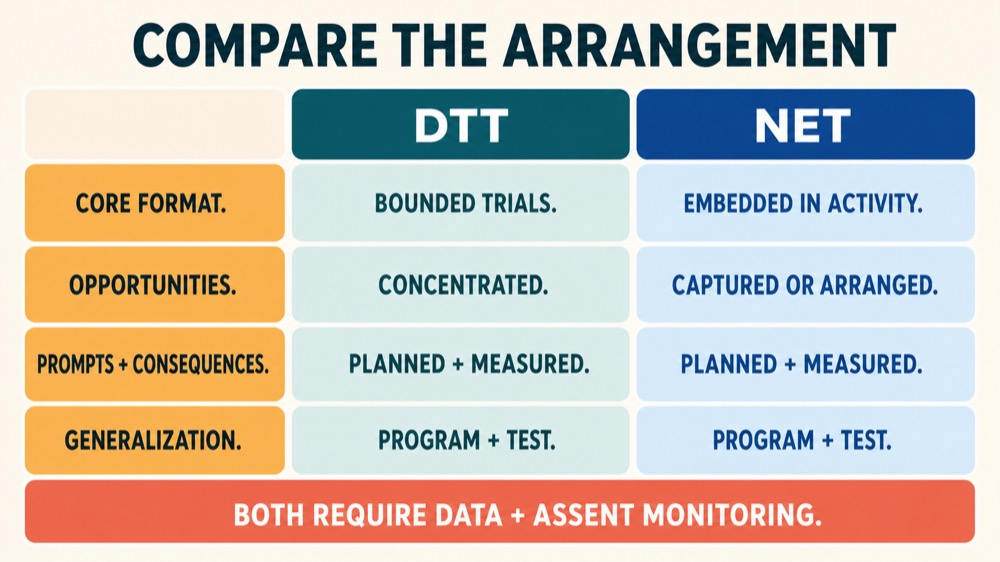
| Dimension | Discrete-Trial Teaching (DTT) | Natural-Environment Teaching (NET) |
|---|---|---|
| Core arrangement | Clearly bounded, practitioner-arranged trials with an intertrial interval | Planned instruction embedded within an ongoing activity or routine |
| Setting | Can be implemented wherever the specified trial components can be arranged | Occurs in a context relevant to the target response |
| Antecedents | Instructions, materials, SDs, and relevant MOs are deliberately arranged | Existing or carefully arranged contextual cues, SDs, and relevant MOs are used |
| Opportunities | Can concentrate repeated opportunities in a short period | Opportunities are captured or arranged within the activity |
| Prompts and correction | Specified, measured, and faded according to the teaching plan | Specified, measured, and faded while preserving the activity context |
| Consequences | Programmed from assessment and the target contingency | Often contextually related, but still selected and evaluated functionally |
| Data collection | Often trial-by-trial; the method follows the response dimension and question | May be trial-by-trial, probe-based, event-based, or another target-matched method |
| Generalization and maintenance | Programmed and measured across relevant people, materials, responses, and settings | Programmed and measured beyond the teaching examples and immediate routine |
| Assent and social validity | Operationalized and monitored for the individual learner | Operationalized and monitored for the individual learner |
How to Choose Between DTT and NET
Selection begins with a measurable objective and the variables that should control the response, then considers the learner’s current performance, history with instruction, communication system, setting, risk, preferences, and signals of assent or withdrawal. The relevant question is which arrangement—or sequence of components—can produce efficient, durable, socially valid change with acceptable procedural integrity. When uncertainty matters, compare outcomes instead of relying on a format label.
- Target and controlling variables: Dense, clearly bounded trials may help evaluate a new discrimination; an embedded arrangement may be useful when the response must contact cues and consequences within a routine. Neither match is automatic.
- Current performance: Use baseline accuracy, prompt dependence, error patterns, latency, and independent responding to decide how much instructional control and practice density are needed.
- Efficiency: Compare trials or opportunities to criterion, teaching time, errors, prompt levels, and staff effort. Do not infer efficiency from the DTT or NET label.
- Maintenance and generalization: Program and measure performance across the people, materials, responses, and settings that matter, even when teaching began in a natural context.
- Assent and social validity: Define individualized participation and withdrawal indicators, offer meaningful choices when possible, and change the plan when engagement or acceptability data warrant it.
- Feasibility and integrity: Choose components the team can implement accurately, supervise within competence, and monitor with a measurement system matched to the target.
- Blending or sequencing: DTT and NET components can be combined or alternated when the rationale is explicit and data show that the blend advances acquisition, independent use, and transfer.
Common Traps in Distinguishing DTT from NET
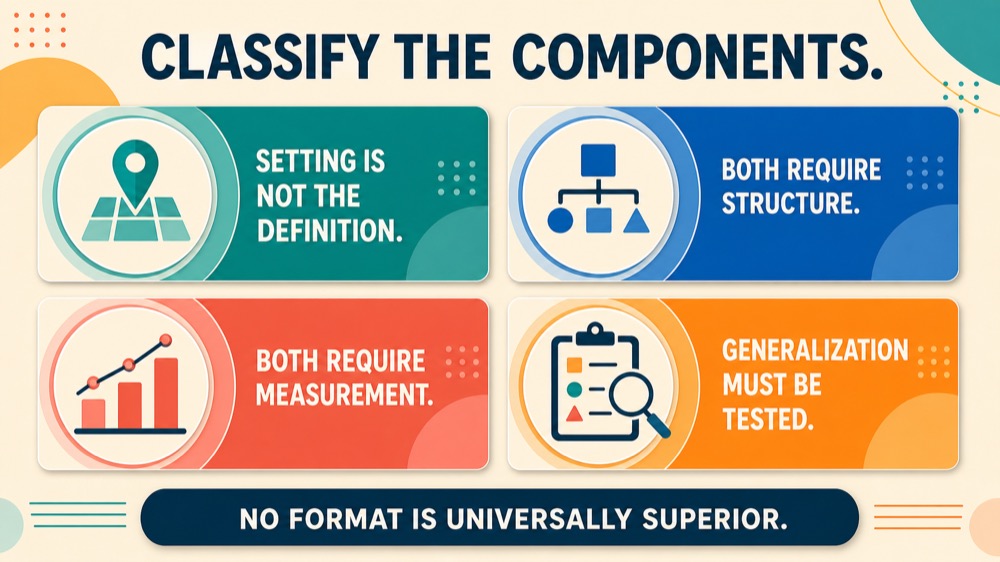
- Setting shortcut: A desk does not define DTT, and moving a trial to a playground does not make it NET. Classify the arranged teaching components.
- Structure shortcut: Instruction embedded in play or a routine still needs defined targets, prompts, consequences, correction procedures, and implementation criteria.
- Measurement shortcut: Both arrangements require data suited to the response and decision. Trial-by-trial recording and probes are options, not ownership labels.
- Generalization shortcut: Neither dense trials nor natural-looking materials establish transfer by appearance. Test performance across relevant untrained examples and contexts.
- Ranking shortcut: Group findings or familiar clinical habits do not identify the best arrangement for every learner, skill, or stage of learning. Compare individual outcomes.
Decision Examples for DTT vs NET
Example 1: Selecting components for tacts. A learner is acquiring object labels and uses the labels accurately with one card set but rarely during play. The team might compare a brief block of clearly bounded trials with embedded opportunities in a preferred matching activity, while holding target definitions and consequence quality as constant as practical. Acquisition rate, prompt level, spontaneous use, engagement, and transfer—not “attention span”—guide whether to retain one arrangement or combine them.
Example 2: Teaching a break request in an existing routine. Assessment and the current plan identify a socially valid break request to teach during already scheduled work. Within those naturally occurring opportunities, the practitioner can prompt the selected communication response, honor it according to the plan, collect data on independent responding, and monitor assent or withdrawal. Brief structured rehearsal may supplement practice, but additional aversive demands should not be created merely to evoke the request.
Example 3: Letter discrimination with transfer probes. The team may use clearly arranged trials to provide repeated comparisons among letters, a prompt-fading plan, and a consequence already supported by assessment. The team then probes untrained fonts, materials, instructors, and storybook routines without assuming mastery will transfer. Embedded practice can be added where letters naturally occur. Trials to criterion, errors, independent accuracy, and generalization probes determine whether the sequence is useful.
Study Checklist for BCBA Exam
- Define DTT from its bounded trial components and NET from planned instruction embedded within an ongoing context.
- Identify the relevant SDs and motivating operations in either arrangement; do not assign an MO to NET or an SD to DTT by format alone.
- Select data collection from the response dimension and decision. Trial-by-trial measures, event recording, latency, probes, and permanent products may be appropriate in either arrangement when justified.
- Specify prompting, fading, error correction, and programmed consequences for both arrangements, then measure implementation and learner performance.
- Program and test generalization and maintenance separately from acquisition. Natural materials or locations do not constitute a generalization result.
- Separate the procedure from behavioral processes and effects; for example, a planned consequence is not shown to reinforce until the measured relation supports that function.
- Use the BCBA Test Content Outline’s relevant Domain G tasks, including conditional discriminations, prompting and fading, trial-based and free-operant procedures, generalization, and maintenance.
- Operationalize assent and withdrawal signals with the individual and stakeholders rather than treating participation in either format as automatic assent.
- Read the cited 2024 group study as bounded evidence from 142 toddlers diagnosed with ASD; do not turn its sample-level findings into a universal learner-selection rule.
Practice and Feedback: Free BCBA Mock Exam
Use our Free BCBA Mock Exam for practice and feedback across ABA concepts; we do not claim that this exact comparison appears. For related antecedent concepts, review stimulus control and stimulus generalization. Keep the source hierarchy clear: the BCBA Test Content Outline (6th ed.) defines current examination content, while individual studies answer narrower empirical questions.
The 2024 article “The Effects of Discrete Trial and Natural Environment Teaching on Adaptive Behavior in Toddlers With Autism Spectrum Disorder” compared groups receiving DTT, NET, or both using baseline and posttest measures in a sample of 142 toddlers. Its reported group differences are relevant evidence, but the design, population, outcomes, and service context limit what can be inferred for another learner or target. Individual assessment and repeated performance data remain necessary.
Next step for BCBA exam prep
Turn this topic into exam-day practice
Use this topic as a focused review, then test it in exam-style conditions with a free mock before deciding whether five full-length mocks are the right next step.
Start the Free BCBA Mock ExamContinue with Five Full-Length Mocks — $99
Review the included materials and access details before ordering. No pass guarantee is implied.



