
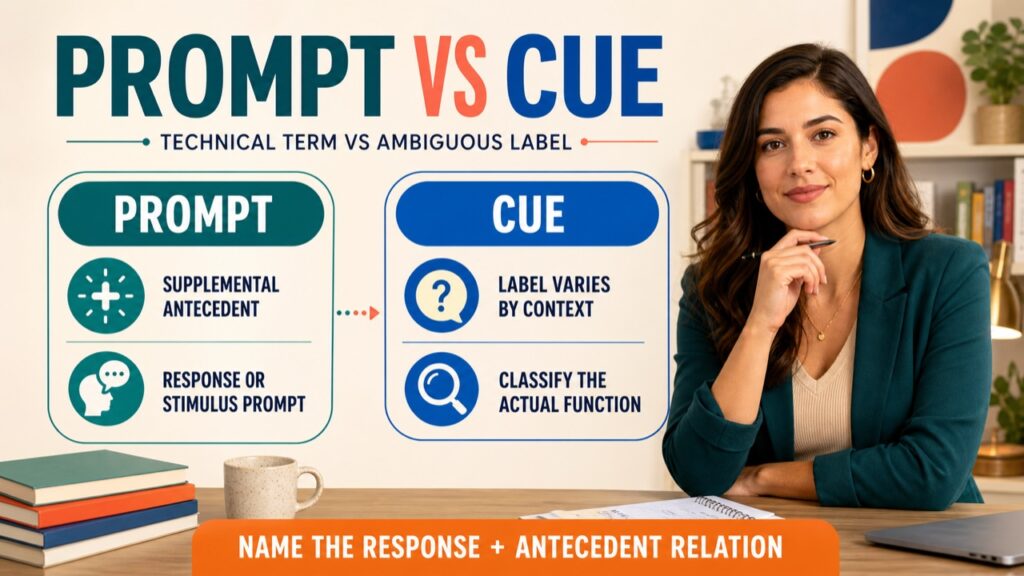
In everyday clinical and educational language, people may use prompt and cue as if they were interchangeable. In behavior analysis, however, prompt has a technical instructional use, while cue does not identify one consistent behavioral function. The useful comparison is therefore not two fixed categories. It is a functional analysis of what an antecedent is doing in the current teaching arrangement. That distinction supports clearer skill-acquisition plans, defensible prompt fading, and direct tests of stimulus control transfer.
Table of Contents
- What Is a Prompt in ABA?
- What Is a Cue in ABA?
- Key Differences: Side-by-Side Comparison
- Practical Examples of Prompt vs Cue
- Common Traps and Misconceptions
- Prompt Fading and Stimulus Control Transfer
- Study Checklist: Understanding Prompt vs Cue
- Test Your Knowledge with a Free BCBA Mock Exam
- Further Reading
What Is a Prompt in ABA?
Prompt is a technical term for a supplemental antecedent stimulus arranged to increase the likelihood of a target response when the relevant teaching antecedent is present. A response prompt, such as a model, gesture, or physical guidance, operates on the form or occurrence of the response. A stimulus prompt, such as changing the position, size, color, or salience of a task stimulus, alters an antecedent feature. A well-designed program identifies the relevant antecedent that should ultimately control responding, selects the prompt deliberately, and specifies how support will be reduced. Correct prompted responding shows that the prompt helped on those trials; it does not by itself demonstrate independent stimulus control. Because a stimulus is an SD only in relation to a particular response and reinforcement history, do not assign that label merely because an object or instruction is present. Name the response class, antecedent condition, and relevant consequence when the available evidence permits that classification.
Suppose the target is touching a ball when the instructor says “Touch ball” while displaying several objects. The instruction and array are the relevant antecedent compound. The instructor might immediately model pointing to the ball, which is a response prompt, or temporarily make the ball card larger, which is a stimulus prompt. Later trials systematically reduce that added help and include unprompted probes with the ordinary array. Prompting and prompt fading are procedures. Stimulus control transfer is supported only when the target response occurs under the intended antecedent conditions without the supplemental prompt, with errors and generalization also measured.
What Is a Cue in ABA?
Cue is used inconsistently across professions and in everyday speech. It may refer to an instruction, a naturally occurring event, a prompt, or simply any signal noticed by the speaker. For behavior-analytic precision, replace the label with a testable description. Ask whether the event is a discriminative stimulus correlated with differential reinforcement, a conditional stimulus that changes another stimulus relation, part of a motivating operation, or a supplemental prompt arranged for teaching. The same-looking event can have different functions across learners or arrangements, so topography and naturalness do not settle the classification.
For example, a picture on a visual schedule may be the relevant instructional stimulus after a learner has acquired the routine. During initial teaching, an instructor’s point toward that picture may be a gestural response prompt. If the picture itself was enlarged or outlined temporarily to make the correct selection more likely, that alteration is a stimulus prompt. Evidence comes from the programmed history and current data: does the learner begin the routine when the ordinary schedule picture is present, without the point, outline, or other added help? Calling each event a “cue” would hide distinctions that the teaching team needs to measure.
Key Differences: Side-by-Side Comparison
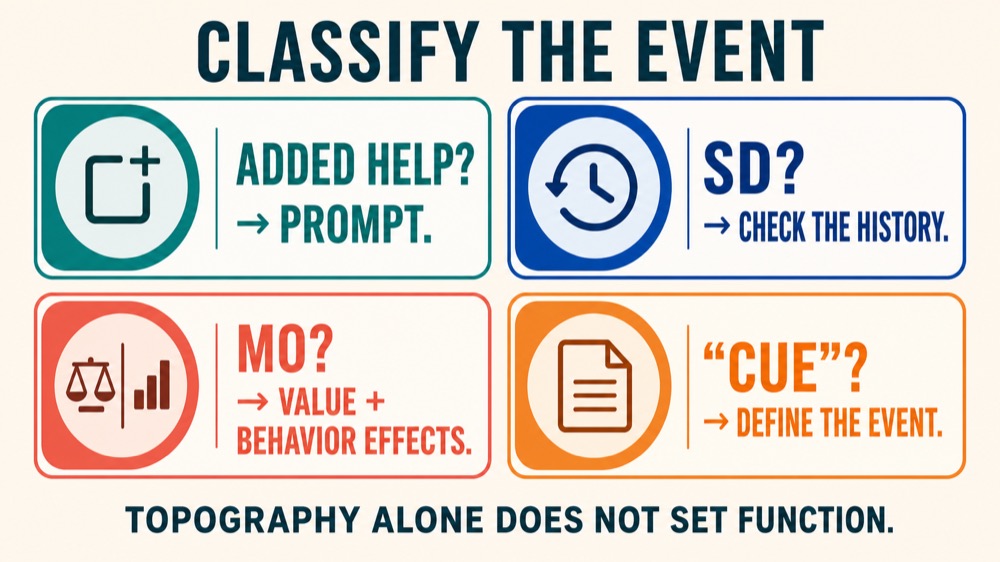
| Feature | Prompt | “Cue” label |
|---|---|---|
| Technical status | Supplemental antecedent arranged to increase the target response | Ambiguous term unless the speaker defines the event and its relation |
| Classification question | Is added help operating on the response or on a task stimulus? | Is the event an SD, conditional stimulus, motivating operation, prompt, or something else? |
| Examples | Model, gesture, physical guidance, positional change, enlarged feature | Instruction, task material, schedule icon, contextual feature, or added help—depending on use |
| Program decision | Specify delivery, error correction, data coding, and a fading or transfer plan | Do not select a procedure from the label alone; first describe the functional relation |
| Evidence | Prompted accuracy documents performance with added help | Independent probes test control by the intended antecedent conditions |
| Generalization | Program and test across relevant people, materials, and settings | Natural occurrence of an event does not establish generalization |
Practical Examples of Prompt vs Cue
Example 1: Teaching a Request for “More”: This example also shows why every relevant antecedent should not automatically be called an SD.
- Target response: The learner signs “more” during a paused snack routine.
- Relevant conditions: Motivation for another cracker, the available communication partner, and a brief pause before more food is delivered.
- Added response prompt: The instructor models the sign “more” while the cracker is visible and waits for an approximation.
- Transfer/fading plan: Move from a full model to a partial model, then insert a planned time delay before any model.
- Evidence of independence: Across repeated opportunities, the learner requests before the model and receives the requested item; prompted and independent responses are recorded separately.
Example 2: Teaching a Learner to Identify the Color Red: Use the points below as a quick study guide.
- Target response: Learner points to a red card when asked “Point to red.”
- Natural SD: The instruction “Point to red” and the set of color cards.
- Added prompt: The teacher positions the red card closer to the learner (stimulus prompt: proximity).
- Transfer/fading plan: Gradually move the red card to a neutral position among other colors.
- Evidence of independence: Learner points to red regardless of position.
Common Traps and Misconceptions
- Trap 1: Calling any antecedent a prompt. A prompt is supplemental within the current instructional arrangement. An event can be naturally occurring and still require functional analysis before it is called an SD.
- Trap 2: Treating “cue” as necessarily natural. Some teams use the word for a prompt and others use it for a relevant task stimulus. Define the event, timing, response, and contingency instead of inferring function from the label.
- Trap 3: Restricting prompts to verbal hints. Response prompts may include models, gestures, or physical guidance; stimulus prompts may change position, size, color, or another task feature. A time delay is a transfer procedure, not an extra antecedent prompt by itself.
- Trap 4: Treating fading as proof of transfer. A learner may respond to residual features such as proximity, gaze, material placement, or timing. Include planned no-prompt probes and measure errors, latency, maintenance, and generalization where relevant.
- Trap 5: Using a universal intrusiveness ranking. Do not assume that physical guidance is the least intrusive option or that one hierarchy fits every skill. Select procedures using the task, learner history, effectiveness, safety, dignity, assent, and feasibility of rapid fading.
Prompt Fading and Stimulus Control Transfer
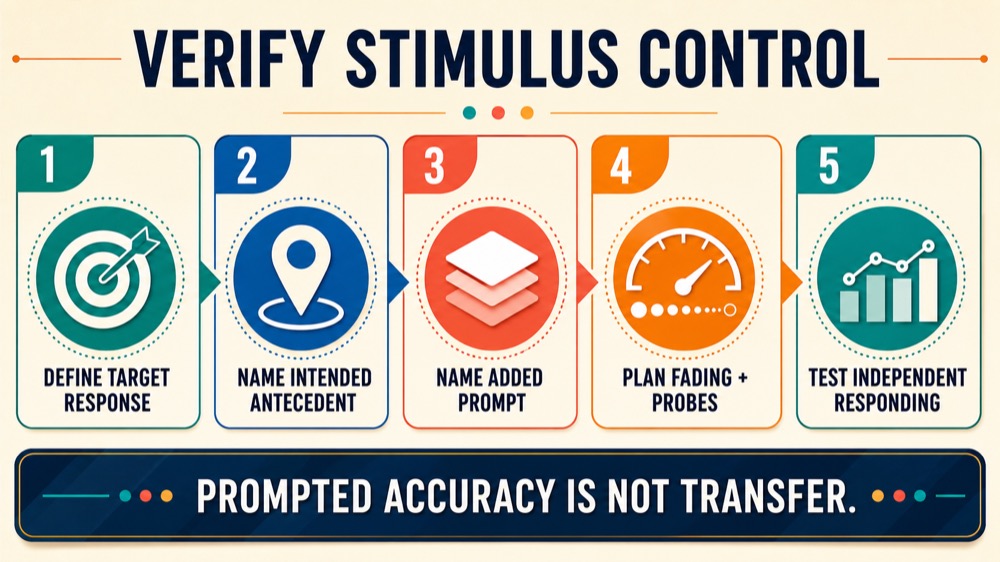
Prompt fading systematically reduces supplemental antecedent assistance so that responding can come under the intended antecedent conditions. Related procedures include most-to-least fading, least-to-most prompting with an opportunity for independent responding, progressive or constant time delay, and stimulus fading. These labels describe arrangements, not guaranteed outcomes. The program should state the prompt level, delay, data code, advancement and regression criteria, error-correction procedure, and conditions for independent probes. For a receptive-identification task, for example, an instructor might reduce a model or gestural prompt according to performance criteria and periodically present the ordinary instruction and materials without added help. Stimulus control transfer is supported when responding is accurate and efficient under those intended conditions, not merely when the team has reached the last step on a fading checklist.
Study Checklist: Understanding Prompt vs Cue
- □ I can define prompt as a supplemental antecedent stimulus arranged to increase a target response.
- □ I can distinguish response prompts from stimulus prompts and identify what each changes.
- □ I can explain that cue has no single standardized function in this comparison and replace it with a functional description.
- □ I can distinguish a discriminative stimulus, conditional stimulus, motivating operation, and added prompt when the teaching arrangement provides enough evidence.
- □ I can write a prompt fading plan with delivery rules, data codes, decision criteria, error correction, and independent probes.
- □ I can describe stimulus control transfer as a measured change in control, rather than a result inferred from completing fading steps.
- □ I can connect these decisions to BACB Test Content Outline tasks G.7 and G.8 without claiming that this page reproduces examination items.
Test Your Knowledge with a Free BCBA Mock Exam
Ready to practice applying behavior-analytic concepts under exam-style conditions? Our Free BCBA Mock Exam provides original practice questions and immediate feedback across a broad range of content areas. Use the results to identify concepts that need more review; the practice resource is not an official BACB examination and does not guarantee coverage of this exact comparison.
Further Reading
- BACB BCBA Test Content Outline (6th ed.) – Official task list for skill acquisition and behavior change.
- Stimulus Control in ABA – Deeper dive into discriminative stimuli and stimulus classes.
Precision rule: identify the intended response, the relevant antecedent conditions, the supplemental prompt, the transfer procedure, and the data that demonstrate independent control. If a team uses the word “cue,” document what event it names instead of assuming its function.



