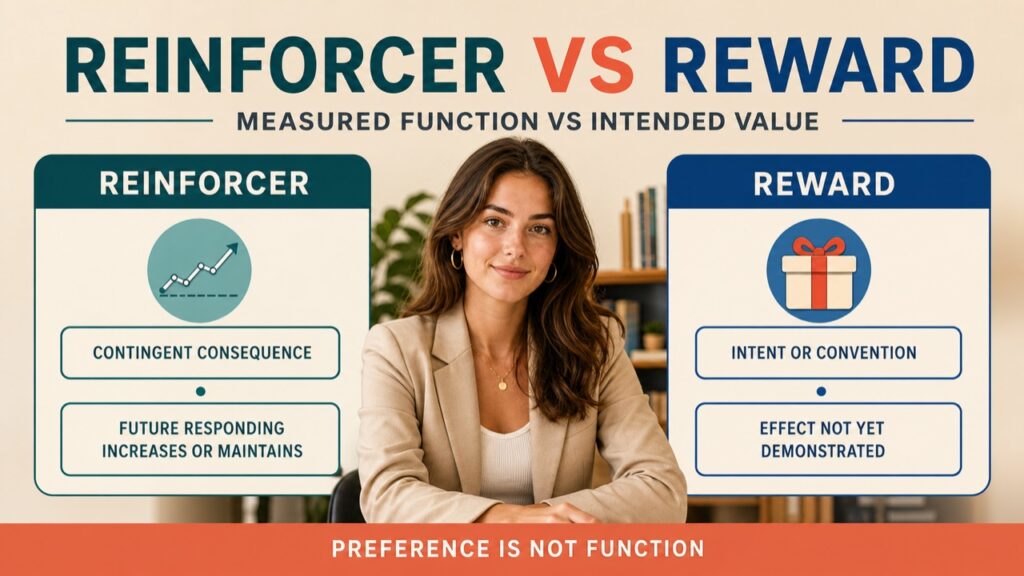
In applied behavior analysis (ABA), “reinforcer” and “reward” are sometimes used interchangeably in casual speech, but they answer different questions. A reinforcer is defined functionally: evidence for that label comes from a contingent consequence followed by an increase or maintenance in the future frequency of the relevant response class under comparable conditions (Catania, 2013). In many everyday service and education contexts, “reward” instead describes what someone intended to give, conventionally values, or expects the recipient to like. Other disciplines use reward in more technical ways, so the contrast here is an ABA practice distinction rather than a universal dictionary rule. Separating intent from measured effect helps behavior analysts avoid treating an attractive item, praise statement, or bonus as effective before the relevant behavioral data support that conclusion.
Table of Contents
- What Is a Reinforcer in ABA?
- What Is a Reward?
- Reinforcer vs Reward: Side-by-Side Comparison
- Examples and Nonexamples
- How to Identify a Reinforcer: A Practical Checklist
- Free BCBA Mock Exam Practice
- Conclusion
What Is a Reinforcer in ABA?
A reinforcer is not identified from appearance, price, praise value, or the provider’s intention. It is identified from a behavioral effect. More precisely, a stimulus change may be classified as a reinforcer for a particular response when it occurs as a contingent consequence and repeated measurement supports an increase or maintenance in that response’s future occurrence under relevant conditions. The conclusion is therefore functional and empirical. For example, if access to a small snack follows an appropriate request and requests subsequently occur more often in comparable opportunities, the data may support a reinforcing function for that consequence in that arrangement. If requests do not increase relative to an appropriate comparison, the test has not demonstrated reinforcement—even when preference data show that the learner readily selects the snack.
Keep the arranged contingency, the observed process or effect, and the functional label separate. A practitioner can arrange a candidate consequence after responding, yet reinforcement has not been demonstrated until the relevant behavior changes in the predicted direction. A preference assessment can identify stimuli that a person selects, approaches, or engages with under specified conditions; it does not by itself establish their effect when made contingent on a target response. A direct reinforcer assessment or another suitable experimental comparison evaluates that effect. If a student frequently selects a toy car but earning it does not increase study behavior in the tested arrangement, the current evidence supports preference but not a reinforcing function for study behavior. That conclusion is deliberately conditional: the same stimulus can have a different function for another response, person, motivating operation, or context.
The BCBA Test Content Outline (6th ed.) requires candidates to distinguish unconditioned, conditioned, and generalized reinforcers (B.7) and to design and evaluate positive and negative reinforcement procedures (G.1). The outline identifies expected knowledge; it is not a complete technical definition. White’s review, “Reward or reinforcement: what’s the difference?”, traces the different histories of the terms and distinguishes approach-related reward from the strengthening of learned relations described as reinforcement. Together, these sources support precise terminology while leaving the functional conclusion to behavioral evidence.
What Is a Reward?
In everyday service language, a reward is commonly something offered to acknowledge, praise, or encourage behavior. That label usually reflects intent, social convention, or anticipated desirability rather than a demonstrated change in responding. A parent may call a sticker a reward after chore completion even though later chore data have not changed. The sticker is a candidate consequence, and a contingent test can determine whether it has a reinforcing effect for that response under those conditions. Bonus pay, gold stars, verbal praise, trophies, and certificates illustrate the same distinction: each can be valuable or preferred, but its behavioral function remains an empirical question. This practical usage should not be confused with every scientific use of “reward”; White’s review shows that the term also has a distinct research history related to approach behavior.
A socially labeled reward can even participate in a punishment contingency. Suppose public presentation of a “Most Improved” certificate follows class participation and participation subsequently decreases across comparable opportunities. The observable decrease—not an assumption about embarrassment—would support a punishing effect in that arrangement. In another context, private delivery of the same certificate might have no measurable effect or might increase responding. The object’s name therefore does not settle its function. Praise and money require the same caution: history, delivery conditions, motivating operations, competing consequences, and the response being measured can alter their effects. Analysts should describe what was arranged, measure what changed, and limit the functional conclusion to the conditions actually evaluated.
Reinforcer vs Reward: Side-by-Side Comparison
To clarify the differences, the following table contrasts reinforcer and reward across key dimensions:
| Dimension | Reinforcer | Reward |
|---|---|---|
| Definition basis | Functional: effect on future frequency of behavior | Intentional/conventional: labeled as desirable |
| Determined by | Empirical data (reinforcer assessment) | Social agreement or perceived value |
| Example | Giving a child 5 minutes of iPad time contingent on completing math problems, resulting in increased math completion | Giving a child a trophy for participation, even if behavior does not change |
| Relation to preference | Preferred items may or may not function as reinforcers | Often based on assumed preference |
| Fails to be a reinforcer when | Behavior does not increase or maintain | N/A (it remains a reward label regardless of effect) |
Examples and Nonexamples
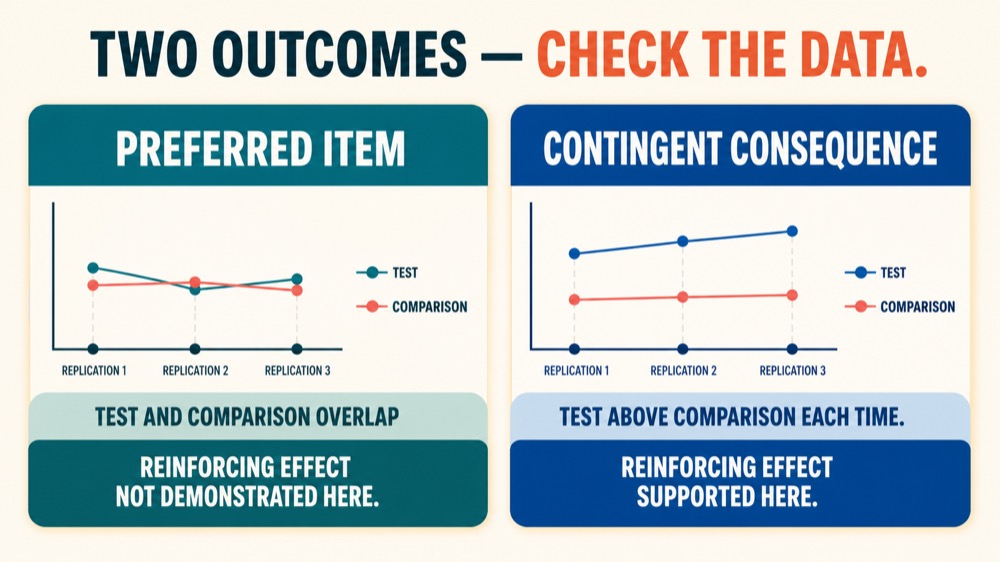
Example 1: Preferred Item Without a Demonstrated Reinforcing Effect. Alex selects gummy bears frequently in a preference assessment. His teacher then arranges a careful comparison in which completing a defined spelling response produces a gummy bear in one condition. Across repeated sessions, the rate of the target response does not increase relative to the comparison condition. The teacher intended the gummy bear as a reward, but these data do not demonstrate it as a reinforcer for that response under the tested conditions. The next step is to review the contingency and motivating operations and, when appropriate, assess other candidate consequences rather than generalizing the null result to every behavior and context.
Example 2: An Unconventional Consequence With a Reinforcing Effect. In a hypothetical comparison, a classroom timer sound stops immediately after Maria completes a defined work unit. Across repeated comparable sessions, work-unit completion occurs more often when completion produces termination of the sound than in the comparison condition. Those data support negative reinforcement under the tested arrangement: the relevant stimulus change is termination of the ongoing sound. The teacher need not call that change a reward for it to strengthen responding. This is an analytic example, not a recommendation to introduce aversive stimulation; real procedures require appropriate assessment, consent or assent when applicable, risk review, and a less intrusive effective option.
Common Traps to Avoid:
- Assuming a preferred item is automatically a reinforcer. Conduct reinforcer assessments to confirm.
- Claiming praise always reinforces behavior. Praise may function as a reinforcer, punisher, or neutral event depending on the individual’s history.
- Confusing an intended reward-delivery arrangement with a demonstrated reinforcement effect. Describe the arranged contingency separately from the measured behavioral outcome.
- Using terms like “positive reinforcement” to describe anything given after a behavior without data on its effect.
How to Identify a Reinforcer: A Practical Checklist
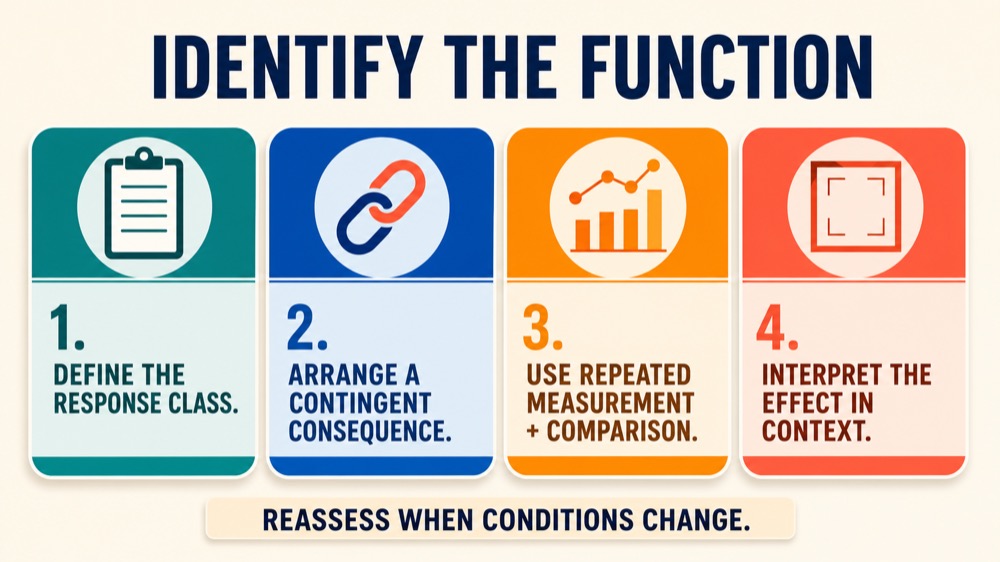
The following checklist can help behavior analysts determine whether a consequence is a reinforcer, rather than merely a reward:
- Define the response class. Specify the behavior you want to increase (e.g., raising hand, completing 5 math problems).
- Arrange the candidate consequence contingently. Specify the stimulus change that follows the response; for negative reinforcement, that change may be termination or reduction rather than delivery of an item.
- Use repeated measurement and a suitable comparison. Choose a design that can separate the contingent consequence from time, practice, instruction, and other plausible variables.
- Interpret the tested effect narrowly. A replicated increase or maintenance relative to the comparison supports a reinforcing function in that arrangement. A null result means that arrangement did not demonstrate the effect; it does not establish a permanent property of the stimulus.
- Consider motivating operations. Deprivation, satiation, recent access, and competing events can change the momentary effectiveness of a consequence and the behavior that has produced it.
- Reassess periodically. Reinforcing effectiveness can change over time due to satiation or other variables.
This checklist emphasizes that preference information can guide candidate selection, whereas the reinforcer conclusion depends on measured behavior. The current BACB outline places preference assessment at F.4, distinguishes reinforcer types at B.7, and addresses reinforcement procedures at G.1. It does not label F.5 or F.6 as reinforcer-assessment tasks. Practitioners should select an assessment and experimental logic suited to the client, response, context, feasibility, and risk, then revisit the conclusion when conditions change.
Free BCBA Mock Exam Practice
Apply the functional distinction to unfamiliar scenarios in our Free BCBA Mock Exam, which provides practice and feedback across ABA concepts. We do not claim that this exact comparison appears in the mock exam; use it to practice identifying contingencies and selecting evidence-based interpretations. For related antecedent concepts, continue with our guides to stimulus control in ABA and stimulus generalization in ABA.
Conclusion
A reinforcer is a functional label supported by a contingent relation and its measured effect on the future frequency of a response class. In everyday ABA communication, reward commonly describes intention, convention, or expected value. Preference can help identify candidates, but it does not substitute for an effect test. Precise reporting therefore names the response, the consequence, the contingency, the comparison, the observed change, and the conditions under which it occurred. This approach improves treatment decisions and makes communication with clients, caregivers, and colleagues easier to audit. For source context, consult the current BACB outline and White’s review of the different historical meanings attached to reward and reinforcement.
References
- Behavior Analyst Certification Board. (2022). BCBA Test Content Outline (6th ed.; updated 2024). https://www.bacb.com/wp-content/bcba-outline-6thEd/
- Catania, A. C. (2013). Learning (5th ed.). Sloan Publishing.
- White, J. M. (1989). Reward or reinforcement: what’s the difference? American Psychologist, 44(10), 1306-1307. https://pubmed.ncbi.nlm.nih.gov/2682404/