

Short answer: Behavior momentum theory explains why behavior can become more resistant to change when it occurs in a context with a strong history of reinforcement. For BCBA study purposes, separate two ideas: response rate describes how often a response occurs, while resistance to change describes how much responding persists when a disruptor is introduced. A learner can respond quickly without having behavior that is especially persistent, and a response can remain persistent even when its current rate is not the highest.
Table of Contents
- What is behavior momentum theory?
- What variables does the theory separate?
- How does behavior momentum theory explain response persistence?
- How is the theory different from a high-probability request sequence?
- How can you apply the theory to a BCBA exam scenario?
- What does the BCBA exam expect you to recognize?
- What mistakes should you avoid?
- How should a BCBA use the theory responsibly?
- Behavior momentum theory FAQ
- Take the Free BCBA Mock Exam
The phrase behavior momentum theory is often mixed together with the practical high-probability request sequence. They are related, but they are not interchangeable. The theory is a conceptual and quantitative account of response persistence; a high-probability sequence is an applied procedure that arranges several easy requests before a harder request. This guide keeps that boundary clear so you can read an exam scenario accurately instead of treating every “easy requests first” example as a complete statement of the theory. Table of Contents
What is behavior momentum theory?
Behavior momentum theory is a framework for understanding the relation between the rate of reinforcement available in a stimulus context and the persistence of behavior in that context. The common physics analogy is useful only if it is used carefully: an object in motion resists stopping, while behavior that has a history of reinforcement in a context may show greater resistance to disruption. In behavior analysis, “momentum” is not a claim that a person has a fixed trait or that a behavior is permanently strong.
The theory distinguishes the direct response–reinforcer relation from the broader stimulus–reinforcer relation. The direct contingency helps explain response rate: what happens after the response can change how often the response occurs. The reinforcement obtained in the presence of a stimulus context helps explain response persistence: behavior may be less affected by extinction, satiation, distraction, or another disruptor when that context has a richer reinforcement history. This is why the same response rate and the same persistence are not automatically the same measurement.
For a BCBA candidate, the safest working definition is: behavior momentum theory describes how reinforcement history in a context can affect resistance to change, while response rate and resistance to change are related but separable dimensions. The current BACB Test Content Outline places behavioral momentum under concepts and principles, including recognizing how it can be used to understand response persistence. That exam connection does not make every applied example a formal test question, so use it as a reasoning framework rather than a promise about question wording.
What variables does the theory separate?
When a question uses the word “momentum,” first ask what the stem is actually measuring. Is it counting responses, describing persistence after a disruption, or asking about a procedure intended to increase compliance? The table below gives a compact map.
| Part of the model | What it asks | Exam reading |
|---|---|---|
| Response rate or “velocity” | How often does the response occur during a period? | Look for frequency, rate, or response–reinforcer contingency. |
| Reinforcement context or “mass” | How much reinforcement has been obtained in the stimulus context? | Look for context-wide reinforcement history, not just one response. |
| Disruptor | What operation challenges the ongoing response? | Examples can include extinction, satiation, distraction, or a changed context. |
| Resistance to change | How much does responding decline relative to its baseline? | A smaller relative decline indicates greater persistence under that disruption. |
This distinction prevents a common error: assuming the behavior with the highest baseline rate must also have the greatest resistance to change. A response can occur rapidly because of its direct contingency while still dropping sharply when reinforcement is removed. Conversely, a response with a moderate rate may show greater persistence because of the reinforcement history associated with the context. Always read the dependent variable and the disruption described in the stem.
How does behavior momentum theory explain response persistence?
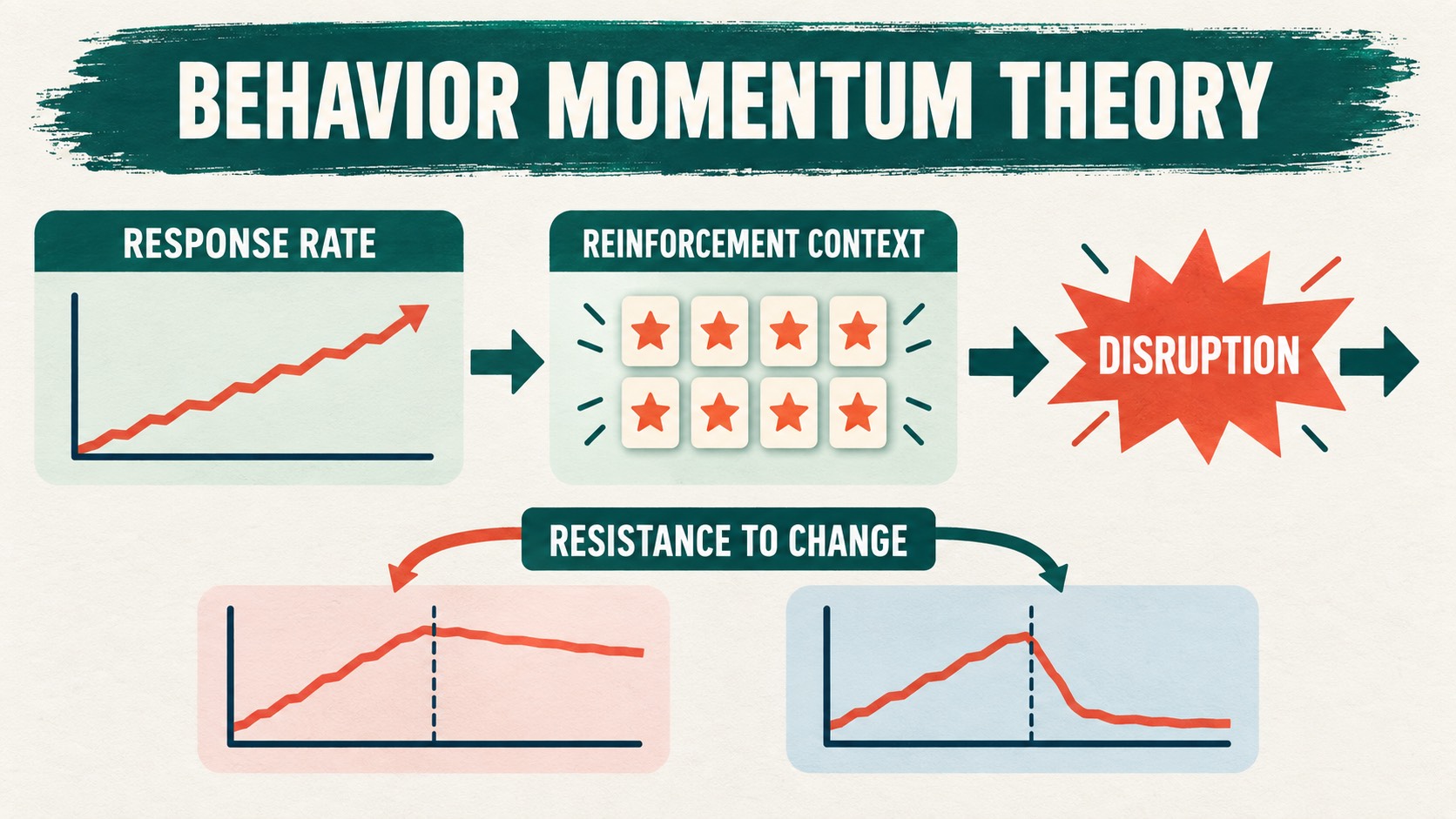
Use a five-step reasoning sequence when a question asks you to apply behavior momentum theory:
- Identify the context. Find the stimulus situation in which the behavior occurs, such as a component of a multiple schedule, a classroom activity, or a treatment condition.
- Describe the reinforcement history. Ask how frequently, how richly, and under what arrangement reinforcement has been obtained in that context. Do not reduce this to the last reinforcer delivered.
- Separate rate from persistence. Record whether the stem is talking about responses per minute, time engaged, or change after a disruption. These are not interchangeable outcomes.
- Locate the disruptor. Extinction, satiation, an added distraction, a context change, or another operation may challenge responding. The same disruptor can produce different changes across contexts.
- Compare relative change. Examine the response during disruption relative to its own baseline. The context with the smaller proportional decline shows greater resistance to change in that comparison.
That sequence is an interpretation aid, not a recipe for deliberately exposing a learner to distress or withholding needed care. In applied work, the professional must consider consent, risk, social validity, function, and the least intrusive effective approach. A theory question may use extinction or satiation as an experimental description, but an article about the theory should not turn that description into an unsupervised treatment recommendation.
How is the theory different from a high-probability request sequence?
High-probability request sequences are often called a practical use of behavioral momentum because a few requests that are likely to be followed can precede a low-probability request. However, the procedure is not identical to the theory. One is an arranged teaching or intervention procedure; the other is a framework for analyzing response rate, reinforcement context, and persistence.
| Question | Behavior momentum theory | High-probability request sequence |
|---|---|---|
| What is it? | A conceptual and quantitative account of response persistence. | A procedure that sequences easy requests before a harder request. |
| Main outcome | Resistance to change under a specified disruptor, considered separately from rate. | Often increased compliance with a low-probability request, if the arrangement is appropriate. |
| Typical mistake | Calling every fast response “high momentum.” | Using easy requests without checking function, reinforcement, assent, or task difficulty. |
The distinction also protects your writing from overclaiming. The presence of a high-probability sequence does not prove that a learner’s behavior has acquired greater resistance to all forms of disruption. It shows that a particular arrangement may influence performance in a particular context. Examine the procedure and the outcome separately.
How can you apply the theory to a BCBA exam scenario?
Imagine that a question describes two stimulus contexts. In both contexts, a learner completes a target response at roughly the same baseline rate. Context A has a richer history of reinforcement delivered in the presence of its discriminative stimulus. The examiner then introduces the same disruptor in both contexts and asks which response should be more persistent. The best answer is not selected from baseline rate alone; it depends on the relative change during the disruption.
| Scenario clue | Reasoning question | Likely interpretation |
|---|---|---|
| Same baseline rate in two contexts | Are rate and persistence being treated as the same measure? | No. Baseline rate alone does not identify response strength under disruption. |
| More reinforcement in Context A | Which stimulus–reinforcer relation is stronger? | Context A is predicted to show greater resistance to change, all else equal. |
| Responses decline after a disruptor | Which context shows the smaller proportional decline? | The smaller relative decline indicates greater persistence in that comparison. |
This example is intentionally abstract. It does not tell a practitioner to arrange a particular reinforcement schedule for a client. In clinical or educational work, the intervention must be based on assessment, evidence, client preferences, contextual fit, and safety. The theory helps you interpret a relation; it does not replace functional assessment or data-based decision making.
What does the BCBA exam expect you to recognize?
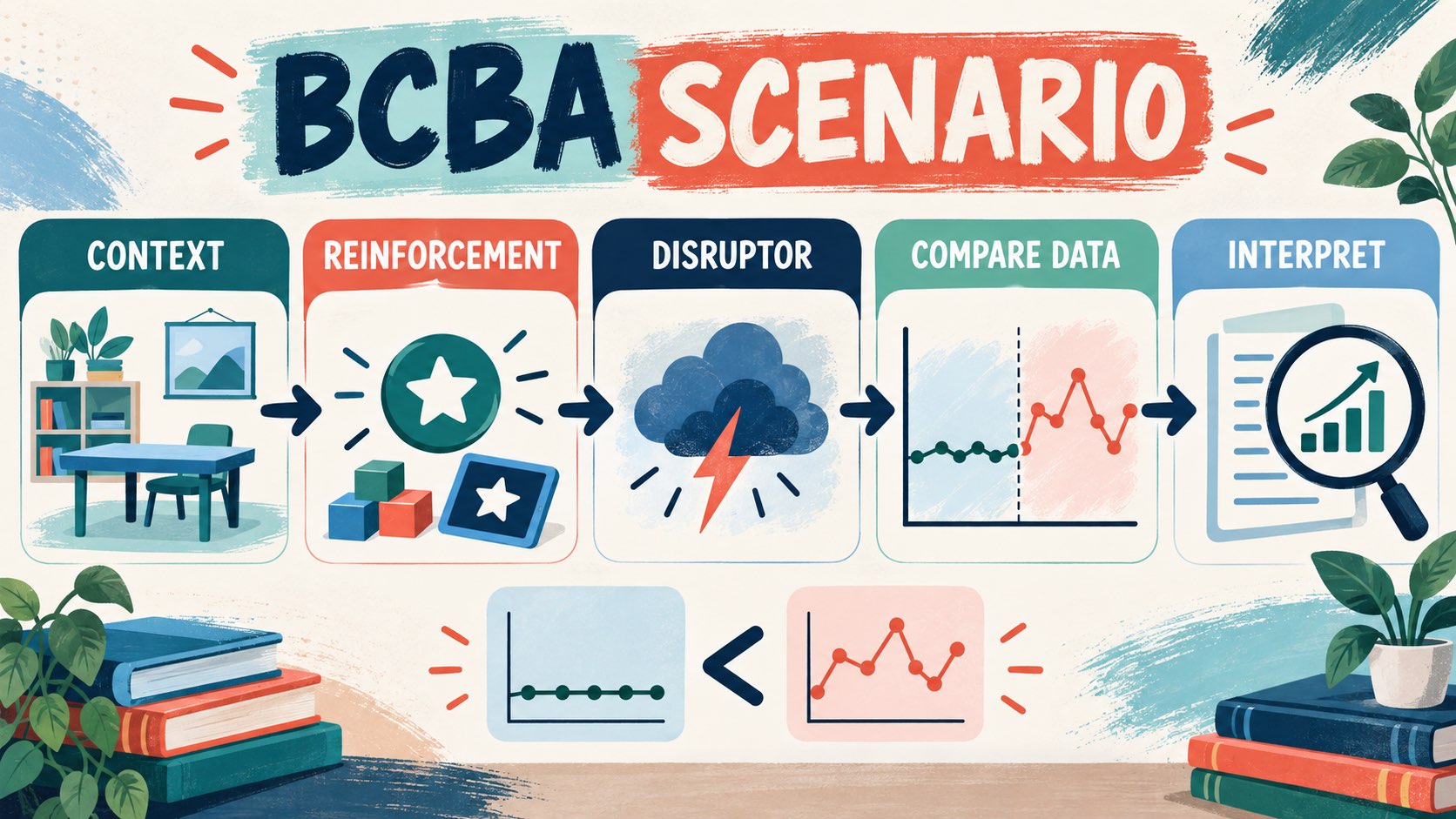
The current BACB BCBA Test Content Outline identifies behavioral momentum as a concept connected to understanding response persistence. A strong study answer should therefore connect the term to the correct level of analysis: reinforcement obtained in a stimulus context can influence persistence, while the direct response–reinforcer relation helps explain response rate. The outline is the exam framework; it is not evidence that the BACB has published the exact wording of a future question. On a scenario item, look for these clues:
- Context: a stimulus or schedule component is linked to a history of reinforcement.
- Disruption: the question describes extinction, satiation, distraction, or a comparable change.
- Relative comparison: the answer depends on the proportional change from baseline, not simply the largest raw rate.
- Conceptual boundary: the stem may mention compliance procedures, but a procedure and a theory are not synonyms.
What mistakes should you avoid?
- Equating speed with persistence: a high response rate is not automatically a high resistance-to-change measure.
- Confusing behavioral momentum theory with High-P: the theory can inform an application, but it is broader than one request sequence.
- Ignoring the context: the reinforcement history in the presence of a stimulus matters to the prediction.
- Comparing raw counts only: interpret change relative to each condition’s baseline.
- Turning a research model into a universal treatment: an applied decision still needs assessment, consent or assent as applicable, safety review, and data.
How should a BCBA use the theory responsibly?
Use behavior momentum theory as one layer of interpretation. Start with an operational definition and a measurement system that captures the dimension the question or case actually cares about. Then identify the relevant antecedent context, reinforcement history, and possible disruptor. If you are selecting or evaluating an intervention, consider whether the plan is socially valid, feasible for implementers, culturally responsive, and consistent with the person’s goals.
Also separate student or client outcome data from procedural-integrity data. If responding changes, ask whether the learner’s behavior changed, whether the context changed, and whether staff implemented the planned contingencies accurately. A theory-based explanation that ignores implementation fidelity can look elegant while leading to the wrong decision.
- Define the response: use an observable measure that matches the decision you need to make.
- Define the context: identify the relevant discriminative stimulus and reinforcement arrangement.
- Define the comparison: state the baseline and the disruptor before interpreting persistence.
- Check implementation: review procedural integrity before attributing a change to the theory.
Behavior momentum theory FAQ
Is behavior momentum the same as behavioral momentum?: In BCBA study materials, the terms are often used as near variants for the same conceptual area. The important issue is not the extra syllable; it is whether the writer explains response rate, reinforcement context, disruption, and resistance to change accurately.
Does behavior momentum theory mean behavior will always continue?: No. The theory predicts relative persistence under specified conditions. Behavior can still change when reinforcement, context, motivation, task requirements, or disruptors change. The prediction is conditional, not a guarantee.
Is a high-probability sequence proof of behavioral momentum?: No. A high-probability request sequence is an applied procedure. It may increase compliance with a difficult request, but that applied result should not be treated as proof that every aspect of the quantitative theory has been demonstrated.
What is the fastest way to remember the concept?: Use the cue “rate is how much; persistence is how lasting.” Then ask: what reinforcement history belongs to the context, what disruptor was introduced, and which condition shows the smaller relative decline?
Quick review: define the context, separate response rate from resistance to change, identify reinforcement history and the disruptor, compare relative change, and keep theory distinct from procedure. For a broader applied overview, read this behavior momentum theory and applied ABA overview, then use the free BCBA mock exam for practice and feedback. It is not an official BACB exam and does not guarantee certification or a passing result.
Take the Free BCBA Mock Exam
When you are ready to apply the idea, use the free practice resource below for additional feedback. Take the Free BCBA Mock Exam



