
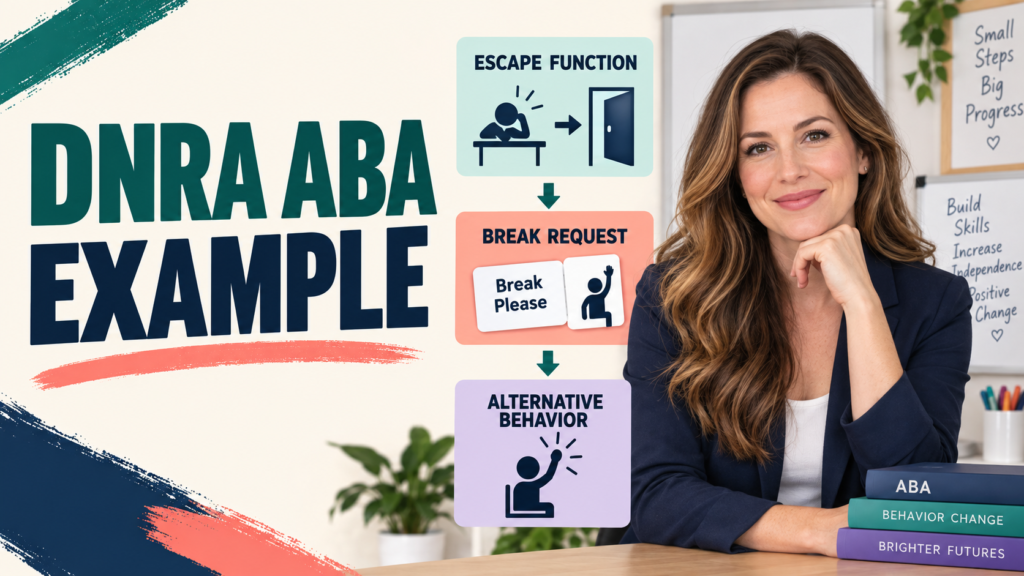
A DNRA ABA example shows how differential negative reinforcement of alternative behavior teaches an acceptable response that produces escape or a break when escape is the function of a problem behavior. The key is function matching: the replacement response must give the learner an efficient, meaningful way to contact the same type of outcome without requiring the problem behavior.
Table of Contents
- What Is a DNRA ABA Example?
- How Does Differential Negative Reinforcement of Alternative Behavior Work?
- What Does a Complete DNRA Example Look Like?
- How Do You Test Whether the Alternative Is Function Matched?
- How Is DNRA Different From DRA and DRO?
- What Should Be Measured in a DNRA Plan?
- What Are the Common DNRA BCBA Exam Traps?
- What Safety and Assent Boundaries Matter?
- DNRA ABA Example FAQ
- Quick Review Checklist
- Take the Free BCBA Mock Exam
In a study question, DNRA is not simply “reinforce a good behavior.” It is a specific differential-reinforcement arrangement in which a functionally relevant alternative behavior produces negative reinforcement, commonly a brief break from a demand. The plan still requires assessment, individualized definitions, data, safety planning, and professional oversight. This guide uses the current BCBA Test Content Outline for exam context and peer-reviewed behavior-analytic sources for the differential-reinforcement discussion. The learner example is fictional and educational, not a protocol for a particular person. Table of Contents
What Is a DNRA ABA Example?
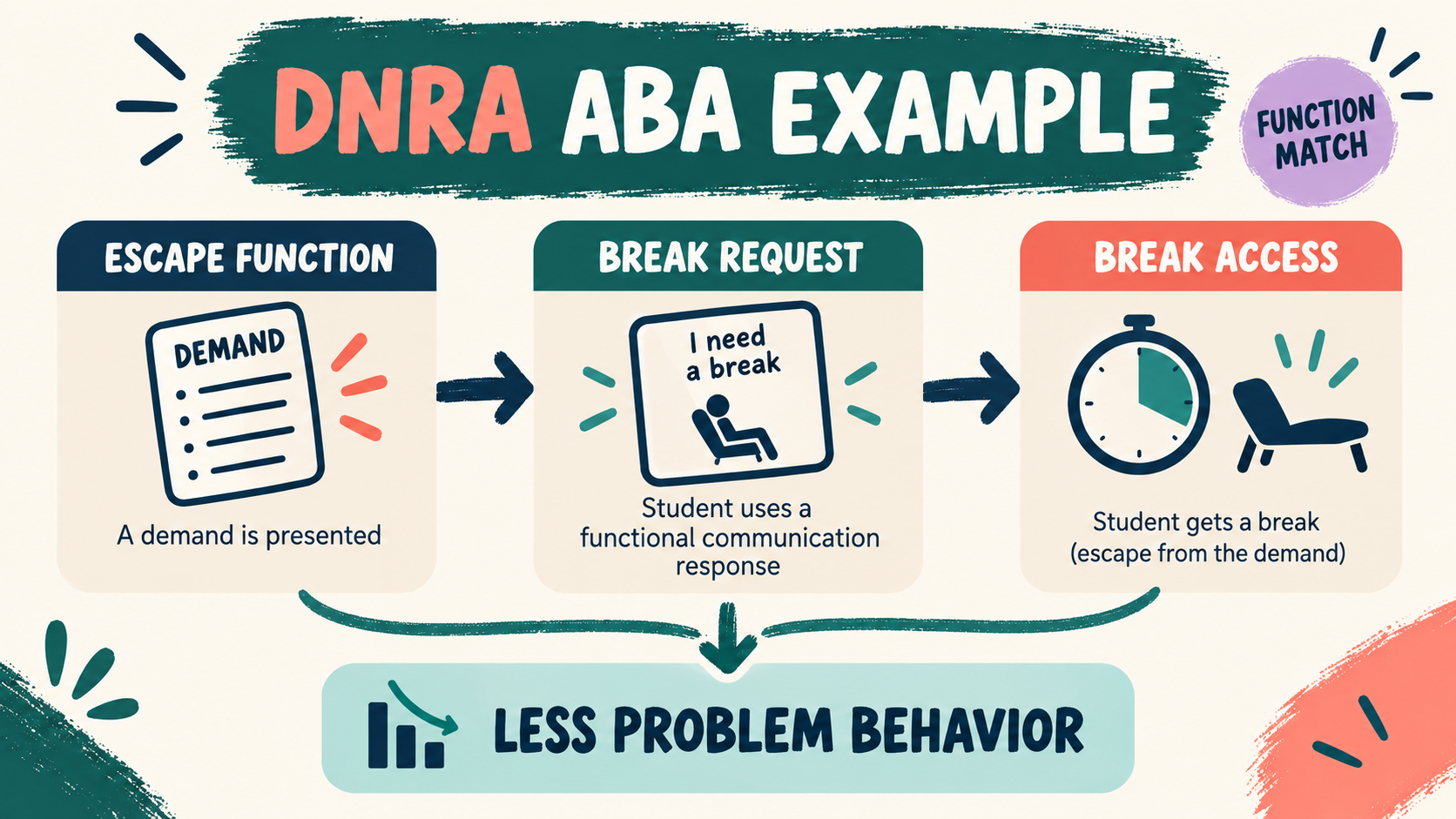
DNRA stands for differential negative reinforcement of alternative behavior. A DNRA ABA example has four essential parts:
- A target problem behavior has a likely escape or avoidance function.
- The team teaches an acceptable alternative response.
- The alternative response produces a functionally relevant escape outcome, such as a brief break.
- The team measures both the alternative response and the target behavior, then adjusts the plan using data.
“Negative” means that a stimulus is removed or postponed; it does not mean bad, punitive, or emotionally negative. “Reinforcement” means the consequence increases the future likelihood of the response. “Alternative” means the response is different from the target problem behavior. “Differential” means the consequences are arranged differently across response classes.
A useful one-line example is: When a difficult task is presented, a learner hands over a break card instead of throwing materials; the break card produces a brief break, so appropriate break requesting becomes more likely. That is only a DNRA example if the break is actually relevant to the escape function and the procedure is implemented as written.
How Does Differential Negative Reinforcement of Alternative Behavior Work?
DNRA is easiest to understand as a contingency map. The antecedent is often a task, instruction, transition, or other event associated with escape-maintained behavior. The alternative response may be a vocal request, sign, AAC selection, break card, help request, or another response that is feasible for the learner. The consequence is a removal, delay, reduction, or pause in the aversive demand, arranged according to the individualized plan.
The negative-reinforcement part is about what happens after the alternative response. If a break increases future break requests under similar conditions, it functions as a negative reinforcer for that alternative. The label depends on the measured effect and assessment-supported function.
DNRA should not be selected simply because a person refuses work. Refusal can reflect escape, communication difficulty, task mismatch, pain, sensory variables, fatigue, unclear instructions, or a reasonable attempt to communicate. Assessment and collaboration come before labeling the function. The current BACB framework emphasizes assessment-informed intervention selection, acceptable alternatives, treatment integrity, and data-based decisions. DNRA does not mean that every request ends the task forever. The arrangement must be feasible, safe, and individualized.
What Does a Complete DNRA Example Look Like?
Consider this fictional case used only to show the logic. During independent math work, Jordan frequently pushes materials to the floor after the teacher presents a worksheet. The behavior is more likely after difficult items and is often followed by the worksheet being removed while adults discuss what happened. A functional assessment is needed before drawing a causal conclusion, but suppose the assessment supports an escape-related hypothesis.
The team defines the target behavior operationally: pushing materials means using one or both hands to move a worksheet, pencil, or related work item at least 10 centimeters from its starting position. Examples and nonexamples help observers score it consistently. The team selects an alternative Jordan can perform quickly: handing over a “break please” card or selecting the equivalent AAC message. The initial teaching arrangement might look like this:
- Present a clearly defined, appropriately sized work demand.
- Prompt the break request early enough that Jordan can contact the communication response before pushing materials.
- When Jordan uses the break card, provide the planned brief break and record the response.
- After the break, return to the agreed task step or modified demand using the approved support.
- If pushing occurs, follow the safety and response plan; do not invent a consequence.
The example is DNRA because the alternative response is specifically reinforced with escape from or a pause in the demand. It would not be enough to give praise after the card while continuing the same demand if the hypothesized function is escape and the learner never contacts an escape-related consequence. Praise can be added, but it does not replace the function-matched component.
How Do You Test Whether the Alternative Is Function Matched?
Use the “same outcome, safer response” test carefully. The replacement does not need to look like the problem behavior. It needs to access a relevant outcome in an acceptable and efficient form. A break request can be function matched to escape behavior; a request for attention is not automatically matched to escape; a token may be useful but may not itself be the consequence that historically maintained the behavior.
| Question | What to check | DNRA example |
|---|---|---|
| What is the likely function? | Look at assessment data, not the label “refusal.” | Escape from difficult demands is supported as a working hypothesis. |
| What can the learner do? | The response must be observable, feasible, and teachable. | Hand a break card or select “break” on AAC. |
| What follows the alternative? | The consequence must match the function and be delivered consistently. | A planned brief break or demand pause. |
| What shows success? | The alternative increases and problem behavior decreases or becomes safer, without unacceptable side effects. | More independent requests, fewer or less severe pushes, and usable participation after the break. |
Function matching is not the same as giving the learner unlimited escape or assuming that all demands should disappear. The team must define how the break begins and ends, how work resumes, how prompts are faded, and what data will trigger a review. Those details belong in the approved plan, not in an improvised response.
How Is DNRA Different From DRA and DRO?
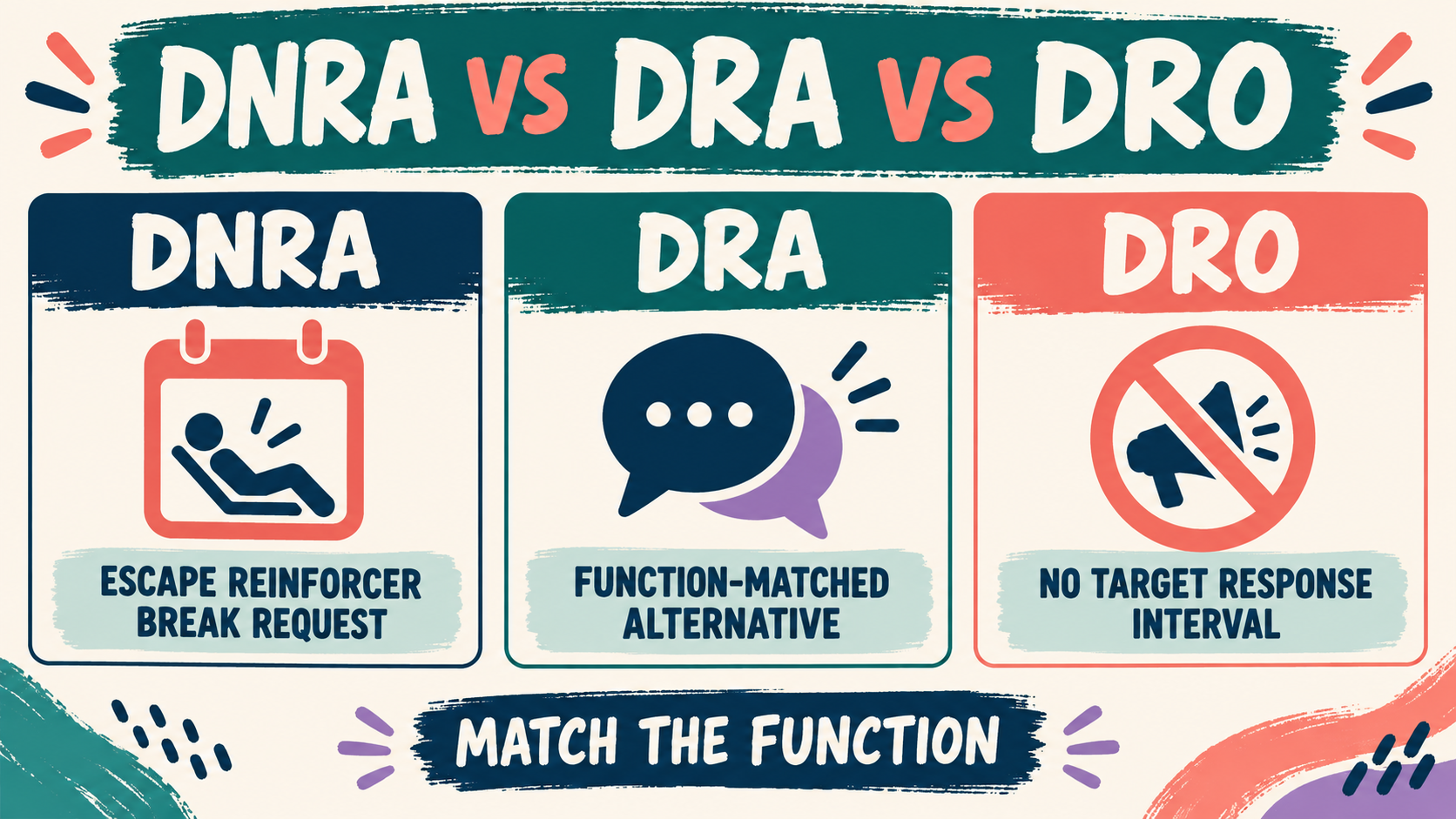
DNRA is a subtype or special case of differential reinforcement in which the relevant reinforcer is negative and the alternative response is reinforced. DRA is broader: it reinforces an alternative behavior, and the reinforcer may be positive, negative, or otherwise functionally relevant. DRO reinforces the absence of a target behavior for a specified interval or condition; it does not require a particular alternative response.
| Procedure | What is reinforced? | Typical exam clue |
|---|---|---|
| DNRA | A specific alternative response that produces a function-matched removal, escape, delay, or break. | “Request a break instead of throwing, and the demand is paused.” |
| DRA | A defined alternative behavior, with the consequence selected according to the plan. | “Reinforce an acceptable replacement response more strongly than the target.” |
| DRO | The absence of the target behavior during a defined interval or at a defined moment. | “Deliver reinforcement if the target did not occur during the interval.” |
Do not choose DNRA merely because a scenario mentions a break. The break must follow the alternative response in a way that fits the escape-related contingency. If reinforcement is delivered after any behavior other than the target, the question may be describing DRO. If a specific alternative earns attention, tokens, or another consequence, it may be DRA without being DNRA.
What Should Be Measured in a DNRA Plan?
A DNRA plan should make its decision rules visible. Define the target behavior, alternative response, prompt level, consequence, and observation context. Depending on the question, record frequency, rate, opportunity percentage, latency, duration, independent versus prompted requests, break length, task completion, or safety events.
For the fictional example, useful measures might include independent break requests per ten demand opportunities, prompted break requests, material-pushing episodes per session, the percentage of opportunities completed after a break, and the integrity with which staff honored the communication response. A decline in problem behavior cannot be interpreted confidently if staff stopped presenting demands, delivered breaks after problem behavior, or stopped recording opportunities.
Schedule thinning is another boundary. A rich initial schedule may help the alternative compete with problem behavior, but later changes require gradual decision rules. Communication access and safety cannot be treated as disposable, and research does not create one universal schedule for every learner.
What Are the Common DNRA BCBA Exam Traps?
Trap 1: confusing negative reinforcement with punishment. In DNRA, the escape or break is a consequence that can strengthen the alternative response. “Negative” describes removal, not a penalty. Trap 2: reinforcing the wrong response. If the plan says the break follows a break request but staff deliver it only after throwing, the contingency is not being implemented as described. The data may then reflect accidental reinforcement of the target.
Trap 3: selecting an alternative that is not function matched. Giving praise for a break request may be pleasant, but praise alone does not answer an escape-function question if the learner needs a workable way to pause or reduce the demand. Trap 4: calling absence of behavior DRA. A specific alternative response points toward DRA or DNRA. Reinforcement for not engaging in the target during an interval points toward DRO.
Trap 5: treating “extinction” as required in every DRA definition. Current behavior-analytic discussions distinguish differential reinforcement from a rigid requirement that extinction always be possible. The BCBA exam still expects careful attention to the contingency described, not a reflexive selection of extinction when the scenario does not support it.
What Safety and Assent Boundaries Matter?
Escape-maintained behavior can involve distress, self-injury, aggression, elopement, or unsafe conditions. A study article cannot determine whether a real demand should be continued, paused, modified, or discontinued. A qualified behavior analyst must consider medical variables, communication access, preferences, assent or consent, risk, feasibility, and the least restrictive effective arrangement.
Never withhold a needed communication response to make a data sheet look cleaner. If a plan creates escalation or side effects, the responsible professional should review and modify it rather than persist because the keyword says “DNRA.” Use the free BCBA mock exam as a practice checkpoint for identifying function-matched alternatives. It is a study aid, not an official BACB product and not a substitute for supervision or individualized assessment.
DNRA ABA Example FAQ
What is the simplest DNRA example?: A learner who engages in problem behavior to escape a difficult task is taught to request a break. When the learner uses the request, the planned break is provided. If the break strengthens the request and the arrangement is based on assessment, the example illustrates DNRA.
Is DNRA the same as DRA?: DNRA is narrower. Both reinforce an alternative response, but DNRA specifically uses a negative reinforcer, such as escape, removal, postponement, or a break. DRA is the broader alternative-behavior procedure.
Is a break card DNRA by itself?: No. A break card is a response form. It becomes part of a DNRA arrangement only when the alternative is taught and the planned escape-related consequence follows it in a function-matched, measurable contingency.
What is the one-sentence BCBA exam answer?: DNRA reinforces an acceptable alternative response with a function-matched negative reinforcer—often a break from an escape-related demand—instead of allowing the problem behavior to be the most efficient route to escape.
A strong DNRA ABA example always connects four points: the assessed escape function, an observable alternative response, a planned negative reinforcer, and data showing whether the alternative is increasing while risk and problem behavior are changing. If any of those links is missing, the scenario may describe a different differential-reinforcement procedure or an incomplete intervention plan.
Quick Review Checklist
Use this final checklist to turn dnra aba example into exam-ready reasoning. The goal is not to memorize a label in isolation; it is to identify the relevant evidence and explain why the best answer fits the scenario. Key ideas to review:
- State the central definition or decision point for dnra aba example in your own words.
- Identify the detail that makes dnra aba example different from its closest related ABA term.
- Separate the observable facts in a scenario from assumptions that are not supported by the facts.
- Write one example and one nonexample so you can recognize the concept in a new setting.
Exam application checks:
- Ask what the question is actually requesting before comparing the answer choices.
- Mark the antecedent, response, consequence, or other evidence that supports the selected answer.
- Look for a distractor that describes a related process but does not answer the specific question.
Final self-check:
- Explain how you would verify the interpretation with clear observations or data.
- Change one detail in the scenario and decide whether your answer should change.
- Give a one-sentence rationale that a supervisor or study partner could evaluate.
Take the Free BCBA Mock Exam
When you are ready to apply the idea, use the free practice resource below for additional feedback. Take the Free BCBA Mock Exam



