

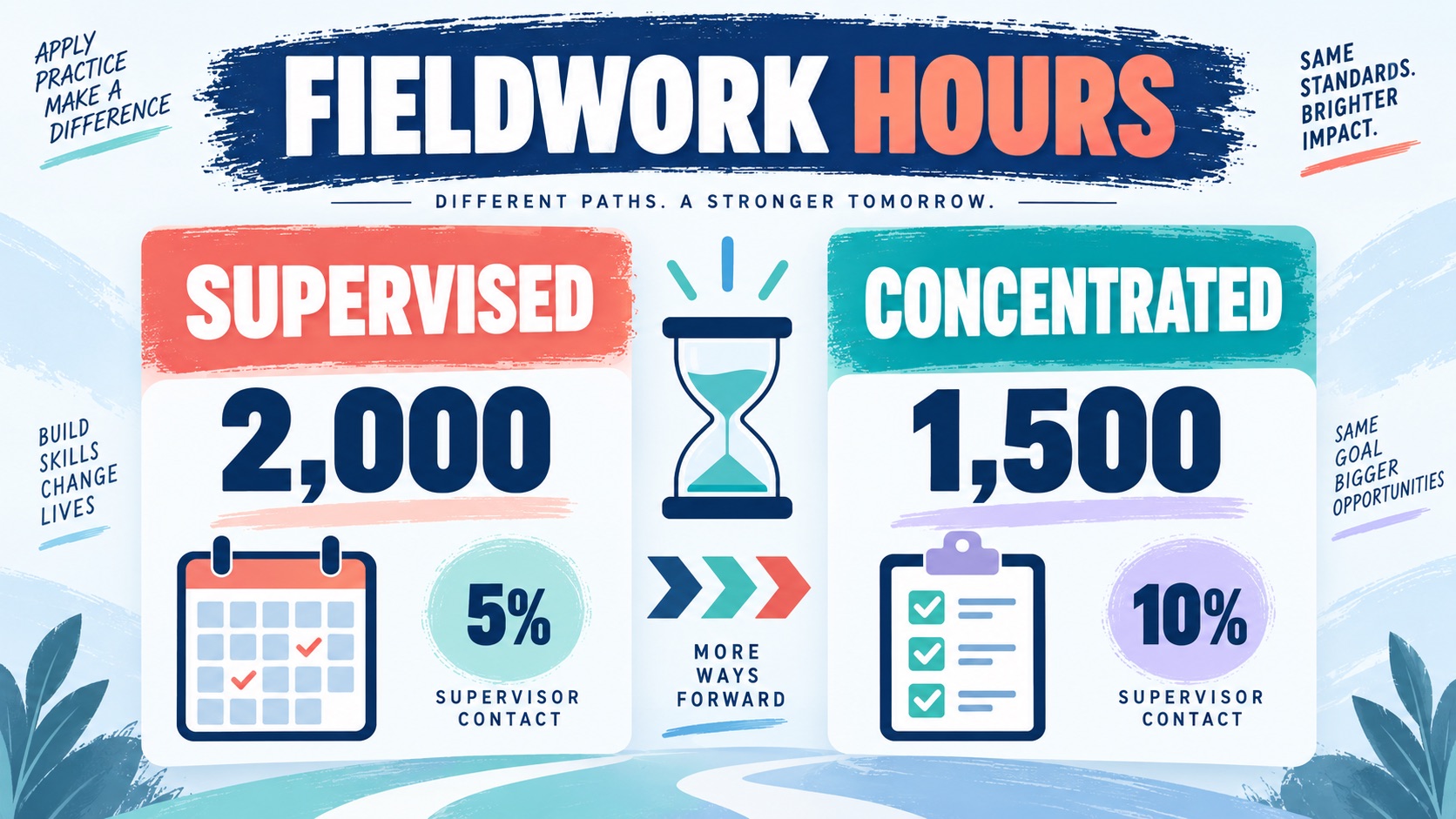
BACB hour requirements depend on the fieldwork type and the rules that apply when you apply. Under the current BCBA Handbook, most candidates complete either 2,000 hours of Supervised Fieldwork or 1,500 hours of Concentrated Supervised Fieldwork, or a permitted combination. The monthly supervision percentage, contacts, observations, documentation, and unrestricted-activity rules matter just as much as the headline total.
Table of Contents
- BACB hour requirements: the short answer
- What are the current 2026 BCBA hour requirements?
- Supervised Fieldwork versus Concentrated Supervised Fieldwork
- How do monthly supervision requirements work?
- How many unrestricted hours are required?
- When can you start counting fieldwork hours?
- How should you document your hours?
- What changes in the 2027 BCBA hour requirements?
- Which fieldwork option should you choose?
- Common hour-counting mistakes
- How to study hour requirements
- BCBA hour requirements FAQ
- Quick Review Checklist
- Take the Free BCBA Mock Exam
Applicants planning for 2027 must use the published 2027 requirements and the current transition guidance. The totals remain 2,000 and 1,500, but several monthly details change, including the concentrated-supervision percentage, the monthly maximum, observation minutes, supervisor-consultation conditions, and fieldwork forms. This guide separates the two versions so you can plan without relying on a number copied from an older article. Table of Contents
BACB hour requirements: the short answer
For the current BCBA certification requirements, the headline fieldwork choices are:
- Supervised Fieldwork: 2,000 hours.
- Concentrated Supervised Fieldwork: 1,500 hours.
- Combination: a permitted mixture, calculated using the BACB’s conversion method.
Those totals are not a free-standing hour bank. The hours only qualify when the supervision structure, supervisor, contacts, observations, activities, documentation, and applicable forms meet the relevant handbook. The BACB states that applicants must meet all current fieldwork requirements when they apply, regardless of when the hours were earned. That is why the application date and handbook version belong at the top of your tracking plan.
Use the official BCBA Handbook and the 2027 BCBA Requirements page as the primary sources. A study guide can explain the math, but it cannot change which version of the rules applies to your application.
What are the current 2026 BCBA hour requirements?
The current BCBA Handbook updated in June 2026 describes a one-calendar-month supervisory period and the following overview. Read the detailed fieldwork section for supervisor qualifications, acceptable activities, contracts, documentation, and exceptions.
| Requirement | Supervised Fieldwork | Concentrated Supervised Fieldwork |
|---|---|---|
| Total hours | 2,000 | 1,500 |
| Fieldwork per month | 20–130 hours | 20–130 hours |
| Supervisor contacts per month | 4 contacts | 6 contacts |
| Supervision percentage | 5% | 10% |
| Client observation | 1 observation | 1 observation |
| Individual supervision | At least 50% of supervised time | At least 50% of supervised time |
The current handbook also requires at least 60% of overall supervised fieldwork to be unrestricted activities. That percentage is measured across the total accumulated fieldwork, not necessarily achieved in every calendar month. Under the current pathway 4 rules, a qualifying applicant may have a 500-hour Supervised Fieldwork requirement, but pathway eligibility is a separate question and must be verified in the handbook.
Supervised Fieldwork versus Concentrated Supervised Fieldwork
Supervised Fieldwork and Concentrated Supervised Fieldwork are different fieldwork types, not two names for the same monthly schedule. Concentrated fieldwork requires more supervision in each period but has a lower total-hour target. A candidate should choose based on the availability of a qualified supervisor, the quality of the setting, realistic scheduling, and the application rules—not simply because 1,500 looks faster.
If you mix the two types, the BACB’s current documentation guidance explains how to estimate progress: total the Concentrated Supervised Fieldwork hours, multiply that total by 1.33 for BCBA planning purposes, and add the Supervised Fieldwork hours. Use the conversion only for estimating whether you are approaching the total requirement. Record actual hours on the official forms and keep the fieldwork type identified. Do not rewrite a form to show the adjusted number.
Each fieldwork type must still meet its own monthly requirements. Hours cannot become eligible simply because the converted total looks high. If a month fails a required supervision percentage or observation condition, work with the supervisor to adjust the qualifying hours using the method in the current handbook. Concentrated fieldwork cannot be casually prorated or treated as a flexible multiplier.
How do monthly supervision requirements work?
The supervisory period is one calendar month. For current Supervised Fieldwork, the handbook describes at least four supervisor-trainee contacts and 5% supervision. For current Concentrated Supervised Fieldwork, it describes at least six contacts and 10% supervision. At least half of the supervision meeting time must be individual, so a schedule made entirely of group meetings does not satisfy the individual-supervision rule.
At least one supervisor must observe you working with a client during each supervisory period. The observation may be in person or use an allowed video format, but the arrangement must satisfy the relevant fieldwork and supervision conditions. A recorded video watched without real-time interaction may count differently from a live supervision meeting with immediate feedback. The BACB advises trainees to work with their supervisor to determine how an activity should be categorized.
The supervisor must be qualified for the role and the fieldwork type. The current resources describe an active BCBA with no current disciplinary sanctions and additional certification or consultation conditions. Supervisors also need the required supervision training before supervising fieldwork trainees. Confirm qualifications before you begin, not after several months of hours have accumulated.
How many unrestricted hours are required?
For the standard current BCBA fieldwork requirement, at least 60% of the total supervised fieldwork must be unrestricted activities. If your plan is based on 2,000 Supervised Fieldwork hours, that means at least 1,200 hours must be unrestricted. The percentage is calculated over the total fieldwork, so the monthly mix can vary, but your tracking system should show whether you are on pace.
Unrestricted activities are activities that more closely represent what a BCBA does after certification. Examples may include conducting or analyzing assessments, developing behavior programs, training caregivers or staff, reviewing data for programming decisions, and meeting with clients about behavior-analytic services. Whether a task is restricted or unrestricted can depend on context. Ask the supervisor before counting an ambiguous activity.
Do not fill the unrestricted category with reading, podcasts, generic administrative work, role-play unrelated to real clients, or a simulated exercise that does not meet the handbook’s fieldwork requirements. The purpose of the hours is competency development with real behavior-analytic practice, not merely accumulating a large number in a spreadsheet.
When can you start counting fieldwork hours?
Under the current handbook, trainees may not begin accumulating fieldwork hours until the required starting conditions are met. These generally include securing a qualified supervisor, developing and signing a supervision contract with each supervisor, and beginning qualifying graduate-level behavior-analytic coursework for the applicable pathway. The handbook also describes a separate condition for pathway 4 candidates.
A job title is not the same as a fieldwork arrangement. Working as an RBT or behavior technician does not automatically turn every paid service hour into BCBA fieldwork. The activity, supervision contract, supervisor qualifications, documentation, and applicable RBT or BCaBA rules all matter. Some hours may satisfy more than one requirement only when all sets of rules are met; never assume that “double dipping” is automatic.
How should you document your hours?
Set up the documentation system before the first month closes. Track the fieldwork type, total hours, supervision percentage, individual and group time, contacts, client observation, activity category, supervisor, setting, and required signatures. If multiple supervisors or settings are involved, confirm who is the responsible supervisor and which monthly and final forms apply.
The BACB’s fieldwork documentation guidance says monthly forms must be signed by the deadline stated in the current process and that trainees and supervisors should retain copies for the required period. A missing monthly verification form can make those hours unusable in an audit. Save the final form, open the saved file to confirm that the data is present, and keep a backup that is easy to locate.
Do not wait for an audit to discover that your tracker used the wrong formula. Compare your personal record with the current handbook, ask the supervisor to review the monthly totals, and preserve the evidence supporting any correction. The person who signs the form is making an attestation, so the record should be understandable to someone who was not present at every meeting.
What changes in the 2027 BCBA hour requirements?
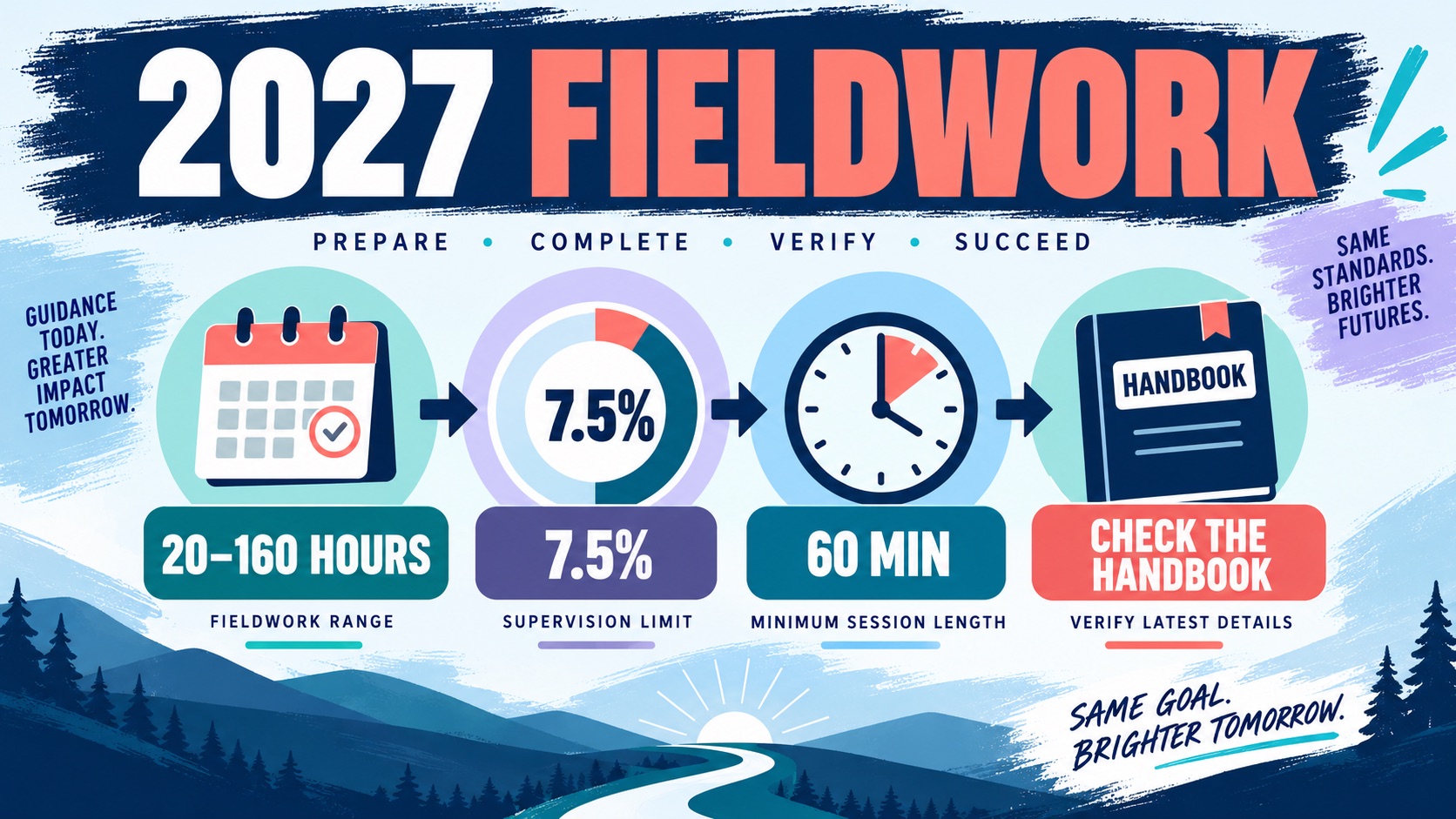
The 2027 BCBA requirements keep the headline totals at 2,000 Supervised Fieldwork hours or 1,500 Concentrated Supervised Fieldwork hours, but the monthly details change. The official table for applications under the 2027 rules lists the following differences:
| Item | 2027 Supervised | 2027 Concentrated |
|---|---|---|
| Total hours | 2,000 | 1,500 |
| Fieldwork per period | 20–160 hours | 20–160 hours |
| Supervision percentage | 5% | 7.5% |
| Client observation | 60 minutes cumulative | 90 minutes cumulative |
| Individual supervision | At least 50% of supervised hours must be individual | |
The 2027 page also describes supervisor qualifications, the requirement for at least 60% unrestricted activities, and new monthly and final fieldwork verification forms for applicants after January 1, 2027. A new BCBA with less than one year of certification may need monthly consultation with a qualified consulting supervisor under the 2027 route. Check the transition guidance before deciding which forms or totals apply to you.
The BACB says significant eligibility and maintenance changes take effect January 1, 2027. To be reviewed under the current 2022 requirements, a complete application—including payment and required documents—must be received by December 31, 2026. That is a transition rule, not permission to submit incomplete records. Put the application date, document deadline, and applicable fieldwork version in writing.
Which fieldwork option should you choose?
Choose the option you can complete accurately and sustainably. Concentrated fieldwork may reduce the headline total, but it requires a higher monthly supervision percentage under the current rules. A setting with excellent client access, a qualified supervisor, and consistent documentation is usually more valuable than a nominally faster plan that repeatedly misses monthly conditions. Use this decision sequence:
- Identify the application date and handbook version that will control your application.
- Confirm that a qualified supervisor is available for the entire arrangement.
- Check whether the setting can provide real clients, required observations, and enough unrestricted activities.
- Calculate the monthly supervision, contacts, individual time, and fieldwork range before signing the contract.
- Choose the fieldwork type only after the supervisor agrees that the documentation plan is workable.
Common hour-counting mistakes
- Using 1,500 as a universal answer: that number belongs to Concentrated Supervised Fieldwork, not every BCBA pathway.
- Mixing versions: combining current 10% concentrated supervision with the 2027 7.5% rule without checking the application route creates an invalid plan.
- Counting paid hours automatically: employment hours count only when the fieldwork requirements are satisfied.
- Forgetting unrestricted activities: a large total can still fail if the 60% requirement is not met.
- Counting an observation without a contract: the supervisor and trainee must have the required supervision arrangement in place.
- Using the 1.33 conversion on official forms: use it for planning, while recording actual hours on the forms.
- Trusting a tracker without checking it: software is not BACB approval; compare calculations with the handbook and supervisor.
How to study hour requirements
Build a one-page comparison sheet with four columns: fieldwork type, total hours, monthly rules, and documentation. Then add a separate 2027 column. Practice questions should ask you to distinguish totals from monthly conditions, actual hours from converted planning values, and current requirements from transition requirements.
After reviewing the official tables, use a free BCBA mock exam to practice under time pressure. When you miss an hour question, label the error: total-hour confusion, fieldwork-type confusion, monthly-supervision confusion, unrestricted-activity confusion, or date/version confusion. The practice resource is educational support and is not BACB approval, legal advice, licensure advice, or a guarantee of a passing score.
BCBA hour requirements FAQ
How many hours are required for BCBA certification?: Under the current and published 2027 overview, the standard choices are 2,000 Supervised Fieldwork hours or 1,500 Concentrated Supervised Fieldwork hours, with a permitted combination in some situations. Monthly requirements must also be met.
Is concentrated fieldwork faster?: It has a lower total-hour target, but it requires a different and more intensive supervision schedule. “Faster” depends on whether your setting can consistently meet the applicable monthly percentage, contacts, observation, and documentation rules.
How many unrestricted hours does a BCBA trainee need?: At least 60% of total supervised fieldwork hours must be unrestricted under the current handbook and the published 2027 overview. For a 2,000-hour plan, that equals at least 1,200 unrestricted hours.
Can I combine supervised and concentrated hours?: The BACB permits combinations when the applicable requirements are met. For BCBA planning, the current documentation guidance uses a 1.33 multiplier for concentrated hours when estimating progress; record actual hours and fieldwork type on the official forms.
Do the 2027 changes alter the total hours?: The published 2027 overview keeps the 2,000 and 1,500 headline totals but changes several monthly conditions and forms. Check the transition guidance and your application date before choosing a calculation.
The reliable answer to “What are the BACB hour requirements?” is therefore not one isolated number. Start with the application version, choose the fieldwork type, verify the supervisor and contract, meet every monthly condition, track unrestricted activities, and preserve the forms. That source-first process protects the hours you have worked and keeps your BCBA plan aligned with the rule set that will actually review your application.
Quick Review Checklist
Use this final checklist to turn bacb hour requirements into exam-ready reasoning. The goal is not to memorize a label in isolation; it is to identify the relevant evidence and explain why the best answer fits the scenario. Key ideas to review:
- State the central definition or decision point for bacb hour requirements in your own words.
- Identify the detail that makes bacb hour requirements different from its closest related ABA term.
- Separate the observable facts in a scenario from assumptions that are not supported by the facts.
- Write one example and one nonexample so you can recognize the concept in a new setting.
Exam application checks:
- Ask what the question is actually requesting before comparing the answer choices.
- Mark the antecedent, response, consequence, or other evidence that supports the selected answer.
- Look for a distractor that describes a related process but does not answer the specific question.
Final self-check:
- Explain how you would verify the interpretation with clear observations or data.
- Change one detail in the scenario and decide whether your answer should change.
- Give a one-sentence rationale that a supervisor or study partner could evaluate.
Take the Free BCBA Mock Exam
When you are ready to apply the idea, use the free practice resource below for additional feedback. Take the Free BCBA Mock Exam



