

Short answer: If you are asking, “Is BCBA certification worth it?,” the answer can be yes when you want to practice behavior analysis at the graduate level, can complete the education and supervised fieldwork requirements, and are comfortable with ongoing ethical and professional responsibility. It is not automatically worth it because a job advertisement lists a higher salary. The value depends on fit, total cost, time, local licensure, the work you actually want to do, and your ability to finish the pathway.
Table of Contents
- Is BCBA Certification Worth It for You?
- What Does the BCBA Credential Actually Provide?
- What Is the Full Commitment Beyond Tuition?
- How Does the 2027 Transition Affect the Decision?
- Who Is Most Likely to Find the Path Worthwhile?
- How Can You Test the Fit Before Enrolling?
- Which Decision Mistakes Should You Avoid?
- Is BCBA Certification Worth It FAQ
- Sources Checked for This Decision Guide
- Take the Free BCBA Mock Exam
The better question is not “Does every BCBA earn back the investment?” It is “Does this credential solve the career problem I actually have?” A careful answer should include the daily work, the education and fieldwork commitment, examination preparation, maintenance requirements, and the January 1, 2027 eligibility transition. It should also leave room for a different ABA role if the BCBA scope is not the right fit. Table of Contents
Is BCBA Certification Worth It for You?
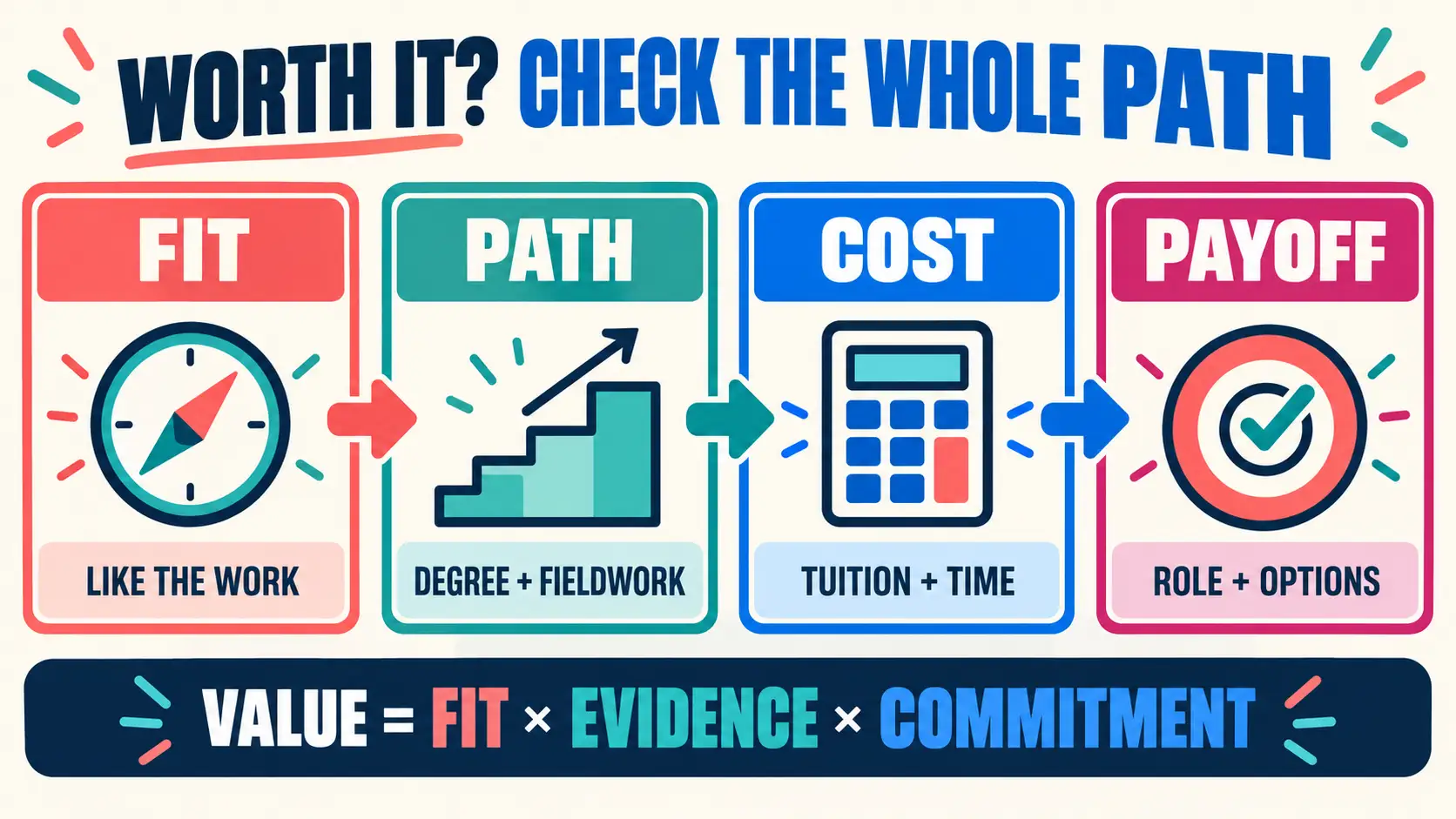
For many people, the answer is a conditional yes. The credential may be valuable when it opens the type of behavior-analytic role you want and when you have a realistic plan for the work required to obtain and maintain it. The same credential can be a poor investment when the main motivation is a promised salary, when the available supervision is weak, or when the day-to-day work does not match what you enjoy.
| Decision area | A promising signal | A reason to pause |
|---|---|---|
| Work fit | You want to assess behavior, analyze data, design interventions, collaborate, and supervise within your scope. | You mainly want a title or salary and have little interest in measurement, caregiver collaboration, or clinical responsibility. |
| Path readiness | You can identify a qualifying graduate route, a credible supervisor, and a way to document fieldwork. | The program cannot explain its pathway, the supervision arrangement is vague, or the hours depend on an unsupported promise. |
| Long-term value | The credential supports a role, setting, or responsibility you have researched in your location. | You have not checked state licensure, employer expectations, payer limits, or continuing-education obligations. |
Think of the decision as a chain. If work fit is strong but the education route is not verified, the decision is not ready. If the route is sound but you dislike the daily job, a higher credential will not solve that mismatch. If both are strong but the financial plan cannot absorb the time and tuition, you may need a slower route, employer support, or a different timing decision.
What Does the BCBA Credential Actually Provide?
The BCBA is a graduate-level professional certification issued by the Behavior Analyst Certification Board. It signals that the certificant has met the applicable eligibility requirements and passed the BCBA examination. The credential can support independent behavior-analytic practice and supervision of BCaBAs and RBTs within the relevant rules, but it is not the same thing as a university degree or a state license.
That distinction is central to the “worth it” decision. A program may award a master’s degree, a graduate certificate, or coursework that supports an eligibility pathway. None of those labels alone guarantees BCBA eligibility. Likewise, holding BCBA certification does not automatically satisfy every state’s behavior-analyst licensure requirement. Before enrolling, check the BACB pathway and the state or employer rules that govern the work you want to perform.
The credential may create access to responsibilities such as behavior assessment, intervention design, data-based clinical decisions, staff or caregiver training, supervision, and program leadership. Those responsibilities also create obligations: accurate measurement, ethical practice, documentation, collaboration, competence, and continuing education. Value comes from the combination of opportunity and responsibility, not from the letters alone.
- Certification: a national professional credential with BACB requirements and maintenance rules.
- Degree: an academic award from a university; it may or may not be part of a BCBA eligibility route.
- State license: a jurisdiction-specific authorization that can add requirements beyond BACB certification.
- Job title: an employer’s role label that should not be treated as proof of credential scope.
For a broader orientation, see the existing Behavior Analyst Certification Board and BCBA guide. This article narrows the question to value and readiness so it does not repeat a step-by-step certification page.
What Is the Full Commitment Beyond Tuition?
Tuition is only one line in the decision. A realistic plan includes the cost of qualifying education, books and technology, application and examination fees, supervision or fieldwork-related costs, travel or schedule changes, and the income or opportunities you may give up while completing the route. The exact numbers vary by program, employer, location, pathway, and year, so a single national total can create false confidence.
Time is also a real cost. You may need to balance graduate coursework with supervised fieldwork, paid employment, documentation, exam preparation, and personal responsibilities. Ask a program or employer to explain how candidates actually obtain qualifying hours, who supervises them, what happens when a client or supervisor changes, and how records are reviewed. “We can help you get hours” is not a complete plan.
| Line item | Question to answer | Evidence to save |
|---|---|---|
| Education | What degree or coursework route fits your intended pathway and 2027 timing? | Program status, curriculum, tuition schedule, and written pathway explanation. |
| Fieldwork | Who will supervise, where will qualifying activities occur, and how will monthly records be protected? | Contract, supervisor credentials, activity plan, forms, and review process. |
| Exam | How much weekly study time can you protect after work and fieldwork? | A calendar with practice blocks, review time, and a realistic exam window. |
| Maintenance | What continuing education, ethics, supervision, and renewal tasks will continue after certification? | Current handbook section, renewal calendar, employer expectations, and budget. |
Do not turn this worksheet into a promise of return on investment. Use it to expose unknowns. The most expensive surprise is often not a fee; it is discovering late that the program, supervisor, schedule, or jurisdiction does not support the route you thought you purchased.
How Does the 2027 Transition Affect the Decision?
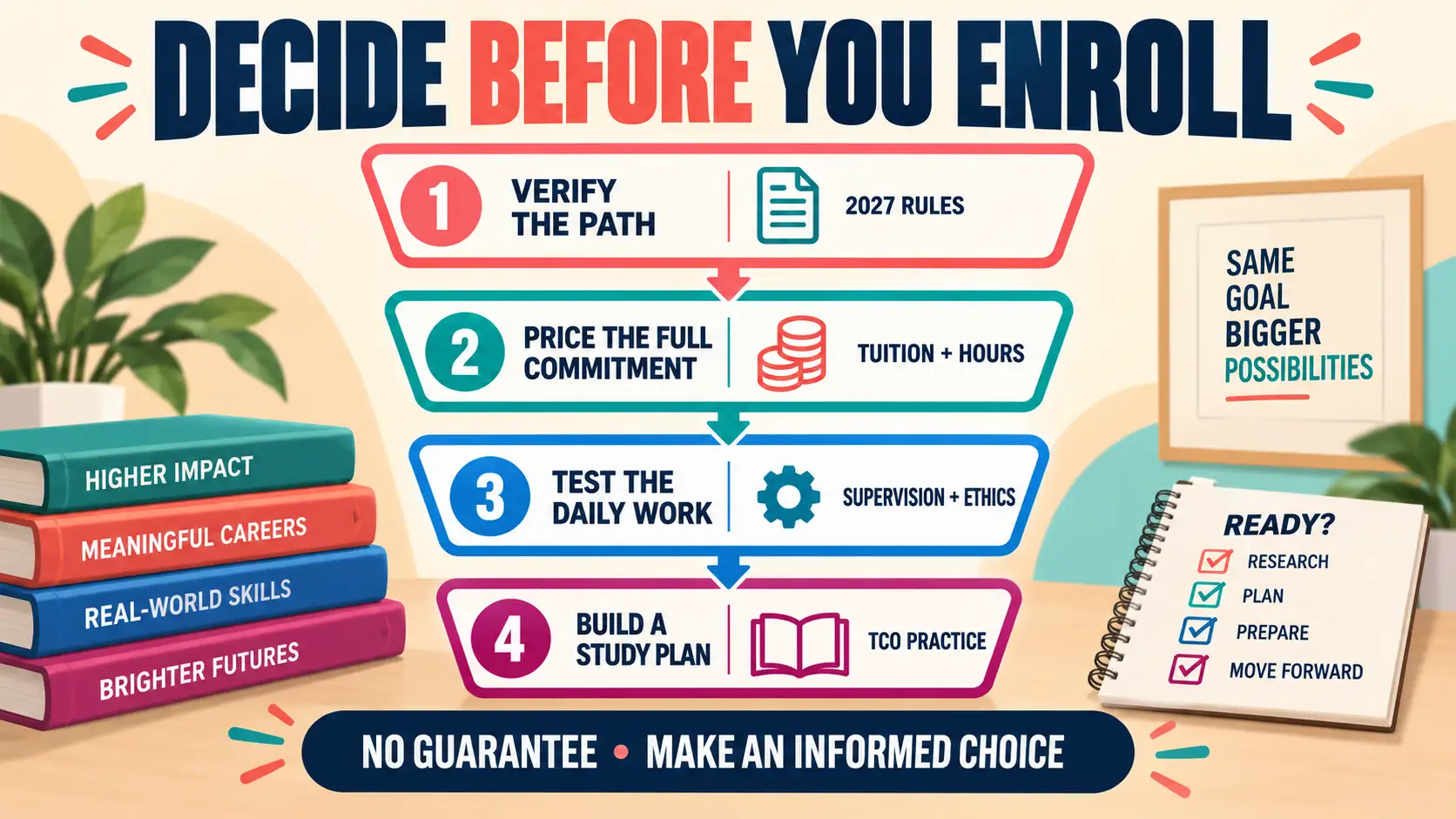
The 2027 transition makes the timing question more important. The BACB’s current guidance says that beginning January 1, 2027, BCBA applicants use two eligibility pathways: a qualifying accredited or recognized degree route, or a behavior-analytic coursework route. Pathways 3 and 4 are not available for new applications after the transition. The 2027 coursework and fieldwork rules also introduce details that a program should be able to explain in writing.
This does not mean that every candidate should rush to apply before 2027. A rushed, incomplete application is not a safer investment decision. It means you should identify which requirement set applies to your realistic application date, confirm the current documents, and ask your university or supervisor how they handle the transition. The official transition guide is a planning resource; a formal application review remains the BACB’s decision.
| If you are considering… | Verify before paying or changing course |
|---|---|
| Applying under the current requirements | Whether every required item can be completed and received by the transition boundary. |
| Applying on or after January 1, 2027 | Whether your degree, coursework, fieldwork, forms, and attestation meet the 2027 route. |
| Choosing an online program | Who provides supervision and how real client-based fieldwork and records are handled. |
Requirements changes are separate from examination-content changes. Continue to use the current BCBA Test Content Outline and official examination information for study decisions. A program that uses “2027” in its marketing should still show you which requirement source it means and how that source affects your application.
Who Is Most Likely to Find the Path Worthwhile?
The strongest candidates are not necessarily the ones who already know every technical term. They are the ones who can connect the credential to a specific work plan and are willing to build competence slowly. You may be a good fit if several of these statements are true:
- You enjoy asking what variable may be influencing behavior and how to measure it.
- You can tolerate repeated observation, data review, and revision instead of relying on intuition alone.
- You want to teach or supervise ethically, not simply direct other people’s work.
- You have researched the setting and population where you hope to practice.
- You can identify a credible education and supervised-fieldwork route.
- You are prepared to study for an examination and keep learning after certification.
You may want to pause if your plan depends on an unverified “guaranteed hours” promise, if the total cost is already unsafe for your household, or if the daily work sounds unlike the role you want. Pausing is not failure. It can prevent a large commitment from becoming a sunk-cost problem.
How Can You Test the Fit Before Enrolling?
A short, low-risk investigation is more useful than reading only success stories. Before you sign an enrollment agreement, complete these checks:
- Interview two working BCBAs: ask what they do during a normal week, which responsibilities are most difficult, and what they wish they had verified earlier.
- Read the role description: compare assessment, data, caregiver, supervision, documentation, travel, and schedule expectations with your preferences.
- Request the pathway in writing: ask the program to identify the applicable BACB pathway, supervisor arrangement, fieldwork records, and transition plan.
- Calculate a conservative schedule: include school, fieldwork, work, commuting, family care, and recovery time.
- Try a small study sample: read the current TCO, answer a few practice questions, and inspect the rationales. This does not predict your official score, but it reveals whether the learning process is tolerable and interesting.
When you use practice material, treat it as a diagnostic tool. A missed question should lead to a concept review and a new example, not to a promise that a score on a mock exam predicts certification. If you want a structured first check, the free BCBA mock exam can help you see which TCO areas deserve study time.
Which Decision Mistakes Should You Avoid?
Career pages often compress a multi-year professional route into a salary headline. Avoid these common shortcuts:
- Choosing a program because it says “BCBA” without verifying the actual eligibility pathway.
- Treating a master’s degree, graduate certificate, and BACB certification as interchangeable.
- Using a national salary estimate as a personal offer or return-on-investment guarantee.
- Ignoring state licensure or employer requirements until after graduation.
- Assuming supervision hours will appear automatically after enrollment.
- Rushing toward an old requirement set without a complete, realistic application plan.
- Underestimating documentation, ethics, feedback, and continuing-education work.
- Buying exam preparation before confirming which TCO and eligibility documents apply.
A sound choice is not the choice with the most enthusiastic marketing. It is the choice whose pathway, evidence, daily work, timing, and total commitment you can explain to another person without relying on a promise.
Is BCBA Certification Worth It FAQ
Is BCBA certification worth it if I mainly want a higher salary?: Salary can be one factor, but it is not a safe stand-alone reason. Compare realistic local roles, total education and fieldwork costs, time to completion, benefits, schedule, licensure, and the responsibilities you would actually accept. A higher advertised range does not guarantee a personal offer.
Does a BCBA certification guarantee a job?: No. It can qualify you for roles that require or prefer the credential, but employment depends on location, experience, setting, licensure, employer needs, and your competence. The BACB credential is not a placement guarantee.
Should I wait until after the 2027 requirements change?: There is no universal best date. Compare your realistic application timeline with the official current and 2027 requirements. If your application will cross the transition, plan for the newer rules and confirm the form, attestation, coursework, and fieldwork details with the BACB and your program.
Bottom line: BCBA certification is most likely to be worth it when it matches the work you want, the pathway is verified, the commitment is financially and personally realistic, and you are willing to keep learning after the exam. Make that decision first; then use focused practice to prepare for the part of the pathway you have chosen.
Sources Checked for This Decision Guide
- BACB 2027 BCBA Requirements — current eligibility and maintenance overview.
- Guidance for Meeting the BCBA Requirements During the 2027 Transition — current-versus-2027 planning boundaries.
- BCBA Handbook — credential, eligibility, examination, fieldwork, and maintenance context.
- BACB University Training Resources — pathway and coursework transition information.
- Recent and Upcoming Changes to BACB Requirements — effective dates to recheck before committing.
Take the Free BCBA Mock Exam
When you are ready to apply the idea, use the free practice resource below for additional feedback. Take the Free BCBA Mock Exam



