

Short answer: The most useful behavior analyst certification board updates today are the official BACB pages that tell you what is current, what is changing, and what action belongs to your own account. As of October 4, 2026, the practical items to verify are application-processing dates, BACB portal notices, the January 1, 2027 BCBA and BCaBA transition, current document versions, and any new official announcement.
Table of Contents
- What Are the Behavior Analyst Certification Board Updates Today?
- What Should BCBA Candidates Do Before January 1, 2027?
- How Should You Check BACB Portal and Application Updates?
- Do These BACB Updates Change the BCBA Exam?
- Which Update-Checking Mistakes Create Avoidable Delays?
- Behavior Analyst Certification Board Updates FAQ
- Official Sources Checked for This Snapshot
- Take the Free BCBA Mock Exam
That wording matters because “today” is a search intent, not a permanent rule. A social-media post or an older exam-prep article can describe a real BACB change but still be stale for your application. Use the date on the official page, match the notice to your credential and application pathway, and then record the next step. This guide organizes that process without presenting itself as a substitute for a formal BACB eligibility review. Table of Contents
What Are the Behavior Analyst Certification Board Updates Today?
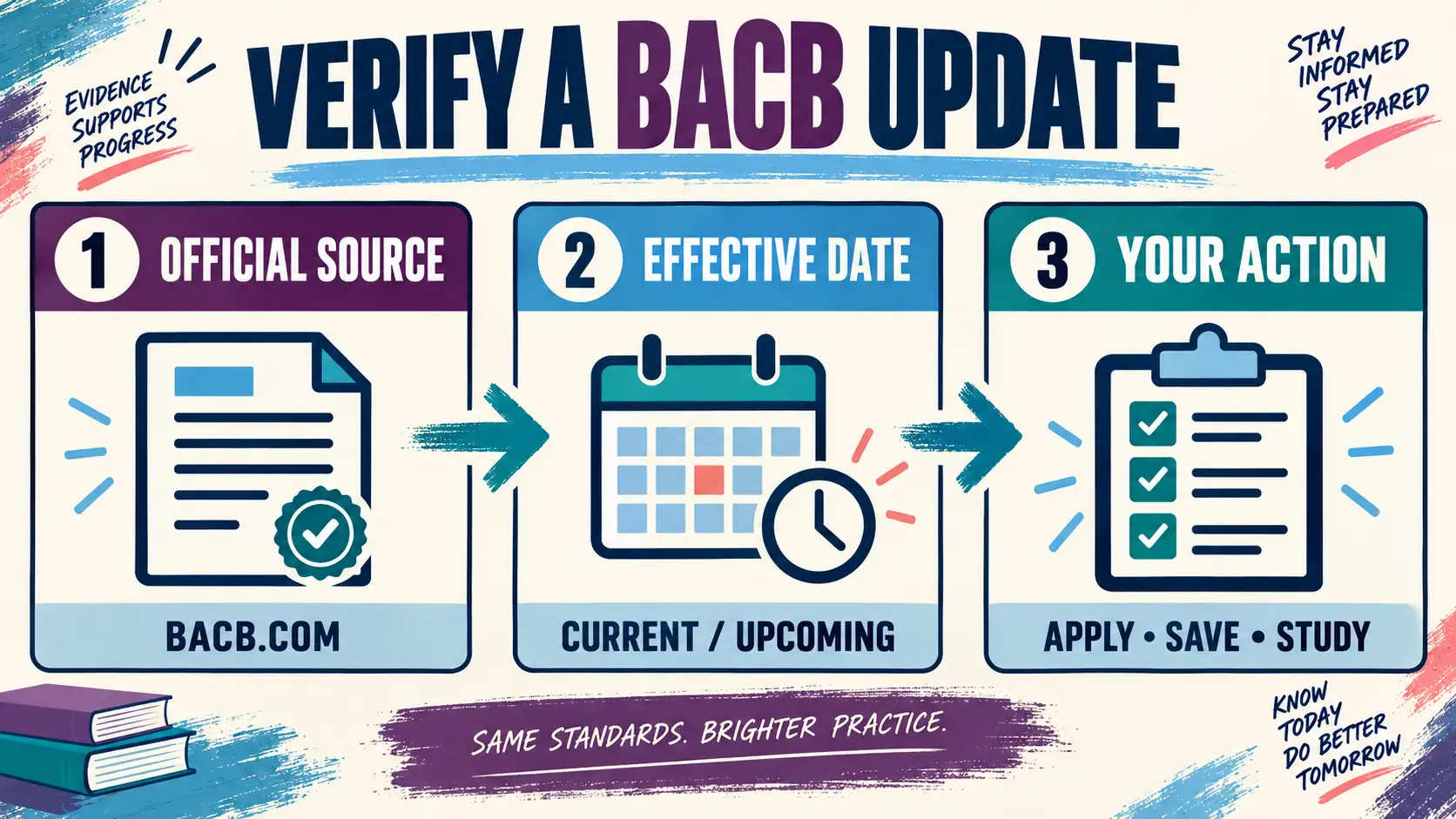
The official BACB site currently points candidates to several different update channels. They answer different questions, so checking only one page can leave you with an incomplete picture. The table below is a dated snapshot of the update categories that matter most to a BCBA candidate right now.
| Update channel | What it answers | Your next move |
|---|---|---|
| Application Processing Updates | Which submission dates the BACB is currently reviewing for BCBA/BCaBA and RBT applications or resubmissions. | Compare the displayed processing date with your paid application, transcript, or resubmission date. |
| Portal Updates and Known Issues | Whether a login, status, record, or account-display problem is already recognized by the BACB. | Read the stated workaround before opening a duplicate support request. |
| Recent and Upcoming Changes | The effective date and scope of announced certification, maintenance, jurisdiction, and provider changes. | Write down the effective date; do not apply a future rule to an earlier application automatically. |
| Newsletters and home-page news | New explanations, reports, reminders, and announcements that may point to a full handbook or transition document. | Follow the linked primary document before changing your plan. |
As of the review date, the BACB application-processing page says that BCBA/BCaBA applications are reviewed after the paid application and official transcripts have been received. It lists a current review date, and it separately lists dates for RBT applications and recertification documents. Those dates are operational updates, not a guarantee that an individual application will be approved by a certain day.
The BACB home page also highlights the major January 1, 2027 certification transition, the new portal’s status resources, and recent RBT information. A headline on the home page can change quickly; treat it as a signpost and open the linked source for the actual requirement, document version, or deadline.
What Should BCBA Candidates Do Before January 1, 2027?
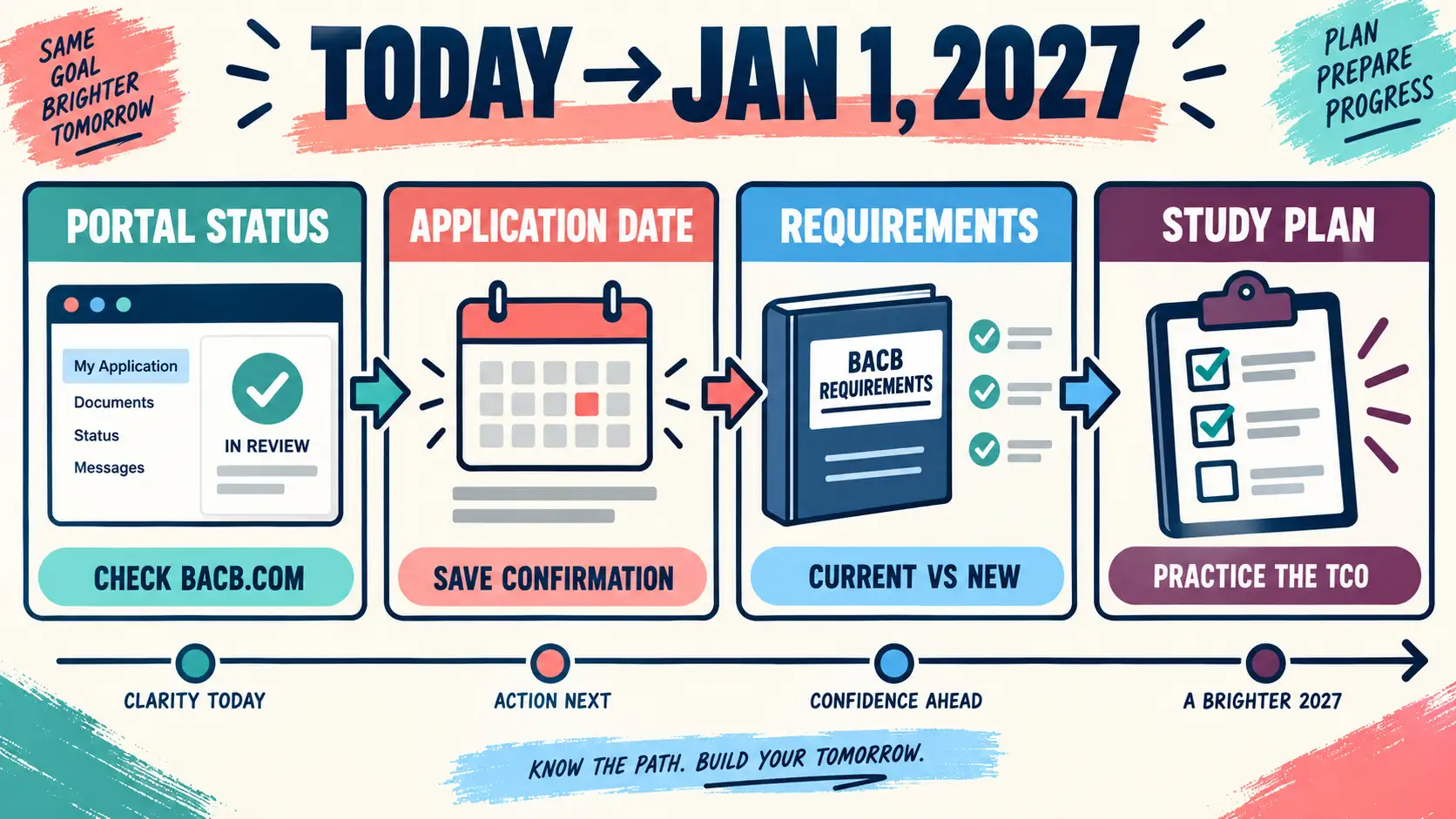
The 2027 transition is the update most likely to change a BCBA candidate’s planning decision. The BACB says that significant eligibility and maintenance changes take effect January 1, 2027. The transition guidance also explains that a complete application, including payment and required documents, must be received by December 31, 2026 to be reviewed under the current 2022 requirements. “I finished my hours” and “I submitted a complete application” are not interchangeable statements.
| Question | Current planning frame | 2027 check |
|---|---|---|
| Which requirements apply? | Your application date, pathway, education, fieldwork, and documents determine the relevant frame. | Compare the facts against the current BACB transition guide, not a generic blog date. |
| What happens to Pathways 3 and 4? | They may still matter to a candidate who is applying under the current transition window. | The 2027 framework discontinues Pathways 3 and 4, so verify the complete-application boundary. |
| Does the exam automatically change? | Certification requirements and examination content are related but not the same update stream. | Check the current TCO and exam notices separately; do not infer an exam change from an eligibility change. |
Use this three-part decision sequence before you change programs, postpone an application, or buy a new study course:
- Identify your date: record when the application will be complete, not only when fieldwork will end.
- Identify your pathway: note the education, attestation, fieldwork, and document route you are actually using.
- Identify your evidence: keep the official form version, confirmation email, transcript, and submission record together.
If the transition is relevant to your case, read the detailed BCBA 2027 fieldwork changes guide for study context, then return to the BACB transition document for the authoritative application decision. A study article can explain a rule; it cannot approve your application.
How Should You Check BACB Portal and Application Updates?
The new BACB portal combines account functions that many candidates previously treated as separate tasks. That makes a record-first workflow valuable. If your account view looks different from a screenshot in an older article, the screenshot is not evidence that your account is wrong.
1. Start with the official page, not a repost: Open the BACB application-processing page, portal status page, or change tracker directly. Note the page’s “updated” date and the document version named in the notice. A search result snippet can omit a qualification such as “after payment and transcripts are received.”
2. Match the update to the correct credential: BCBA, BCaBA, RBT, and ACE Provider updates can appear next to one another. Read the credential label before applying a number, deadline, or form to your situation. For example, an RBT professional-development update is not automatically a BCBA CEU rule.
3. Preserve the account evidence: Save the submission confirmation, payment receipt, transcript-delivery proof, action-item response, and any portal message. If a status changes, add the date and the exact wording to one timeline. This helps you distinguish “the BACB is processing this date” from “my application has been approved.”
- Record the official URL and the date you checked it.
- Record the credential and pathway named in the notice.
- Record the effective date or review date.
- Record the action the BACB asks you to take.
- Save the confirmation or document version that supports your action.
If the portal shows a known issue, follow the stated workaround and allow the BACB’s processing guidance to control your expectation. Do not submit duplicate applications merely because the displayed status is delayed. When the issue is not covered, contact the BACB through its official channel and include concise dates and evidence rather than a long speculative explanation.
Do These BACB Updates Change the BCBA Exam?
Not automatically. A change to certification eligibility, fieldwork, continuing education, or application processing does not by itself rewrite the exam. The BACB explains that updates to the BCBA examination and its Test Content Outline can occur independently of certification-requirement changes. This is why an update check should have two separate columns: eligibility and maintenance versus examination content.
For study purposes, use the current BCBA Test Content Outline and official examination information as your exam sources. Use the current handbook and transition guidance for eligibility and documentation. If your exam date crosses a transition boundary, verify the applicable official notice instead of relying on a forum post that says “the exam changed.”
A practical study response to a verified update is usually small and specific. If the update concerns a fieldwork term, add that distinction to your flashcards. If it concerns a document deadline, update your application checklist. If it concerns a TCO domain, practice questions in that domain and review the rationale. The goal is not to panic-rewrite your entire study plan every time the BACB posts a notice.
- Eligibility update: revise your pathway and document checklist.
- Portal update: revise your account-record and follow-up timeline.
- Exam-content update: revise your TCO map and practice priorities.
- News item with no action: save it, but do not invent a new requirement.
For general orientation, you can also review our Behavior Analyst Certification Board and BCBA guide. This update page has a narrower job: help you decide which official source to open today and what evidence to keep after you read it.
Which Update-Checking Mistakes Create Avoidable Delays?
Most update-related errors are not caused by a lack of effort. They happen when a candidate collapses different dates, credentials, or source types into one informal rule. Watch for these patterns:
- Using a third-party article’s “updated” date as proof that the BACB changed a requirement.
- Confusing an application-processing date with an approval date.
- Applying a BCaBA or RBT notice to a BCBA application.
- Assuming that finishing fieldwork is the same as submitting a complete application.
- Using an old form because a saved PDF still opens on your computer.
- Assuming that a certification transition automatically changes the exam.
- Submitting duplicate materials without reading the portal’s known-issue guidance.
- Changing a study plan before checking whether the notice actually affects your pathway.
A reliable update log can be simple: source URL → page date → credential → effective date → action → evidence saved. That chain is more defensible than a screenshot with no context and makes future content audits much easier.
Behavior Analyst Certification Board Updates FAQ
How often should I check BACB updates?: Check before you submit an application, respond to an action item, choose a pathway, schedule an exam, or renew a credential. During a transition, a weekly check of the official update channels is more useful than repeatedly searching social media throughout the day.
Where can I find the current BACB application processing time?: Use the BACB Application Processing Updates page. It publishes the submission dates currently being reviewed and separates application types. Treat the displayed date as queue information, not a promise of approval for every applicant.
Should I stop studying because requirements are changing?: No. First classify the notice. If it changes eligibility or documentation, update your administrative checklist. If it changes exam content, use the current TCO and official exam notice. If it is only a portal or processing update, preserve your evidence and keep studying according to your verified exam plan.
Next step: after you verify your current BACB pathway and exam source, use a focused free BCBA mock exam to identify which TCO areas need practice. The mock exam is a study tool; it is not an official BACB exam or a guarantee of certification.
Official Sources Checked for This Snapshot
- BACB Application Processing Updates — current processing dates and document-version notes.
- BACB Portal Updates and Known Issues — known portal problems and status guidance.
- Recent and Upcoming Changes to BACB Requirements — effective dates and scope of announced changes.
- Guidance for Meeting the BCBA Requirements During the 2027 Transition — transition boundaries and application planning.
- 2027 BCBA Requirements — the requirements that take effect in 2027.
- BACB Newsletters — dated explanations and announcements.
Take the Free BCBA Mock Exam
When you are ready to apply the idea, use the free practice resource below for additional feedback. Take the Free BCBA Mock Exam



