
Short answer: This behavior response plan example shows what adults will do after a target behavior occurs and what they will do when the student uses the replacement response. A useful response plan is observable, safe, function-informed, and consistent with the rest of the Behavior Intervention Plan (BIP). It is not simply a list of punishments. It should protect safety, avoid accidentally reinforcing the target behavior, prompt or teach the alternative, reinforce the replacement, and identify what data the team will review.
Table of Contents
- What is a behavior intervention response plan?
- What should the response section include?
- How do you write a behavior response plan example step by step?
- What do response plan examples look like?
- How should safety and crisis boundaries be handled?
- How should the team train and measure responses?
- What does the BCBA exam test?
- What mistakes should you avoid?
- Behavior intervention response plan FAQ
- Take the Free BCBA Mock Exam
The search phrase behavior intervention response plan example usually signals that the reader wants wording they can understand, not a blank form with unexplained boxes. The examples in this article are hypothetical study examples. They are not individualized treatment instructions and should not be copied into a student’s plan without assessment, team review, and applicable school procedures.
In a complete BIP, the response section must fit the hypothesized function. A response to escape-maintained behavior should not automatically allow the student to avoid every difficult task. A response to attention-maintained behavior should not deliver a long, dramatic conversation after the target behavior. A response to dangerous behavior must follow the setting’s safety and crisis procedures. The adult response is one part of a larger prevention, teaching, reinforcement, and measurement system. Table of Contents
What is a behavior intervention response plan?
A response plan is the adult decision rule for what happens after a target behavior or replacement behavior. It should tell implementers what to do immediately, what not to provide accidentally, how to prompt the next appropriate response, and when to record information. The plan may be written as one section of a BIP, a quick-reference page, or a broader school support document.
A response plan is not the same as the entire intervention. Prevention happens before the behavior, teaching builds the replacement, reinforcement makes the replacement valuable, and response procedures guide the adult’s actions after the event. The sections should work together. If the prevention plan reduces difficult tasks, the teaching plan teaches a help request, and the response plan removes all work whenever the student pushes materials away, the contingencies may still strengthen the target behavior. For study purposes, a strong response plan has four qualities:
- Observable: two trained adults can tell whether the step occurred.
- Function-informed: the response does not accidentally deliver the maintaining consequence for the target behavior.
- Teach-oriented: the adult creates an opportunity for the replacement response whenever safe and appropriate.
- Measurable: the team can record the target behavior, replacement response, prompts, and implementation steps.
What should the response section include?
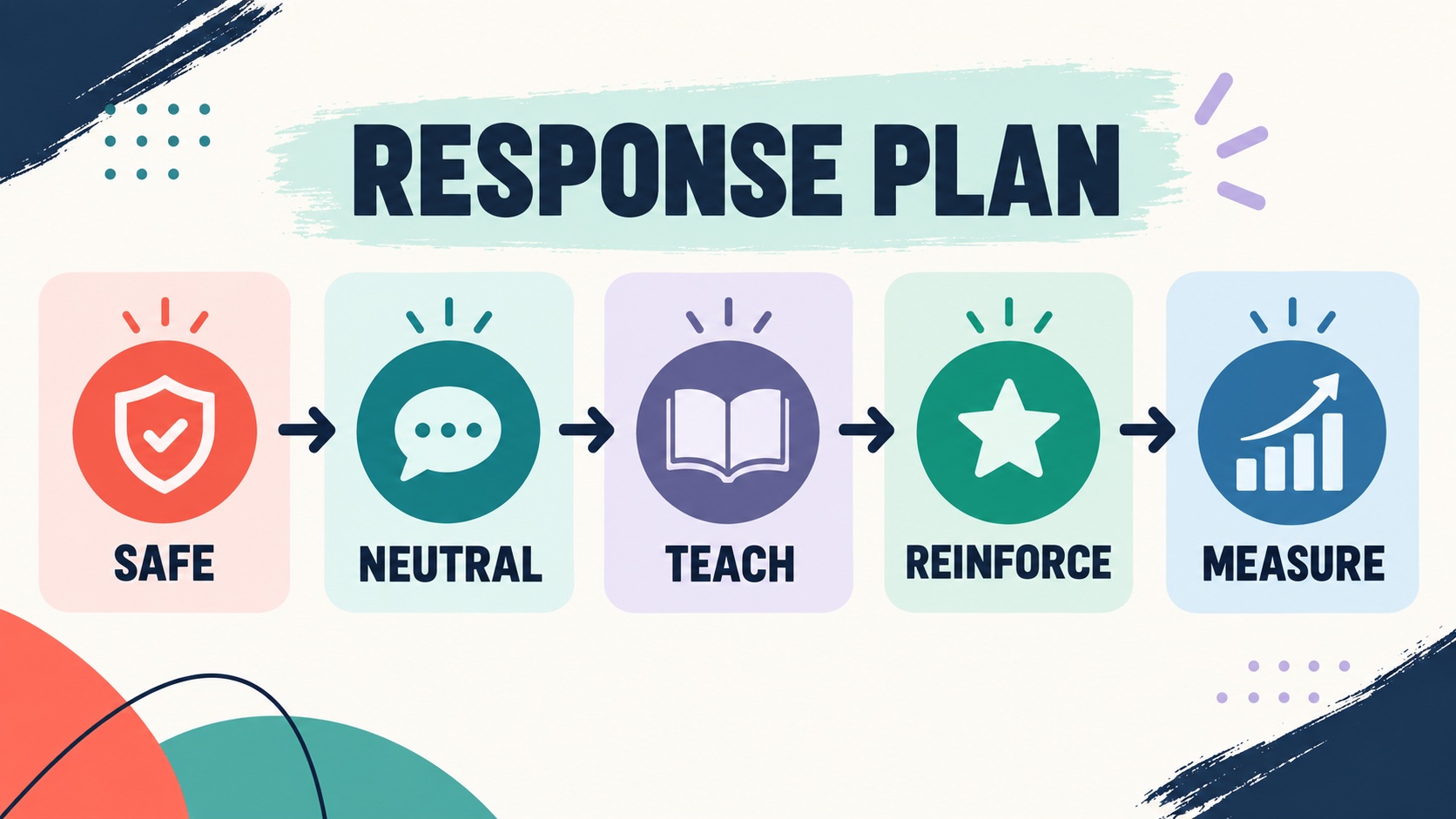
Before writing a sentence such as “redirect the student,” define what redirection means in this context. A complete response section usually identifies the target behavior, the immediate adult action, the prompt or teaching step, the reinforcement rule, the safety boundary, and the data to record. It should also specify when the adult should consult a supervisor or follow a separate crisis procedure.
| Response element | Question it answers | Example wording pattern |
|---|---|---|
| Immediate action | What does the adult do first? | Use the agreed brief prompt and maintain a calm, neutral tone. |
| Replacement prompt | What should the student do instead? | Prompt the help, break, attention, or item request defined in the plan. |
| Consequence boundary | What outcome should not follow the target behavior automatically? | Do not deliver the maintaining outcome solely because the target behavior occurred, unless safety or another authorized rule requires it. |
| Reinforcement | What happens after the replacement response? | Provide the planned function-relevant outcome promptly and record independence or prompts. |
| Safety and review | When does the adult use a safety procedure or contact the team? | Follow the approved safety procedure and document the event required by policy. |
The plan should not use vague labels such as “ignore,” “be firm,” or “give a consequence” without defining the observable action. “Ignore” can be unsafe or impossible if the behavior involves injury, property destruction, or a student who needs immediate support. A precise plan distinguishes attention, instruction, access, task demands, and safety responses.
How do you write a behavior response plan example step by step?
Use the functional hypothesis as the organizing question. What outcome is likely maintaining the target behavior, and how can the student obtain that outcome through an appropriate response? The plan should not make the replacement response harder, slower, or less reliable than the target behavior.
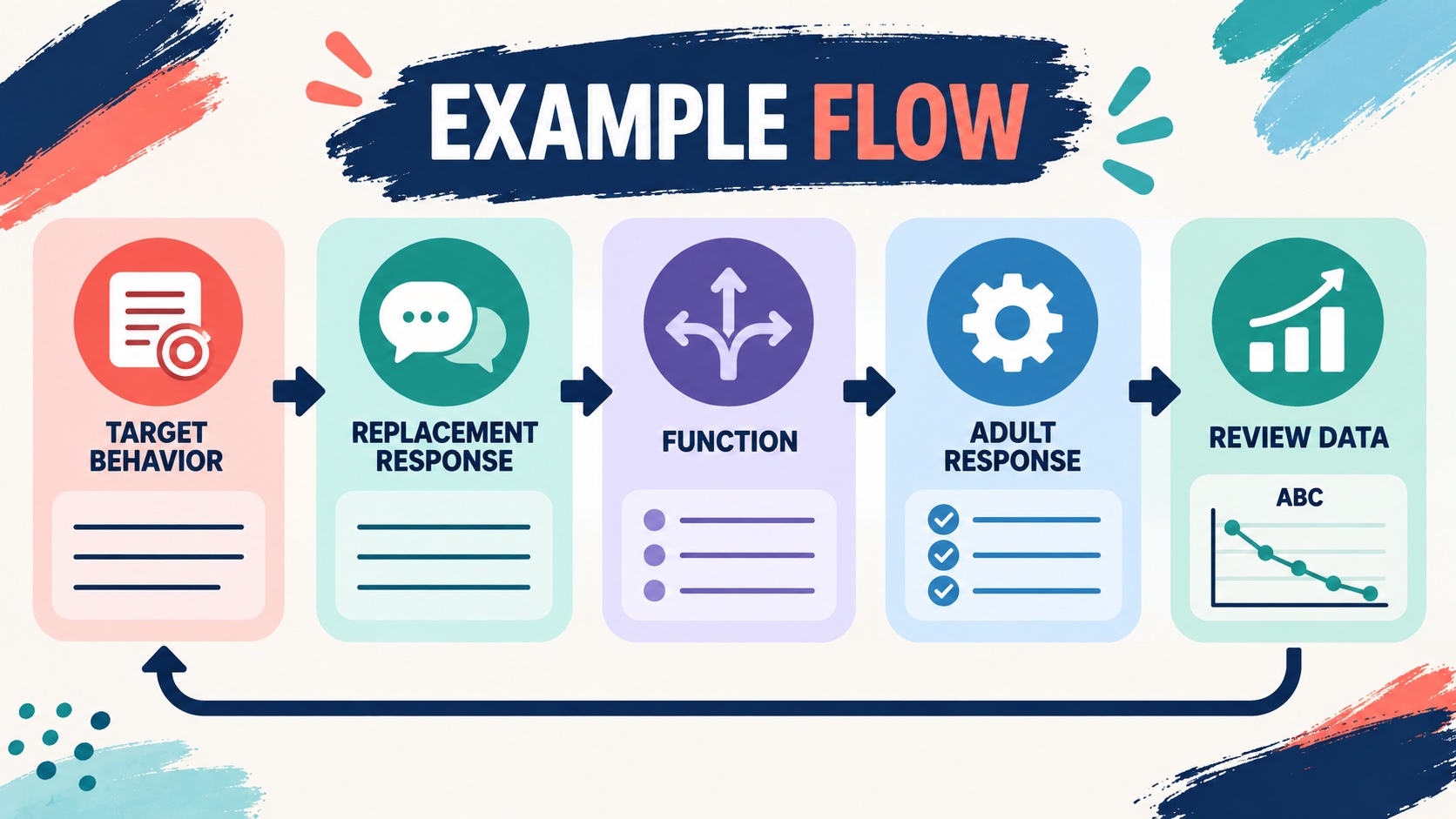
- Define the target behavior: describe what an observer can see or hear and specify examples and nonexamples.
- Identify the relevant consequence: review assessment data rather than assuming the same topography has the same function in every context.
- Choose the immediate adult response: keep it brief, safe, and consistent with the prevention and teaching sections.
- Prompt the replacement: use the agreed prompt hierarchy and give the student a realistic opportunity to respond.
- Reinforce the replacement: deliver the function-relevant outcome according to the plan.
- Record the event: capture the selected measure, prompt level, and any variable that changes the interpretation.
- Review the pattern: use data to decide whether the plan, implementation, or functional hypothesis needs revision.
For example, if a student calls out to obtain adult attention, a response might include a brief neutral cue, a prompt to use an attention request, and planned attention after the appropriate request. That is not a universal prescription. The team would need to confirm the function, consider the classroom routine, teach the request, and define how to respond when the behavior is unsafe or occurs during instruction.
What do response plan examples look like?
The following examples are hypothetical and intentionally simplified. Their purpose is to show how the function, replacement response, adult action, and data fit together. A real plan would include individualized assessment information, team decisions, training, and setting-specific safety procedures.
| Hypothetical pattern | Replacement response | Response-plan logic |
|---|---|---|
| Escape from difficult work | Student uses a help card or asks for the next smaller step. | Acknowledge the request, provide the planned support, and avoid making task removal the automatic result of pushing work away. Record the request, prompt, and task engagement. |
| Access to attention | Student raises a card, waits for a cue, or uses an appropriate attention request. | Keep the initial response brief and prompt the request; provide the planned attention after the replacement response, while following safety rules if needed. |
| Access to a preferred item | Student requests the item or waits through the defined schedule. | Prompt the request or schedule response, then deliver access according to the agreed contingency rather than automatically after grabbing. |
Notice what these examples do not say. They do not prescribe a universal extinction procedure, promise that the target behavior will stop immediately, or recommend a consequence without a functional assessment. They also do not treat the replacement response as a magic phrase. The student must be taught the response, the adult must honor the relevant contingency, and the team must monitor whether the arrangement is safe and effective.
How should safety and crisis boundaries be handled?
Safety takes priority over a routine response script. If behavior creates an immediate risk of injury, the adult should follow the school, program, and jurisdictional safety procedures that apply. A BIP should identify when the standard response ends and when the approved crisis or emergency protocol begins. It should not ask untrained staff to improvise restrictive procedures or physical management.
A response plan can include prevention and early-warning supports, such as reducing unnecessary audience attention, moving unsafe materials, using a pre-taught communication response, or contacting the designated team member. The exact action depends on the setting and training. The plan should also specify how the event is documented and how the team reviews whether the safety procedure was needed.
- Define observable indicators that the situation is escalating.
- State which trained person or approved protocol is contacted.
- Separate routine response steps from emergency or crisis procedures.
- Review whether prevention, communication, and environmental supports can reduce recurrence.
How should the team train and measure responses?
A written response plan does not guarantee consistent implementation. The team should model the response, rehearse realistic examples, observe the routine, and provide feedback. Training should include what to do after the target behavior, what to do after the replacement response, what to record, and how to recognize the safety boundary.
| Question | Possible measure | Why it matters |
|---|---|---|
| Did the adult use the planned response? | Percentage of observed critical response steps completed. | Separates implementation fidelity from student outcome. |
| Did the student use the replacement? | Independent and prompted replacement responses per opportunity. | Shows whether teaching and reinforcement are producing usable skill. |
| What happened to the target behavior? | A consistent measure of frequency, duration, latency, or opportunities. | Supports a data-based decision about maintaining or revising the plan. |
If adults implement the response accurately but the target behavior does not improve, the team can revisit the functional hypothesis, replacement response, reinforcement value, measurement, and context. If the response is not being implemented, coaching and plan simplification may be the first need. This distinction is often the point of a BCBA exam question.
What does the BCBA exam test?
For the current exam-domain frame, consult the BACB BCBA Test Content Outline. A scenario about a response plan usually tests whether you can connect consequences to function, protect safety, teach a replacement, reinforce the alternative, and measure implementation rather than choose a generic punishment.
Common distractors include giving attention immediately after attention-maintained behavior, removing all demands after escape-maintained behavior without teaching an appropriate request, delivering a preferred item after grabbing it, or ignoring dangerous behavior because the plan says “do not reinforce.” The correct answer must respect the functional contingency and the safety context at the same time.
What mistakes should you avoid?
- Writing only a consequence: a response plan also needs teaching and reinforcement for the replacement.
- Using vague language: define what “redirect,” “ignore,” and “follow through” mean.
- Ignoring function: the same adult response is not automatically appropriate for every behavior.
- Forgetting safety: routine response rules do not replace crisis procedures.
- Measuring only the student: collect fidelity data when adult implementation affects the outcome.
- Copying an example: hypothetical wording must be adapted through assessment and team review.
Behavior intervention response plan FAQ
Is a response plan the same as a Behavior Intervention Plan?: No. A response plan is usually one component of a broader BIP. The full BIP may include assessment information, prevention, replacement-skill teaching, reinforcement, response procedures, measurement, staff roles, and review dates.
Does a response plan always use extinction?: No. Extinction is a specific procedure with important conditions and risks, not a synonym for “do not reinforce.” The team should identify the function, consider safety and feasibility, teach a replacement response, and use only procedures that are appropriate, authorized, and monitored.
What should happen after a student uses the replacement behavior?: The replacement response should contact the planned function-relevant outcome as promptly and consistently as possible, subject to the plan and safety context. The team should record whether the response was independent or prompted and review whether the outcome is valuable enough to compete with the target behavior.
Can a teacher write a response plan without an FBA?: Some settings use interim supports while assessment is incomplete, but a function-based response plan should be informed by the best available data and clearly labeled as provisional when necessary. The responsible team must follow applicable school procedures and review the plan as new information becomes available.
Quick review: define the behavior, identify the likely function, state the immediate adult response, prompt and reinforce the replacement, separate routine and safety procedures, and collect both student and fidelity data. For a broader overview, compare this behavior response plan example guide with the larger BIP framework. For additional scenario practice, use the free BCBA mock exam as a practice and feedback resource. It is not an official BACB exam and does not guarantee certification or a passing result.
Take the Free BCBA Mock Exam
When you are ready to apply the idea, use the free practice resource below for additional feedback. Take the Free BCBA Mock Exam



