
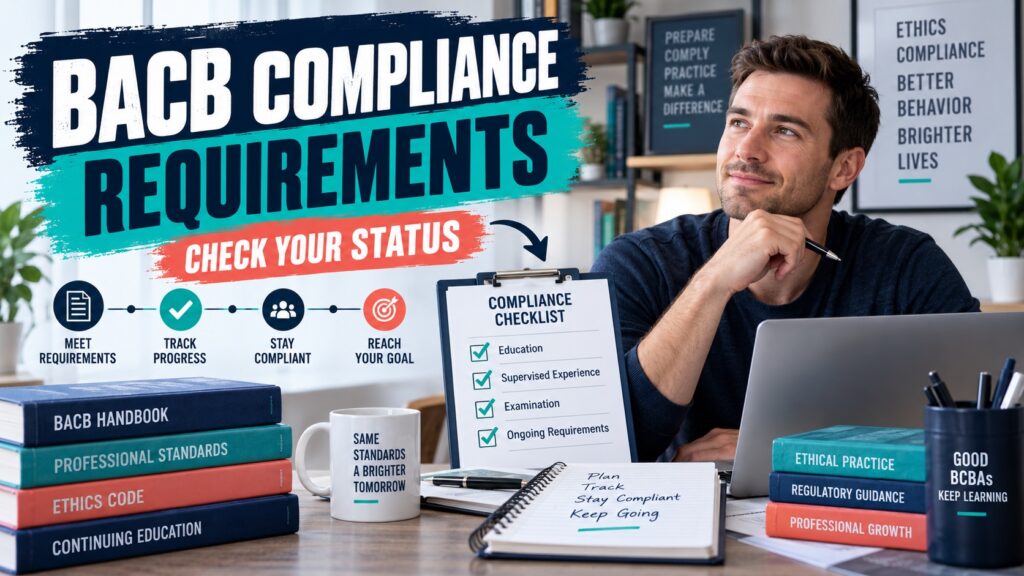
BACB compliance requirements are the rules applicants and certificants must follow to qualify for certification, maintain their status, and practice ethically within the BACB’s jurisdiction. They include more than passing the BCBA examination: you also need accurate eligibility documentation, a complete application, compliance with the Ethics Code, required supervision and continuing education, and timely responses to BACB requests. State licensure, payer contracts, and employer policies may add separate requirements.
Table of Contents
- BACB compliance requirements: the short answer
- What areas do BACB compliance requirements cover?
- Eligibility and application compliance
- Ethics, self-reporting, and professional conduct
- Supervision, fieldwork, and documentation
- Maintenance after certification
- What the BACB does not control by itself
- What changes on January 1, 2027?
- The compliance checklist
- Common compliance mistakes
- How to study compliance requirements
- BACB compliance requirements FAQ
- Quick Review Checklist
- Take the Free BCBA Mock Exam
This guide maps BACB compliance for 2026 and 2027. It explains what to check first, which documents control each decision, and why practice rules do not all come from the BACB. Requirements change, so use the current handbook and official BACB pages. Table of Contents
BACB compliance requirements: the short answer
BACB compliance means following the current requirements that apply to your status and role. For a person seeking BCBA certification, that usually means meeting an eligibility pathway, completing the required coursework and supervised fieldwork, submitting truthful and complete application materials, paying the required fees, and passing the examination. For an active certificant, it also means following the Ethics Code, meeting maintenance and continuing-education requirements, documenting supervision appropriately, and responding to official BACB communications.
The word compliance does not mean that the BACB is the only authority in a behavior analyst’s professional life. The current BACB ethics resources explain the ethical obligations for applicants and certificants, while the current BCBA Handbook explains certification and maintenance procedures. A state licensing board, funder, school district, or employer can impose additional conditions. When two sources apply, document the stricter or more specific requirement instead of assuming that a national certification rule replaces local law.
What areas do BACB compliance requirements cover?
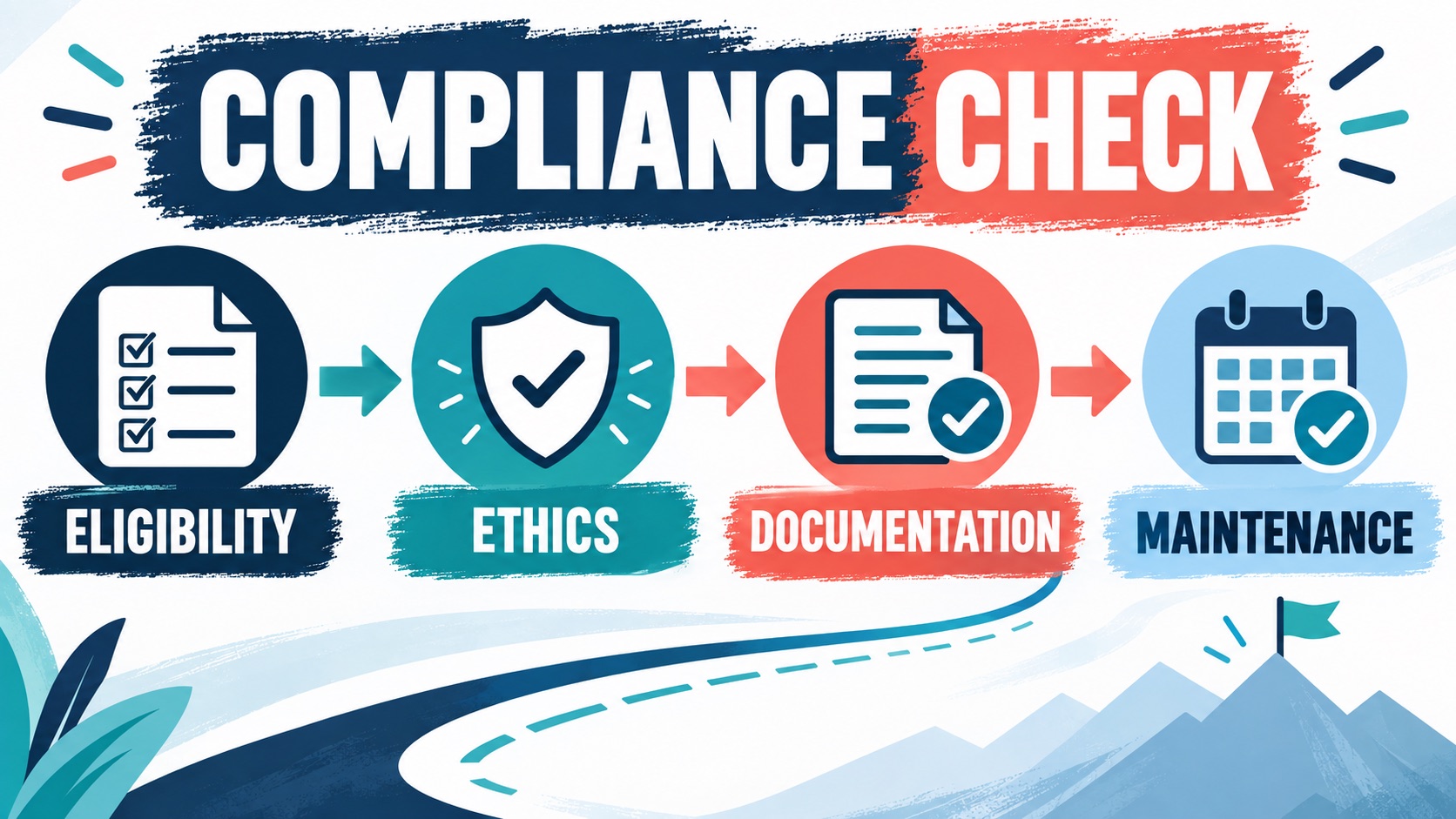
A useful way to organize BACB compliance requirements is to separate the professional timeline into stages. The exact rule depends on your pathway and role, but the following map helps you find the correct source before you act.
| Compliance area | What it usually covers | Primary source to check |
|---|---|---|
| Eligibility | Degree, coursework, fieldwork, supervisor qualifications, and pathway conditions | Current BCBA Handbook and applicable requirements page |
| Application | Truthful forms, required records, payment, deadlines, and official correspondence | BACB application instructions and handbook |
| Ethics | Professional conduct, client protection, supervision, conflicts, and self-reporting | Ethics Code for Behavior Analysts |
| Maintenance | Renewal, continuing education, supervision CEUs, and current status obligations | BCBA Handbook and current BACB announcements |
| Role-specific practice | RBT or BCaBA supervision, delegation, fieldwork, and documentation | BACB supervision resources plus state, funder, and employer rules |
This map prevents a frequent error: using the right document for the wrong question. The Ethics Code is essential for conduct questions, but it is not a substitute for the current fieldwork table. A state license page may explain practice authority, but it is not the document that decides whether a fieldwork form satisfies a BACB application.
Eligibility and application compliance
Before you apply, confirm which eligibility pathway applies to your situation and which version of the requirements controls your application date. Check the degree or program condition, behavior-analytic coursework, supervised fieldwork, supervisor qualifications, documentation, and examination requirement as one connected package. A candidate who satisfies one item but cannot document another is not ready to rely on a general statement such as “I completed the requirements.”
Application compliance also means accuracy. Use the name, dates, institutions, supervisor information, and fieldwork records exactly as the official documents support them. Do not estimate hours, copy a supervisor’s signature, or submit a form based on an old handbook because it looks familiar. Keep a versioned folder with transcripts, contracts, supervision forms, monthly records, verification documents, and correspondence. That folder makes it easier to answer a BACB request without reconstructing your history from memory.
Also check the submission condition. A complete application may require payment and all required documents, not merely an online account or an unfinished form. If a deadline matters, save proof of what was submitted and when. Use the current application instructions rather than relying on a study group’s summary.
Ethics, self-reporting, and professional conduct
The Ethics Code is a central part of BACB compliance requirements for applicants and certificants. It covers responsibilities related to professional conduct, clients and service delivery, supervision, training, and colleagues. Compliance is not limited to memorizing definitions for an exam. It is an ongoing duty to recognize conflicts, protect clients, work within competence, communicate honestly, and address problems through the appropriate process.
Self-reporting is another area where casual advice can create risk. The current handbook and Ethics Code identify circumstances that may require reporting or responding to the BACB. Do not decide that an event is irrelevant because it happened outside your workplace or because another professional handled it. Read the current self-reporting instructions, record the relevant dates, and seek qualified legal or ethics advice when the situation is not clear. The BACB’s ethics department provides procedures and resources, but the BACB does not replace a state board or a licensed attorney.
Good compliance documentation should show what you knew, what source you checked, what action you took, and when you followed up. If you supervise someone, document the supervision, feedback, competency concerns, corrective plan, and escalation path. If you identify a possible violation, follow the current reporting procedure rather than making a public accusation or promising an outcome you cannot control.
Supervision, fieldwork, and documentation
Supervision compliance has several distinct meanings. A trainee may be accruing supervised fieldwork toward certification. An active BCBA may be supervising an RBT or BCaBA. A BCBA may also receive ongoing supervision or consultation under a particular rule. The correct documentation, training, observation, and percentage requirements depend on the relationship and the applicable version of the handbook.
The BACB’s supervision and training resources explain the roles of supervisors and the requirement for specified supervision training before supervising certain roles. They also emphasize that a supervisor remains accountable for work that is delegated to a qualified and proficient assistant. Delegation is not a transfer of professional responsibility. Before assigning a task, confirm competence, define the limits, observe performance when required, provide feedback, and retain the records that show how the work was monitored.
For fieldwork, do not use a generic “supervision hours” number without checking the current table. Review the required fieldwork type, supervision percentage, observations, contacts, unrestricted activities, supervisor qualifications, and monthly documentation. A form can be neatly completed and still fail if the underlying arrangement did not meet the current rule. Record the service context and the date range so you can match each entry to the right handbook version.
Supervision compliance also has an ethical dimension. A supervisor must accept only the number of trainees or supervisees for whom effective supervision is possible. Client needs, travel, telehealth, scheduling, language access, and organizational support can affect whether a plan is workable. If the arrangement is too large to monitor responsibly, adding more names to a spreadsheet does not make it compliant.
Maintenance after certification
Passing the examination is not the end of BACB compliance requirements. After certification, track renewal dates, continuing education, ethics and supervision CEUs where applicable, supervision obligations, changes in contact information, and any required self-reporting. Do not wait until renewal week to discover that a certificate, CEU, or supervisor record is missing.
Use a compliance calendar with separate entries for the BACB renewal cycle, state license renewal, employer credentialing, payer enrollment, and internal training. These dates may not be the same. Keep continuing-education certificates and verify whether each activity counts for the category you intend to use; repeating an activity or double-counting one CEU can create a maintenance problem.
When your role changes—such as moving from trainee to BCBA, beginning to supervise RBTs, changing states, joining a new payer network, or providing telehealth—repeat the source check. Update written procedures instead of assuming that an unchanged certification number means unchanged obligations.
What the BACB does not control by itself
BACB compliance requirements are one layer of a professional compliance system. State practice law, payer authorization terms, employer policies, and school contracts may add conditions. For each decision, write down what the BACB, state, funder, and organization require; document the most specific or restrictive applicable condition and ask the responsible licensing, compliance, legal, or clinical authority to resolve conflicts.
What changes on January 1, 2027?
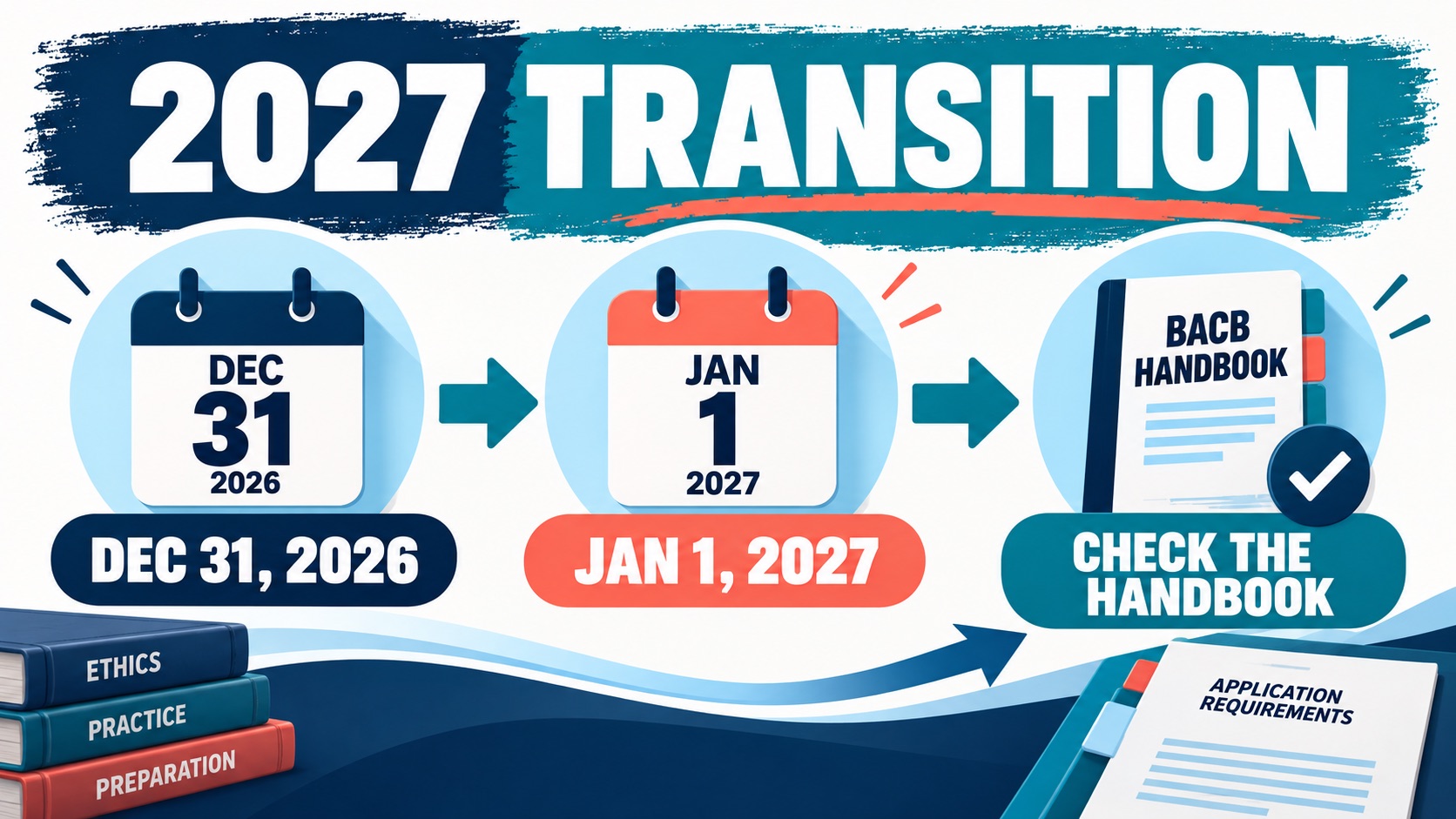
The BACB has published significant changes to BCBA and BCaBA certification requirements that take effect on January 1, 2027. The BACB’s transition notice says that a complete application, including payment and all required documents, must be received by December 31, 2026 to be reviewed under the current 2022 requirements. That statement concerns the national certification transition; it does not remove state, payer, employer, or client-specific compliance duties.
The published 2027 BCBA requirements describe revised eligibility pathways, fieldwork, supervision, continuing education, and ongoing-supervision expectations. The BACB’s recent and upcoming changes page lists additional effective dates, including the future change to BCBA eligibility pathways. Because a candidate’s applicable rule depends on the application and certification timeline, save the version of the handbook and transition guidance that you used.
Do not turn a transition date into a permanent shortcut. If you are close to submitting an application, compare the complete-application definition, document checklist, payment status, and pathway rules directly against the official transition guidance. If you are planning for 2027, use the new requirements as your planning baseline while still checking the current handbook for implementation details.
The compliance checklist
Use this checklist at the beginning of a new application, a new job, or a new supervision arrangement:
- Identify your status: applicant, trainee, active BCBA, BCaBA supervisor, RBT supervisor, or another role.
- Open the current BACB handbook and the role-specific resource instead of an old saved PDF.
- Confirm the applicable pathway, dates, forms, supervisor qualifications, and documentation rules.
- Check the Ethics Code and self-reporting guidance for conduct or disclosure questions.
- Check the state board, payer contract, and organization policy for additional conditions.
- Create a record of the source, effective date, decision, responsible person, and follow-up date.
- Review the plan before work begins and again whenever the role, location, client, or payer changes.
Common compliance mistakes
- Using “I passed” as proof of compliance: certification is a status, not evidence that every current maintenance or workplace requirement is satisfied.
- Following an old handbook: transition dates and requirements can change, especially around 2027.
- Mixing national certification with state licensure: a BACB credential does not answer every practice-authority question.
- Counting hours without checking the rule: fieldwork and supervision depend on the applicable pathway and documentation.
- Delegating without monitoring: assigning a task does not erase the responsible professional’s accountability.
- Ignoring small communications: failing to respond to a BACB request by its stated deadline can affect status.
- Writing a policy from memory: use the official source and record the effective date instead.
How to study compliance requirements
Compliance questions become easier when you study by authority and scenario instead of memorizing a long list. Create four columns in your notes: BACB, state, funder, and organization. For each practice question, record who creates the rule, what document proves compliance, and what fact would change the answer. This is especially useful for absolute wording such as “only,” “always,” or “never.”
After reviewing the official sources, use a free BCBA mock exam to test recall under time pressure. Review every missed question and label the error: source confusion, date confusion, role confusion, documentation gap, or ethics reasoning. The practice resource is educational support; it is not BACB approval, legal advice, licensure advice, or a guarantee of a passing score.
BACB compliance requirements FAQ
What are the main BACB compliance requirements?: The main areas are eligibility, accurate application materials, examination and certification procedures, Ethics Code compliance, self-reporting, supervision and documentation, continuing education, renewal, and timely responses to official BACB requests. The exact requirements depend on your status, pathway, and applicable handbook version.
Does BACB compliance replace state licensure?: No. BACB certification and state licensure are separate systems. A state may regulate practice, titles, supervision, or documentation even when a person holds an active BCBA certification. Check the state board for the location and service involved.
Do BACB compliance requirements apply before certification?: Yes. Applicants and trainees must follow the requirements that apply to eligibility, supervised fieldwork, application records, examination procedures, and the Ethics Code. Do not assume that ethics and documentation obligations begin only after the certificate is issued.
How often should I review BACB requirements?: Review the official handbook before starting an application, changing pathways, beginning a supervision role, renewing certification, or responding to a compliance issue. Also watch BACB updates when a published effective date is approaching.
What is the safest way to prove compliance?: Keep a dated record that connects the requirement to the source, form, certificate, supervision record, policy, or correspondence that proves it. Store the version or link you used and note any follow-up date. If another authority also applies, keep that evidence in the same decision file.
BACB compliance requirements are best understood as a source-matching system. Start with your role and date, open the current official document, document the decision, and then check state, payer, and employer layers. That process is more reliable than relying on a short checklist copied from an old article, and it gives you a defensible record when the rules or your professional role change.
Quick Review Checklist
Use this final checklist to turn bacb compliance requirements into exam-ready reasoning. The goal is not to memorize a label in isolation; it is to identify the relevant evidence and explain why the best answer fits the scenario. Key ideas to review:
- State the central definition or decision point for bacb compliance requirements in your own words.
- Identify the detail that makes bacb compliance requirements different from its closest related ABA term.
- Separate the observable facts in a scenario from assumptions that are not supported by the facts.
- Write one example and one nonexample so you can recognize the concept in a new setting.
Exam application checks:
- Ask what the question is actually requesting before comparing the answer choices.
- Mark the antecedent, response, consequence, or other evidence that supports the selected answer.
- Look for a distractor that describes a related process but does not answer the specific question.
Final self-check:
- Explain how you would verify the interpretation with clear observations or data.
- Change one detail in the scenario and decide whether your answer should change.
- Give a one-sentence rationale that a supervisor or study partner could evaluate.
Take the Free BCBA Mock Exam
When you are ready to apply the idea, use the free practice resource below for additional feedback. Take the Free BCBA Mock Exam



